An international shopper who reaches checkout and sees an unfamiliar currency, a vague delivery date or a surprise import charge is likely to abandon the order. For direct-to-consumer (DTC) brands selling physical goods abroad, that last screen decides whether the money spent attracting the shopper pays off.
Getting duties right matters more in 2026. The EU began charging a flat EUR 3 customs duty on small parcels valued under EUR 150 from 1 July 2026, ending duty-free entry for low-value goods. The US had already suspended duty-free de minimis treatment for all countries in August 2025.
Global DTC ecommerce platforms sit on top of the ecommerce software a brand already runs and handle the cross-border work, from local prices and payments to tax, shipping and returns. Some act as merchant of record (MoR), meaning they become the legal seller and take responsibility for tax and fraud on each international sale. Others leave the brand as the seller and automate the parts around it.
Below we compare six platforms on features, pricing and the responsibilities each one takes on.
Global DTC Ecommerce Platforms at a Glance
| Platform | Best For | Pricing Model | Highlights |
|---|---|---|---|
| Global-e | Mid-market and enterprise brands, plus eligible Shopify stores, that want one MoR for the full international journey | Custom quote; per-transaction fee via Shopify Managed Markets | MoR in 200+ destinations, borderfree.com shopping channel |
| ESW | Enterprise brands running a managed international programme | Custom enterprise quote | Hosted, embedded or composable checkout across 200+ markets |
| Reach | Retailers adding MoR without changing payment provider or platform | Transaction-based, no fixed fees or monthly minimums | Local card processing in 70+ countries, keeps your existing setup |
| Glopal | Brands that need international traffic as well as checkout | Translation app from $0/month; other products quoted | Marketing, translation, checkout in 45 languages |
| Swap | Brands that want cross-border selling and returns in one system while staying MoR | Swap Global typically 4% or less plus a monthly minimum | Guaranteed landed cost, returns, duty recovery on returns |
| Zonos | Teams adding guaranteed duty and tax collection to checkout or via API | $2 per order plus 10% of duties, taxes and fees | 40+ payment methods, works with your own carriers, published fees |
How We Evaluated Global DTC Ecommerce Platforms
We reviewed each platform against the jobs a DTC brand has to cover when it sells across borders. Sources were vendor product pages and documentation, official marketplace listings and company filings, all checked in November 2026.
- Liability model: whether the platform acts as merchant of record and which tax, fraud and compliance duties move to it.
- Localisation: currencies, local payment methods, languages and how prices look in each market.
- Landed cost accuracy: whether duties and taxes are calculated and guaranteed at checkout, and who pays when the estimate is wrong. Landed cost is the full price a shopper pays, including shipping, duties and taxes.
- Logistics and returns: carrier options, shipping with duties prepaid, return routes and how refunds reach the brand's systems.
- Integration fit: support for Shopify, Salesforce Commerce Cloud, Adobe Commerce and custom builds, and whether the brand keeps its current payment provider and warehouse partner.
- Pricing transparency: published rates or custom quotes.
The 6 Best Global DTC Ecommerce Platforms
1. Global-e
Global-e is a cross-border ecommerce platform that acts as merchant of record for international orders and serves shoppers in more than 200 destinations.
Best for: Mid-market and enterprise DTC brands, plus eligible Shopify merchants, that want one provider to own international checkout, tax and compliance.
Why we like it: Global-e covers the whole chain in one contract, from localised checkout through tax payments to finding new international shoppers. It also runs at scale, with reported Q2 2026 GMV of $2.089 billion, up 44% year over year.
Notable Limitations:
- Shopify Managed Markets excludes B2B orders, so the merchant acts as its own merchant of record for those, and subscriptions work for domestic orders only (Shopify Help Center).
- Shopify stores have to choose one route, because Managed Markets and the standalone Global-e app can't run on the same store.
- Direct contracts are quote-based, which makes early cost comparison with published-rate platforms harder.
Pricing: Direct Global-e contracts are quoted per merchant. For Shopify stores, Shopify's international pricing page lists the Managed Markets fee at 3.5% per transaction (3.25% on Shopify Plus), deducted from payouts, as of November 2026. Ask for a market-by-market proposal that covers payment methods, delivery, returns and the tasks your team keeps.
2. ESW
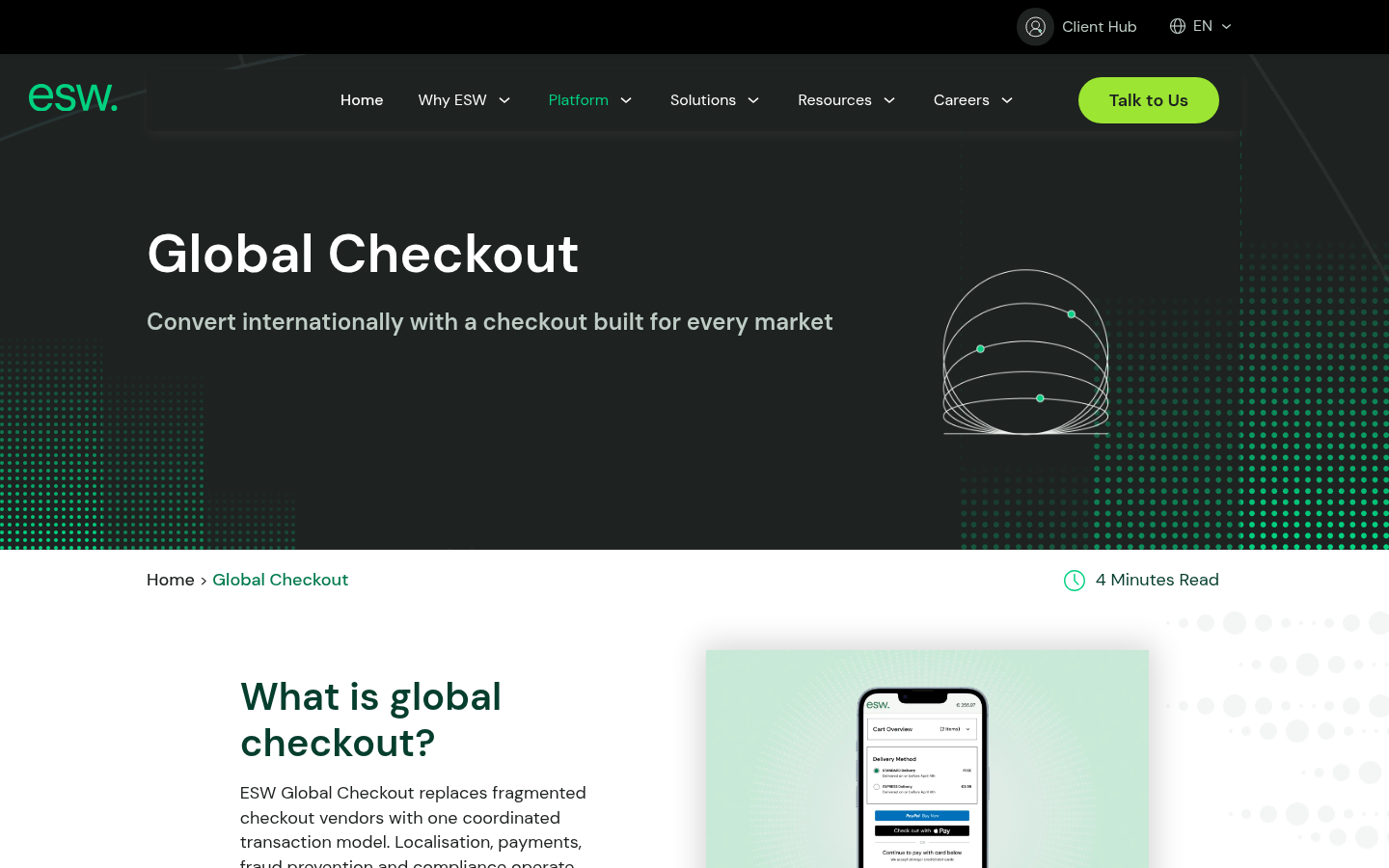
ESW is a Dublin-based cross-border commerce provider that acts as merchant of record across 200+ markets and bundles checkout, logistics, customer care and growth services into one programme.
Best for: Enterprise brands that want a managed international operation and a choice of how closely checkout is built into their own storefront.
Why we like it: The three checkout setups let a brand start hosted and move to composable later without switching provider. ESW said KnitWell Group, the owner of Ann Taylor and Chico's, went live across its international markets in seven weeks in July 2026.
Notable Limitations:
- ESW publishes no pricing tiers, so every evaluation runs through a sales-led proposal.
- The embedded checkout runs inside an iframe on the retailer's page (ESW developer docs), which affects analytics, testing and design control.
- Carl Cowling became CEO in September 2026, so brands signing multi-year terms should get roadmap commitments in writing.
Pricing: Not publicly listed. ESW sells custom enterprise contracts, and the core checkout and MoR service is scoped separately from Growth Services and logistics. Confirm which parts the proposal includes and how stock and returns will move between markets.
3. Reach
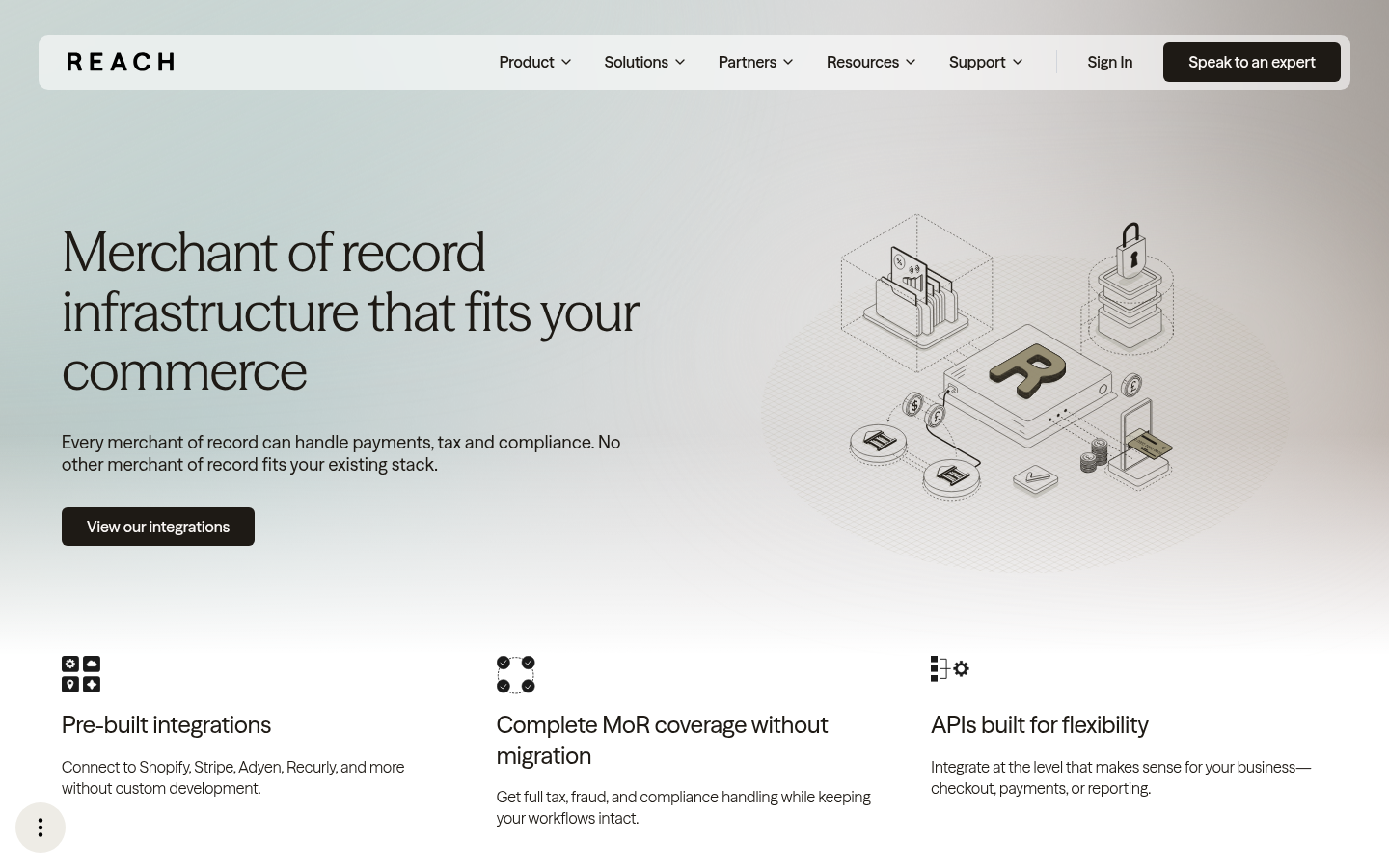
Reach is a modular merchant of record that plugs into a brand's current setup, so it keeps its payment provider, ecommerce platform and checkout.
Best for: Retailers that want to hand over cross-border tax, fraud and chargeback risk while keeping their payment provider, platform and warehouse partner in place.
Why we like it: Reach is the least disruptive way on this list to add a merchant of record. A brand that already converts well on its own checkout can keep it and move only the cross-border risk.
Notable Limitations:
- Reach runs no carrier network of its own, so shipping rates, labels and return logistics depend on a separate partner.
- With payments, tax, fulfilment and support split across vendors, each exception needs a named owner, from a failed payment to a refund on a returned parcel.
Pricing: Transaction-based, with no fixed fees or monthly minimums advertised and no public rate card. Ask for the percentage in writing, then walk through a payment, a shipment and a refund with your current partners during the demo.
4. Glopal
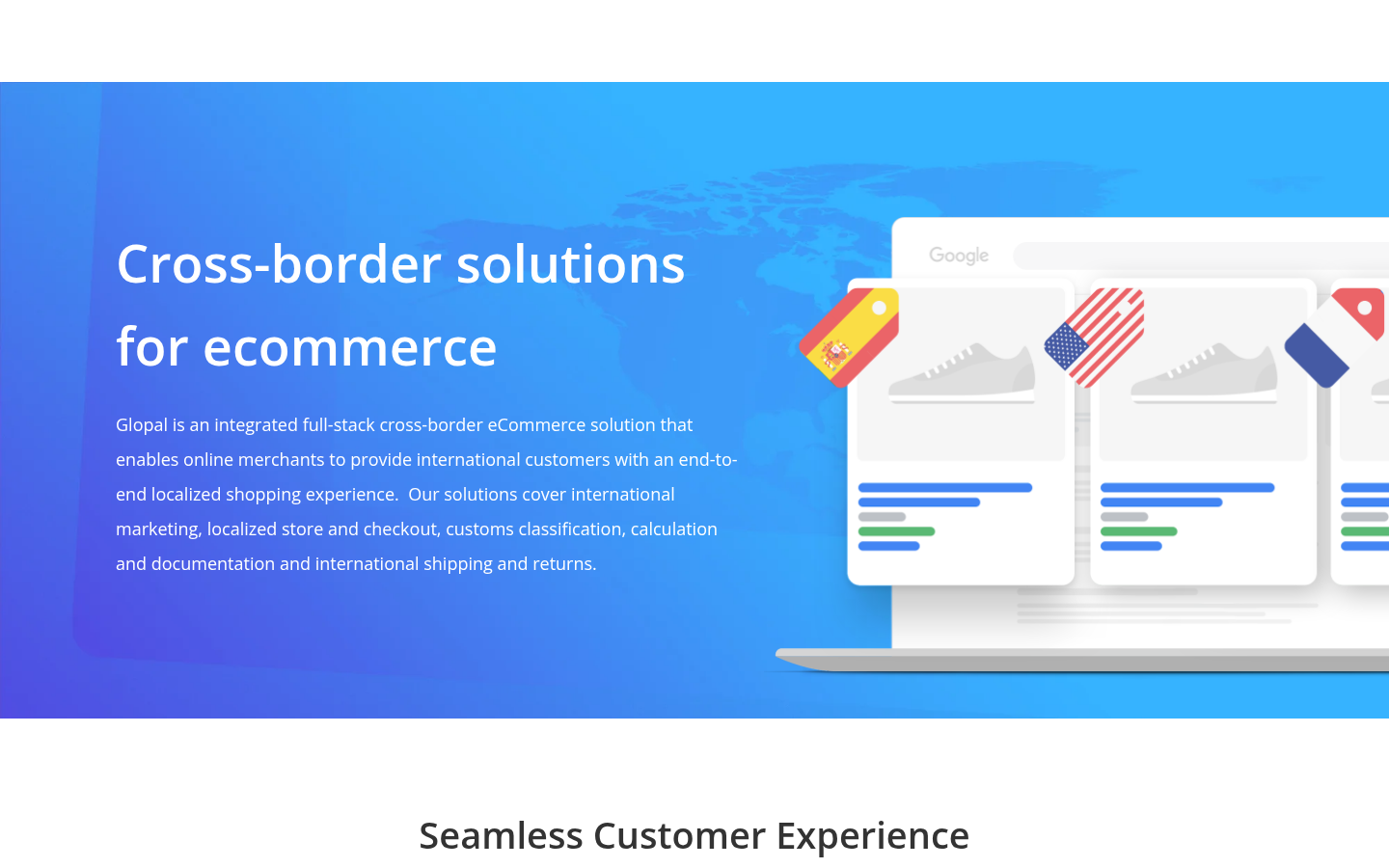
Glopal is a full-stack cross-border platform that starts with international marketing and translation and runs through localised checkout, duties, shipping and returns.
Best for: Shopify, Magento and BigCommerce brands that need international traffic as much as a localised checkout.
Why we like it: Glopal builds marketing into the product, running paid, social and search campaigns alongside translation and checkout. A translated checkout does little for growth if shoppers abroad never find the product pages, and Glopal covers both steps.
Notable Limitations:
- Published pricing covers only the translation app, so checkout, logistics and marketing each need a separate quote.
- The free translation plan stops at three languages and the $49 Pro plan at five languages and 200,000 words, so multi-market brands move to Advanced or Enterprise quickly.
- Self-serve plans centre on Shopify, while Salesforce Commerce Cloud and other platforms sit in the Enterprise tier.
Pricing: Glopal Translate is $0/month (Freemium), $49/month (Pro), $199/month (Advanced) or custom (Enterprise), per Glopal's pricing page in November 2026. Checkout, logistics and marketing services are quoted per merchant. Review a translated product page and checkout in one priority market before committing.
5. Swap
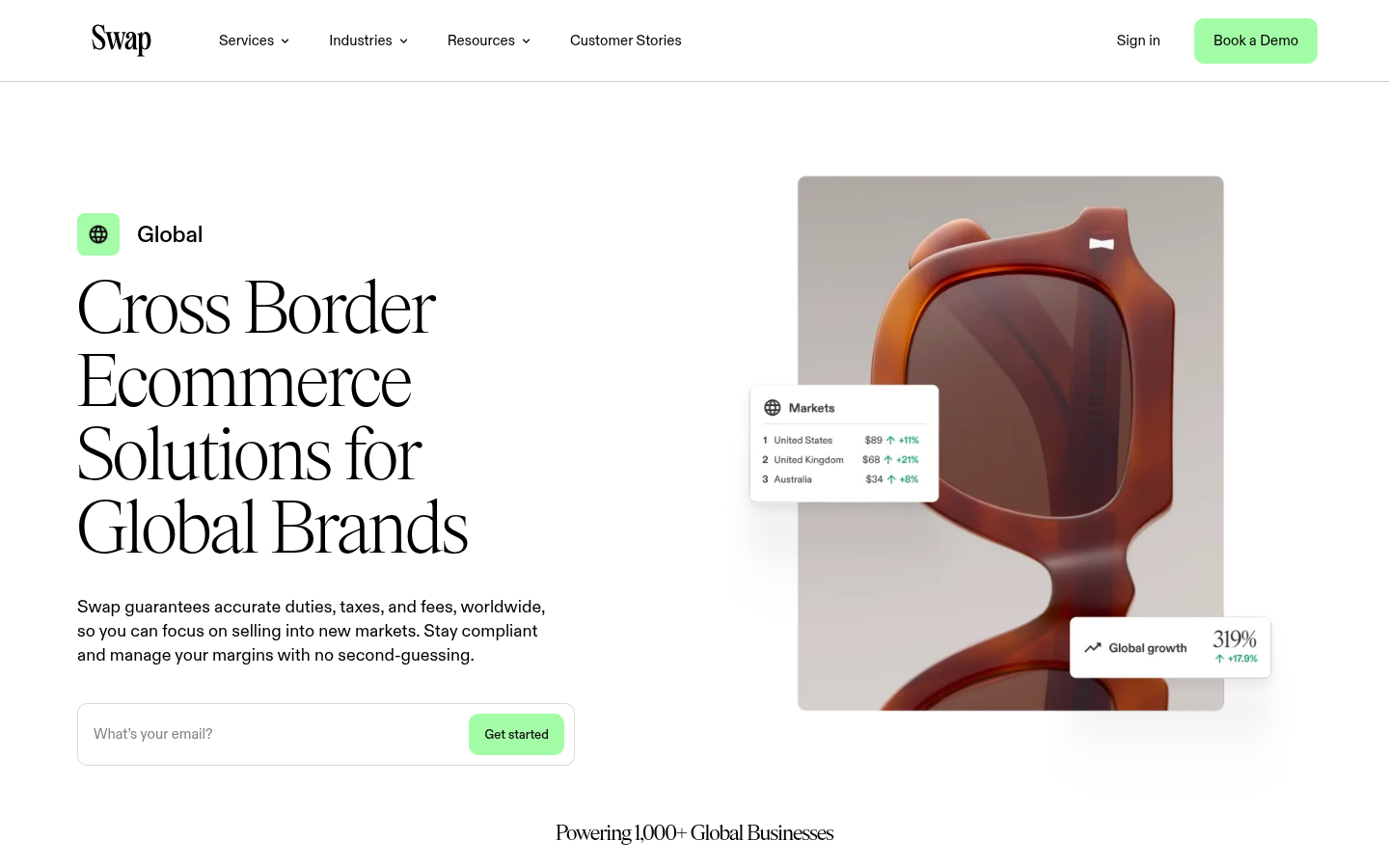
Swap is a commerce operations platform that combines cross-border tax, shipping and returns while the brand stays merchant of record.
Best for: Brands that want guaranteed landed cost and returns in one system and want to keep checkout, customer data and cash flow in-house.
Why we like it: Swap treats the return as part of the cross-border sale, and its duty recovery puts part of the duty paid on returned orders back with the brand.
Notable Limitations:
- Staying merchant of record means the brand keeps the payment, fraud and legal risk that a merchant of record provider would take on.
- Swap Global carries a monthly minimum, and returns and shipping products are priced separately.
- Duty recovery applies to eligible returned orders only, so check which markets and order types qualify.
Pricing: Quoted per business based on products used and order volume. Swap says the Swap Global fee is typically 4% or less plus a monthly minimum, with other products priced separately (Swap FAQ, November 2026). Confirm how shipping, duties, exchanges and refunds connect to your warehouse or fulfilment partner.
6. Zonos
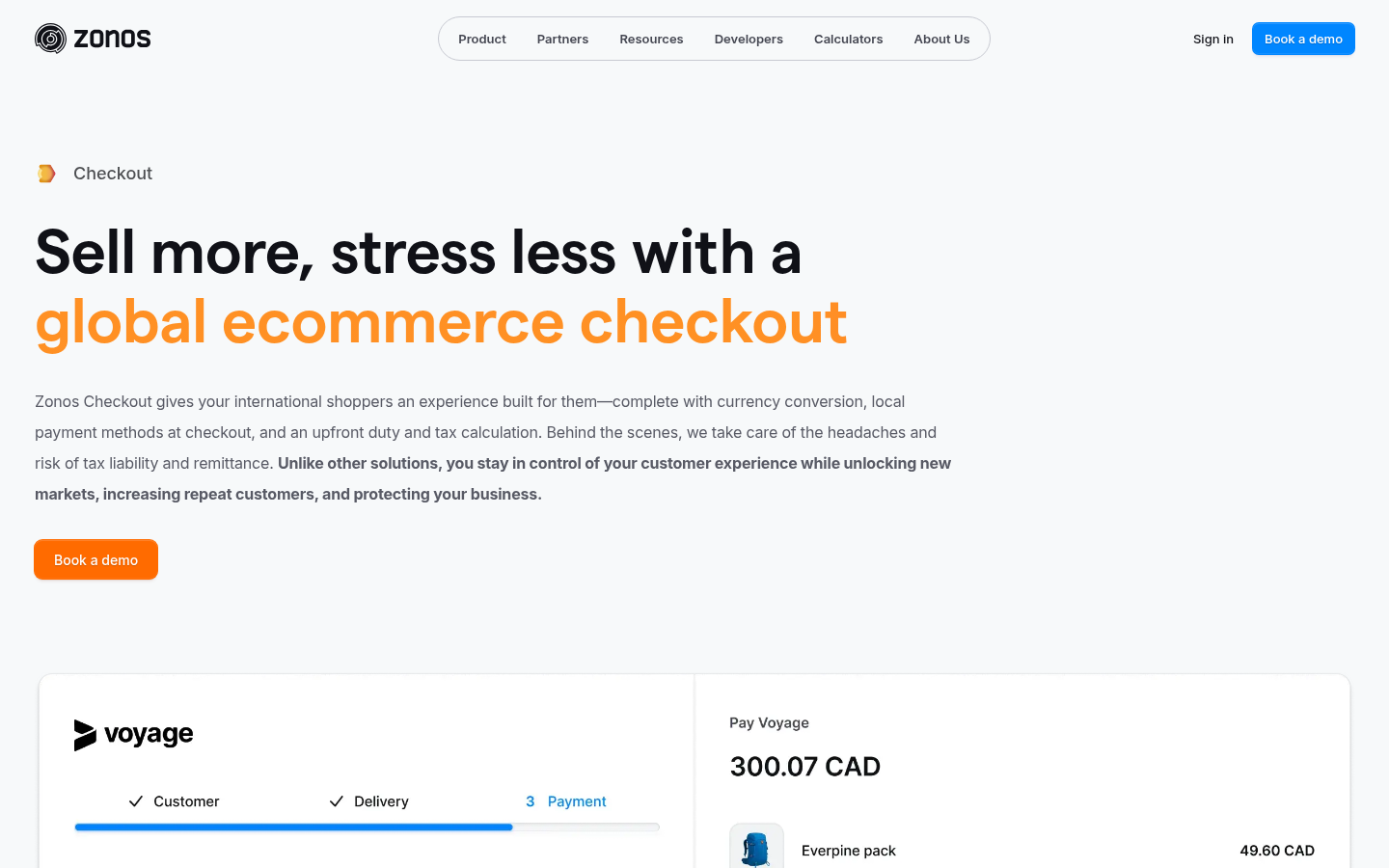
Zonos builds landed cost, product classification and international checkout software that calculates and collects duties and taxes before the parcel ships.
Best for: Teams that want to keep their own carriers and rates and add guaranteed duty and tax collection to their checkout or systems.
Why we like it: Zonos publishes its landed cost formula, so brands can model costs before the first sales call. Carrier flexibility suits brands that have already negotiated their own shipping rates.
Notable Limitations:
- Checkout orders need shipping labels printed in Zonos Dashboard unless the merchant is certified to print elsewhere (Zonos docs).
- Because Zonos collects international payments, refunds and cancellations run through Zonos Dashboard, outside the store admin.
- Checkout platform fees beyond the landed cost formula are quoted by sales.
Pricing: Guaranteed landed cost is $2 per order plus 10% of duties, taxes and fees, typically paid by the shopper at checkout (Zonos docs). On Shopify, the Zonos Duty and Tax app starts at $2,500/year, and Zonos Checkout pricing comes through sales. Check merchant-country eligibility and carrier connections first.
Strategic Decision Framework
Use these questions in every demo so the answers line up side by side.
| Critical Question | Why It Matters | What to Evaluate | Red Flags |
|---|---|---|---|
| Do you want to stay merchant of record? | It decides who carries tax, fraud and compliance risk in each market | Registrations you hold today, appetite for chargeback risk, customer data ownership | Vague answers on who files and pays tax in each country |
| How much of your setup must stay in place? | Changing platform or payment provider adds months and risk | Supported platforms, payment provider compatibility, warehouse connections | A proposal that assumes a checkout or payment change you did not plan for |
| Are duties guaranteed at checkout? | Underquoted duties land on you or the shopper at delivery | Who pays the difference when the estimate is wrong, handling of the EU EUR 3 duty | Estimates labelled "approximate" with no guarantee terms |
| How do returns work across borders? | International returns eat into margin fast | Return routes, refund timing, duty recovery on returned goods | No answer on duty refunds or where returned parcels go |
| What is the full cost per order? | Percentage fees, currency spreads and shipping add up | Transaction fee, currency conversion, shipping, returns and service charges | An undefined fee base, with no answer on whether shipping and duties count |
Problems & Solutions
Here are four common cross-border problems and the platforms that address them.
| Problem | Solution | Platforms That Help |
|---|---|---|
| Shoppers abandon checkout when they see import charges late | Show a guaranteed landed cost at checkout | Global-e, Glopal, Swap and Zonos all calculate duties and taxes up front, and Zonos and Swap publish how that cost is charged |
| New EU and US duty rules change margins on low-value orders | Use a provider that pays duties on your behalf | Through Shopify Managed Markets, Global-e pays the EU EUR 3 customs duty and guarantees the amount shown at checkout |
| Tax registrations in dozens of countries stretch a small finance team | Hand the responsibility to a merchant of record | Global-e and ESW take it on as part of a managed programme, and Reach does it while leaving your payment provider and checkout in place |
| International returns wipe out the margin on cross-border orders | Treat returns as part of the cross-border workflow | Swap combines returns with duty recovery on eligible orders, and ESW includes returns in its post-purchase services |
The Bottom Line
Global-e and ESW suit brands that want one merchant of record for the whole international journey, and Global-e also covers eligible Shopify stores. Reach adds merchant of record coverage and keeps your payment provider and checkout. Glopal is the pick when international traffic is the gap.
Swap fits brands that want to stay the seller, with returns built in, and Zonos fits teams that want published fees and their own carriers. Start with one priority market. Ask each provider to walk through the same order, from product page to return, and compare who does what at each step.