Most teams discover that their climate data breaks at the asset level during pre-deal diligence or renewal time with insurers, not from the sustainability report. From our experience in the startup ecosystem, the biggest wins come from getting three things right early: fast geocoding of assets to hazard tiles, portfolio-level scenario testing against standardized pathways, and a repeatable workflow to generate TCFD or ISSB-ready outputs. As disclosure rules ebb and flow in the U.S. and expand elsewhere, leaders are prioritizing tools that turn physical, transition, and market risks into financial metrics investors can use - a trend analysts expect to continue even with regulatory uncertainty in the U.S. (SEC rulemaking and court stay, AP coverage of the pause).
Verdantix estimates the climate risk software market at roughly $550 million in 2023, forecast to reach about $1.16 billion by 2029, a 13 percent CAGR, driven by global reporting regimes like CSRD and ISSB as well as physical risk exposure (Verdantix market forecast). Four platforms consistently delivered credible modeling depth, auditability, and time-to-value across real portfolios. Below, you will see how each platform handles emissions, asset-level risk, and disclosures, plus what to watch on pricing and deployment so you can buy once and deploy fast.
Clarity AI
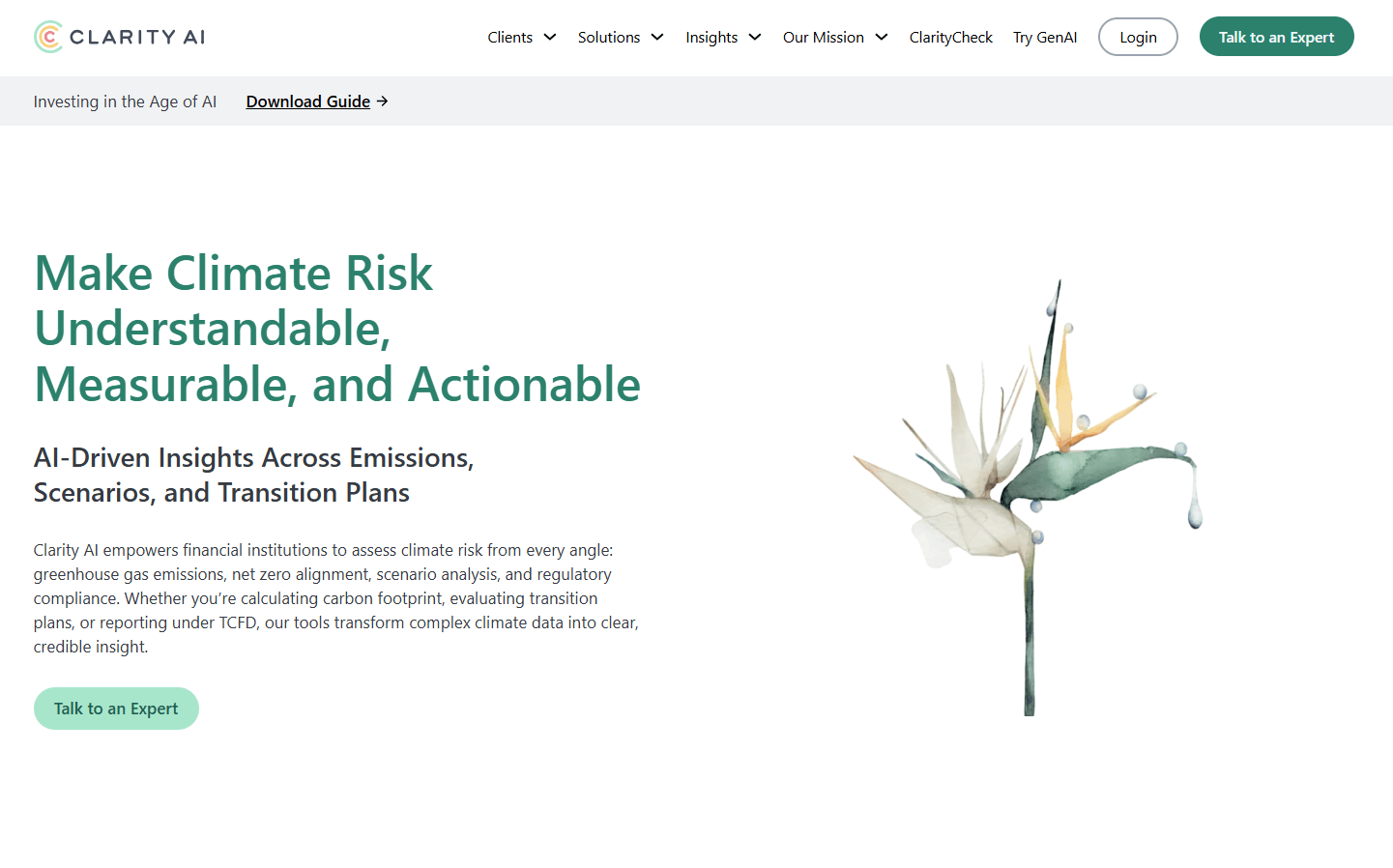
Enterprise platform for portfolio climate analytics and disclosures, with AI-driven data processing for Scope 1, 2, and 3 emissions, transition readiness, scenario risk, and TCFD-aligned reporting. Per vendor documentation, it also supports PCAF-aligned financed emissions and automated disclosure generation.
Best for: Asset managers, banks, and large corporates that need portfolio-scale analytics and TCFD, CSRD, or ISSB-aligned reports.
Key Features:
- Automated TCFD report generation, emissions coverage including Scope 3, transition plan analytics, and scenario outputs, per vendor documentation.
- Portfolio climate scenario analysis aligned to market standards and investor workflows, per vendor documentation.
- Extensive ESG and climate data coverage recognized by independent analysts, including a Leader placement in Forrester's 2024 evaluation of ESG Data and Analytics providers (Forrester coverage via Business Wire).
Why we like it: Working across different tech companies, we have seen Clarity AI shorten the time from raw positions to decision-useful portfolio metrics, especially when teams must turn modeled Scope 3 into defensible filings.
Notable Limitations:
- Limited peer reviews on major review sites as of December 2025, which can slow internal procurement sign-off (G2 listing indicates no reviews).
- Modeled Scope 3 remains challenging industry-wide, which adds uncertainty to estimates that feed regulatory reports (IFRS Foundation progress commentary summarized by Harvard Law's forum).
- Enterprise-level pricing can be a hurdle for small teams, and marketplace listings show high contract minimums (AWS Marketplace listing shows a 12-month, $50,000 per user option).
Pricing: AWS Marketplace lists a 12-month contract at $50,000 per user, additional options may vary by contract. For broader deployments, contact the vendor or marketplace partner for a custom quote. Note, Clarity AI expanded consumer capabilities via its July 2025 acquisition of ecolytiq, which may affect packaging for banking use cases (acquisition announcement).
ClimateForte

AI-powered climate risk intelligence platform with real-time risk assessment, predictive alerts, portfolio analytics, and API access. Per vendor documentation, it emphasizes multi-hazard scoring and enterprise integrations.
Best for: Teams piloting portfolio-level physical risk monitoring and alerting that want quick dashboards and an API.
Key Features:
- Multi-hazard risk assessment with portfolio visualization, per vendor documentation.
- Predictive alerts and mitigation recommendations, per vendor documentation.
- REST API for integration into existing BI stacks, per vendor documentation.
Why we like it: After helping startups scale, we value the combination of portfolio-wide maps plus alerting and an API, which shortens pilot timelines when you have limited engineering bandwidth.
Notable Limitations:
- No independent analyst coverage or verified third-party reviews we could find as of December 7, 2025. Treat claims around accuracy and customer logos as marketing until validated internally.
- Pricing, SLAs, and data sources are not corroborated by trusted third-party listings, which can complicate procurement.
- If you operate in regulated finance, you may need additional documentation or model validation not visible publicly.
Pricing: Pricing not publicly available. Contact ClimateForte for a custom quote. Disclaimer: we did not find trustworthy third-party pricing references.
ClimateAi ClimateLens

AI-driven climate resilience platform focused on hyper-local forecasting and adaptation planning for agriculture, food, energy, and supply chains. ClimateLens provides short- to seasonal-range hazard insights and longer-term scenario views.
Best for: Agrifood, CPG, and energy supply chain teams that need 1 km hazard forecasts, yield outlooks, and procurement planning.
Key Features:
- Hyper-local forecasts at approximately 1 km resolution with templates for operational decisions, per vendor documentation.
- Weekly climate-driven crop yield outlooks for key commodities to anticipate sourcing risk (press announcement).
- Government procurement pathway validated via DIU and a GSA MAS contract for weather intelligence solutions at 1 km resolution (company GSA contract news post).
Why we like it: From our experience in the startup ecosystem, you get fast operational wins. Teams can act on planting windows, irrigation, frost risk, logistics reroutes, and supplier diversification before the quarterly business review.
Notable Limitations:
- Pricing is not publicly listed, which slows early budgeting.
- Limited product reviews on major B2B review platforms as of December 2025 make reference checks important during diligence.
- If you need finance-grade disclosure automation, you may still need a separate reporting stack, given the product's primary focus on operations and supply risk.
Pricing: Pricing not publicly available. Contact ClimateAi for a custom quote. Funding and product milestones are covered by third-party releases (Series B coverage).
ResilienceAI

AI-native climate intelligence platform for investors that combines multi-agent research workflows, retrieval-augmented analysis, and geospatial scenario modeling to assess physical and transition risks. Per vendor documentation, it targets the full climate-investing workflow.
Best for: Investment teams that want AI agents to automate climate and financial research, integrate structured and unstructured sources, and run asset-level spatial risk.
Key Features:
- Multi-agent AI research workflows that synthesize filings, news, and climate data into decision-useful insights, per vendor documentation.
- Spatial Intelligence application for asset-level geospatial risk under multiple climate scenarios, per vendor documentation.
- Data integration across PDFs, spreadsheets, and APIs with RAG-style grounding for transparency, per vendor documentation.
Why we like it: Working across different tech companies, we have seen multi-agent workflows cut weeks from climate-thematic screening and memo drafting, especially when you must combine financials with climate model outputs.
Notable Limitations:
- Early-stage platform with limited third-party reviews or analyst coverage as of December 2025, so plan for a robust pilot and model validation.
- Pricing and deployment options are not independently listed, which adds diligence overhead.
- If you require strict model provenance and regulatory audit packs on day one, request documentation and sample validations upfront.
Pricing: Pricing not publicly available. Contact ResilienceAI for a custom quote. We did not find trustworthy third-party pricing references.
AI-Driven Climate Risk Analytics Tools Comparison: Quick Overview
| Tool | Best For | Pricing Model | Highlights |
|---|---|---|---|
| Clarity AI | Financial institutions, large corporates needing portfolio analytics and disclosures | Enterprise contracts, marketplace option | Forrester-recognized ESG and climate data depth, disclosure automation |
| ClimateForte | Fast pilots for portfolio physical risk, alerts, API integration | Custom enterprise | Real-time alerts and multi-hazard portfolio views, API, per vendor documentation |
| ClimateAi ClimateLens | Agrifood and supply chains needing hyper-local forecasts and yield outlooks | Custom enterprise | 1 km hazard insights, weekly yield outlooks, DIU-validated capability and GSA path |
| ResilienceAI | Investors seeking AI-agent workflows plus geospatial risk | Custom enterprise | Multi-agent research, RAG grounding, spatial risk engine, per vendor documentation |
AI-Driven Climate Risk Analytics Platform Comparison: Key Features at a Glance
| Tool | Emissions Coverage | Scenario Analysis | Asset-Level Physical Risk |
|---|---|---|---|
| Clarity AI | Scope 1, 2, 3, portfolio financed emissions per PCAF, per vendor documentation | TCFD-aligned outputs and transition plan analytics, per vendor documentation | Company and asset tagging for risk drill-downs, per vendor documentation |
| ClimateForte | Portfolio emissions context, per vendor documentation | Portfolio stress testing, per vendor documentation | Multi-hazard risk scoring and alerts, per vendor documentation |
| ClimateAi ClimateLens | Operational emissions context for planning, per vendor documentation | Seasonal to multi-decade climate views for operations | 1 km hazard layers, crop yield outlooks |
| ResilienceAI | Company and project-level climate metrics, per vendor documentation | Scenario-based analysis across physical and transition vectors | Geospatial scenario engine for asset locations |
AI-Driven Climate Risk Analytics Deployment Options
| Tool | Cloud API | On-Premise | Integration Complexity |
|---|---|---|---|
| Clarity AI | Yes, marketplace and enterprise connectors referenced | Not advertised | Moderate, data feeds plus reporting workflows |
| ClimateForte | Yes, REST API per vendor documentation | Not advertised | Low to moderate, dashboards plus API |
| ClimateAi ClimateLens | Yes, enterprise SaaS, government contracting path | Not advertised | Moderate, templates shorten onboarding |
| ResilienceAI | Yes, API and web app per vendor documentation | Not advertised | Moderate, multi-agent workflows may require onboarding sessions |
AI-Driven Climate Risk Analytics Strategic Decision Framework
| Critical Question | Why It Matters | What to Evaluate | Red Flags |
|---|---|---|---|
| Do we need finance-grade disclosures or operational forecasting first | Mismatching tool to use case wastes budget | Evidence of TCFD or ISSB reporting outputs vs. hyper-local forecasts | No audit trail or export for filings |
| Can the model map risk to financial metrics we use | Boards and LPs need dollarized impact | Methodology transparency, assumptions, sensitivity ranges | Black-box scores without documentation |
| Is Scope 3 estimation defensible | Most companies still lack complete Scope 3, weakening reports | Data lineage, quality scoring, estimation methods | Unsupported Scope 3 estimates without caveats |
| What is the regulatory outlook for us | U.S. SEC rule status is in flux, while ISSB and CSRD advance | Jurisdiction coverage, templates, attestation readiness | Tool ignores evolving requirements |
AI-Driven Climate Risk Analytics Solutions Comparison: Pricing & Capabilities Overview
| Organization Size | Recommended Setup | Monthly Cost | Annual Investment |
|---|---|---|---|
| Small investment firm | Start with one portfolio in Clarity AI or ResilienceAI pilot, add ClimateAi for supply risk if relevant | Varies | Varies |
| Mid-market corporate | ClimateAi for operations, add Clarity AI for disclosures, keep pilot scope tight | Varies | Varies |
| Large financial institution | Clarity AI enterprise for disclosures and portfolio analytics, consider ResilienceAI for research workflows | Varies | Varies |
Note: most vendors do not publish pricing. Clarity AI has a public marketplace option at $50,000 per user for 12 months as a reference point; enterprise pricing varies by scope.
Problems & Solutions
-
Problem: Insurers are pulling back and premiums are rising in high-risk regions, with U.S. housing exposure cited at $12.7 trillion in severe or extreme risk categories across flood, wind, and wildfire, which destabilizes coverage and valuations.
How tools help:
- Clarity AI: Portfolio heatmaps and physical risk metrics help CFOs quantify exposure and prepare disclosures investors expect, even as the U.S. SEC rule is paused - investors still ask for climate risk clarity (housing risk context).
- ClimateForte: Per vendor documentation, real-time alerts and mitigation recommendations flag at-risk locations ahead of renewal cycles so risk managers can reduce losses, useful when carriers tighten terms.
- ClimateAi ClimateLens: Hyper-local hazard forecasts guide site-level measures like defensible space and heat hardening windows, helping risk engineering teams justify capex to stabilize coverage.
- ResilienceAI: Spatial scenario analysis translates hazard deltas into asset-level financial impacts for investors weighing re-underwriting or market exits.
-
Problem: River levels in Europe and the U.S. keep disrupting barge traffic, driving freight surcharges and production delays, which ripple through commodity sourcing.
How tools help:
- ClimateAi ClimateLens: Seasonal hazard outlooks and weekly crop yield forecasts help procurement teams re-route and re-contract earlier, which matters when Rhine or Mississippi constraints force partial loads and surcharges (Reuters on Rhine disruptions, UPI on Mississippi).
- Clarity AI: Portfolio scenario tools quantify how transport shocks flow into margins and valuation under different warming pathways, which helps explain quarterly variance to investors.
- ClimateForte: Per vendor documentation, predictive alerts can trigger inventory buffers in high-risk corridors.
- ResilienceAI: Agent workflows can scan news and filings daily to surface supply chain risk signals for holdings, speeding portfolio actions.
-
Problem: Over half of companies report operations hit by climate events, yet disclosure quality and Scope 3 completeness still lag, which undermines investor confidence.
How tools help:
- Clarity AI: Automated TCFD outputs and emissions coverage reduce manual work while adding transparency investors want (Morgan Stanley corporate survey).
- ResilienceAI: RAG-grounded outputs keep memos traceable to sources, improving auditability for investment committees.
- ClimateAi ClimateLens: Operational metrics backstop disclosure narratives with concrete adaptation actions.
- ClimateForte: Per vendor documentation, portfolio analytics provide a baseline view that teams can disclose while maturing their data pipelines.
Conclusion: What to buy now, what to pilot next
If you are a financial institution or a large corporate reporting under ISSB or CSRD, start with Clarity AI for portfolio analytics and disclosures, backed by independent analyst recognition and a marketplace price anchor to speed procurement. If your biggest pain is operational disruption, pilot ClimateAi ClimateLens for 1 km hazard outlooks and yield signals so sourcing and logistics can act sooner. For research-heavy investors, ResilienceAI's agent workflows can compress diligence cycles, but plan a rigorous pilot and validation. ClimateForte may suit teams that want quick dashboards and an API, but insist on references and documentation before enterprise rollout. The market is growing, and even with U.S. regulatory uncertainty, global demand is set to more than double by 2029, so the right move is to pick one disclosure platform and one operational platform, then expand as your data matures.