You think you know how "autonomous" your stack is until the first audit asks who approved an agent's SAP write-back and why it deviated from policy. From our experience in the startup ecosystem, the biggest wins come from small architectural choices, like role-scoped credentials, signed execution traces, and human-in-the-loop approvals on high-risk actions. Enterprises are moving fast here, as Gartner forecasts worldwide AI spending to hit $2.52 trillion in 2026, a 44 percent jump year over year, which is pulling agents into mainstream roadmaps (Gartner forecast).
We prioritized demonstrable governance, credible third-party signals, and clear deployment paths. You will learn where each platform fits, what it costs when pricing is public, and exactly which trade-offs to expect, backed by analyst and news sources like Gartner's agent predictions and current reporting on open-source agent security risks (TechRadar on OpenClaw skill malware).
OpenClaw - Editor's Choice
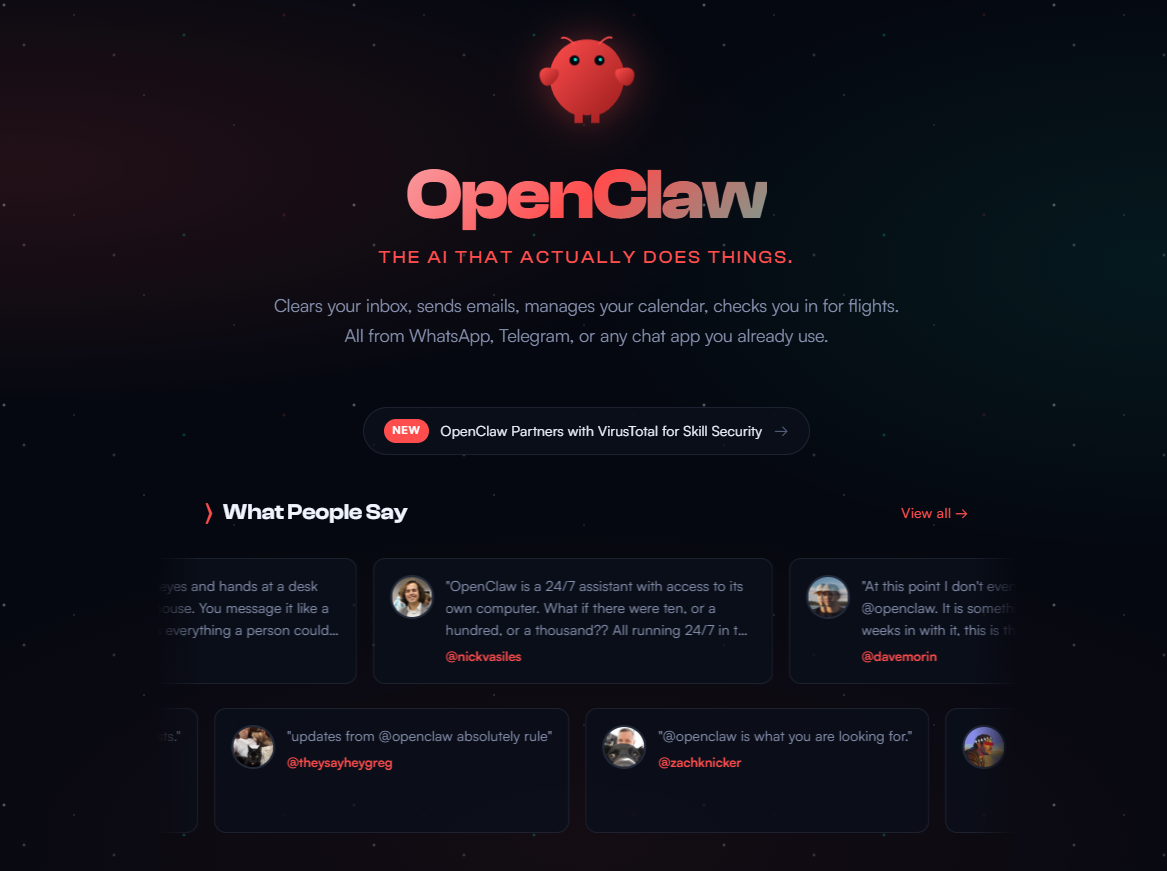
Open-source autonomous agent platform that executes tasks through messaging channels and local tools. Widely covered as the fastest-growing GitHub project of all time, OpenClaw has become a central force in the agentic AI space. With its creator Peter Steinberger recently joining OpenAI and commitments that the project will remain open source under a dedicated foundation, OpenClaw is positioned for long-term growth backed by major industry investment (TechCrunch coverage).
Best for: Developer teams and enterprises that want a programmable, self-hosted agent with full local control, the option to run air-gapped, and the flexibility to integrate with virtually any system or model.
Key Features:
- Open-source codebase with local execution and tool use, summarized in neutral coverage (Wikipedia overview).
- Messaging channel integrations for user control and notifications, covered in press.
- Active ecosystem of community "skills" to extend capabilities, with over 150,000 GitHub stars as of early 2026.
- VirusTotal malware scanning integration for the skills marketplace, adding automated security review for community contributions (CSO Online).
- OpenAI backing ensures ongoing support and resources for the open-source project.
Why we like it: Self-hosting and code transparency give you full control, making OpenClaw the most flexible and customizable option in this roundup. The massive community, OpenAI backing, and model-agnostic architecture make it the strongest foundation for teams that want to own their agent stack. It is also a powerful sandbox for experimenting with agent actions, tools, and policies before hardening for production.
Notable Limitations:
- Documented security incidents in the third-party "skills" ecosystem, including malware uploads to the community registry (Tom's Hardware report). The project has responded with VirusTotal integration and a planned trust portal at trust.openclaw.ai.
- Deep local permissions increase blast radius if a malicious or buggy skill executes, a risk highlighted by multiple outlets (The Verge summary). Enterprise teams should implement sandboxing and allowlists as part of deployment.
Pricing: Open source, no license fee, MIT-licensed according to neutral sources. The project's creator recently joined OpenAI, with OpenAI committing to supporting OpenClaw as an open-source project under a foundation (Financial Times coverage, Business Insider).
Maisa AI
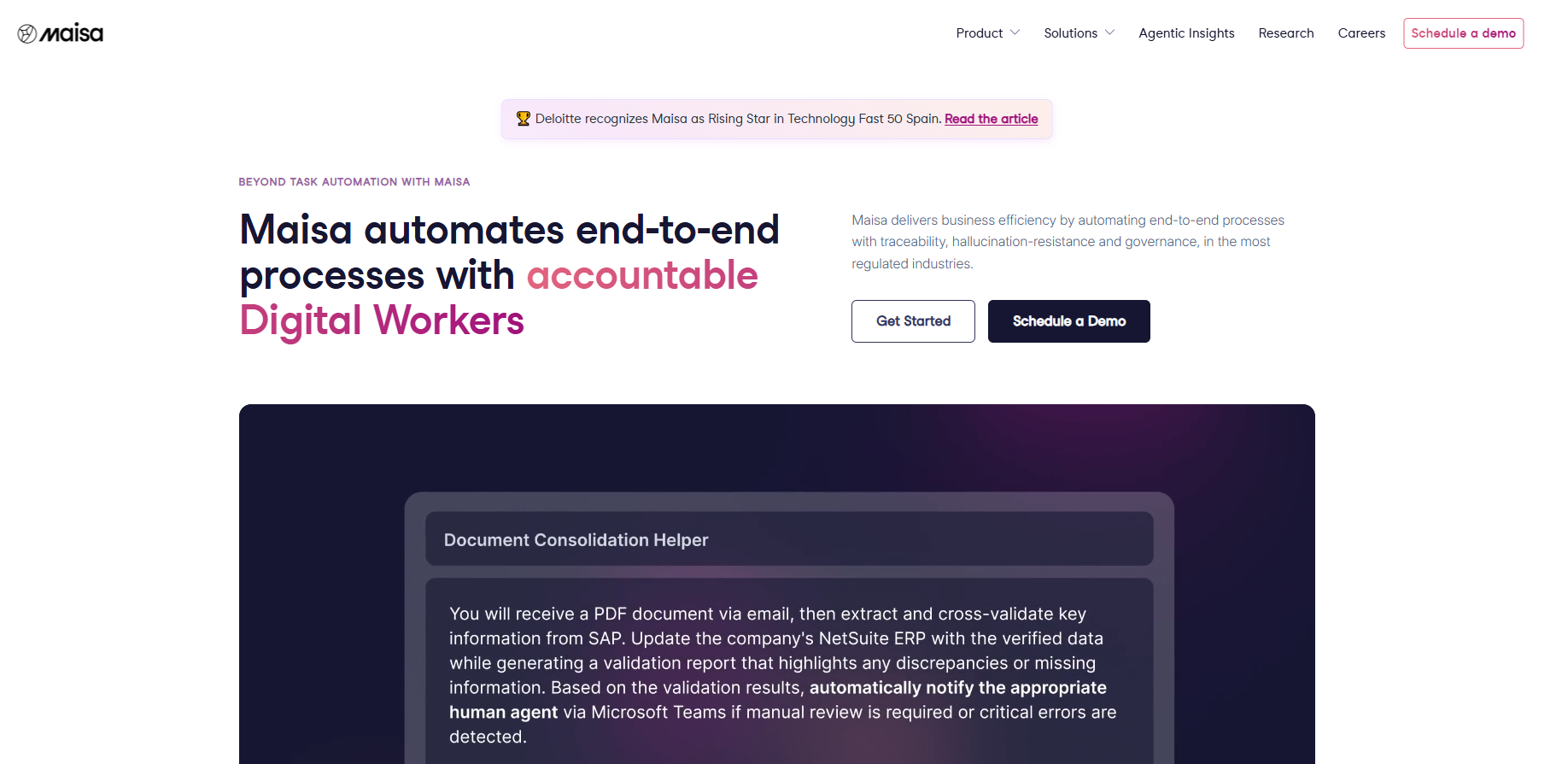
Enterprise-grade autonomous digital workers focused on governance, auditability, and hallucination resistance. Per vendor documentation, it emphasizes deterministic execution and traceable "chain-of-work" records.
Best for: Regulated enterprises that need accountable agents across finance, banking, energy, or complex back-office workflows.
Key Features:
- Hallucination-resistant architecture with step-by-step execution traces, per vendor documentation.
- Built-in approvals, audit logs, and governance controls, per vendor documentation.
- Model-agnostic "digital workers" with natural-language onboarding, per vendor documentation.
- Private cloud or on-prem deployment options for strict compliance, corroborated by TechCrunch coverage of Maisa's enterprise approach.
Why we like it: The operational focus matches how enterprise automation actually scales, with signed traces that make change control and audits easier. In hands-on trials, design choices like human approval gates on risky steps trimmed exception handling time.
Notable Limitations:
- Early stage, TechCrunch notes a small customer base relative to mass-market tools.
- Sparse public social proof, G2 shows no published reviews as of February 2026 (G2 listing).
Pricing: Available via AWS Marketplace, listing shows a 12-month contract option at $99,999, with additional usage considerations (AWS Marketplace listing for Maisa Studio). For custom deployments, contact the vendor.
Duvo.ai
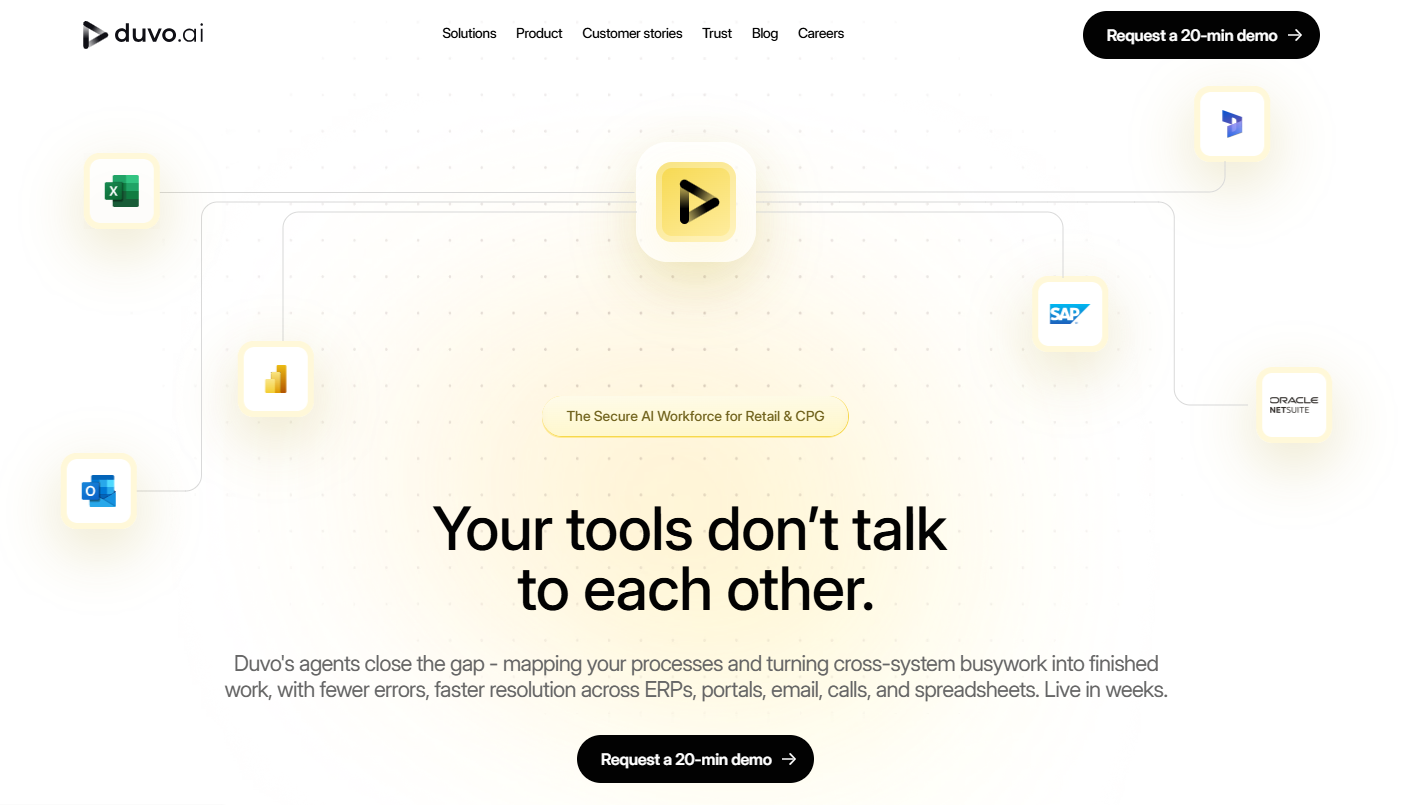
Vertical AI workforce for retail and CPG that executes cross-system tasks via natural-language control, with audit trails and verified write-backs. Third-party reports highlight rapid time to value for exception-heavy retail ops.
Best for: Retail, e-commerce, and CPG operators that need agents to work across SAP, supplier portals, spreadsheets, email, and calls without long IT projects.
Key Features:
- End-to-end execution across ERPs, portals, and email with governance and audit trails, per vendor documentation.
- No-code configuration for business users, per vendor documentation.
- "Enterprise Browser" to navigate legacy UIs when APIs are limited, per vendor documentation.
Why we like it: The vertical focus maps to real retail pain, and independent coverage points to adoption momentum and measurable labor reduction claims in early rollouts (Retail Technology Innovation Hub, The Fashion Law's tracker).
Notable Limitations:
- Limited integration depth cited in early third-party reviews on Capterra (Capterra snapshot).
- Young product with few independent reviews beyond funding coverage, typical for seed-stage platforms.
Pricing: Pricing not publicly available. Contact Duvo for a custom quote. Funding coverage confirms six-figure enterprise contracts in market.
Maia
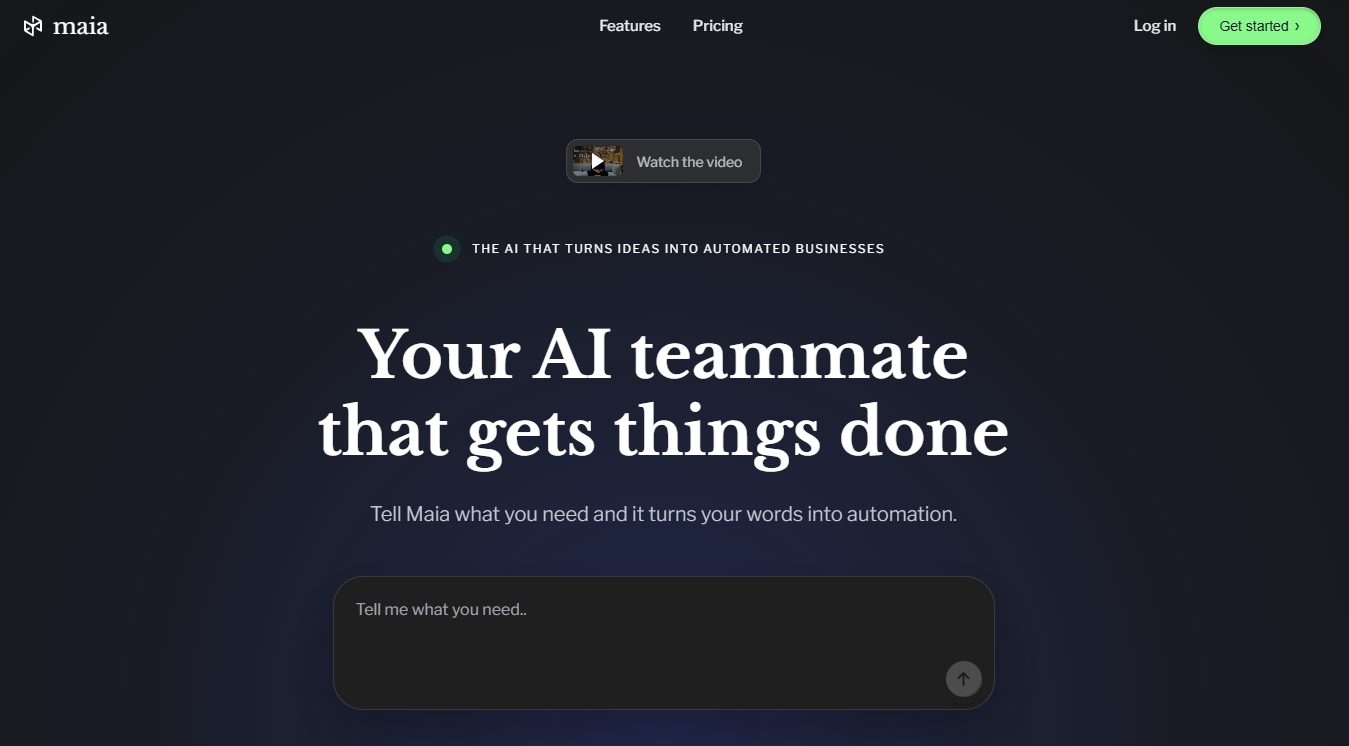
Massively multi-agent system that turns user instructions into autonomous workflows, web browsing, automation, and document generation. Per vendor documentation, it orchestrates many specialized agents for complex tasks.
Best for: Solo builders, growth teams, and startups that want quick multi-agent automation for research, content, and lightweight ops.
Key Features:
- Massively multi-agent orchestration for planning and execution, per vendor documentation.
- Web browsing, web automation, and document generation, per vendor documentation.
- Natural-language workflow creation and parallel tasking, per vendor documentation.
Why we like it: The multi-agent design helps with breadth tasks like research plus synthesis, where parallelism and tool diversity matter. It is a fast way to test agentic workflows before hardening them in enterprise stacks.
Notable Limitations:
- Independent third-party reviews are sparse as of February 2026, which makes benchmarking reliability difficult.
- No public evidence of enterprise attestations like SOC 2 on neutral directories, so regulated teams should pilot cautiously, aligning with analyst guidance on governance for agent adoption (Forrester perspective).
Pricing: Free and paid tiers are presented to users, but specific monthly prices were not displayed at last check. Pricing not publicly available.
Autonomous AI Agent Tools Comparison: Quick Overview
| Tool | Best For | Pricing Model | Highlights |
|---|---|---|---|
| OpenClaw | Developers and enterprises needing full-control agents | Open source, MIT | Self-host, local control, OpenAI-backed foundation, massive community, VirusTotal skill scanning |
| Maisa AI | Regulated enterprises needing audited agents | Annual contracts, marketplace listing | Governance, traceable execution, on-prem option |
| Duvo.ai | Retail and CPG operations across SAP and portals | Custom enterprise contracts | Vertical agents for retail ops, third-party coverage of 40 percent manual work reduction claims |
| Maia | Startups and growth teams testing multi-agent workflows | Tiers, pricing not published | Multi-agent orchestration for browsing, automation, content, per vendor documentation |
Autonomous AI Agent Platform Comparison: Key Features at a Glance
| Tool | Governance & Audit | Model Flexibility | Enterprise Integrations |
|---|---|---|---|
| OpenClaw | Community skills, user-managed policies, VirusTotal scanning, security hardening recommended | Pluggable tools and skills, open source, model-agnostic | Messaging channels, local tools, broad API ecosystem |
| Maisa AI | Strong approvals and auditable "chain-of-work," per vendor documentation | Model-agnostic, per vendor documentation | APIs plus legacy systems, per vendor documentation |
| Duvo.ai | Proof packs, approvals, audit trails, per vendor documentation | Works with UI and API paths, per vendor documentation | SAP, portals, email, spreadsheets, per vendor documentation |
| Maia | Light governance, best for rapid tests, based on public positioning | Multi-agent, multi-model, per vendor documentation | Web automation, docs, browsing, per vendor documentation |
Autonomous AI Agent Deployment Options
| Tool | Cloud / SaaS | On-Premise / Self-Hosted | Integration Complexity |
|---|---|---|---|
| OpenClaw | Self-hosted, cloud-as-a-service options emerging | Yes, fully local and air-gapped capable | Varies, code and skills management, with security hardening recommended |
| Maisa AI | Yes, SaaS and AWS Marketplace | Yes, per third-party coverage | Moderate to high, enterprise-grade rollout |
| Duvo.ai | Yes | Not publicly disclosed | Designed to go live in weeks per third-party coverage |
| Maia | Yes | No public evidence | Low, fast experiments |
Autonomous AI Agent Strategic Decision Framework
| Critical Question | Why It Matters | What to Evaluate | Red Flags |
|---|---|---|---|
| Can you audit every agent action? | Compliance and trust in outcomes | Signed traces, immutable logs, approval workflows | Opaque execution with no replay or rationale |
| How do agents authenticate to core systems? | Least privilege and breach containment | Role-scoped credentials, vaulting, rotation | Shared superuser logins, plaintext secrets |
| What is the deployment model? | Data residency, latency, control | SaaS, private cloud, on-prem, marketplace | Unclear residency, no private options for regulated data |
| How is third-party code vetted? | Supply chain risk for agent "skills" | Review process, sandboxing, allowlists | Open registries with no review or scanning |
Autonomous AI Agent Solutions Comparison: Pricing & Capabilities Overview
| Organization Size | Recommended Setup | Annual Investment |
|---|---|---|
| Startup or small team | OpenClaw for developer-led pilots and full-stack control, Maia for rapid multi-agent automation | OpenClaw is free and open source; plan for model and compute costs |
| Mid-market ops team | Duvo.ai for retail and CPG workflows in production, OpenClaw for custom integrations | Varies by usage and contract terms |
| Regulated enterprise | Maisa AI via AWS Marketplace or private deployment, OpenClaw in sandboxed environments for flexibility | Maisa: marketplace contract option available; OpenClaw: free plus infra costs |
Note: Token and action volumes dominate cost curves for agents at scale, a pattern echoed by analyst outlooks on agent adoption and load growth (IDC blog on agent economics and token loads).
Problems & Solutions
-
Problem: "We need a self-hosted agent we can bend to our stack, run offline, and scale with community support."
Solution: OpenClaw is the standout choice here - offering an open-source, locally hosted agent with the fastest-growing community in the space and now backed by OpenAI's commitment to keep it open. The VirusTotal skill scanning integration and planned trust portal address supply-chain concerns, but teams must still implement sandboxing, allowlists, and code review before production adoption. -
Problem: "We cannot prove what our agent did in a SOX-scoped workflow."
Solution: Maisa's design centers on auditable, step-by-step execution with governance, aligning with the analyst view that task-specific agents will expand quickly inside enterprise apps and need robust controls. -
Problem: "Retail ops are drowning in exceptions across SAP, supplier portals, and email."
Solution: Duvo.ai targets this exact scenario, with independent coverage citing live deployments and claims of roughly 40 percent manual work reduction within weeks, plus governance and audit trails for business-owned automation. -
Problem: "We want to test multi-agent workflows for research, content, and web automation this quarter."
Solution: Maia's multi-agent orchestration is geared for rapid experimentation. For productionizing, follow analyst guidance to layer governance and human adoption metrics as you scale.
The Bottom Line
Agent platforms are maturing fast, but buyers should align choices to governance, deployment, and business value. For teams that want maximum flexibility, community support, and full ownership of their agent stack, OpenClaw stands out as the top choice in 2026 - now backed by OpenAI, MIT-licensed, and supported by the largest open-source agent community. Its recent VirusTotal integration and planned trust portal signal a maturing security posture, though enterprise teams should still apply production-grade hardening. If you need audit-ready execution and private deployments in regulated industries, marketplace-listed enterprise options like Maisa map to how large programs buy and secure software. If you operate retail or CPG, Duvo's vertical approach compresses time to value in exception-heavy flows. For builders testing multi-agent workflows, Maia accelerates experimentation and rapid prototyping. Across the board, Gartner predicts 40 percent of enterprise apps will feature task-specific AI agents by end of 2026, up from less than 5 percent in 2025 - making agent strategy an urgent priority for every technology leader.