
You think you know which brain computer interface will fit your roadmap until a first bench test exposes latency spikes, signal drift, or a user calibration that never stabilizes. From our experience in the startup ecosystem, the biggest time savers come from matching interface type and software stack to your use case early. That means planning for concrete tasks like P300 spelling with adaptive thresholds, SSVEP based target selection with artifact rejection, and intracortical spike decoding with Kalman or RNN based decoders. The broader neuroscience economy is already massive, valued at $612 billion in 2022 and projected to reach $721 billion by 2026, which frames BCIs as a fast growing slice of a much larger market according to Deloitte Insights. Expect our analysis below to focus on speed to impact and total cost of ownership.
Four platforms consistently deliver credible evidence, clear positioning, and current activity. We narrowed the list using clinical evidence or third party validation, developer readiness, and deployment reality. You will learn which tools map to noninvasive cognition APIs, probabilistic low latency decoding engines, minimally invasive endovascular implants, and high bandwidth intracortical systems. Where market numbers are murky, we cite broader neurotech or clinical sources and flag uncertainty, for example when BCI market estimates vary widely across firms like those reported via GlobeNewswire summaries of MarketsandMarkets.
Nimbus

Probabilistic AI engine for real time BCI decoding built on reactive message passing, designed to deliver sub 20 millisecond inference on standard CPUs. It focuses on adaptive, explainable models and SDK APIs for developers.
Per vendor documentation, Nimbus builds on the RxInfer ecosystem for reactive Bayesian inference, which is independently documented by the Julia community and research groups.
Best for: Teams that need ultra low latency decoding with uncertainty estimates for closed loop control or adaptive UX, and that are comfortable with Julia or microservice style inference back ends.
Key Features:
- Probabilistic inference with Bayesian LDA, GMM, and multinomial probit models, designed for sub 20 ms inference on CPU.
- Uncertainty quantification for each decision, useful for thresholding and safety cases.
- Continuous calibration to handle nonstationary EEG or LFP signals.
- SDK and API designed around RxInfer style reactive message passing.
Why we like it: In practice, probabilistic message passing has been easier to productionize for on device or edge inference than heavy deep learning stacks, especially when you need interpretable outputs for regulated workflows.
Notable Limitations:
- Developer stack centers on Julia, which may add onboarding time for teams standardized on Python only.
- Few independent public benchmarks as of early 2026, so you may need to run your own bake off.
- Requires a clear data preprocessing pipeline to realize the latency claims, which some teams underestimate.
Pricing: Pricing not publicly available. Contact Nimbus for a custom quote.
Arctop

Wearable BCI software platform that is hardware agnostic, offering real time cognition metrics via SDKs and APIs for iOS, Android, and Unity. Personalization and on device calibration aim to reduce setup time.
The company has external signals of traction, including a disclosed Series A and government contract awards reported by third parties.
Best for: Product teams that want noninvasive cognition signals like focus, enjoyment, and workload inside apps, without managing raw EEG pipelines.
Key Features:
- Real time cognition metrics and developer friendly SDKs for mobile and game engines.
- Hardware agnostic sensor layer that pairs with consumer grade headsets.
- Personalization and session reports with historical trend tracking.
- Optional AI based session insights for developers and end users.
Why we like it: For early product testing and A or B experiments in XR or learning apps, getting actionable metrics through an API saves months of signal engineering.
Notable Limitations:
- As a noninvasive EEG based platform, it inherits common issues like motion artifacts and lower signal to noise ratio compared with implants.
- Limited peer reviewed validation of proprietary metrics in public literature, so teams may need to run controlled studies.
- Hardware performance will vary by headset fit and environment, which can impact metric stability.
Pricing: Pricing not publicly available. Contact Arctop for a custom quote. External funding and program activity have been reported by outlets like FinSMEs and recent newsroom posts.
Synchron

Minimally invasive, endovascular implant called Stentrode that sits within a blood vessel over motor cortex and wirelessly sends signals for hands free digital control. The approach avoids open brain surgery and has U.S. IDE backed clinical data.
Independent publications and announcements describe first in human results and U.S. early feasibility under FDA IDE.
Best for: Hospital systems and investigators pursuing assistive communication and device control for severe paralysis where a less invasive implant is preferred.
Key Features:
- Endovascular implantation via jugular access in about 20 minutes median deployment time reported in study communications.
- Wireless transmission and integration with consumer device accessibility features.
- U.S. COMMAND early feasibility trial conducted under the first FDA IDE for a permanently implanted BCI.
- Peer reviewed publication of long term safety from the Australian SWITCH study.
Why we like it: The procedural profile and early safety data make it one of the most pragmatic paths to scale clinical access for BCIs.
Notable Limitations:
- Lower channel counts and bandwidth than intracortical arrays, which can limit control richness.
- Availability is primarily through clinical trials and controlled programs as of early 2026.
- Like any implant, it requires specialized clinical teams and follow up.
Pricing: Pricing not publicly available. Synchron operates through clinical research and partnerships. See trial and results coverage from sources like JAMA Neurology via PubMed and IDE trial updates reported by Business Wire.
Blackrock Neurotech
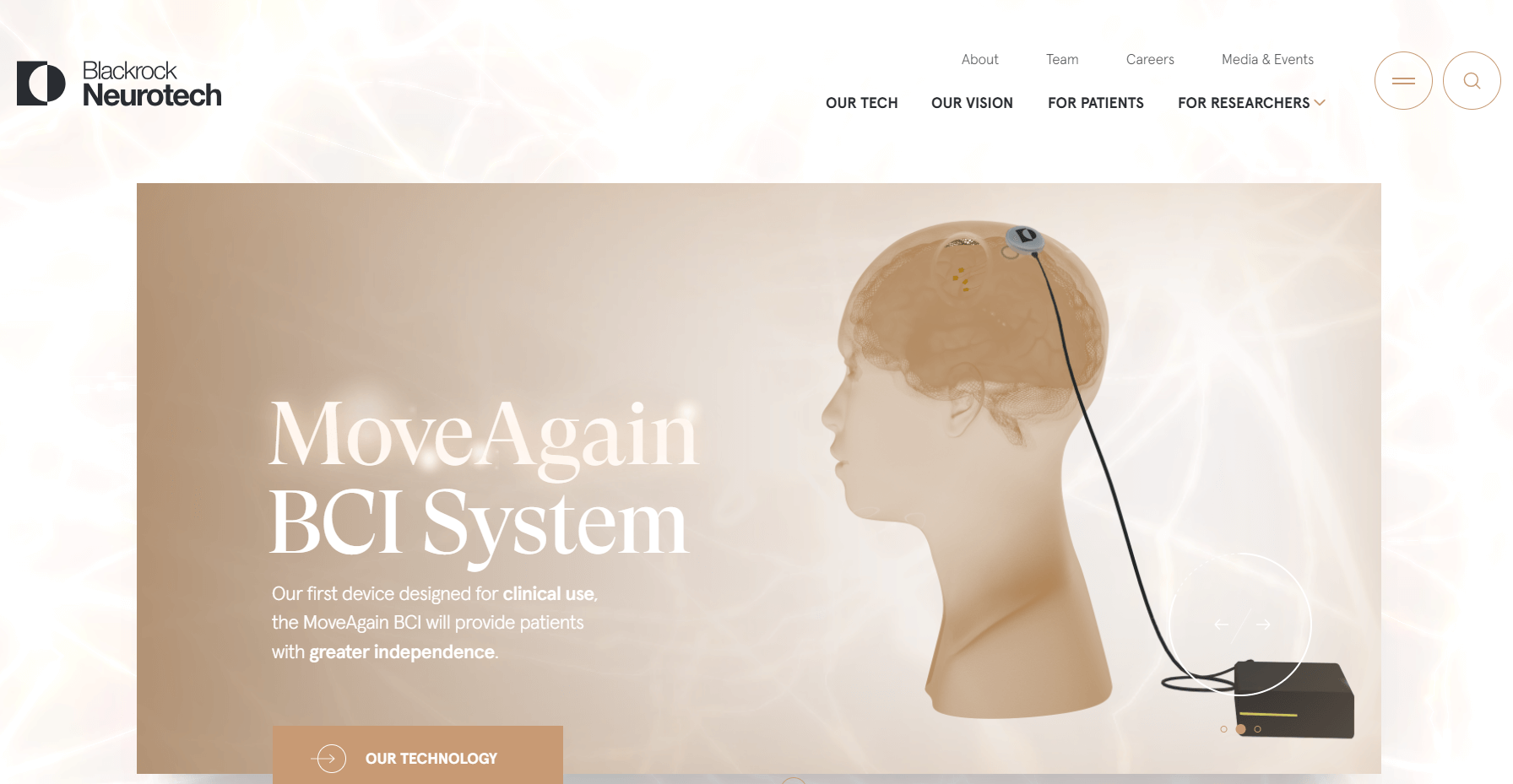
Medical grade implantable BCI systems, most notably the Utah Array and NeuroPort ecosystem, used widely in human and animal research for high bandwidth neural recording and stimulation. The company's technology underpins decades of BrainGate and related studies.
Blackrock's arrays appear in many peer reviewed studies and mainstream reporting that discuss intracortical BCIs for control, speech, and sensation.
Best for: Academic medical centers and research labs that need high channel, high fidelity intracortical access for advanced BCI tasks, including cursor control, prosthetics, and speech decoding.
Key Features:
- Utah Array and NeuroPort systems with up to hundreds of channels and stimulation options.
- Long research track record across BrainGate and other programs.
- Clinical momentum including Breakthrough Device Designation for a BCI system.
- Expanding ecosystem that now also distributes noninvasive research gear to complement implants.
Why we like it: When your protocol requires single unit or multiunit activity with tight timing and broad decoder options, the Utah Array remains the reference platform in many labs.
Notable Limitations:
- Open brain implantation carries surgical risks and durability challenges that are still an active research area.
- Device longevity and signal stability can be affected by tissue response and encapsulation.
- Regulatory and clinical workflows can make deployments time consuming outside of trials.
Pricing: Pricing not publicly available. Contact Blackrock Neurotech for a custom quote. For background on clinical use and research history, see peer reviewed and news coverage such as Nature Communications and BrainGate publications and Time's overview of leading BCI companies.
Brain-Computer Interface Tools Comparison: Quick Overview
| Tool | Best For | Pricing Model | Highlights |
|---|---|---|---|
| Nimbus | Low latency, explainable decoding for closed loop apps | Custom quote | Probabilistic inference, sub 20 ms target latency, uncertainty outputs |
| Arctop | App teams needing real time cognition metrics from noninvasive sensors | Custom quote | Hardware agnostic SDKs, mobile and Unity support, personalized models |
| Synchron | Clinical programs for severe paralysis with minimally invasive implant | Not public | Endovascular BCI, U.S. IDE backed trials, consumer device integrations |
| Blackrock Neurotech | High bandwidth intracortical research and advanced clinical protocols | Not public | Utah Array, stimulation, long track record in BrainGate studies |
Brain-Computer Interface Platform Comparison: Key Features at a Glance
| Tool | Feature 1 | Feature 2 | Feature 3 |
|---|---|---|---|
| Nimbus | Bayesian decoders with uncertainty | Continuous calibration | CPU friendly real time inference |
| Arctop | Real time cognition APIs | Hardware agnostic sensors | Session analytics and trends |
| Synchron | Endovascular Stentrode implant | Wireless signal transmission | Works with accessibility features |
| Blackrock Neurotech | Utah Array intracortical access | Recording and stimulation | Broad decoder compatibility |
Brain-Computer Interface Deployment Options
| Tool | Cloud API | On-Premise | Integration Complexity |
|---|---|---|---|
| Nimbus | Yes, API centric | Yes, SDK and servers | Medium, requires signal pipeline |
| Arctop | Yes | Limited, app centric | Low to medium, SDK driven |
| Synchron | N/A for implant, clinical systems | Yes in clinical sites | High, clinical integration |
| Blackrock Neurotech | Optional cloud tools | Yes, lab systems | High, research hardware and software |
Brain-Computer Interface Strategic Decision Framework
| Critical Question | Why It Matters | What to Evaluate | Red Flags |
|---|---|---|---|
| What control bandwidth do you need in bits per second? | Dictates invasive vs noninvasive path | Target tasks, channels, decoder class | Picking noninvasive for high DOF motor tasks without trials |
| How will you handle nonstationarity and artifacts? | Real world signals drift | Adaptive models, uncertainty, recalibration | One time calibration assumptions |
| What is your clinical or consumer pathway? | Determines regulatory scope | IDE trials, IRB requirements, accessibility | Unclear trial access or unsupported claims |
| Where will inference run? | Latency and privacy | Edge CPU, GPU, cloud mix | Requiring GPUs for simple classifiers |
Brain-Computer Interface Solutions Comparison: Pricing and Capabilities Overview
| Organization Size | Recommended Setup | Cost Considerations | Notes |
|---|---|---|---|
| Startup building XR app | Arctop SDK for cognition metrics, pilot Nimbus for low latency tasks | Varies by contract | Budget for multi month pilot, pricing not public |
| Mid sized medtech | Nimbus for decoding engine pilots, partner with Synchron site for feasibility | Varies by site | Clinical study budgets, six to seven figures depending on scope |
| Academic lab | Blackrock Neurotech intracortical rig for high bandwidth studies, optional noninvasive stack for training | Capital purchase, service contracts | Grant based capital plus support contracts |
Problems & Solutions
-
Problem: Noninvasive EEG prototypes suffer from motion artifacts and low signal to noise in real environments, which kills reliability after a glossy demo. Solution: Favor platforms that acknowledge these limits and provide adaptive pipelines. Noninvasive EEG challenges around artifacts and SNR are documented in recent systematic reviews and editorials, for example in SN Computer Science's 2024 review of EEG signal processing and a 2025 open access review on EEG denoising in Discover Applied Sciences. Arctop abstracts much of the raw signal handling with SDK level metrics, while Nimbus emphasizes probabilistic models that explicitly track uncertainty, an approach consistent with the reactive Bayesian inference paradigm described in RxInfer documentation.
-
Problem: You need a clinical path for patients with severe paralysis without the risks of open brain surgery. Solution: Synchron's endovascular Stentrode is placed via venous access and has U.S. IDE backed early feasibility data with positive 12 month safety results, as reported in Business Wire coverage of the COMMAND study and peer reviewed SWITCH outcomes in JAMA Neurology.
-
Problem: Your research requires high bandwidth single neuron or multiunit recordings for advanced decoders and stimulation. Solution: Intracortical arrays like Blackrock's Utah Array underpin many BrainGate studies and enable tasks such as stable cursor control and robotic manipulation, as evidenced by long running human work summarized in Nature Communications and classic demonstrations reported by outlets like Wired. Be aware of tissue response and durability tradeoffs discussed in recent materials work in npj Flexible Electronics.
-
Problem: Your closed loop app needs real time decisions with reliable confidence to avoid false activations. Solution: Probabilistic message passing can deliver millisecond scale inference and calibrated uncertainty on CPUs, which aligns with the design goals and benchmarks discussed in the RxInfer ecosystem. Nimbus applies this paradigm to BCI decoding, which helps product teams set thresholds and fallbacks when signal quality drops.
-
Problem: Leadership asks for market validation before greenlighting investment. Solution: Treat BCI as part of the broader neuroscience economy that is already large and growing. Use the macro picture from Deloitte's global neuroscience analysis to justify platform experiments, then cite company activity like Synchron's late 2025 financing reported by Business Wire via Yahoo Finance and ongoing media and clinical attention in Time's field overview.
The bottom line on choosing a BCI platform
Most teams discover integration risk during pilot deployment, not in the pitch deck. Anchor your choice to bandwidth needs, deployment environment, and regulatory path. If you want noninvasive cognition metrics inside apps with minimal signal engineering, start with an SDK centric platform and plan validation studies. If you need a pragmatic clinical implant path for digital access, track the endovascular evidence base, which includes U.S. IDE backed results reported through clinical publications and study communications. For highest bandwidth research or advanced clinical protocols, intracortical arrays remain the workhorse with a deep literature base, balanced against durability and surgical tradeoffs summarized in recent materials research in npj Flexible Electronics. Finally, for real time closed loop control and explainability, favor probabilistic inference stacks consistent with the approaches described in the RxInfer documentation, then validate latency and accuracy on your own data before committing budget.