Most teams discover silent model failures during a 2 a.m. incident, not from their dashboards. Working across different tech companies, we have seen edge deployments go sideways when GPU thermals spike without alarms, when the wrong model version ships to 500 stores, or when video analytics flood the network after a firmware update. From our experience in the startup ecosystem, the biggest wins come from platforms that handle three specifics well: per-GPU metrics and throttling, versioned model rollouts with rollback, and on-device anomaly detection that survives flaky links.
Edge spending, not just cloud, is where the action is. IDC estimates global edge computing services will reach about $261 billion in 2025 and $380 billion by 2028, driven by AI workloads at the edge, according to a recent analysis of IDC figures reported by Computer Weekly. Four platforms consistently delivered robust Edge AI monitoring across device fleets, offline sites, and AI workloads. In 8 minutes, you will learn where each tool fits, the real constraints to watch, and how to avoid surprise costs, with citations to independent reports where possible.
Avassa for Edge AI
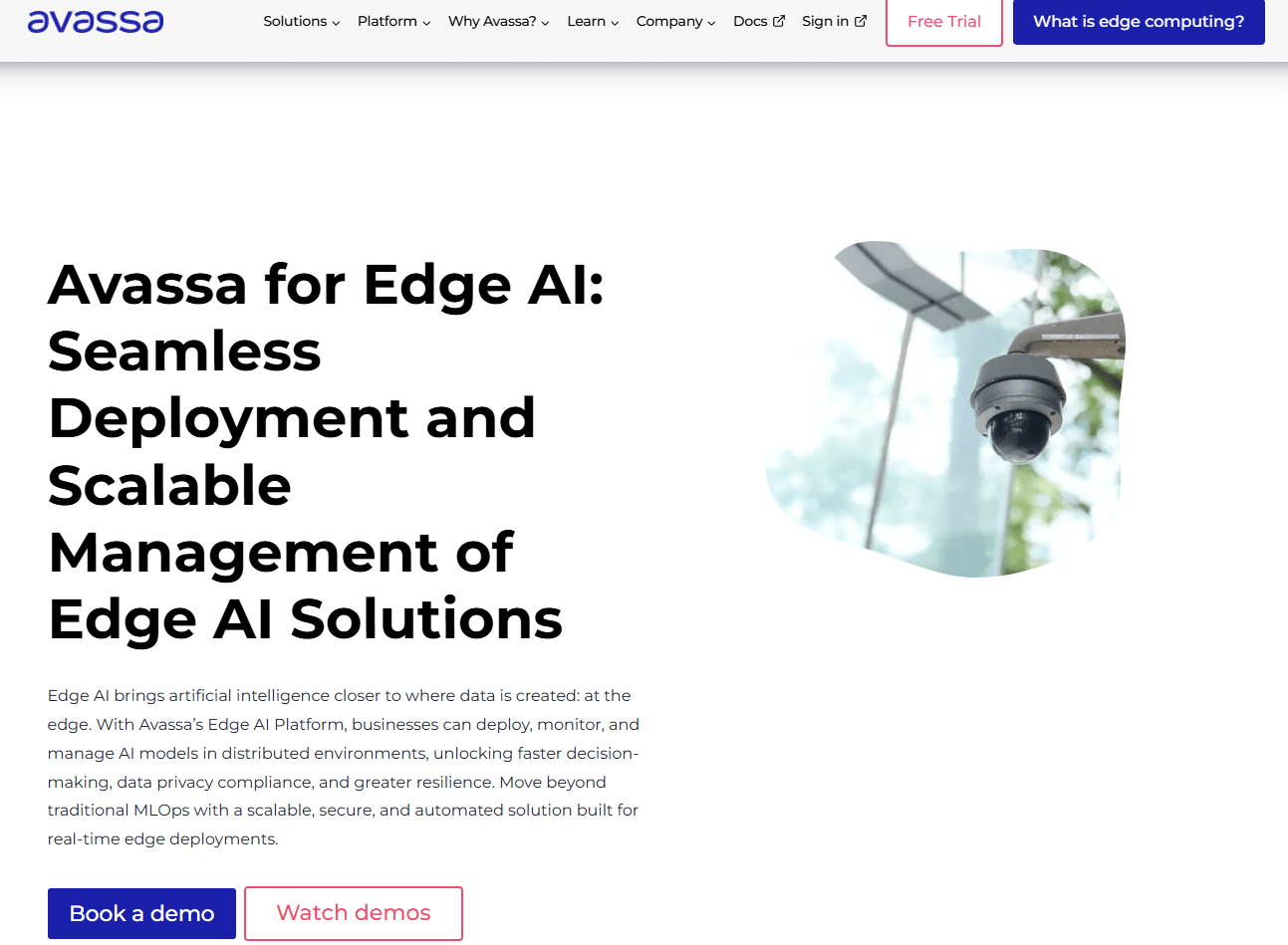
An edge application and operations platform that manages containerized apps and AI models across thousands of sites. Built for distributed, sometimes offline locations, with centralized policy and site-level autonomy, per vendor documentation.
Best for: Product teams that need application-centric orchestration and monitoring for AI apps at hundreds of retail, industrial, or telco sites.
Key Features:
- Container and VM lifecycle management at the edge, including placement policies and health monitoring, as covered by Edge Industry Review's product launches and partnerships.
- OS upgrade orchestration for edge hosts with controlled rollouts and minimal downtime, per vendor documentation and industry write-ups.
- GPU and device discovery at sites to bind models to local accelerators, per vendor documentation.
- Partnerships that validate industrial use, for example Wind River Linux integration for edge application management, reported by Wind River and trade press.
- Recognition in independent analyst coverage for edge orchestration, such as GigaOm's Radar, cited in industry articles.
Why we like it: Avassa treats the edge as an application platform, not a mini data center. That mindset cuts the time to ship and observe AI models in the field.
Notable Limitations:
- Smaller partner marketplace and community than hyperscaler stacks, and it is a younger company founded in 2020, which some enterprises view as vendor risk, as noted by funding and profile trackers.
- If you require Kubernetes-native tooling at every site, Avassa's opinionated approach may not align with a strict K8s standard, per analyst commentary.
Pricing: Pricing not publicly available. Contact Avassa for a custom quote. Analyst coverage confirms active enterprise deployments and partnerships, but no public list pricing is posted.
Citations: Wind River partnership and integration were reported by Wind River's newsroom and summarized by Edge Industry Review. Analyst recognition appears in press summaries of GigaOm's report. Company maturity details are visible on Crunchbase and in investment news on PR Newswire.
ClearBlade

An enterprise edge platform that brings monitoring, AI inferencing, and no-code digital twins to industrial and IoT operations. Designed for real-time control and offline continuity at the edge.
Best for: Operations and engineering teams modernizing plants, fleets, or smart-facility programs that need on-site AI with central oversight.
Key Features:
- Edge AI inferencing and video analytics to upgrade existing cameras and assets without rip-and-replace, covered by Edge Industry Review.
- Offline operation with synchronization to cloud and enterprise systems, documented across developer materials and third-party write-ups.
- Intelligent Assets, a no-code layer to visualize assets, detect anomalies, and automate actions, as described in product briefings.
- New Forecasting AI component for edge-based predictions and operator workflows, reported by trade press.
- Broad protocol and hardware support for industrial gateways, noted in analyst notes and product docs.
Why we like it: ClearBlade shortens the gap between OT data and action. The no-code layer plus edge components make it practical for non-data-science teams to monitor and improve outcomes.
Notable Limitations:
- Reviews and buyer guides cite a learning curve when deeply customizing logic and data flows, and note that comprehensive projects can require services. Directory listings also flag higher costs for large fleets.
- Public, SKU-level pricing for the full edge platform is limited, which makes apples-to-apples forecasting harder.
Pricing: Pricing not publicly available for Edge AI bundles. Some software directories list starting prices, but treat those as directional only. For context on capabilities and recent modules, see coverage from Edge Industry Review and Edge Industry Review's Forecasting AI article.
Lumana Video Intelligence Platform

A camera-agnostic video security and intelligence system that turns IP cameras into real-time sensors. Focused on behavioral detection, incident response, and operational insights.
Best for: Security, safety, and operations teams that want real-time video intelligence and anomaly detection across many sites using existing cameras.
Key Features:
- Transforms existing IP cameras into edge-AI devices with real-time detection and response, as detailed in company launch coverage.
- Hybrid architecture for scale, central management, and fast search across footage, reported in news coverage.
- Rapid growth benchmarks, such as surpassing 50,000 cameras, signal production-scale deployments in 2025 to 2026, per press reporting.
- Use cases include gun and violence detection, safety violations, and occupancy insights, per reported customer examples.
Why we like it: If your primary Edge AI monitoring need is video, Lumana removes the heavy lift by focusing on camera-native workflows and incident automation.
Notable Limitations:
- Young vendor with limited third-party comparative testing in the public domain, and with most evidence coming from press coverage of customer wins.
- AI video analytics raises privacy and policy concerns across industries, as regulators and media have spotlighted facial recognition and biometric surveillance risks in recent years.
Pricing: Pricing not publicly available. Funding and growth details are widely reported, for example the Series A and camera counts in PR Newswire and launch coverage from PR Newswire in 2024. Privacy and policy context appears in outlets like Reuters and The Washington Post.
LogicMonitor AI Monitoring
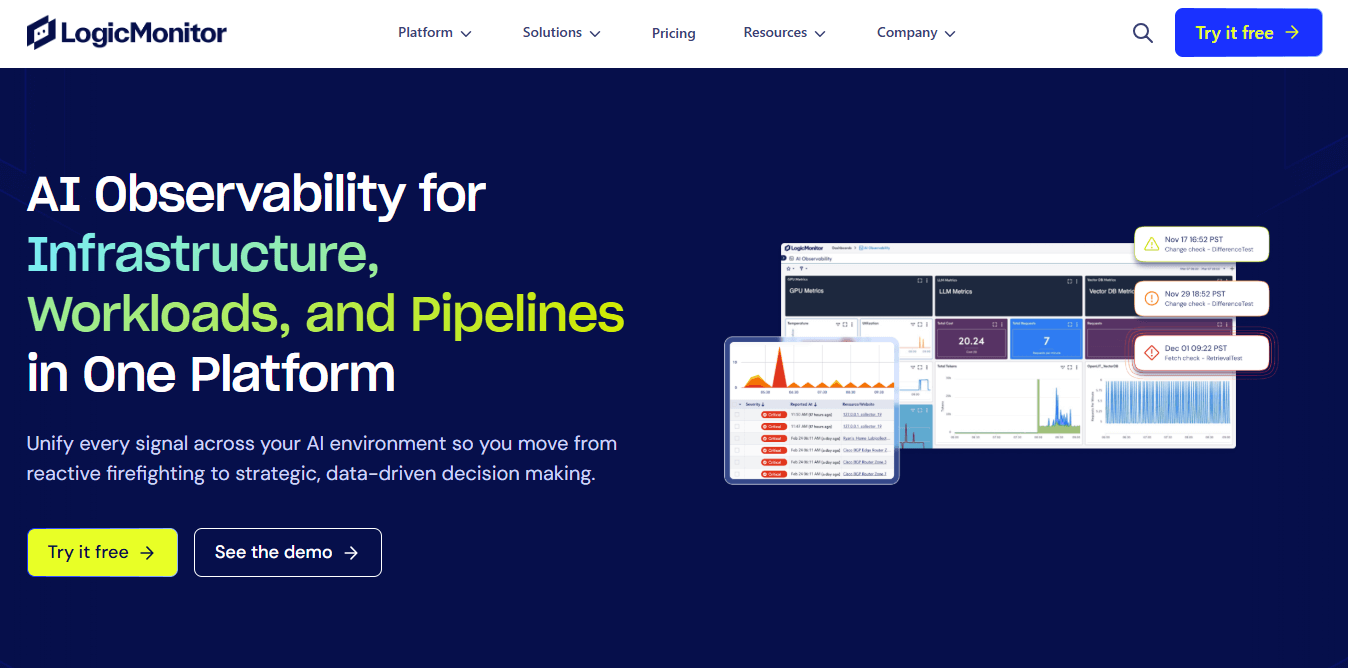
A hybrid observability platform with AI monitoring for GPUs, LLMs, and APIs, plus AIOps for noise reduction, incident correlation, and cost tracking.
Best for: Platform, SRE, and infrastructure teams that need unified monitoring of edge hosts, GPUs, Kubernetes, LLM APIs, and WAN dependencies.
Key Features:
- Full-stack visibility for AI workloads, including Nvidia GPU metrics and LLM API telemetry, covered by channel and trade press.
- Out-of-the-box monitoring packs for OpenAI usage, latency, and cost to manage LLM spend, per public documentation.
- Agentic AIOps that correlates events and cuts alert noise, with results cited by customer case write-ups.
- Expanding scope via acquisitions and integrations, such as Catchpoint for internet and digital experience monitoring.
Why we like it: In mixed edge and cloud estates, LogicMonitor helps teams watch GPU health, LLM costs, and service dependencies in one place, which shortens mean time to resolve.
Notable Limitations:
- G2 reviewers frequently note complexity and a learning curve for advanced customization and data sources, along with alert tuning effort.
- Some AI monitoring features and higher data volumes can increase spend, and several capabilities come as add-ons, as discussed in competitive comparisons.
Pricing: Public per-unit pricing and marketplace offers are available. Competitive blogs cite tiered pricing starting at $16 per hybrid unit, and AWS Marketplace lists package pricing, for example an Enterprise package offer and optional add-ons. See third-party mentions such as Atera's comparison and offers on AWS Marketplace. For features that target AI workloads, see coverage from CRN and community documentation for monitoring OpenAI.
Edge AI Monitoring Tools Comparison: Quick Overview
| Tool | Best For | Pricing Model | Highlights |
|---|---|---|---|
| Avassa for Edge AI | Application-centric orchestration and monitoring across many sites | Enterprise contract | App and OS lifecycle, GPU awareness, VM support |
| ClearBlade | Industrial IoT operations with on-site AI and no-code automation | Enterprise contract | Intelligent Assets, edge analytics, offline resilience |
| Lumana Video Intelligence Platform | Real-time behavioral video monitoring on existing cameras | Enterprise contract | Camera-agnostic AI, incident response, fast search |
| LogicMonitor AI Monitoring | Unified GPU, LLM, API, and edge infra monitoring | Tiered packages and marketplace offers | GPU metrics, LLM cost tracking, AIOps correlation |
Edge AI Monitoring Platform Comparison: Key Features at a Glance
| Tool | AI Workload Visibility | Offline / Edge Autonomy | Video Analytics Capability |
|---|---|---|---|
| Avassa | Binds models to local accelerators, app-centric health | Yes, site-level autonomy and OS upgrades | Via partner apps on the platform |
| ClearBlade | Edge inferencing and anomaly detection components | Yes, designed for intermittent links | Intelligent Video Analytics module |
| Lumana | Video events, behavior, and search at scale | Hybrid design with local processing | Core strength, camera-agnostic |
| LogicMonitor | GPU metrics, LLM APIs, vector DBs, Kubernetes | Collectors run on-prem, SaaS control plane | Integrates with third-party probes |
Edge AI Monitoring Deployment Options
| Tool | Cloud API | On-Premise | Integration Complexity |
|---|---|---|---|
| Avassa | Control plane can be hosted | Yes, supported patterns for offline sites | Medium, application-centric |
| ClearBlade | Yes | Yes, often used in restricted networks | Medium, no-code plus dev options |
| Lumana | Cloud plus edge nodes | Yes, for VMS components | Low to Medium for camera fleets |
| LogicMonitor | SaaS control, on-prem collectors | Yes, via collectors (limited air-gapped) | Medium to High for large estates |
Edge AI Monitoring Strategic Decision Framework
| Critical Question | Why It Matters | What to Evaluate |
|---|---|---|
| Do you need days of offline operation? | Stores, plants, and vehicles lose links | Local rules, buffering, bidirectional sync |
| How will you manage model versions at 1000 sites? | Drift and rollbacks drive outcomes | Staged rollouts, site targeting, audit trails |
| What GPU and LLM telemetry do you need? | Cost and performance hinge on this | Per-GPU health, token and latency metrics |
| Can you reuse existing cameras? | Saves capex and avoids vendor lock-in | Camera-agnostic analytics, hybrid VMS |
Edge AI Monitoring Solutions Comparison: Pricing and Capabilities Overview
| Organization Size | Recommended Setup | Notes on Cost Visibility |
|---|---|---|
| Mid-market with 50-200 sites | Avassa or ClearBlade for on-site autonomy, LogicMonitor for GPU and LLM monitoring, Lumana if video is core | Most vendors quote custom pricing. LogicMonitor has public packages and marketplace offers. |
| Enterprise with 200-2000 sites | Avassa or ClearBlade as the edge control plane, LogicMonitor across cloud and data centers, Lumana for security operations | Budget by number of sites, cameras, GPUs, and data volumes. Treat directory price points as directional only. |
| Regulated or air-gapped sites | ClearBlade or Avassa for local autonomy and sync policies | Confirm deployment and compliance models during proof-of-concepts. |
Problems & Solutions
-
Problem: Edge sites drop connectivity, causing data gaps and missed incidents.
Solution: ClearBlade's platform is designed for offline continuity with synchronization to cloud and enterprise tools, a pattern highlighted in developer documentation and industry coverage. Its Intelligent Video Analytics runs on legacy cameras to reduce bandwidth and keep detection local. ClearBlade added Forecasting AI to help operators predict issues directly at the edge. -
Problem: Managing model versions and updates across hundreds of stores or factories.
Solution: Avassa focuses on application and OS lifecycle at the edge with placement policies, health monitoring, and upgrades built in. Partnerships with industrial Linux vendors validate deployment at scale. Analyst notes also recognize Avassa in edge orchestration landscapes, which supports its fit for broad rollouts. -
Problem: AI workloads are opaque, GPU bottlenecks and LLM costs go unnoticed until bills or outages.
Solution: LogicMonitor added AI workload monitoring and agentic AIOps to its platform, including Nvidia GPU metrics and expanded AI stack coverage. OpenAI monitoring packs provide usage and cost insights for LLM calls, per public documentation. Marketplace listings provide contract transparency for some offers. -
Problem: Video analytics projects stall due to rip-and-replace camera costs and slow incident response.
Solution: Lumana is covered as transforming existing IP cameras into intelligent sensors with behavioral detection and real-time response, reported when it emerged from stealth and as it surpassed 50,000 cameras managed. For policy context that teams must consider, regulators and media continue to scrutinize AI video systems.
The Bottom Line on Edge AI Monitoring
Edge AI is scaling fast with dollars to match. IDC's outlook shows edge services climbing toward $380 billion by 2028, with AI workloads a key driver, per Computer Weekly's summary of IDC. If your priorities are application-centric control at the edge, Avassa and ClearBlade give you resilient on-site monitoring and operations that survive poor links. If your challenge is GPU saturation, runaway LLM costs, or chasing root cause across hybrid environments, LogicMonitor adds the observability and AIOps you need. For camera-first monitoring, Lumana can turn a camera fleet into a proactive safety and operations signal, backed by reported customer growth in press articles.
Choose the platform that aligns with your operations reality, not just a feature grid. Start with a proof of value at two or three sites, measure alert precision and rollback speed, and only then scale.