

Most teams discover their EV charging bottlenecks during the first utility bill cycle after installing chargers, not from the vendor's demo. Working across different tech companies, we have seen the same traps - like failing to map demand charges to load limits, delaying OCPP 1.6J to 2.0.1 migrations, and skipping OCPI roaming tests. You think you know your costs until the first peak coincides with a fleet return, then operations and finance collide. Interoperability is now table stakes, since U.S. NEVI rules require chargers to conform to OCPP 2.0.1 and networks to support OCPI 2.2.1 for interoperability, per the federal regulation in 23 CFR 680.108. Global charging continues to scale, with China holding roughly 65 percent of public charge points at the end of 2025, and the global public stock reaching over 7 million chargepoints, according to the IEA's latest charging chapter in the Global EV Outlook 2026.
You will see where each option fits, what it really takes to deploy, and how to avoid the pitfalls that cause surprise demand charges and downtime. For context, the United States had over 242,000 public LDV charging points by end of 2025, and the IEA projects that global public charging capacity will need to grow roughly sixfold by 2035 to match EV fleet expansion, which raises the stakes for choosing the right charge management stack.
NeoCharge App
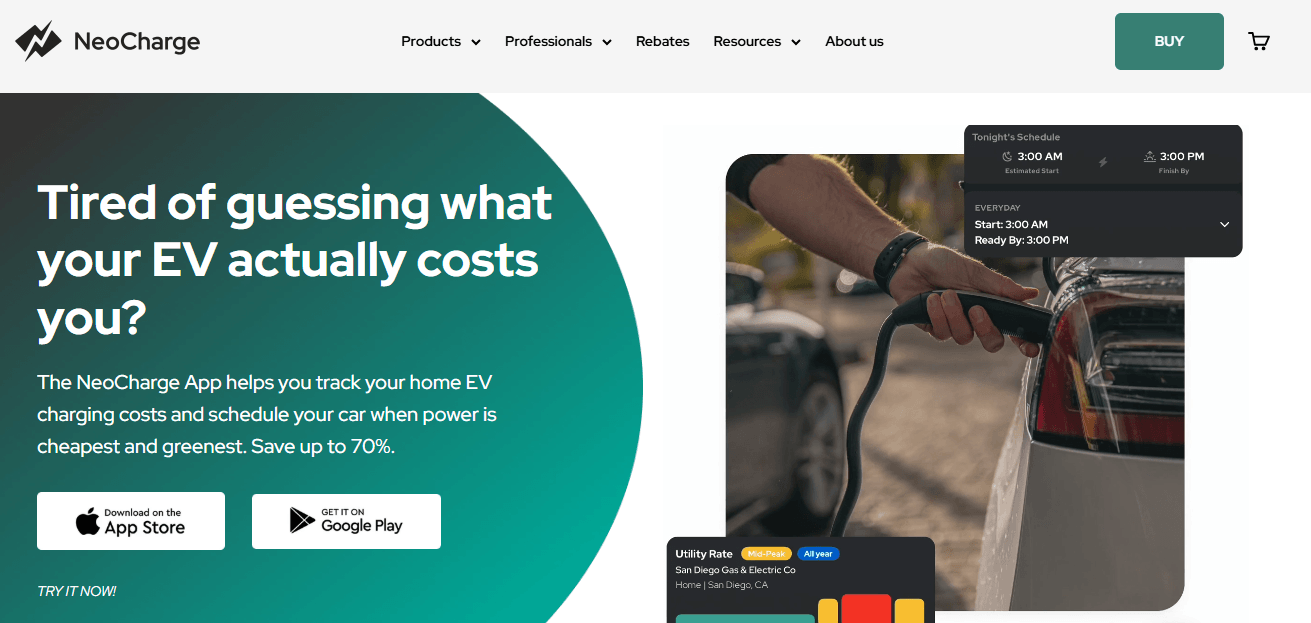
Home charging automation that syncs with utility rate plans and schedules sessions for lowest cost. Works with many EVs and several Level 2 chargers, per vendor documentation and the iOS listing.
Best for: Homeowners and small multi-EV households that want utility-synced scheduling and cost tracking.
Key Features:
- Utility rate syncing and off-peak scheduling, as described in the iOS listing for the app's Time-of-Use support in the App Store.
- Multi-vehicle energy and cost reports, per the same listing.
- Smart Splitter power sharing for two Teslas and real-time power visibility, per vendor documentation.
Why we like it: The biggest residential savings come from aligning charging with TOU windows and solar surplus. NeoCharge makes that practical without new wiring in many homes.
Notable Limitations:
- App reliability and setup complexity are recurring themes in user feedback on the App Store and on third-party review aggregators like JustUseApp.
- Brand-specific integration quirks are documented in help content and reflected in user reviews.
Pricing: Free to download with in-app purchases per the App Store listing. No public page disclosing premium tier pricing, so treat advanced feature costs as "Pricing not publicly available."
Killswitch
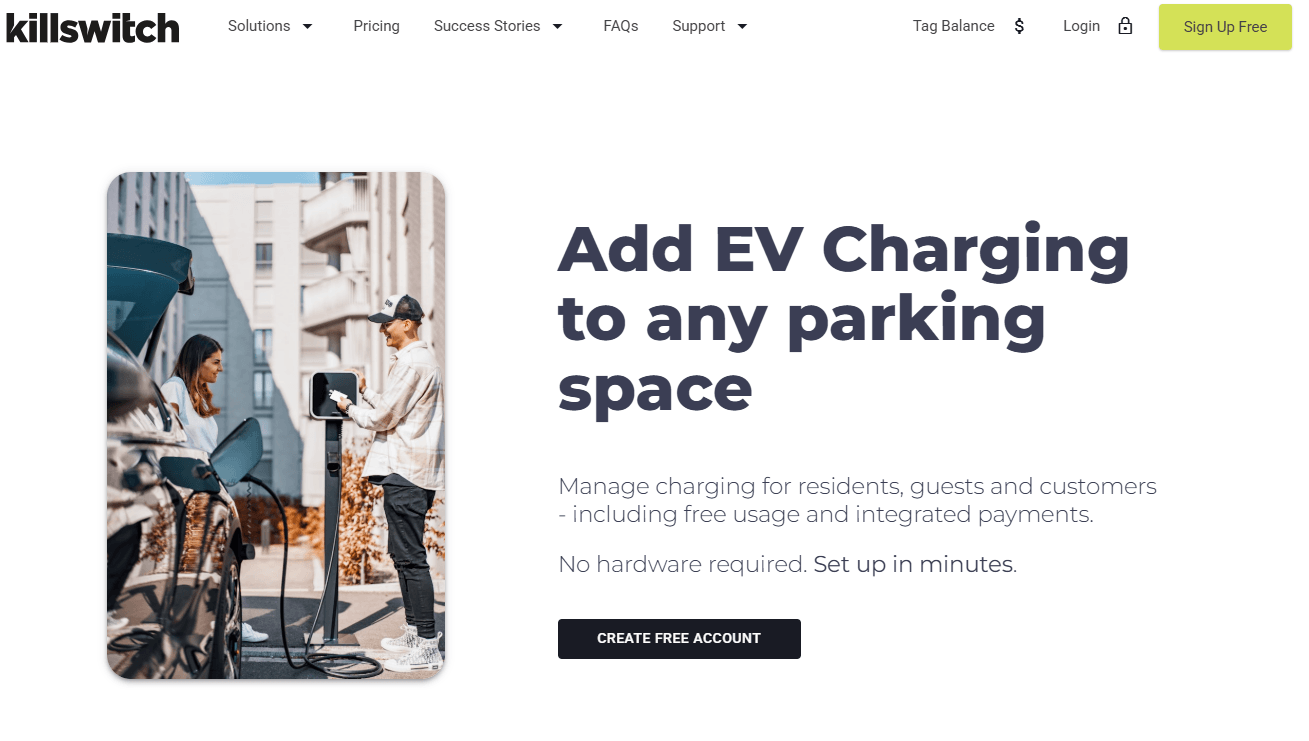
Hardware-agnostic charger management and integrated payments with QR, RFID, and scan-to-charge flows, per vendor documentation. Targets simple rollout for public or private sites.
Best for: Property managers, hospitality, small CPOs that want fast scan-to-charge deployment and basic OCPP management.
Key Features:
- QR scan-to-charge checkout and optional RFID support, per vendor documentation and product summaries on G2.
- Works with OCPP-capable chargers and can gate access and pricing rules, per vendor documentation.
- No subscription claims and pay-as-you-go payment processing referenced on G2.
Why we like it: We prioritize low-friction payments and a short path to revenue. Killswitch makes it easy to charge for kWh or time without forcing driver app installs.
Notable Limitations:
- Very limited independent reviews, as shown by the 0-review status on G2, so buyers should run pilots before standardizing.
- QR-only payment flows can face fraud risks from malicious stickers, a problem documented in community reports and news - for example posts warning about fake QR decals at public chargers on Reddit and coverage of public charging headaches on TechSpot.
Pricing: The tool is listed as free to use with pay-as-you-go pricing on G2. Transaction fees and payout terms are not detailed publicly, so confirm in contract.
SortGrid
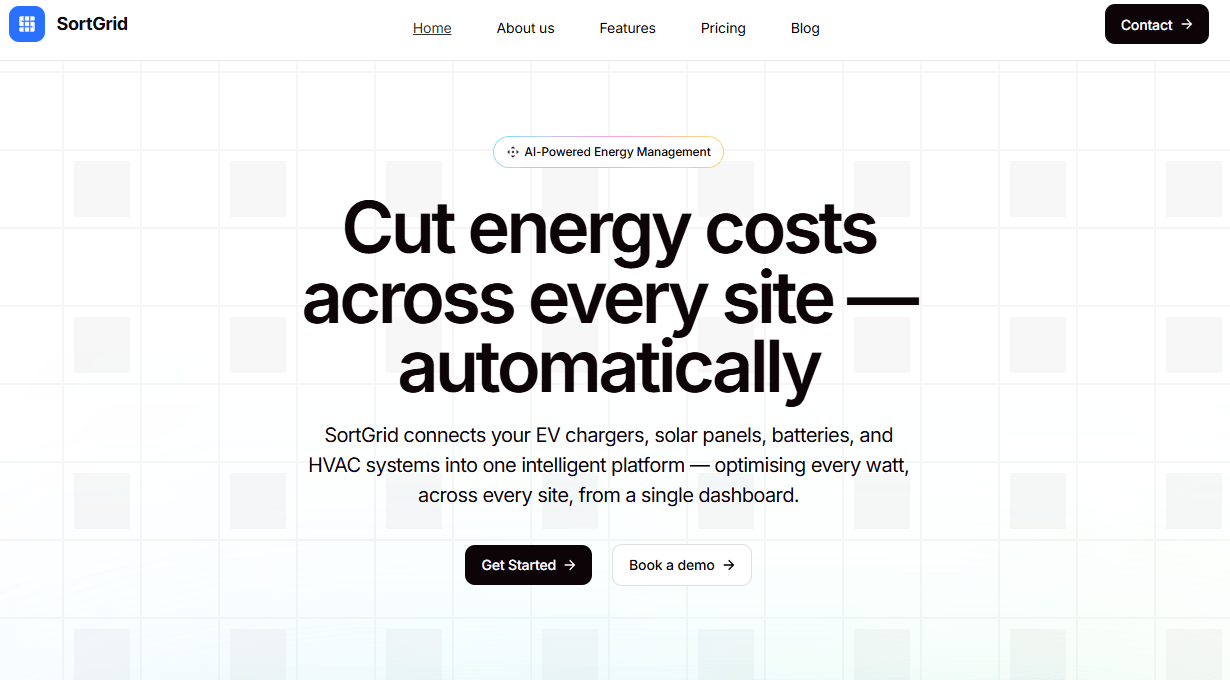
AI-powered multi-site energy platform that unifies EV charging with solar, storage, and HVAC for portfolio-level optimization, per vendor documentation.
Best for: Multi-site businesses that need to coordinate EV charging with DERs across buildings, with a focus on tariff, solar, and battery dispatch.
Key Features:
- Single dashboard for EV chargers, solar, storage, and HVAC with optimization against tariffs and forecasts, per vendor documentation.
- Multi-site orchestration that shifts charging to off-peak and solar-rich hours, per vendor documentation.
- Analytics for cost, CO2, and site-level KPIs, per vendor documentation.
Why we like it: The cost drivers in 2026 are portfolio scale, not just individual depots. A platform that coordinates HVAC load, solar export, and EV charging can materially reduce peaks, which aligns with research showing large demand reductions from building-EV co-optimization in peer-reviewed studies like a 2025 office-building analysis in Transportation Research Part D.
Notable Limitations:
- Few or no independent, third-party reviews as of June 2026. Treat performance claims as unverified and request a measured pilot with metered baselines.
- Integrations across HVAC, PV, and BESS can be complex and data-quality sensitive, a general challenge echoed in grid-integration research such as the V2B2G study in Building Simulation.
Pricing: Pricing not publicly available. Request a custom quote and a fixed-fee pilot with shared savings or KPI-based acceptance criteria.
Solidstudio CPMS

Enterprise-grade charge point management system with OCPP and OCPI integrations, real-time controls, analytics, and smart charging features, per vendor documentation.
Best for: CPOs, fleets, and utilities that require conformance-tested OCPP backends and roaming via OCPI.
Key Features:
- Certified OCPP 1.6J and 2.0.1 CSMS, documented by an Open Charge Alliance certificate for Solidstudio CPMS in 2025 - see the OCA's published certificate list at the OCA PDF. Independent coverage by EV Magazine also confirms full certification for both protocol versions.
- OCPI gateway and roaming support, per vendor documentation and industry practice.
- Advanced monitoring and anomaly detection capabilities, including AI-driven self-healing features per independent coverage.
Why we like it: NEVI compliance and backend portability matter. The federal rule explicitly requires OCPP 2.0.1 and OCPI 2.2.1 interoperability, and a CSMS with OCA certificates for both 1.6J and 2.0.1 reduces technical risk during onboarding and switching.
Notable Limitations:
- Enterprise implementations require careful charger configuration and certificate management, which can extend timelines. OCPP deployment complexity is a known industry issue, discussed in practitioner threads like those in the OCPP developer community on Reddit.
- Public pricing is limited, and total cost depends on roaming, analytics, and support SLAs.
Pricing: Pricing not publicly available. Solidstudio offers a licensing and ownership model rather than the standard per-charger SaaS approach. Contact Solidstudio for a custom quote.
EV Charge Management Platforms Comparison: Quick Overview
| Tool | Best For | Pricing Model | Highlights |
|---|---|---|---|
| NeoCharge App | Homeowners and small multi-EV households | App with in-app purchases | Utility-synced scheduling, cost tracking |
| Killswitch | Small CPOs, hospitality, property managers | Pay-as-you-go processing | QR, RFID, scan-to-charge with OCPP support |
| SortGrid | Multi-site businesses with DERs | Custom quote | AI scheduling across EV, solar, storage, HVAC |
| Solidstudio CPMS | CPOs, fleets, utilities | Custom quote, licensing model | OCA-certified OCPP 1.6J and 2.0.1 CSMS with OCPI gateway |
EV Charge Management Platforms: Key Features at a Glance
| Tool | Standards | Payments | Analytics |
|---|---|---|---|
| NeoCharge App | EV cloud integrations, TOU alignment | N/A, home use focus | Session cost and energy reports |
| Killswitch | OCPP backend connectivity | QR, RFID, card wallets | Basic session and device reporting |
| SortGrid | OCPP device control, DER integrations | Supports commercial billing stacks | Portfolio KPIs, tariff and forecast driven |
| Solidstudio CPMS | OCPP 1.6J and 2.0.1 CSMS, OCPI roaming | Supports CPO billing integrations | Advanced monitoring and anomaly detection |
EV Charge Management Platforms: Deployment Options
| Tool | Cloud API | On-Premise | Integration Complexity |
|---|---|---|---|
| NeoCharge App | Yes | No | Low, homeowner setup |
| Killswitch | Yes | No | Low to medium, OCPP pointing plus QR/RFID |
| SortGrid | Yes | Possible by request | Medium to high, multi-system DER links |
| Solidstudio CPMS | Yes | Yes | Medium, charger certs and roaming setup |
EV Charge Management Platforms: Strategic Decision Framework
| Critical Question | Why It Matters | What to Evaluate | Red Flags |
|---|---|---|---|
| Do you need NEVI-compliant open standards? | Federal funds and interoperability require OCPP 2.0.1 and OCPI 2.2.1 | Check OCPP conformance certificates and OCPI version support | Proprietary backends without switching paths |
| How exposed are you to demand charges? | Demand charges can dominate site OPEX | Load limits, peak-shaving logic, tariff modeling | No demand charge modeling or alerts |
| Will you coordinate EV, solar, storage, and HVAC? | Co-optimization drives cost and CO2 down | DER integrations, forecast accuracy, control loops | Manual exports, no forecast-driven dispatch |
| How will drivers pay? | Payments drive adoption and revenue | QR, RFID, wallet support, receipts, refunds | QR only, no fraud mitigation features |
EV Charge Management Platforms: Pricing and Capabilities Overview
| Organization Size | Recommended Setup | Monthly Cost | Annual Investment |
|---|---|---|---|
| Home or duplex | NeoCharge App plus Smart Splitter if needed | App free to start, hardware optional | Pricing varies by hardware, app IAPs not publicly listed |
| Small site, hospitality | Killswitch with QR and optional RFID | Pay-as-you-go per G2 listing | Confirm processing fees and settlement terms |
| Multi-site retail | SortGrid with EV, PV, BESS orchestration | Custom | Custom, request KPI-based pilot |
| CPO or fleet | Solidstudio CPMS with OCPI roaming | Custom | Custom, include certification and SLAs |
Problems & Solutions
Problem: Time-of-use rates and dynamic prices shift daily, so unmanaged home charging overpays. Field experiments show EV charging is highly flexible when given price signals, which helps move load off-peak, per a 2025 study in the American Economic Journal: Economic Policy.
Solution: NeoCharge aligns charging windows to your actual tariff and off-peak periods, reducing bills without new wiring, as reflected in its rate-aware features.
Problem: Public charger payments are fragmented, and scan-to-charge can be abused via fake QR stickers. Industry reports and user accounts document QR scams and payment friction at public chargers.
Solution: Killswitch supports QR and RFID, letting sites mix app-less payments with controlled RFID access. Pair QR with visible anti-tamper decals and staff checks, and keep RFID as a backup for regular users.
Problem: Multi-site portfolios see peaks from EV loads colliding with HVAC and poor solar self-consumption. Research shows building-EV co-optimization can reduce peaks and bills, such as office charging models responding to TOU tariffs and urban V2B2G controls.
Solution: SortGrid coordinates EV, solar, storage, and HVAC to flatten peaks and shift charging to cleaner or cheaper hours. Require a metered pilot with tariff-matched KPIs before rollout.
Problem: Interoperability and funding compliance. U.S. rules under NEVI require OCPP 2.0.1 for charger-to-network communication and OCPI 2.2.1 for network-to-network roaming, and public charging is scaling fast with changing standards.
Solution: Solidstudio CPMS brings a conformance-tested OCPP backend certified for both 1.6J and 2.0.1, plus an OCPI roaming gateway, validated by Open Charge Alliance certificates.
Bottom Line
Choose the platform that matches where your costs actually accrue. If most miles are at home, a rate-aware app can deliver outsized savings with minimal effort. If you monetize guest charging, prioritize payment flexibility and fraud controls, not just QR codes. If you manage many sites, co-optimize EV charging with solar, storage, and HVAC - integrated strategies can materially cut peaks and emissions, as shown in building-EV co-optimization studies. For funded public deployments and fleet networks, anchor on open standards and certifications, because NEVI explicitly calls for OCPP 2.0.1 and OCPI 2.2.1, and the IEA projects substantial growth in public charging through 2035 with the global stock needing to expand roughly sixfold to keep pace with EV fleet expansion.