
You think you know Government ERP is "just finance," until the first utility-billing reconciliation collides with GASB 87 leases, grant subledgers, and procurement audit trails. Working across different tech companies, we have learned the biggest mistakes happen when teams underestimate data conversion complexity, StateRAMP and FedRAMP requirements, and integrations like ESRI GIS or payment gateways. Government and education IT spending is forecast to reach roughly $787 billion in 2025 and to exceed $1.1 trillion by 2029, which explains the flood of options and noise you face during selection, per Gartner's sector forecast. Gartner forecast.
OpenGov Public Service Platform
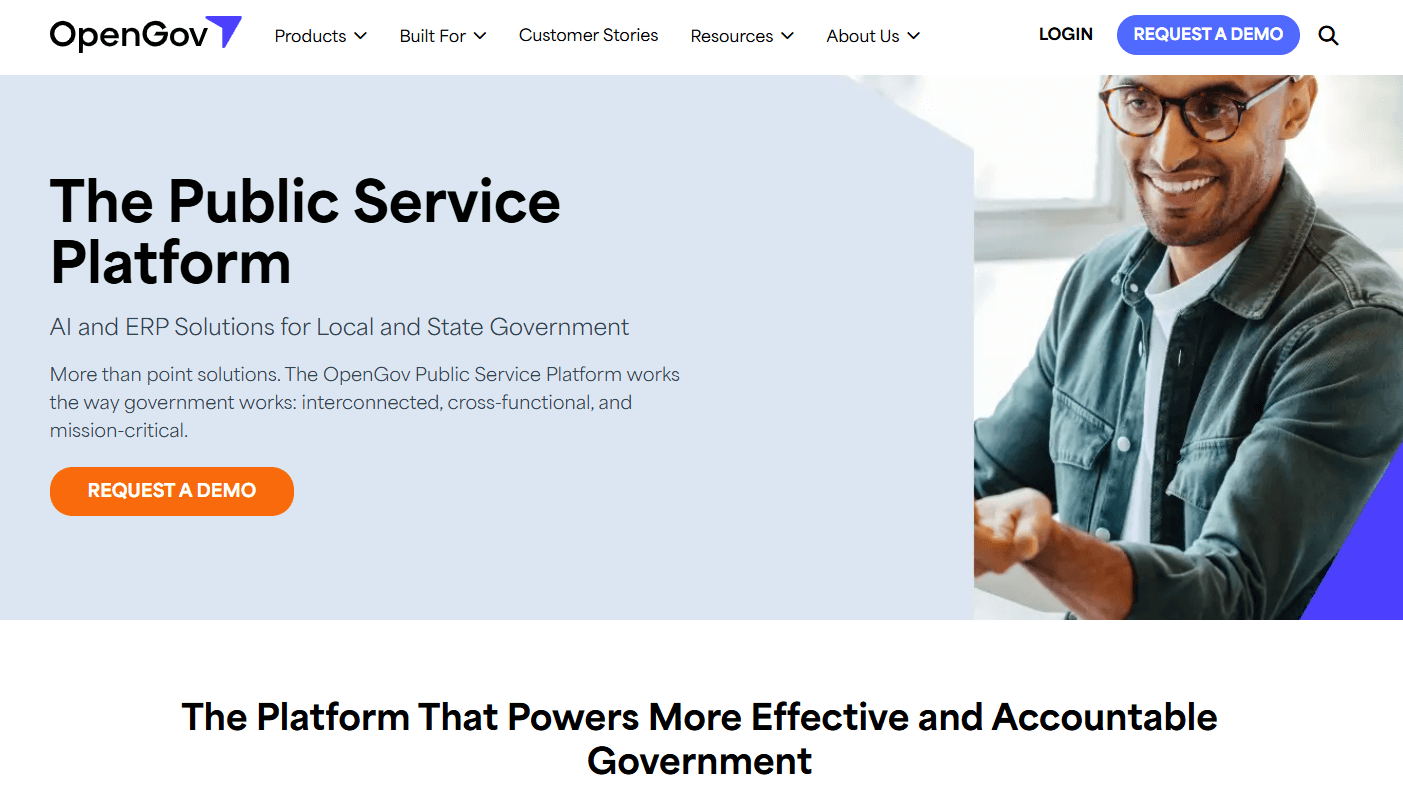
A cloud ERP built for SLED agencies that connects financials, procurement, permitting, asset management, and revenue in one platform. Designed for local and state governments, not retrofitted from commercial ERP.
- Best for: Cities, counties, and special districts that want an integrated, cloud-native suite for budgeting, accounting, procurement, permitting, and work orders.
- Key Features: Fund accounting and reporting, procurement and contract management, permitting and licensing, enterprise asset management, utility billing and revenue.
- Why we like it: Purpose-built modules lower configuration risk versus adapting private-sector ERP, and the suite spans citizen-facing workflows that usually sit outside finance.
- Notable Limitations: Reviews cite advanced reporting complexity in asset management, occasional rough edges on third-party integrations, and inconsistent responsiveness from sales or support. See user feedback on G2's OpenGov pages and additional comments on procurement.
- Pricing: Pricing not publicly available. Public contracts show wide variance by scope, for example the City of Savannah approved $309,750 for year-one OpenGov software licensing and maintenance for budgeting and performance, with scheduled increases in out-years. See the city's agenda item for details.
Infor CloudSuite Public Sector
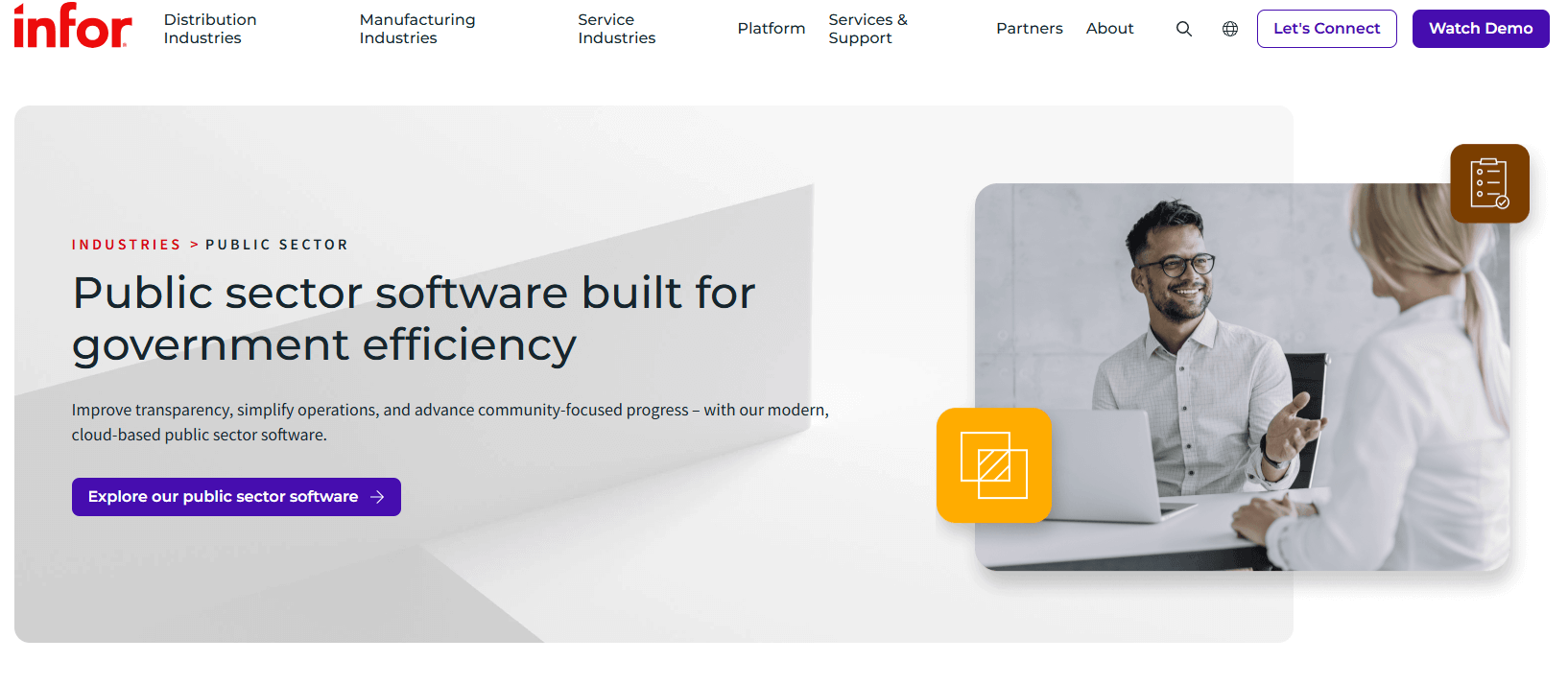
A multi-suite ERP for finance, procurement, HCM, asset and work management, and community development, delivered in the cloud and used by large state programs.
- Best for: States, large cities, and agencies standardizing on cloud ERP with options aligned to FedRAMP and active participation in GovRAMP, plus deep asset and work-management needs.
- Key Features: Cloud ERP for finance and procurement, HCM and payroll, asset and work management, community development and billing, analytics and iPaaS integrations.
- Why we like it: Proven at statewide scale, for example Idaho's Luma program unifying 85 agencies on Infor public sector cloud applications in a FedRAMP environment.
- Notable Limitations: Peer reviews mention complexity in absence management, documentation gaps, and integration effort, along with price sensitivity for smaller buyers. See consolidated user commentary.
- Pricing: Pricing not publicly available. An AWS Marketplace listing shows a 12-month CloudSuite contract at $1,000,000 as an example offer, separate from AWS infrastructure costs. Always request a formal quote and scope. Security note: Infor Government Solutions appears on the GovRAMP (formerly StateRAMP) Authorized Product List as "In Process," and Infor has public FedRAMP-related announcements for specific offerings. Verify current status during due diligence.
Tyler Technologies Enterprise ERP (Munis)
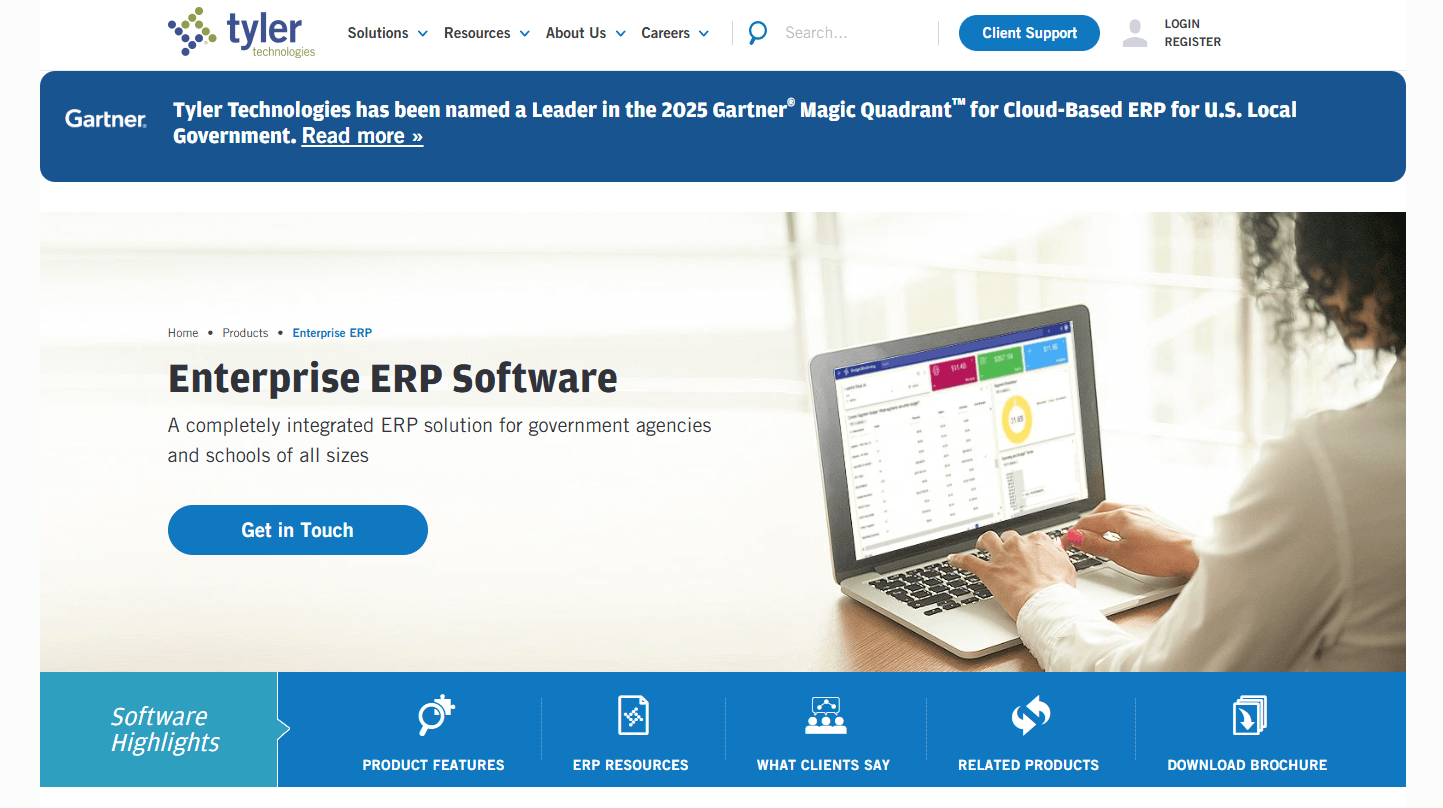
A long-standing public sector ERP covering financials, HR and payroll, procurement, utility billing, and citizen services, with broad adoption across U.S. local government.
- Best for: Cities and counties prioritizing utility billing, revenue and tax, payroll, and core financials with an extensive installed base and partner ecosystem.
- Key Features: Fund accounting and reporting, HR and payroll, procurement, utility billing and revenue, self-service and citizen portals.
- Why we like it: Recognized in the inaugural 2025 Gartner Magic Quadrant for Cloud-Based ERP for U.S. Local Government, with Enterprise ERP positioned as a Leader. This reflects product depth in local government use cases like utility billing and citizen services.
- Notable Limitations: Public reviews frequently cite implementation and change-management challenges, heavy customization, and support responsiveness variability. See aggregated feedback including utility-billing pain points and training burden.
- Pricing: Pricing not publicly available. Recent public approvals illustrate variability by scope, such as a Pacific Northwest city's five-year not-to-exceed ERP award around $2.76 million and a California city's annual subscription near $125,000 with a one-time implementation about $417,000. Always validate against your modules and data-conversion effort.
Unit4 ERPx
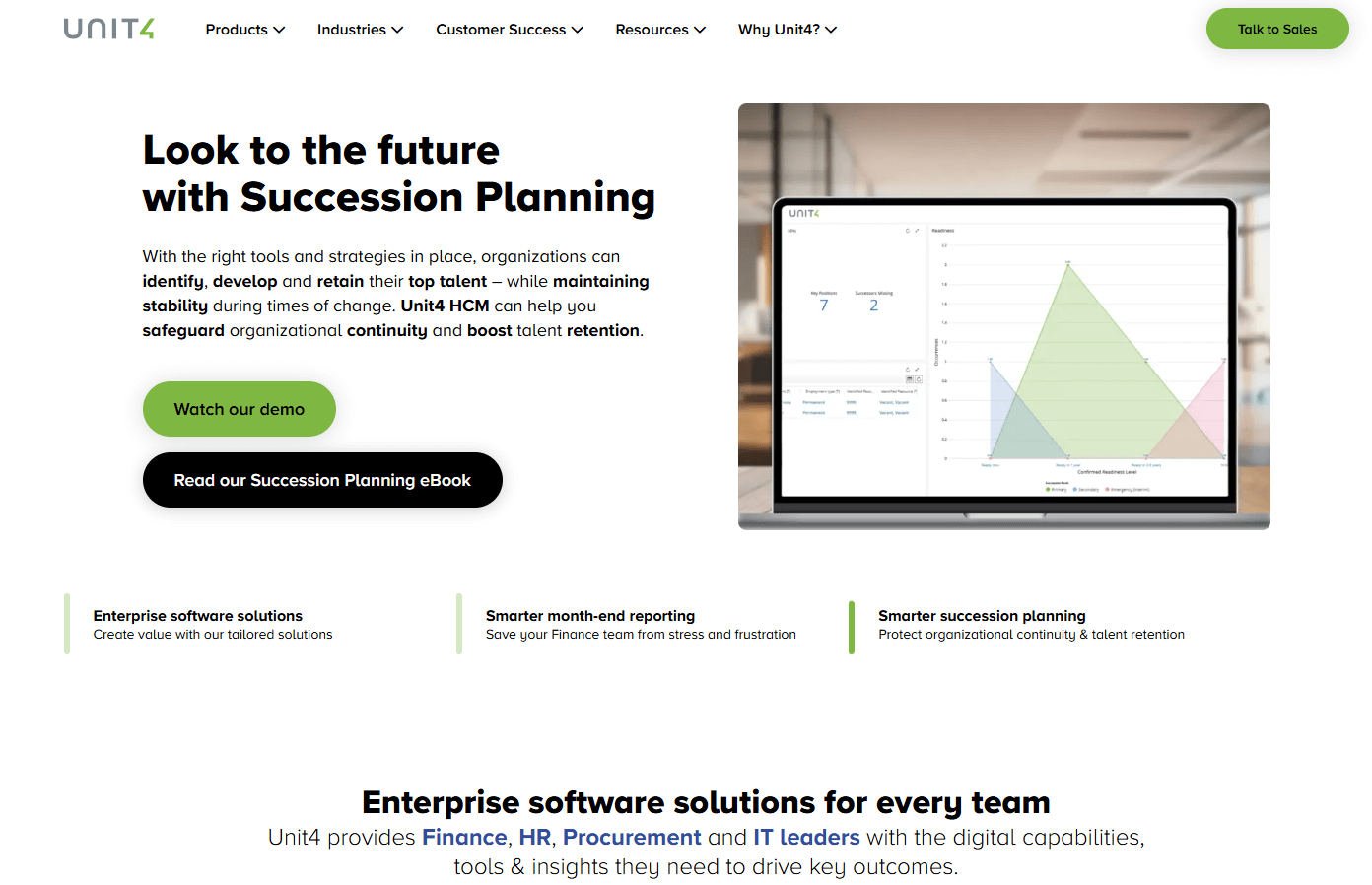
A people-centric, cloud-native ERP focused on finance, projects, procurement, and HR for public service, education, nonprofits, and professional services. Runs on Azure with a modular approach.
- Best for: Public service organizations and NGOs that are project-driven with services-heavy operations and want modern SaaS on Azure.
- Key Features: Financial management, procurement, project and grant accounting, HR and people experience, FP&A, extensibility via low-code tools.
- Why we like it: Cloud-native architecture and strong project-finance orientation fit agencies and NGOs that measure outcomes by programs, not SKUs.
- Notable Limitations: Reviews point to a learning curve and occasional performance or usability complaints, especially during early adoption or when heavily customized. See user feedback.
- Pricing: Pricing not publicly available. ERPx is positioned as SaaS only, and third-party reporting confirms Unit4's shift away from on-prem support after 2024, which affects deployment options and migration planning.
Government ERP Tools Comparison: Quick Overview
| Tool | Best For | Pricing Model | Highlights |
|---|---|---|---|
| OpenGov Public Service Platform | Cities, counties, special districts | Subscription, multi-module | Purpose-built suite spanning budgeting, financials, procurement, permitting, and EAM, with mixed feedback on integrations and reporting. |
| Infor CloudSuite Public Sector | States and large cities | Enterprise subscription | State-scale deployments with FedRAMP-aligned options, GovRAMP participation, broad suite depth across finance, HCM, and assets. |
| Tyler Enterprise ERP (Munis) | Cities and counties | Subscription | Recognized in Gartner's MQ for U.S. local government, strong utility billing and revenue modules, implementation diligence required. |
| Unit4 ERPx | Public service and NGOs | Subscription | Cloud-native on Azure, project-centric finance and FP&A, cloud-only roadmap. |
Government ERP Platform Comparison: Key Features at a Glance
| Tool | Finance and Procurement | HR/Payroll | Asset or Work Mgmt |
|---|---|---|---|
| OpenGov | Fund accounting, eProcurement | Payroll | Enterprise Asset Management |
| Infor CloudSuite Public Sector | Financials, Procurement | HCM and Payroll | Asset and Work Management |
| Tyler Enterprise ERP (Munis) | Financials, Procurement | HR and Payroll | Work/Asset options |
| Unit4 ERPx | Financials, Procurement | HR/People Experience | Project resource focus |
Government ERP Deployment Options
| Tool | Cloud API | On-Premise | Integration Complexity |
|---|---|---|---|
| OpenGov | Yes | Not typical | Moderate, reviewers cite integration friction in places. |
| Infor CloudSuite Public Sector | Yes | Cloud-first for this suite | Moderate-High, user reviews note configuration depth. |
| Tyler Enterprise ERP (Munis) | Yes | Legacy on-prem seen, trend to SaaS | Moderate-High during data conversion and UB rollout. |
| Unit4 ERPx | Yes | No, cloud-only | Moderate, strong APIs on Azure, but change-management needed. |
Government ERP Strategic Decision Framework
| Critical Question | Why It Matters | What to Evaluate |
|---|---|---|
| Do we require GovRAMP or FedRAMP controls? | Many states now align to GovRAMP, and agencies may mandate FedRAMP for certain workloads. | Current authorization status, boundary, and impact level of the vendor's environment. |
| What is our utility billing or revenue complexity? | Utility billing and cashiering drive configuration effort and citizen impacts. | Rate models, back-billing, collections, integrations with payment processors. |
| How much change management can we absorb? | ERP shifts touch every department, training load and cadence matter. | Module go-live phasing, superuser network, training plans, vendor hours in SOW. |
| What security framework will procurement cite? | GovRAMP, modeled on NIST 800-53, gives a reusable baseline and speeds due diligence. | Vendor ATO pathway, continuous monitoring, 3PAO involvement. |
Government ERP Solutions Comparison: Pricing & Capabilities Overview
| Organization Size | Recommended Setup | Investment Range |
|---|---|---|
| Mid-size city seeking budgeting and transparency | OpenGov budgeting and performance modules | Example: $309,750 for year one with scheduled increases, per City of Savannah approval. |
| City replacing legacy Eden financials | Tyler Enterprise ERP financials and HR | Example not-to-exceed five-year award around $2.76M. Validate with official packet during sourcing. |
| State or large enterprise footprint | Infor CloudSuite Public Sector subscription via marketplace | AWS Marketplace shows a 12-month CloudSuite offer at $1,000,000, separate from AWS costs. |
| Services-heavy public organization | Unit4 ERPx cloud subscription on Azure | Pricing not publicly available, confirm in RFP. ERPx is cloud-only, which affects TCO and migration. |
Problems & Solutions
Problem: Security compliance slows procurement. Many jurisdictions now look for GovRAMP, the rebranded StateRAMP program based on NIST 800-53, to standardize vendor assessment and reduce duplicate audits.
- How tools help: Infor offers FedRAMP-aligned environments with public sector references at state scale, and its government cloud appears on the GovRAMP APL as "In Process," which provides an auditable path for SLED buyers. Confirm your exact boundary and impact level during contracting.
Problem: Utility billing and revenue migrations derail timelines. Public comments and review roundups often point to heavy testing needs and data quality issues during cutover.
- How tools help: Tyler's Enterprise ERP has deep UB capabilities and a large installed base, but you should structure parallel runs and mandate explicit vendor UAT hours in the SOW, a lesson underscored by public reviews and council briefings.
Problem: Budgeting and procurement are still spreadsheet-driven, which increases audit and transparency risk.
- How tools help: OpenGov's budgeting and procurement modules centralize workflows and decision histories, and several municipalities have adopted them to support budget transparency portals and eProcurement, as reflected in public meeting records and review sites. Reference contracts and reviews to prioritize reporting and data export in your pilot.
Problem: On-prem ERP stacks are aging out, with vendors focusing innovation on SaaS.
- How tools help: Unit4 ERPx is cloud-native on Azure and third-party reporting confirms the vendor's move away from on-prem support after 2024, which simplifies updates but requires a clear migration plan and data-cleansing window.
Bottom line for Government ERP selection in 2026
Most teams discover ERP risk during data migration and parallel payroll or utility-billing runs, not from glossy demos. Anchor your RFP to verifiable security posture, success metrics for priority modules, and a staffed change-management plan. Government IT spending is expanding, but buyers are scrutinizing outcomes and vendor accountability, which is why independent research like Gartner's new Magic Quadrant and Critical Capabilities for U.S. local government ERP is valuable for shortlists. Close with a pilot that proves reporting, integrations, and user workflows in your environment, then phase rollouts by business impact to avoid costly resets.