

Start with the job you actually need in New York this year: a plant recommendation scored in dollars, a hedge tied to a real shipment, a storefront that changes on the first click, or a private-credit book that closes without a week in Excel. Then confirm the headquarters is still in the city, not a WeWork on the deck. Then check that the team is still under 50 and the last raise names the check. That walk is the filter. A household name with a Manhattan office can wait.
This list is four smaller companies building from New York today: dollar-scored plant recommendations, automated commodity and FX hedges, real-time storefront personalization, and an ops book for private credit. A sales desk in SoHo does not count.
The headquarters had to be confirmable. The last public headcount signal had to sit under 50. The last raise could not be a rumor. The method is on How we review tools. If you are watching the Peninsula, the San Francisco startups page is a different shortlist.
CVector
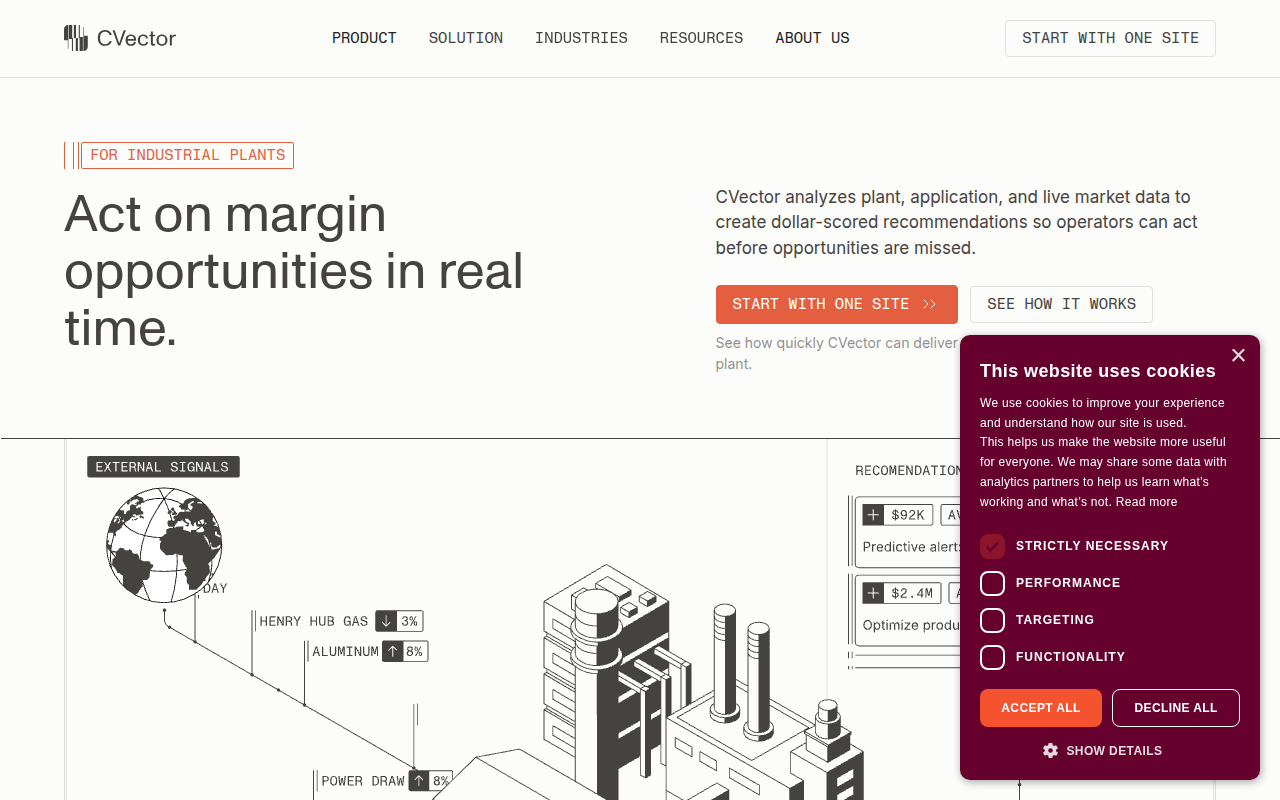
CVector is the plant-margin layer. It reads live equipment, application, and market data, then ranks recommendations in dollars so an operator can act before the window closes. Energy prices move by the hour. Feedstock moves by the day. The homepage job is to make that link visible on the shift, not in a quarterly slide.
The about page still calls CVector a small team headquartered in the Financial District. Jobs are listed on-site in New York. Richard Zhang is co-founder and CEO. Tyler Ruggles is co-founder and CTO. Both names are on the company about page.
Best for: Operators and corporate innovation teams who want industrial AI that scores the next action in dollars, and who will take a FiDi company that is still a small team.
What they sell:
- Continuous analysis of plant telemetry, application data, and external market signals.
- Dollar-scored recommendations with an audit trail of sources and scoring logic.
- Operator review so accepted, rejected, or adjusted calls stay in human control.
- Named modules for plant margin, industrial energy, asset health, and custom model integration. ISO 27001 is on the product site.
Why we like it: Most industrial AI decks sell a dashboard. CVector sells a ranked action and a dollar figure. That packaging is the watch. The company also printed the raise on its own homepage instead of leaving the round to a rumor mill.
Notable limitations:
- Homepage impact ranges (margin, yield, throughput) are company claims. We did not audit them.
- This is a plant deployment, not a self-serve SaaS you turn on after lunch. Confirm the integration path with the team that already owns SCADA and the historian.
- The January 2026 TechCrunch interview put the team at 12. The about page still says small. Confirm the current headcount if team size is the diligence item.
Last raise or stage: $5 million seed, 26 January 2026, led by Powerhouse Ventures, with Fusion Fund, Myriad Venture Partners, and Hitachi Ventures. The company homepage and a company LinkedIn note name the round. Pre-seed was $1.5 million on 24 July 2025, led by Schematic Ventures.
Company LinkedIn: CVector
Pillar

Pillar is the hedging desk for companies that actually ship metal, food, or freight. The product ties a hedge to a specific deal, adjusts when quantities move, and executes across commodity and FX. The legal footer is Stratos Labs Inc. doing business as Pillar Hedging. The firm is a registered CTA and an NFA member. That is not a chatbot with a markets skin.
The about page names Harsha Ramesh as CEO and co-founder and Chinmay Deshpande as CTO and co-founder. It also prints $23 million raised to date. The company LinkedIn page lists New York as headquarters and a team of 13.
Best for: Physical operators who still hedge in a spreadsheet and a broker chat, and who will take a New York CTA instead of a bank desk they cannot get on the phone.
What they sell:
- Transaction-linked hedges that stay tied to the underlying deal.
- Real-time quantity adjustments so the book does not wait for month-end.
- Natural-language workflows on the web app or WhatsApp, then one-click execution.
- A stack the about page describes as analysis through execution, management, and accounting.
Why we like it: The job is narrow and expensive when you get it wrong. Pillar is selling continuous hedges to operators who never had a desk, not another dashboard for people who already have one. That is the packaging to study.
Notable limitations:
- Commodity interest trading involves risk. The company's own disclaimer says so. This is not accounting software with a nicer chart.
- Humans still sit on approvals and large or messy trades. TechCrunch quoted the CEO on that. Do not buy it as a fully lights-out book.
- No public street address. Confirm the contracting entity on the order form if jurisdiction matters.
Last raise or stage: $20 million seed, 14 April 2026, led by Andreessen Horowitz, with Crucible Capital, Gallery Ventures, and Uber CEO Dara Khosrowshahi. The about page says $23 million raised to date, which matches the TechCrunch launch note.
Company LinkedIn: Pillar
Malachyte
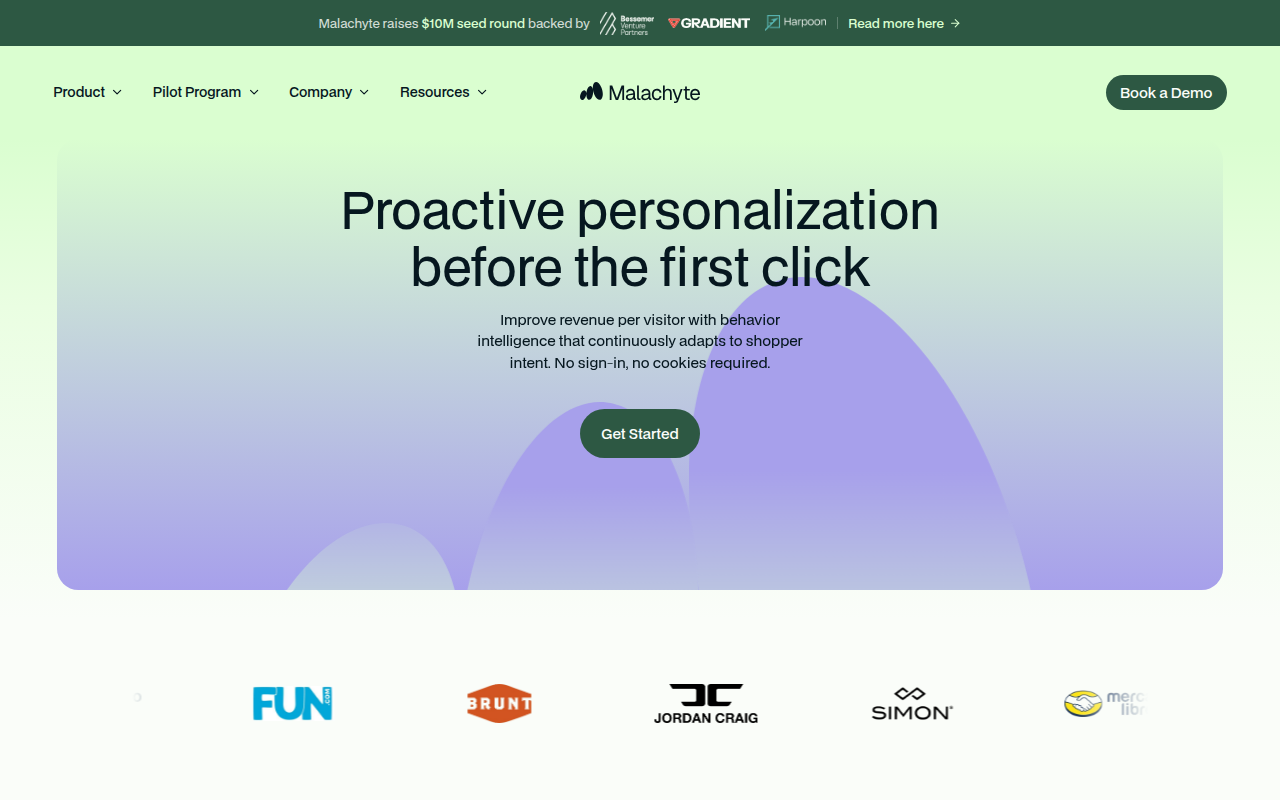
Malachyte is the storefront that changes while the shopper is still on the page. The pitch is a live preference-and-intent profile from the first click, without a login or a cookie pile. Search, recs, and the product page are supposed to share the same read. The company calls that behavior intelligence. The homepage names the $10 million seed and Bessemer, Gradient, and Harpoon.
CEO Sidd Motwani wrote the 6 August 2026 company post with Ian Anderson, CTO, and named Shivaditya Sinha as COO. The company press note and that blog put headquarters in New York. LinkedIn lists the company at 10–20 people.
Best for: Retail and DTC teams whose paid traffic still lands on a generic store, and who want a New York company that shipped the personalization job before it sold a broader AI narrative.
What they sell:
- Real-time personalization across search, recommendations, and product pages.
- A profile that starts from on-page behavior, including first-time and anonymous visitors.
- A merchandiser control layer for rules and overrides, named in the company launch note.
- Shopify for mid-market brands and an API for larger catalogs, per the TechCrunch interview with Motwani.
Why we like it: Most recs engines wait for a purchase history. Malachyte is selling the cold-start session as the product. That is a packaging lesson even if you never buy the product. The raise is on the company blog, not only in a reporter's notebook.
Notable limitations:
- Customer lift figures in the launch note (revenue per visitor, add-to-cart) are company and customer quotes. We did not audit them.
- Sub-200ms and Cyber Monday load claims are also company language. Confirm them in a pilot, not from the press page.
- This is merchandising infrastructure. It will not fix a catalog that is wrong or a brand that has no point of view.
Last raise or stage: $10 million seed, 6 August 2026, co-led by Bessemer Venture Partners and Gradient Ventures, with Harpoon Ventures. The company blog and the company press note agree on the amount, date, and leads.
Company LinkedIn: Malachyte
Ellis
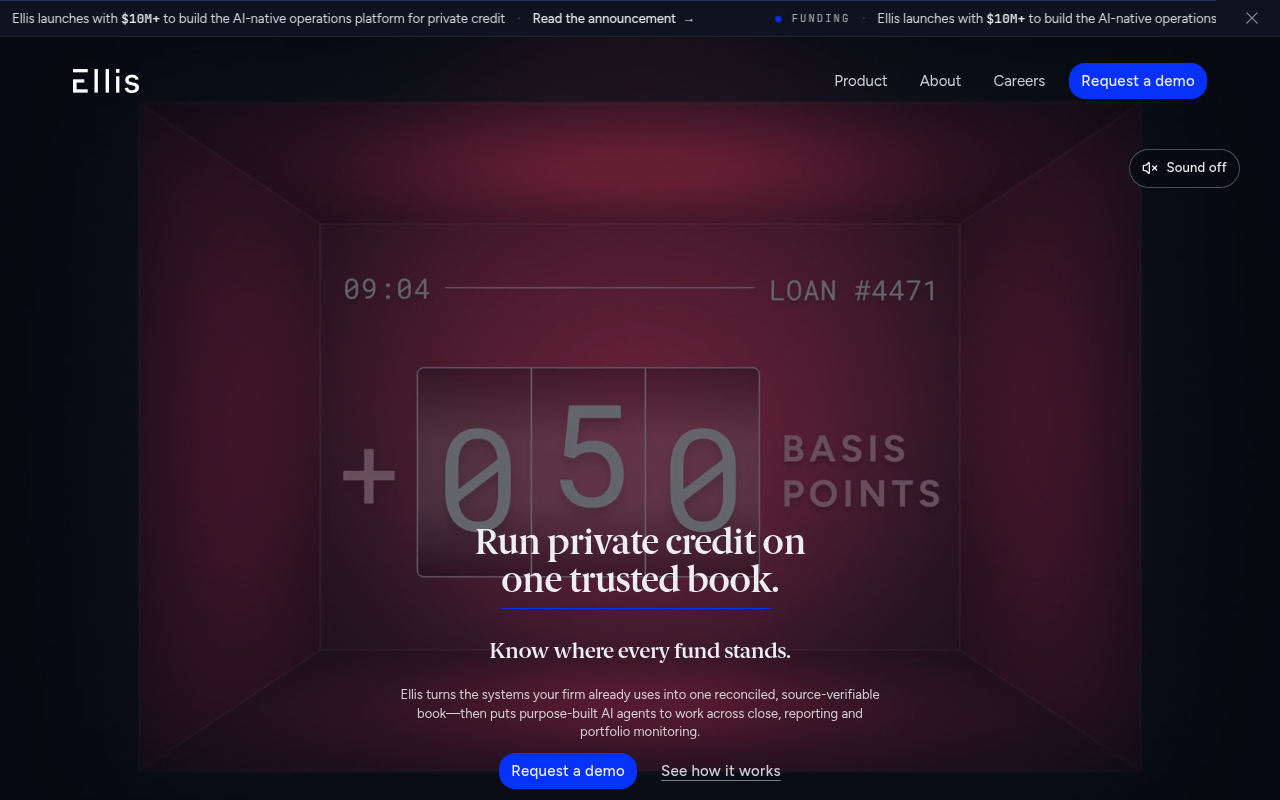
Ellis is the private-credit ops book. Fund admin, general ledger, loan systems, bank feeds, and the spreadsheet in between become one reconciled, source-verifiable record. Agents take a first pass on close, reporting, and portfolio monitoring. The site is explicit that material decisions stay with the human. It does not replace the administrator.
Ryan A. Williams is founder and CEO. He founded Cadre. No public street address or headcount. The homepage lists $10M+ and points at the announcement. That note is datelined New York. A July launch with a seed check is not a 200-person shop.
Best for: CFOs and COOs at private credit managers who still close the month in Excel, and who will take a New York company that is selling the back office instead of another LP portal.
What they sell:
- Connectors into fund admin, GL, loan, bank, portfolio, and compliance sources, without a rip-and-replace.
- A reconciled book where numbers link back to source.
- Agents that reconcile, flag, and draft. The team reviews and approves.
- Security language on the site: encryption, logical isolation by firm, MFA, and a SOC 2 Type II audit in progress.
Why we like it: A decade of fintech went after the front office. Ellis is selling the unglamorous book. A credit manager who still closes in Excel comes here for a reconciled record the team can approve, not another LP portal.
Notable limitations:
- The homepage banner says $10M+. The longer launch note said more than $10 million. There is no single official figure.
- SOC 2 Type II is in progress. That is not a finished report.
- “Built alongside managers representing $50B+ in AUM” is a company line. We did not audit the AUM figure.
Last raise or stage: More than $10 million seed, announced 30 July 2026, led by First Round Capital, with 645 Ventures, Harlem Capital, Khosla Ventures, Slow Ventures, Kearny Jackson, and named operators including Mellody Hobson. The homepage banner shortens that to $10M+. TechCrunch wrote $10 million. The company wording is more than $10 million.
Company LinkedIn: Ellis
Other New York startups worth considering
Ramp, Datadog, and Hugging Face are the names everyone already recites. Ramp and Datadog are too big for a 2026 watch shortlist. Hugging Face still has New York gravity. The company we could confirm files as Brooklyn, which is why it sits here and not on the four.
Oscar Health is a public insurer, not a hidden-gem watch. Runway already had a large 2024 round on the old version of this URL. It is past the under-50, still-quiet bar.
Knoetic, which led the 2024 directory on this slug, listed a 51–200 headcount on that page. That breaks the filter for 2026. Mesh Analytics stayed off because a current public raise and a New York headquarters were not confirmable to the same standard as the four above.
If you want a city list with a different job mix, start with San Francisco or France. Those pages use the same filter. They are not the same companies with a new skyline.
FAQs
Why does Ellis say more than $10 million instead of one number?
The homepage banner says $10M+. The longer launch note said more than $10 million. TechCrunch wrote $10 million. There is no single official figure.
Why aren't Ramp and Datadog on this list?
They are New York stories and they matter. They are also names everyone already knows, and they are well past a 50-person shop. This page is who to watch in 2026. It is not a unicorn roll call.
Is a WeWork in SoHo enough to call a company a New York startup?
No. A confirmable headquarters, a company LinkedIn HQ, or a 2025-2026 raise note. A sales desk in Manhattan does not make a South Bay stack a New York startup.
Is Brooklyn the same filter as Manhattan on this page?
Hugging Face files as Brooklyn, so it sits in leftovers, not on the four. The four need a confirmable New York headquarters we could still call the operating HQ.
Does Pillar replace a bank desk?
No. It is a New York CTA for operators who still hedge in a spreadsheet and a broker chat. Humans still sit on approvals and large or messy trades.
Bottom line
Start with the job you actually need this year, then check that the company still has a New York headquarters you can find and a team that is still small. Plant recommendations, hedges, storefront personalization, and a private-credit book are four different watches. A household name with a Manhattan office can still be a smart pick. It is just a different list.