You think you know "low code" means instant AI until you hit messy data, model risk, and deployment hurdles at once. Working across different tech companies, I have watched teams ship faster when they pair visual workflows with guardrails like drift monitoring, interpretable models, and push‑button deployment. Three common, high‑impact moves: multiseries forecasting at the SKU, store level, SHAP and partial dependence to explain predictions, and drift alerts tied to retraining policies. Low‑code adoption keeps rising, which is why the gap between demos and production still matters, as highlighted by Gartner's continued tracking of this market's growth trajectory and user base shift to business technologists.
Gartner projected worldwide low‑code development technologies revenue at $26.9B in 2023 and forecasted the market to exceed $30B in 2024, with most users coming from outside formal IT by 2026. In minutes, you will know which tool fits your size, governance needs, and budget, and where hidden costs or limits could trip you up.
BigML
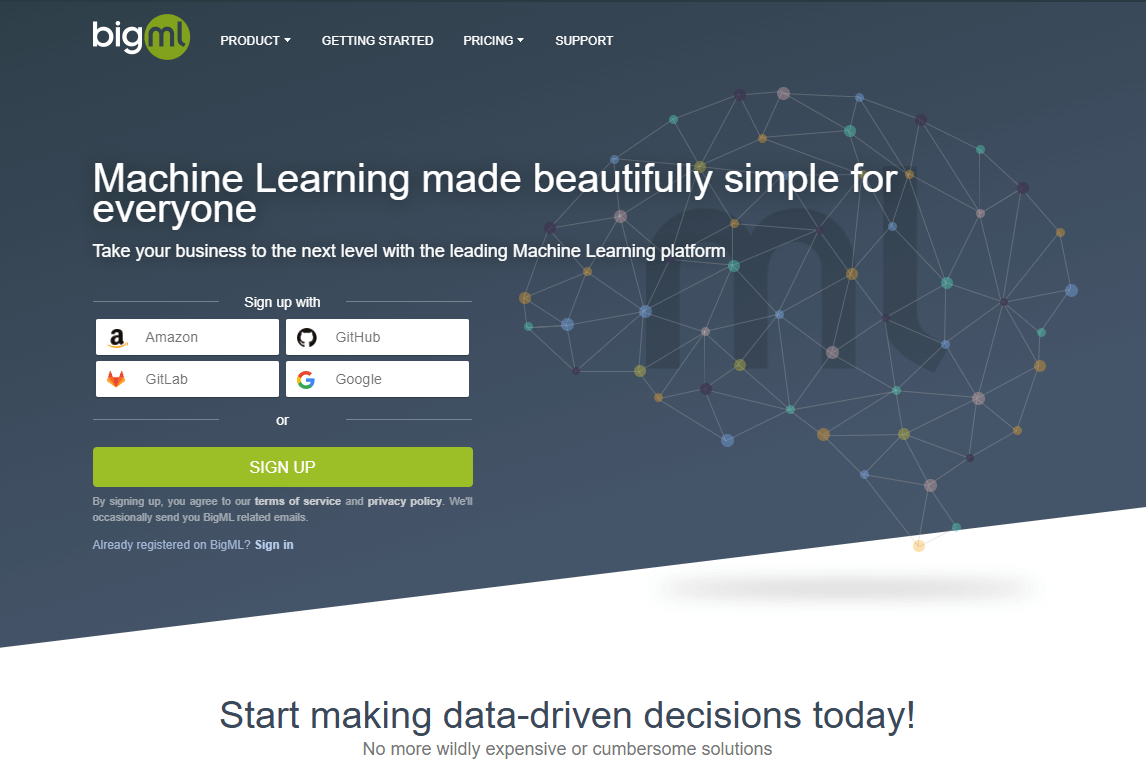
A user‑friendly low‑code machine learning platform with visual workflows, AutoML, and one‑click deployment options. Strong for quick classification and forecasting projects without heavy coding.
Best for: Small to mid‑size teams that want fast prototyping with visual workflows and an API for production.
Key Features:
- Visual dashboard and REST API for end‑to‑end ML workflows, plus AutoML via model selection and tuning.
- Model export and deployment options, including batch and real‑time serving, with collaboration workspaces.
- Broad algorithm coverage for supervised, unsupervised, and time series use cases.
Why we like it: Straightforward to learn, pragmatic AutoML, and a smooth path from experiment to predictions that fits lean teams.
Notable Limitations: Reviews note cloud dependency and limited offline support, occasional data import or format friction, and variable accuracy on some tasks.
Pricing: Public listings differ. G2 shows SaaS plans at $30, $150, and $300 per month, while Capterra lists a $1,000 per month starting price and flags both free trial and free version. For private deployments, pricing is not consistently published by third parties, contact the vendor.
DataRobot
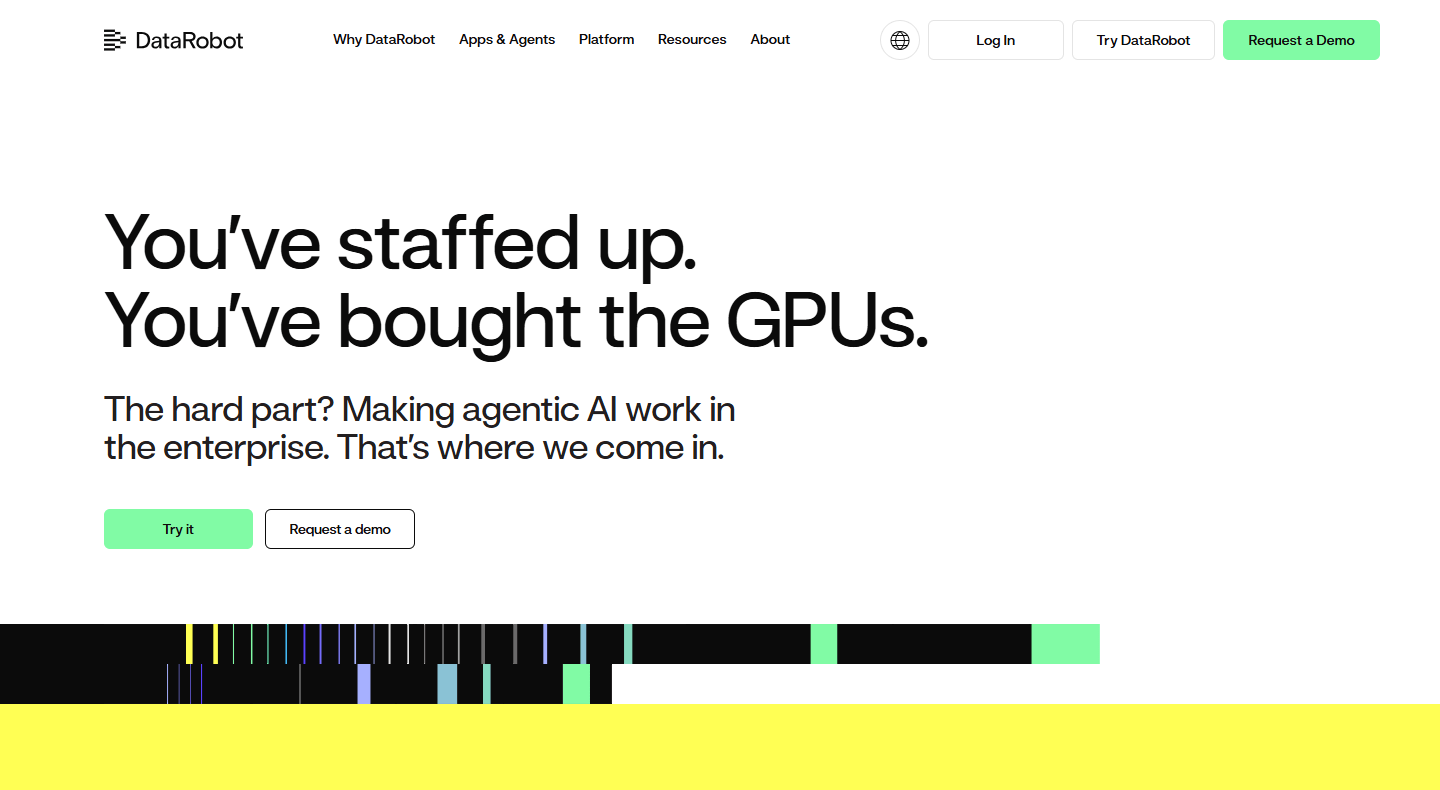
An enterprise AI platform focused on low‑code predictive modeling, MLOps, explainability, and governed deployment at scale. Designed for regulated industries and large programs.
Best for: Enterprises that need strong governance, model monitoring, and flexible deployment, including air‑gapped environments.
Key Features:
- Low‑code AutoML for tabular, time series, and other use cases with explainability built in, per vendor documentation.
- Integrated MLOps with model registry, drift monitoring, and approvals, per vendor documentation.
- No‑code application builder for sharing models with business users, per vendor documentation.
Why we like it: Robust governance and deployment flexibility, with news coverage indicating support for classified or air‑gapped environments and public sector adoption.
Notable Limitations: Pricing transparency is limited and total cost can be high for small teams, plus a learning curve and some integration complexity are commonly cited.
Pricing: Pricing not publicly available. Listings on AWS Marketplace indicate private offer, contract‑based procurement rather than posted rates.
KNIME Analytics Platform

An open‑source, low‑code platform for visually building, deploying, and sharing end‑to‑end data science workflows. Extensible with Python and R when you need code.
Best for: Teams that want a free desktop tool for serious data prep and ML, with optional paid collaboration and governance.
Key Features:
- Visual workflow designer with 300 plus connections; extensible with Python, R, and community nodes, per vendor documentation.
- End‑to‑end workflows for prep, modeling, and reporting, with optional Business Hub for deployment, per vendor documentation.
- Large community and learning resources.
Why we like it: A cost‑effective starting point that scales into governed collaboration when paired with KNIME's paid hub.
Notable Limitations: Reviews mention a learning curve, performance slowdowns on very large workflows, and occasional friction with some integrations.
Pricing: KNIME Analytics Platform is free and open source per third‑party listings. G2 shows paid tiers including Team plan starting at $99 per month and Business Hub Basic from $39,900 per year.
H2O Driverless AI
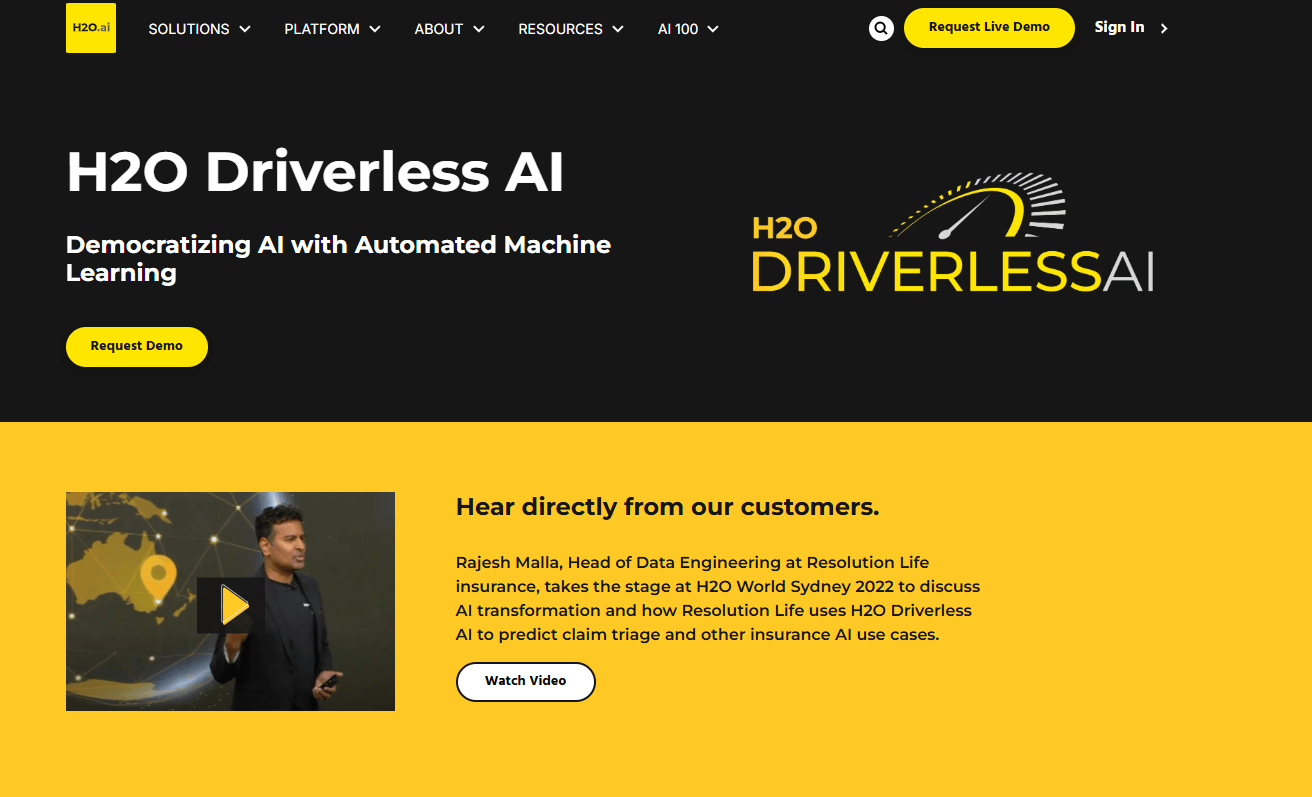
An AutoML tool that automates feature engineering, model training, hyperparameter tuning, and deployment with low code. Often used when you need stronger automation and enterprise deployment options.
Best for: Data science teams that want advanced AutoML, strong model interpretation, and flexible deployment on cloud or on premises.
Key Features:
- Automated feature engineering and model training, with configurable interpretability, per vendor documentation.
- Exportable scoring pipelines for real‑time or batch predictions, per vendor documentation.
- Coverage across tabular, time series, and NLP use cases, per vendor documentation.
Why we like it: Strong automation and production‑grade deployment options, with broad availability on cloud marketplaces.
Notable Limitations: Reviews cite that licenses can be expensive for smaller teams, limited built‑in data prep compared with data‑engineering tools, and risks of overfitting on smaller datasets if not tuned carefully.
Pricing: Pricing not publicly available. BYOL listings on AWS Marketplace confirm license‑based procurement through the vendor, with infrastructure billed by the cloud provider.
Low-Code Machine Learning Platforms Comparison: Quick Overview
| Tool | Best For | Pricing Model | Free Option |
|---|---|---|---|
| BigML | Lean teams needing fast AutoML and visual flows | SaaS subscriptions, enterprise private deployments | Free trial reported by third‑party listings |
| DataRobot | Enterprises with governance and MLOps needs | Contract, private offers via marketplaces | No public free version |
| KNIME Analytics Platform | Cost‑conscious teams needing visual data science | Free desktop, paid collaboration and governance | Yes, open source |
| H2O Driverless AI | Teams wanting advanced AutoML with flexible deployment | BYOL license, marketplace delivery | No public free edition |
Low-Code Machine Learning Platform Comparison: Key Features at a Glance
| Tool | AutoML | Explainability | Deployment Pipelines |
|---|---|---|---|
| BigML | Yes | Yes | Batch and real‑time serving |
| DataRobot | Yes | Yes | Registry, approvals, monitored endpoints |
| KNIME Analytics Platform | Yes via nodes | Yes via nodes | Jobs and apps via Business Hub |
| H2O Driverless AI | Yes | Yes | Exportable scoring pipelines |
Low-Code Machine Learning Deployment Options
| Tool | Cloud API | On-Premise | Air-Gapped |
|---|---|---|---|
| BigML | Yes | Available via private deployments, verify with vendor | Not independently documented by third parties |
| DataRobot | Yes | Yes | Reported support for classified, air‑gapped environments in news coverage |
| KNIME Analytics Platform | Via extensions and servers | Yes through Business Hub | Possible with special install approaches, verify with vendor |
| H2O Driverless AI | Yes via marketplaces | Yes | Frequently referenced in news as deployable in high‑security environments |
Low-Code Machine Learning Strategic Decision Framework
| Critical Question | Why It Matters | What to Evaluate |
|---|---|---|
| Who owns deployment and monitoring | Avoids shadow IT and drift risk | MLOps features, approvals, drift alerts |
| Where can you run it | Data gravity and compliance drive cost and speed | Cloud, on‑prem, private cloud, air‑gapped support |
| How will analysts use it in weeks one to four | Early wins build adoption | Templates, AutoML, training materials, community |
| What is the total cost over 12 months | Budget planning and ROI | License, compute, integration, training |
Low-Code Machine Learning Solutions Comparison: Pricing & Capabilities Overview
| Organization Size | Recommended Setup | Monthly Cost | Annual Investment |
|---|---|---|---|
| Startup, small team | KNIME free desktop for prep, BigML entry plan for AutoML and simple deployment | Varies by usage, see SaaS listings | Verify current SaaS prices on third‑party listings |
| Mid‑market | KNIME plus paid hub for collaboration, or BigML private space for production | Varies, depends on seats and cores | Confirm with published third‑party pricing where available |
| Regulated enterprise | DataRobot or H2O Driverless AI with MLOps, on‑prem or restricted cloud | Custom via contract or BYOL | Contact vendor or marketplace private offer listings |
Problems & Solutions Section
-
Problem: "We need a churn model in a month, but the team is mostly analysts."
- BigML solves this with a visual workflow and AutoML that reviewers say is easy to get productive with, useful when coding skills are thin.
- KNIME helps analysts build a full pipeline visually, then add Python or R only where needed, which reviewers praise for versatility while noting the learning curve.
-
Problem: "Compliance wants an air‑gapped deployment with full audit trails."
- DataRobot is repeatedly covered as deployable in classified or air‑gapped environments, a fit for agencies and defense use cases that need strict governance.
- H2O Driverless AI is widely delivered through cloud marketplaces with on‑prem options, making it adaptable to controlled environments where internet access is constrained.
-
Problem: "We have hundreds of SKUs across stores, forecasts keep drifting."
- DataRobot's platform emphasis on MLOps, drift monitoring, and time series use cases is discussed across third‑party coverage, which helps teams tie retraining to drift events rather than ad‑hoc fire drills.
- KNIME can orchestrate data enrichment and model runs on a schedule via its hub, which users note can scale once the initial learning curve is addressed.
-
Problem: "Feature engineering is the bottleneck, we need better baselines fast."
- H2O Driverless AI is frequently described as strong for automated feature engineering and exportable scoring pipelines, useful when teams need production‑ready baselines quickly.
The Bottom Line
By 2026, low-code machine learning is no longer about demos or speed alone. It is about whether models can survive messy data, audit scrutiny, and continuous change without collapsing into shadow IT. As Gartner has noted, most users now come from outside formal IT, which raises the bar for guardrails around drift, explainability, and deployment ownership.
If you want the fastest path to value with minimal upfront cost, start with KNIME for data preparation and visual workflows, and layer in BigML for simple AutoML and hosted predictions. This combination works well for small teams that need results quickly and can tolerate lighter governance. If your requirements include model risk management, monitoring, approvals, and restricted environments, DataRobot and H2O Driverless AI are better fits, with stronger MLOps controls and deployment flexibility that matter in regulated settings.
The mistake in 2026 is not choosing the wrong algorithm. It is choosing a platform that cannot be governed once models hit production. Pilot with real data, force drift scenarios, require explainability that business stakeholders can defend, and measure total cost over twelve months, not just time to first prediction.