
You think you know SMS cost and reach until your Black Friday campaign hits device limits, green bubble gaps, and manual opt-outs. Working across different tech companies, I have seen teams stumble on RCS Business Messaging only after failed MMS promos, not from vendor brochures. From my experience in the startup ecosystem, the wins come from three details: registering an RBM agent correctly, designing suggested replies and rich cards that match intent, and implementing SMS fallback routing to maintain coverage.
The CPaaS market reached roughly $13.5B in 2024, according to Gartner's market share analysis. At the same time, Google reported over 1 billion RCS messages sent daily in the U.S., a jump accelerated by iOS 18 support in late 2024, as covered by TechCrunch and MacRumors. In minutes, you will learn who each tool fits, real constraints like approval timelines, and where costs usually hide.
Telnyx RCS Business Messaging
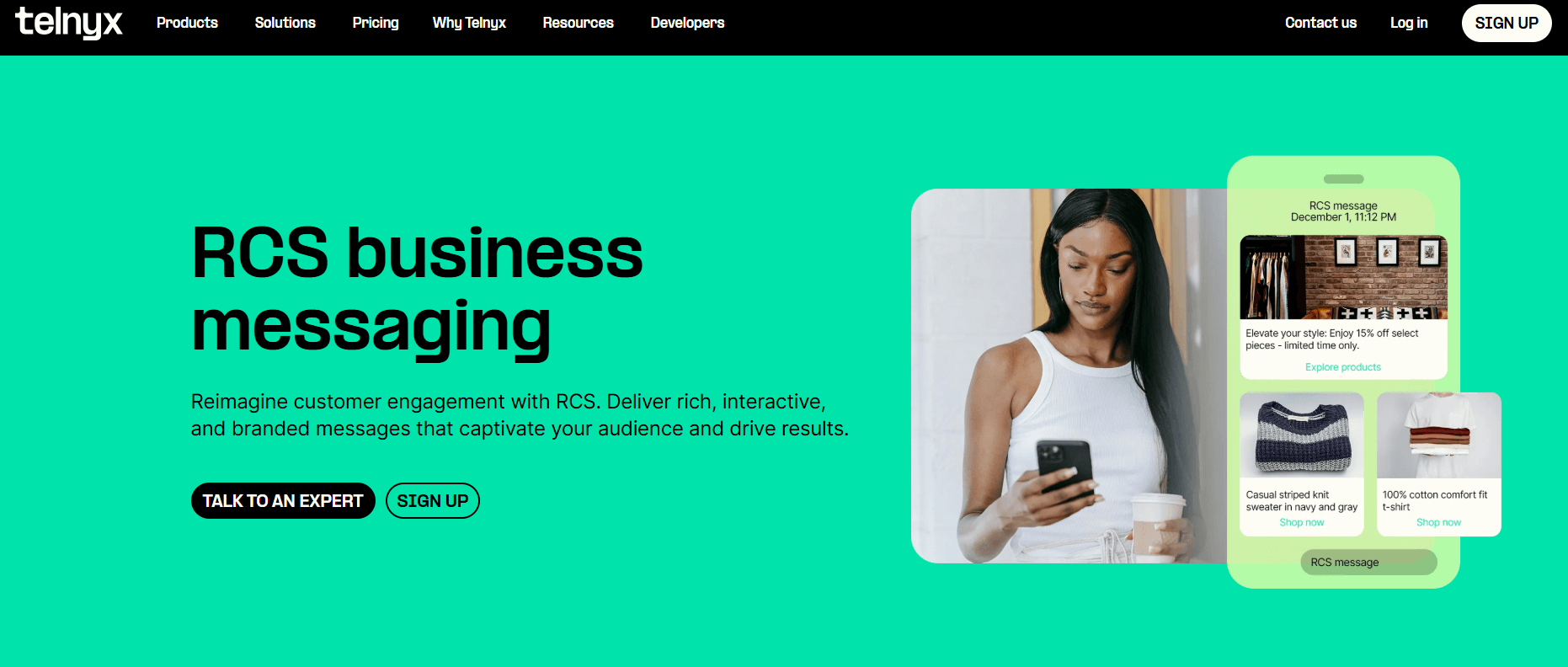
API-led RCS for branded, interactive customer messaging, with verified sender, rich cards, and analytics. Per Telnyx documentation and July 2, 2025 launch coverage, SMS fallback is part of the approach.
Best for: Product and growth teams that prefer a developer-first workflow and need SMS fallback baked in.
Key Features:
- Verified business profile with logo, color, and brand name.
- Rich messages, including carousels, images, video, and suggested replies.
- Delivery analytics with read receipts and engagement metrics.
- SMS fallback when RCS is unavailable, per launch announcement coverage.
- API and webhook model for integration with existing messaging flows.
Why we like it: Strong developer ergonomics and a clear story for mixed device fleets. Teams can ship one message payload, then rely on channel fallback logic to preserve reach.
Notable Limitations:
- Newer RCS offering as of July 2, 2025, so fewer public case studies than legacy SMS, based on GlobeNewswire coverage of the launch.
- Mixed customer feedback about support responsiveness on CPaaS use cases, per recent Trustpilot reviews.
Pricing: Pricing not publicly available. Contact Telnyx for a custom quote.
nativeMsg RCS Business Messaging
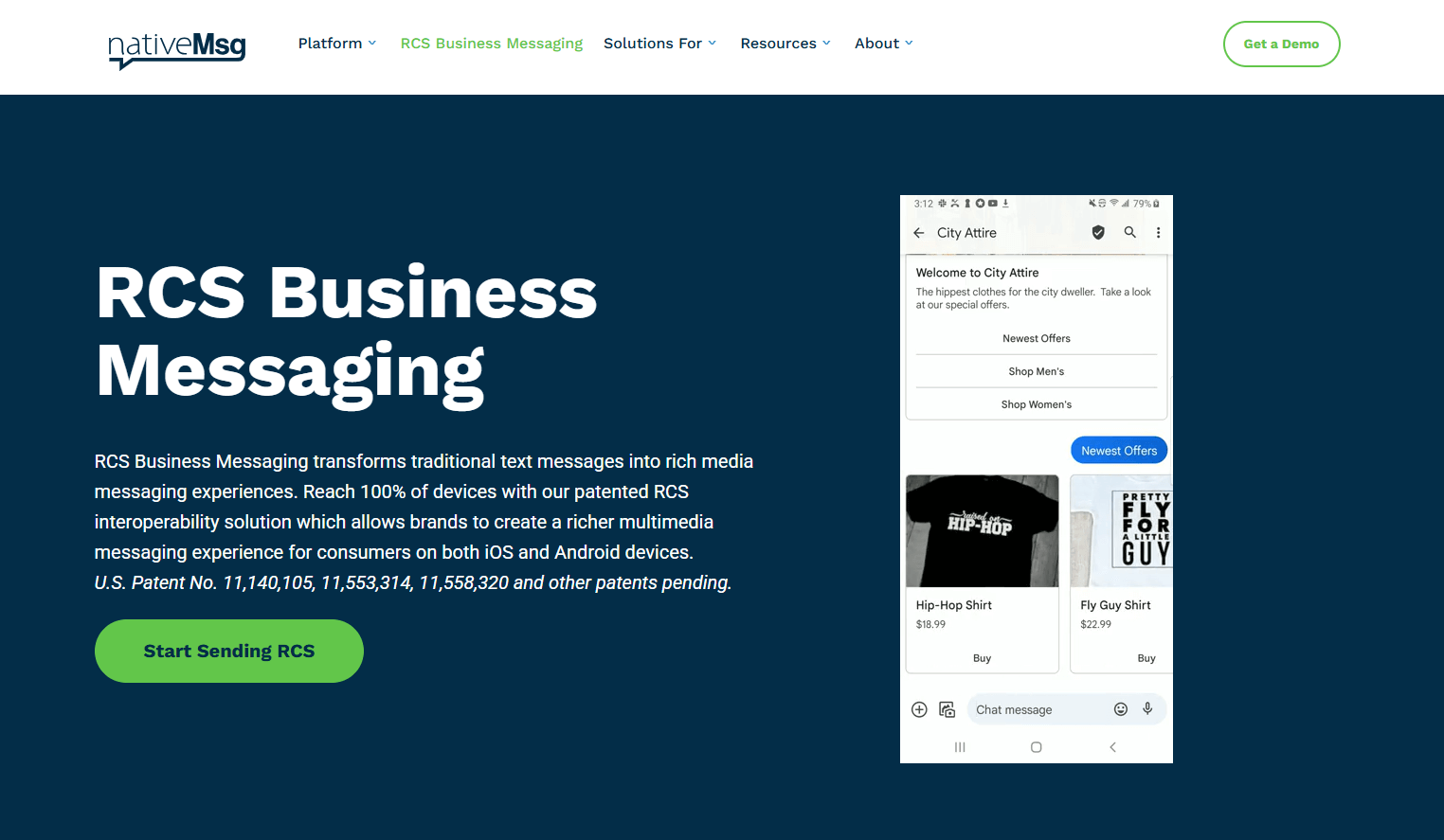
RCS campaign creation and API with a patented interoperability approach to reach devices that lack native RCS. Focus on rich, interactive experiences and analytics.
Best for: Marketing-led teams that want managed pilots and cross-device reach, including fallback experiences when native RCS is missing.
Key Features:
- Patented interoperability and RCS emulator concepts to deliver RCS-style experiences when native RCS is not available, supported by USPTO patent records.
- Rich media, carousels, interactive forms, and verified branding per vendor materials.
- No-code builder options plus API for integration.
- Analytics and attribution reporting across flows.
Why we like it: For brands that need to demonstrate quick value without deep engineering resourcing, the pilot-first model and device coverage claims can accelerate learning.
Notable Limitations:
- Limited independent product reviews, with public references focused on patents and marketing pages, per Justia patent listings and a BBB business profile.
- RCS approvals and brand verification still apply for native network delivery, and timelines depend on carriers, as outlined in Google's brand verification and launch approval documentation.
Pricing: Pricing not publicly available. Contact nativeMsg for a custom quote or pilot offer details.
Bandwidth RCS for Business
U.S.-focused RCS with verified branding, interactive elements, analytics, and expert support for enterprise rollouts.
Best for: U.S. enterprises that want a carrier-savvy partner and guidance on registrations and compliance.
Key Features:
- Verified sender with brand presentation and themes, plus interactive button actions.
- Two-way messaging with read receipts and click tracking.
- U.S. expert support and no-code options for faster starts, per vendor materials.
- Guidance on registration and ongoing compliance.
Why we like it: If you already use Bandwidth for voice or SMS, adding RCS centralizes workflows and leverages established compliance processes.
Notable Limitations:
- Several reviews cite support delays and frustration with ticket handling or the move away from phone support, per recent G2 reviews.
- RCS maturity is still emerging, so production references and tooling can change as carriers evolve policies, a dynamic reflected across the market and noted by multiple analyst and developer sources such as TelecomTV citing IDC CPaaS trends.
Pricing: Pricing not publicly available. Contact Bandwidth for a custom quote.
Syniverse RCS Business Messaging

Enterprise-grade RBM with verified profiles, rich media, real-time analytics, and professional services to navigate onboarding and scale.
Best for: Large enterprises that need professional services, program design, and operator relationships across regions.
Key Features:
- Verified sender profiles with branding to build trust.
- Rich cards, carousels, and interactive actions for two-way experiences.
- Real-time analytics and performance reporting.
- Professional services for strategy, onboarding, and compliance, per Syniverse materials.
Why we like it: Deep telco relationships and services muscle help large, regulated brands stand up programs across multiple carriers and markets.
Notable Limitations:
- Very limited third-party product reviews for RCS offers, with little buyer feedback on public review sites, as seen on G2's Syniverse profile.
- Launch timelines depend on carrier-managed approvals, which can add weeks, consistent with Google's launch approval guidance and third-party commentary that approvals can span 8 to 16 weeks, per OneSignal's overview.
Pricing: Pricing not publicly available. Contact Syniverse for a custom quote.
RCS Business Messaging Tools Comparison: Quick Overview
| Tool | Best For | Pricing Model | Highlights |
|---|---|---|---|
| Telnyx | Developer-led teams needing API control and SMS fallback | Custom quote, usage plus carrier fees | Verified sender, rich cards, analytics, fallback |
| nativeMsg | Marketing-led pilots and cross-device reach | Custom quote, pilot and ongoing plans | Patented interoperability, no-code builder, analytics, verified branding |
| Bandwidth | U.S. enterprises with compliance and registration needs | Custom quote, usage plus carrier fees | Verified sender, analytics, interactive actions, U.S. expert support |
| Syniverse | Global enterprises that want professional services | Custom quote, program-based | Verified profiles, rich media, analytics, professional services |
RCS Business Messaging Platform Comparison: Key Features at a Glance
| Tool | Verified Sender | Rich Cards & Carousels | Read Receipts & CTR | SMS Fallback |
|---|---|---|---|---|
| Telnyx | Yes | Yes | Yes | Yes |
| nativeMsg | Yes | Yes | Yes | Interoperability approach to reach non-RCS devices |
| Bandwidth | Yes | Yes | Yes | Yes, per provider implementation |
| Syniverse | Yes | Yes | Yes | Typically included in enterprise deployments |
RCS Business Messaging Deployment Options
| Tool | Cloud API | On-Premise | Air-Gapped | Integration Complexity |
|---|---|---|---|---|
| Telnyx | Yes | No public indication | No | Moderate, requires RBM agent setup and brand verification |
| nativeMsg | Yes | No public indication | No | Moderate, plus pilot onboarding for campaign builds |
| Bandwidth | Yes | No public indication | No | Moderate, carrier registrations and approvals apply |
| Syniverse | Yes | No public indication | No | Higher for multi-country rollouts, often with professional services |
RCS Business Messaging Strategic Decision Framework
| Critical Question | Why It Matters | What to Evaluate | Red Flags |
|---|---|---|---|
| Do you need verified branding on day one? | Verified sender improves trust and can reduce smishing risk. | Provider's verified sender setup, brand asset workflow, review SLAs | Weak guidance on verification or no preview of the brand profile |
| How will you handle non-RCS devices? | Even with iOS 18 support, not everyone has RCS enabled. | Fallback logic, emulator quality, analytics continuity | No clear fallback plan or fragmented reporting |
| Can you live with 1 to 3 day approvals or 8 to 16 weeks? | Some launches are Google-managed and can be quick, carrier-managed can be slower. | Carriers involved, required assets, partner's escalation path | No SLA on approvals, unclear carrier relationships |
| What KPIs prove ROI vs SMS? | RCS rich cards can outperform SMS. | Event tracking, read receipts, button taps, conversion feeds | No event-level exports or BI connectors |
RCS Business Messaging Solutions Comparison: Pricing & Capabilities Overview
| Organization Size | Recommended Setup | Pricing Transparency | Common Cost Drivers |
|---|---|---|---|
| Startup to SMB | Telnyx or nativeMsg pilot to validate flows, SMS fallback on | Not publicly listed | Per-delivered or session-based RCS fees, carrier charges, setup, creative |
| Mid-market | Bandwidth or Telnyx API, add analytics exports and compliance workflows | Not publicly listed | Message volume, verification, short code or 10DLC for SMS fallback |
| Enterprise | Syniverse or Bandwidth with professional services, multi-carrier launches | Not publicly listed | Multi-region approvals, professional services, SLA tiers |
Note: RCS pricing models commonly include per-delivered fees or 24-hour session charges, plus SMS fallback costs, as described by third-party aggregators like iBASIS.
Problems & Solutions
-
Problem 1, iOS and Android reach is fragmented
What the market shows: RCS usage surged after iOS 18 added support, and RCS now sees more than 1 billion daily messages in the U.S.
How tools help:- Telnyx and Bandwidth implement SMS fallback so one payload still reaches non-RCS devices.
- nativeMsg offers an interoperability path, supported by patent filings.
- Syniverse leans on operator ties to expand RCS coverage across carriers.
-
Problem 2, phishing and sender trust
What the market shows: Verified sender profiles and app-side verification measures improve trust and reduce smishing confusion, as illustrated by GSMA's KDDI case study.
How tools help:- All four vendors support verified sender branding in RBM.
- Telnyx and Bandwidth expose analytics that surface suspicious engagement, while Syniverse pairs this with program governance.
-
Problem 3, slow approvals and unclear timelines
What the market shows: Google-managed launches can complete in 1 to 3 business days if assets and approvals are ready, while carrier-managed approvals may take weeks.
How tools help:- Syniverse provides professional services for onboarding and carrier interactions.
- Bandwidth offers U.S. guidance and no-code options to accelerate first campaigns.
- Telnyx documents asset checklists so teams can minimize iteration cycles.
- nativeMsg runs pilot engagements to show value while approvals complete.
-
Problem 4, proving ROI vs SMS
What the market shows: Brands like Subway recorded 140 percent and 51 percent higher conversions for RCS vs SMS in controlled A/B tests, per Google Jibe's case study and MediaPost coverage.
How tools help:- All four provide read receipts and engagement metrics to measure lift.
- Bandwidth and Telnyx export events for BI analysis.
- nativeMsg emphasizes funnel analytics during pilots.
- Syniverse delivers analytics plus governance for enterprise reporting.
The Bottom Line on RCS Business Messaging
RCS is no longer the next channel, it is now a parallel default alongside SMS, with richer interaction and higher expectations around trust and measurement. The teams that succeed in 2026 treat RCS as infrastructure, not a campaign stunt.
If you want developer control and deterministic fallback, Telnyx is a strong fit. If you need marketing-led pilots and fast proofs across mixed device fleets, nativeMsg lowers the activation barrier. If you are a U.S. enterprise with compliance and carrier complexity, Bandwidth provides a familiar path. For multi-region or services-heavy rollouts, Syniverse’s operator relationships and onboarding support matter more than UI polish.
Across all options, the failure modes are consistent: underestimating approval timelines, skipping fallback design, and assuming RCS pricing behaves like SMS. Budget for verification lead time, negotiate session and fallback economics upfront, and instrument conversion events from day one. With RCS volumes now measured in billions per day and CPaaS spend continuing to grow, the advantage goes to teams that operationalize messaging early, before peak traffic exposes the gaps.