

A threat intelligence platform is a seat that ingests indicators, enriches them with context, and pushes that context into the tools that already fire alerts. A raw feed is a firehose. A SIEM or XDR module that hangs a few IOCs off an alert table is an add-on. Aggregation is not finished intel. If you are shopping this category, you are buying that platform seat, not a wall of 45 logos.
This is the buyer shortlist: seven platforms that claim the full ingest-to-action path, from finished research shops and vendor-neutral hubs to an EDR-fused adversary feed, dark-web collection, and a sharing-first TIP. Every claim below is checked against first-party product and pricing pages, and against the inaugural Gartner Magic Quadrant for Cyberthreat Intelligence Technologies, published 4 May 2026, which assessed 18 vendors and named five Leaders.
Threat Intelligence Platforms at a Glance
| Tool | Best for | Pricing model | Standout |
|---|---|---|---|
| Recorded Future | All-source Intelligence Cloud plus Insikt finished research | Packages, quote | Four solutions on one graph. Mastercard-owned |
| Anomali ThreatStream | Vendor-neutral aggregation TIP that scores and pushes IOCs | Quote | Fuse external intel with your assets, logs, and incidents |
| ThreatConnect | TIP plus orchestration and risk quant, now under Dataminr | Quote | Live buy name is Dataminr for Cyber Defense |
| Google Threat Intelligence | IR-backed finished intel with Mandiant Advantage lineage | ©2025 PDF list packages | Mandiant plus VirusTotal plus Google telemetry, one verdict |
| CrowdStrike Falcon Adversary Intelligence | Adversary intel fused with Falcon endpoint telemetry | Endpoint or employee license | The intel seat lives next to the Falcon console |
| Flashpoint | Criminal-community and dark-web intel for fraud plus CTI | Quote | Primary Source Collection (PSC), not another SIEM IOC store |
| Cyware | Intel sharing plus a TIP/SOAR path across partners | Quote | STIX in, playbooks out to SIEM, SOAR, and EDR |
How we evaluated threat intelligence platforms
We used five checks on vendor product and pricing pages: collection breadth (what actually lands in the library), enrichment and context (finished analysis versus raw indicators), SIEM and SOAR integrations (whether intel can leave the portal), analyst workflow (requirements, scoring, sharing, playbooks), and public pricing friction (printed packages versus quote-only). The method is the same as How we review tools.
Match the seat to the job. Finished research, a feed hub, an EDR-bundled adversary module, and an open-source build you assemble yourself are not the same purchase. A demo that only shows a logo wall of feeds is not this category.
Recorded Future
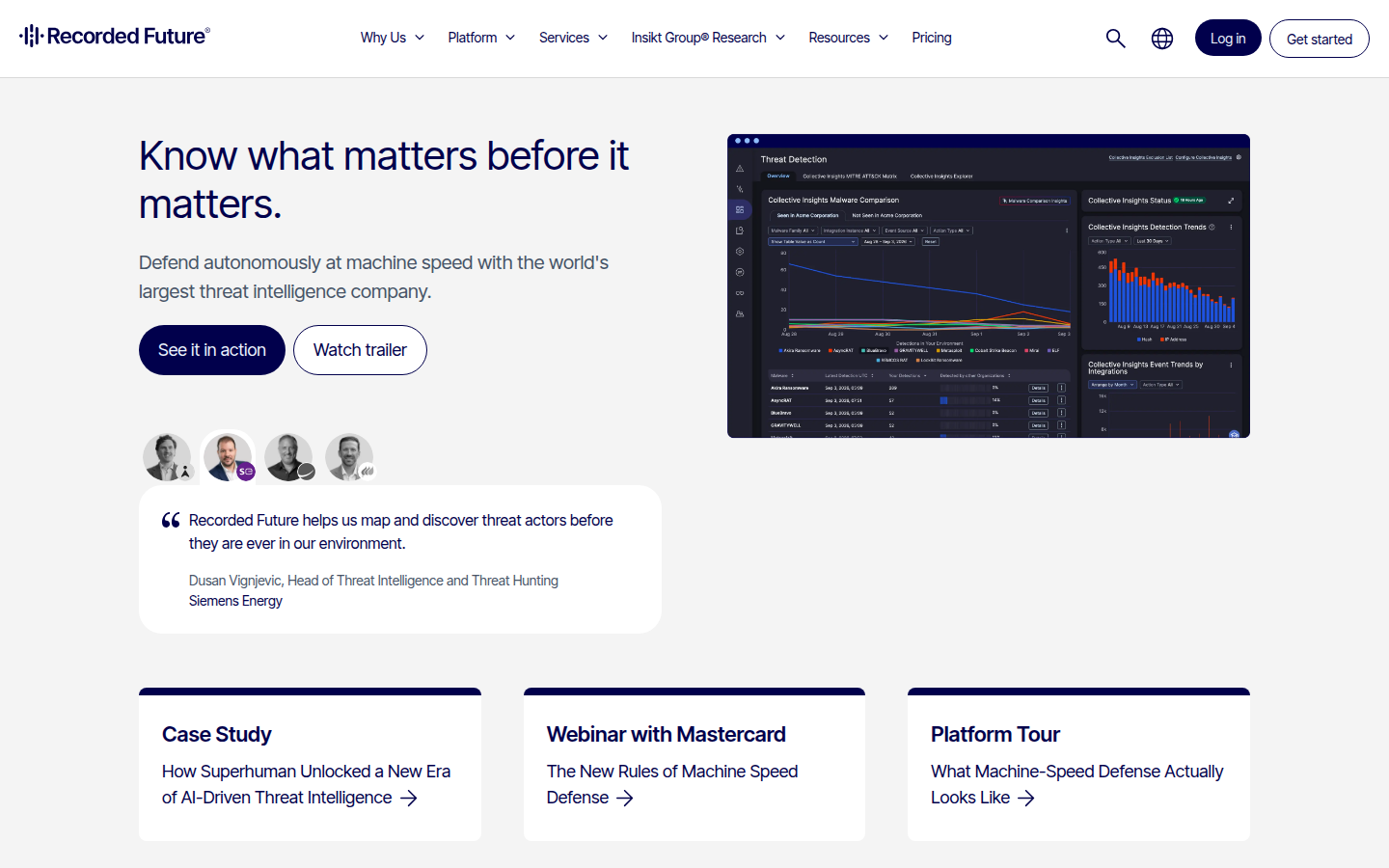
Recorded Future sells an Intelligence Cloud on the Intelligence Graph, with Insikt Group finished research on top. Packages on the pricing page are Core, Professional, and Elite. All packages include unlimited users and unlimited integrations (confirmed Apr 2026). Professional adds autonomous threat hunting, multi-source correlation, and external asset discovery. Elite unifies Cyber Operations, Digital Risk Protection, and Third-Party Risk. Payment Fraud Intelligence is a standalone add-on. Mastercard completed the acquisition on 20 December 2024. Recorded Future remains the product brand.
You are buying all-source collection plus human research in one cloud, not a folder of STIX files. Payment Fraud Intelligence is the Mastercard-aligned lane and sits outside the Core / Professional / Elite map. API call limits still vary by package.
Best for: Teams that want one intelligence cloud with finished Insikt research, not only a normalized IOC store.
Key features:
- Intelligence Graph plus Insikt Group research
- Core, Professional, and Elite: unlimited users and unlimited integrations on all packages
- Payment Fraud Intelligence as a standalone add-on; Elite unifies Cyber Ops, DRP, and Third-Party Risk
Why we like it: Detection engineering and CTI can pull from the same graph, including finished research, instead of buying a feed and a research desk as two separate products.
Notable limitations:
- Payment Fraud Intelligence is a standalone add-on, not folded into Core / Professional / Elite
- Mastercard ownership is closed. It is buying context. It does not turn the whole cloud into a payments-only product
- API call limits still vary by package even when users and integrations are unlimited
Pricing: Quote. Pricing follows package, organization size, usage, and services. Core, Professional, and Elite all include unlimited users and unlimited integrations (confirmed Apr 2026). Payment Fraud Intelligence is a standalone add-on. API limits vary by package. There is no public list dollar figure.
Anomali ThreatStream
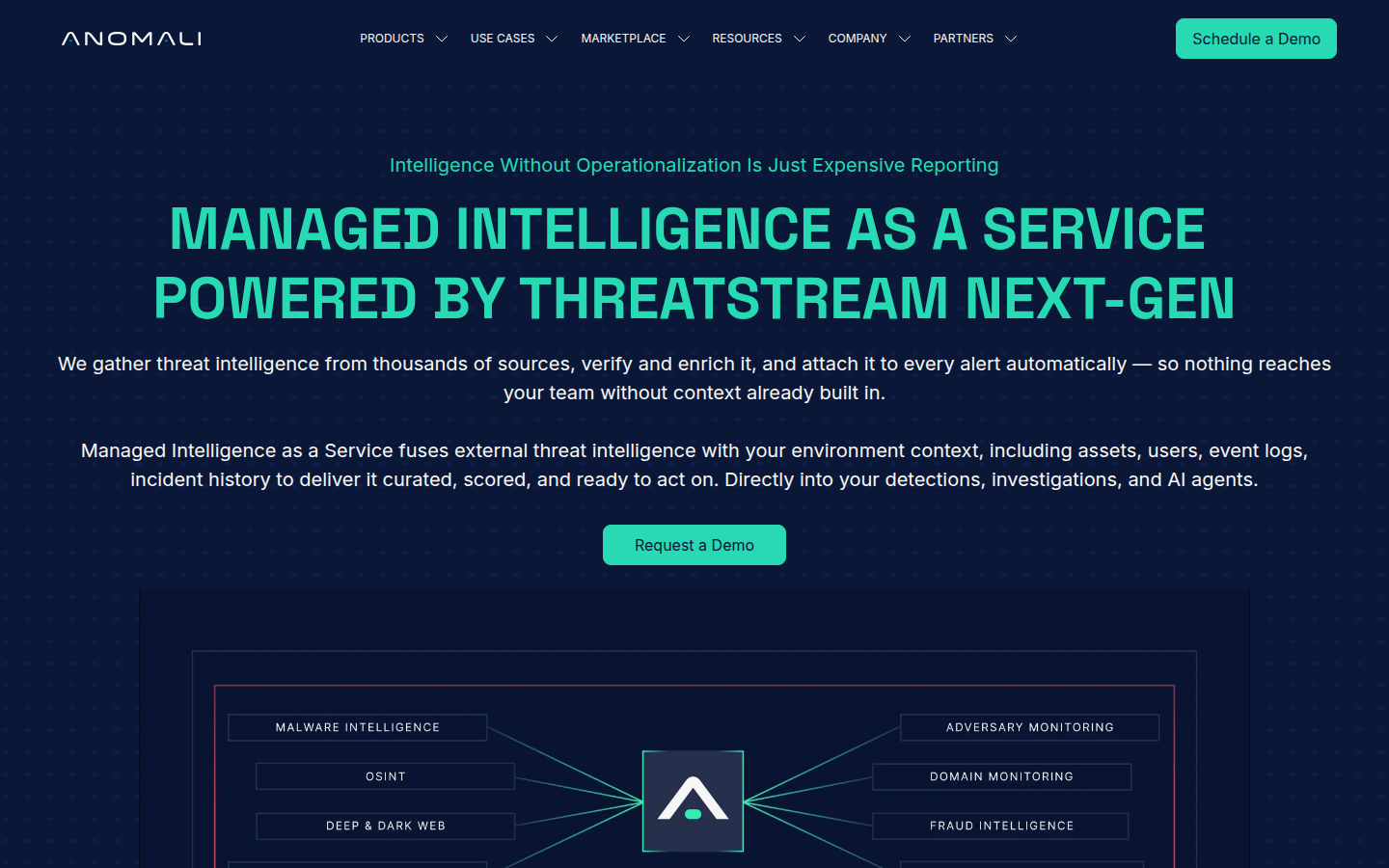
Anomali ThreatStream is the vendor-neutral aggregation TIP on this list. The live product page titles it Managed Intelligence as a Service powered by ThreatStream Next-Gen. Anomali says it gathers intelligence from open, commercial, and community sources, verifies and enriches it, and attaches that context to alerts. The stated path is collect and curate, fuse with your assets, users, event logs, and incident history, then operationalize into detections, playbooks, and agents.
The seat is normalize, score, and push. Not a finished IR memoir. Sharing shows up as Trusted Circles and STIX/TAXII. The page is explicit that collection is not the failure mode; the failure mode is the days between knowing an IOC and having a detection. That is the right question for a feed-sprawl shop. ThreatStream Next-Gen levels 1–2 are shipped; levels 3–5 had an August 2026 full-autonomy target that has now passed. Ask whether levels 3–5 shipped before you treat autonomy as in the seat. It is still quote. Do not treat a marketplace listing from some other catalog as Anomali’s list rate.
Best for: Teams drowning in feeds that need one library to normalize, score, and push IOCs into the stack they already run.
Key features:
- Aggregate, deduplicate, and confidence-score intelligence from many sources
- Fuse external intel with environment context before it hits the analyst
- Push into detections, investigations, playbooks, and AI agents, with STIX/TAXII sharing
Why we like it: The product behavior is fuse-then-push. An indicator picks up your asset and incident context, then it can land in a detection instead of sitting in a larger spreadsheet.
Notable limitations:
- The live pitch is managed intelligence as a service. Confirm the TIP seat, not only a managed overlay
- Next-Gen levels 3–5 targeted full autonomy in August 2026; that window passed. Ask whether they shipped
- This is not a substitute for Mandiant-style IR writing or Insikt finished reports
Pricing: Quote. Contact Anomali. There is no public list rate on the ThreatStream page.
ThreatConnect
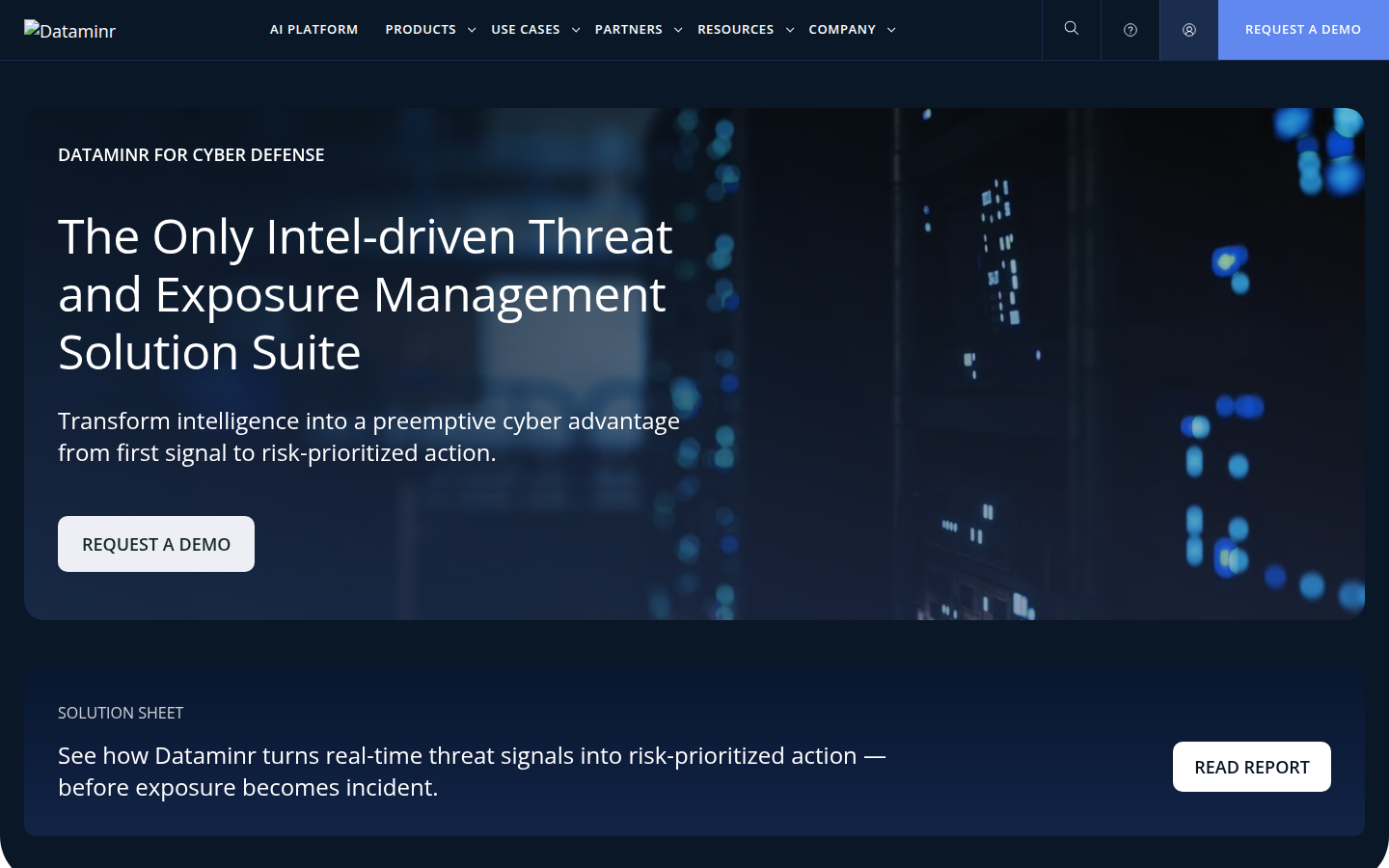
ThreatConnect is the TIP-plus-orchestration name on this shortlist. Dataminr announced a $290M acquisition in October 2025, closed it in November 2025, and launched the combined suite as Dataminr for Cyber Defense on 23 March 2026. The live product door is Dataminr. Inside that suite, the Agentic Threat Intelligence Platform is the TIP seat: normalize sources into one threat library, score and route records, and run playbooks. Risk quantification (RQ) is still in the story, mapped to MITRE ATT&CK and control gaps.
The hub is supposed to structure analyst work so it compounds, with the Dataminr signal layer around it. A closed acquisition, not a loose partnership. The ThreatConnect product brand is still what many RFPs say; the website you will demo is Dataminr. Custom agents were still labeled “coming in summer 2026” on the Agentic TIP page. Ask whether those agents have shipped. Ask whether the quote is ThreatConnect 8.x, Dataminr for Cyber Defense, or a named slice such as Agentic TI Ops.
Best for: Teams that want a TIP with built-in orchestration and risk quant, and will live with the Dataminr brand on the contract.
Key features:
- Threat library with source normalization, scoring, and routing into detection and IR
- Playbooks / agentic TI ops so intel can trigger action, not only sit in a record
- RQ-style risk language tied to ATT&CK and the tools you already run
Why we like it: Intel is supposed to become a reusable record that scores and routes. That is a different job from storing IOCs until someone copies them into the SIEM by hand.
Notable limitations:
- The live buy name and screenshot are Dataminr for Cyber Defense. Confirm the product name on the paper
- Custom agents were still marked coming in summer 2026. Ask whether they have shipped in the version on the quote
- Confirm whether the line item is ThreatConnect 8.x, Dataminr for Cyber Defense, or a named slice such as Agentic TI Ops
Pricing: Quote. Contact Dataminr. There is no public list rate on the Cyber Defense pages.
Google Threat Intelligence (Mandiant)
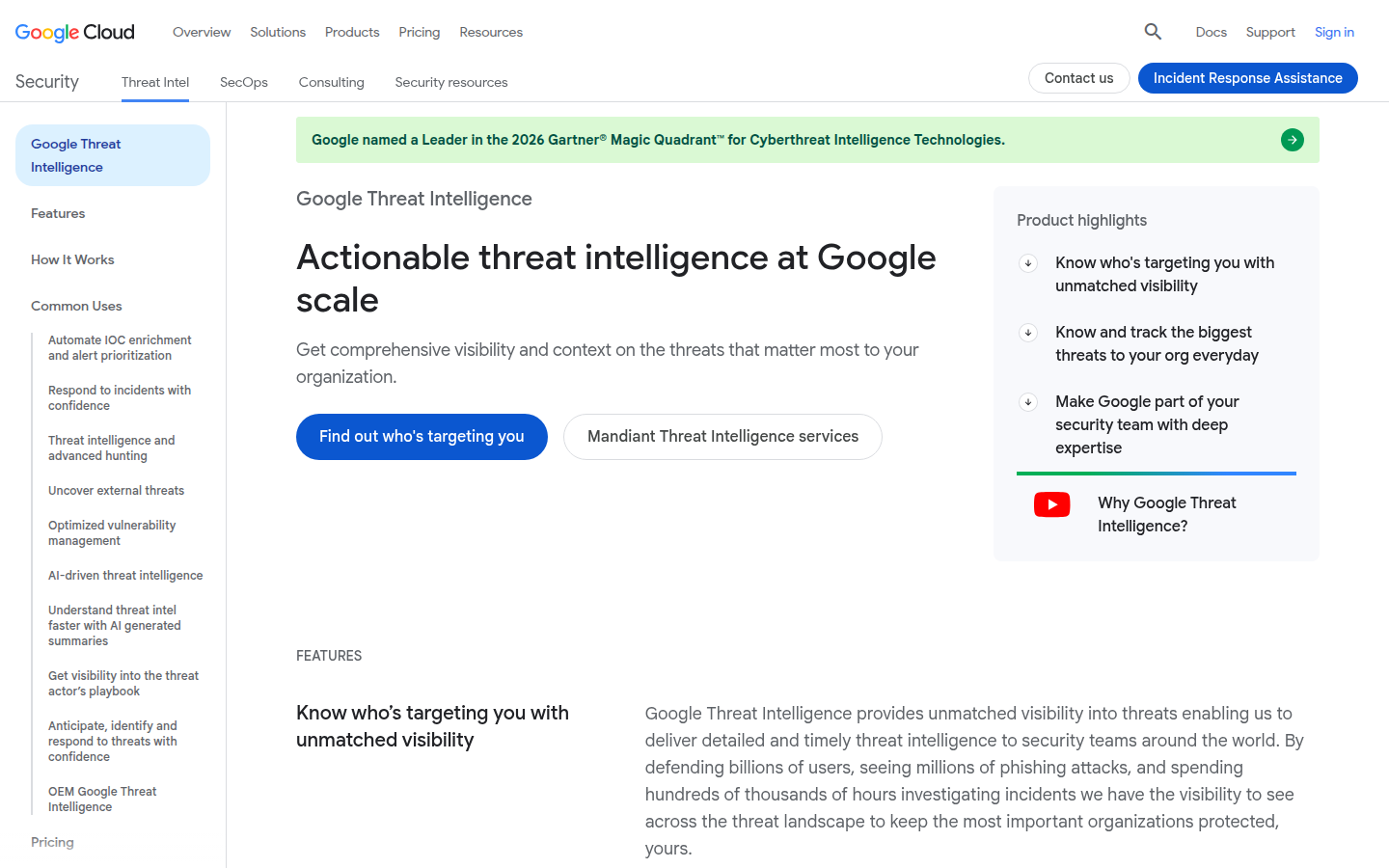
Google Threat Intelligence is the live buy name for Mandiant’s frontline intelligence, VirusTotal’s corpus, and Google’s own telemetry under one verdict. Google closed the Mandiant purchase in 2022. Former Mandiant Advantage Threat Intelligence customers were moved onto this product. The page still offers Mandiant experts in the console, Gemini in Threat Intelligence, a workbench for malware, hunts, and collections, and SIEM alert enrichment with a unified score.
The seat is IR-backed finished intel at Google’s collection scale, not a vendor-neutral feed aggregator. Packages are Standard, Enterprise, Enterprise+, and OEM. Do not treat Mandiant Advantage as the product name on a 2026 contract.
Best for: Teams that want Mandiant-style finished intel and a unified verdict, and will live in Google’s console to get it.
Key features:
- Unified verdict from Mandiant, VirusTotal, and Google telemetry
- In-console Mandiant experts, workbench, and Gemini-assisted research
- SIEM enrichment, hunting, campaign tracking, and OEM embedding
Why we like it: An IR desk, a malware corpus, and Google’s visibility collapse into one answer on an indicator instead of three tabs and three scores.
Notable limitations:
- This is Google Cloud’s product. It is the wrong door if you need a vendor-neutral TIP that only normalizes third-party feeds
- Mandiant Advantage is lineage. The buy name is Google Threat Intelligence
- Enterprise+ IOC feeds (file analysis; URL and domain) are priced separately from the base packages
Pricing: ©2025 packaging PDF list rates (date-qualify; confirm current quote): Standard $75K, Enterprise $600K, Enterprise+ $1.1M annually. API ceilings 5K/day, 30K/day, and 3M/day by package. Add-on API slots $75K–$150K. Enterprise+ IOC feeds are separate (file analysis $468K; URL and domain $340K each).
CrowdStrike Falcon Adversary Intelligence
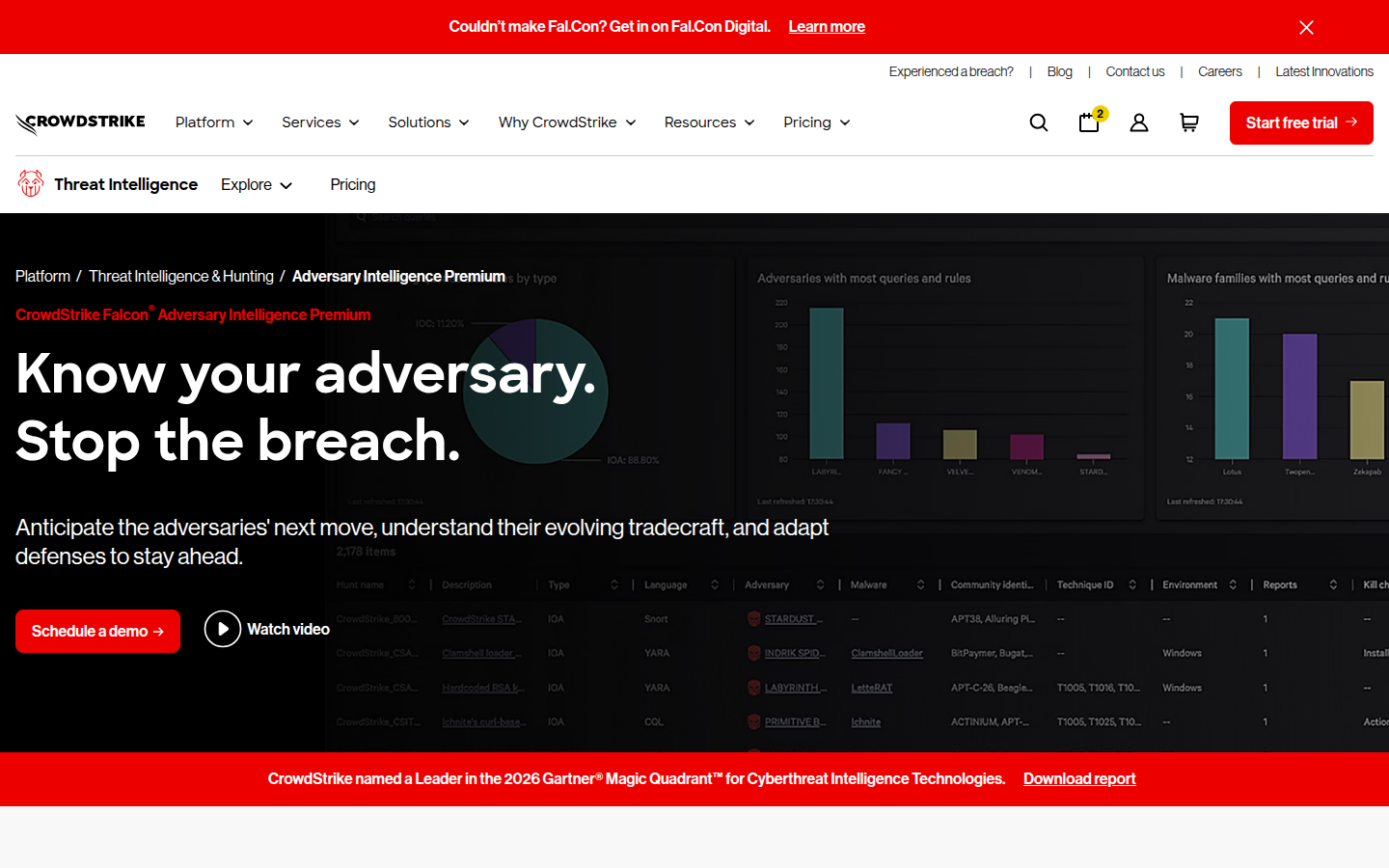
CrowdStrike Falcon Adversary Intelligence is adversary intelligence built to sit on Falcon. The live Premium page is the product URL. CrowdStrike tracks 290+ adversaries (the product page still saying 281+ lags the hub), with IOCs, malware analysis, brand and fraud monitoring, and intelligence reports aimed at hunts and detections. Prebuilt YARA and Snort rules are part of that Premium story. Threat AI agents (Malware Analysis Agent and Hunt Agent) were footnoted for Q4 FY26 (Nov 2025–Jan 2026; FY ends 31 Jan). That window closed 31 Jan 2026. Ask for a live demo of those agents rather than treating the footnote as a roadmap.
You are buying intel fused with Falcon endpoint telemetry, not a standalone TIP you hang off a different EDR. First-party pricing language: Adversary Intelligence and Adversary Intelligence Premium are licensed by endpoint/server or employee count. Counter Adversary Operations Elite requires Premium. There is no public list dollar figure. If Falcon is not already the console, this is usually the wrong shortlist row.
Best for: Falcon shops that want adversary intel in the same console as the endpoint telemetry.
Key features:
- Adversary tracking, IOCs, malware analysis, and brand/fraud monitoring on Falcon
- Intelligence reports plus prebuilt YARA and Snort rules on Premium
- Licensed by endpoint/server or employee count, with Elite sitting on Premium
Why we like it: The intel is meant to change what Falcon already sees, so hunts and detections stay in the same console the SOC already lives in.
Notable limitations:
- This is a Falcon-native seat. It is a weak fit if you do not run Falcon
- Threat AI agents (Malware Analysis Agent and Hunt Agent): Q4 FY26 window closed 31 Jan 2026. Ask for a live demo rather than a footnote
- No public list dollars. The printed fact is the license metric
Pricing: Adversary Intelligence and Premium licensed by endpoint/server or employee count. Elite requires Premium and uses the same metric. Contact CrowdStrike. There is no public list dollar figure.
Flashpoint
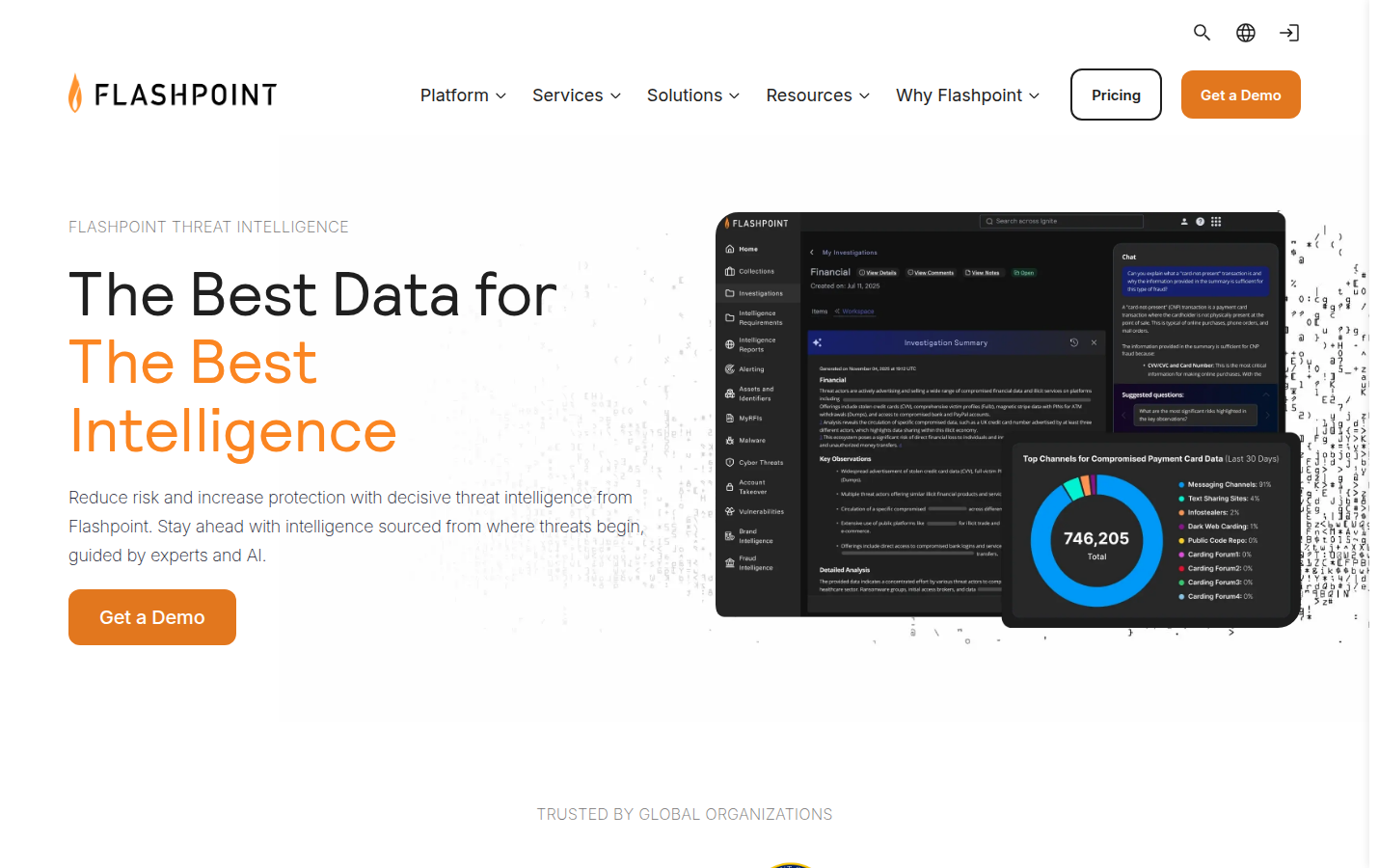
Flashpoint is deep collection from criminal communities, fraud shops, and other hard-to-reach adversary spaces, delivered through the Ignite platform. The brand term is Primary Source Collection (PSC). Flashpoint cites 800+ global customers, including 50+ allied governments. The homepage aims the same data at CTI/SOC, fraud, physical security, vulnerability management, national security, and insider threat. Demo and contact sales are the CTAs. There is no public list rate.
The coverage is Primary Source Collection for people who hunt stolen cards, credentials, and actor chatter. Not a SIEM replacement and not a generic IOC dump. Collection-scale marketing figures on vendor pages are not a price. If the job is finished IR writing in the Mandiant sense, look at Google Threat Intelligence or Recorded Future. If the job is fraud plus CTI in places most feeds never reach, this is the row.
Best for: Fraud and CTI teams that need Primary Source Collection (PSC) across dark-web and criminal communities.
Key features:
- Primary Source Collection (PSC) from open sources and hard-to-reach adversary spaces
- Ignite platform plus API paths, with CTI, fraud, vuln, and physical lanes
- 800+ global customers, including 50+ allied governments
Why we like it: The collections start where fraud crews and criminal markets actually talk, rather than normalizing the same commercial IOC feed everyone else already bought.
Notable limitations:
- This is not a SIEM and not a general-purpose feed hub for every STIX source you already own
- Ignite is the platform name. Confirm the current product door on the call
- Get a demo. There is no public list rate on the homepage
Pricing: Quote. Get a demo or contact sales. There is no public list rate on the homepage.
Cyware
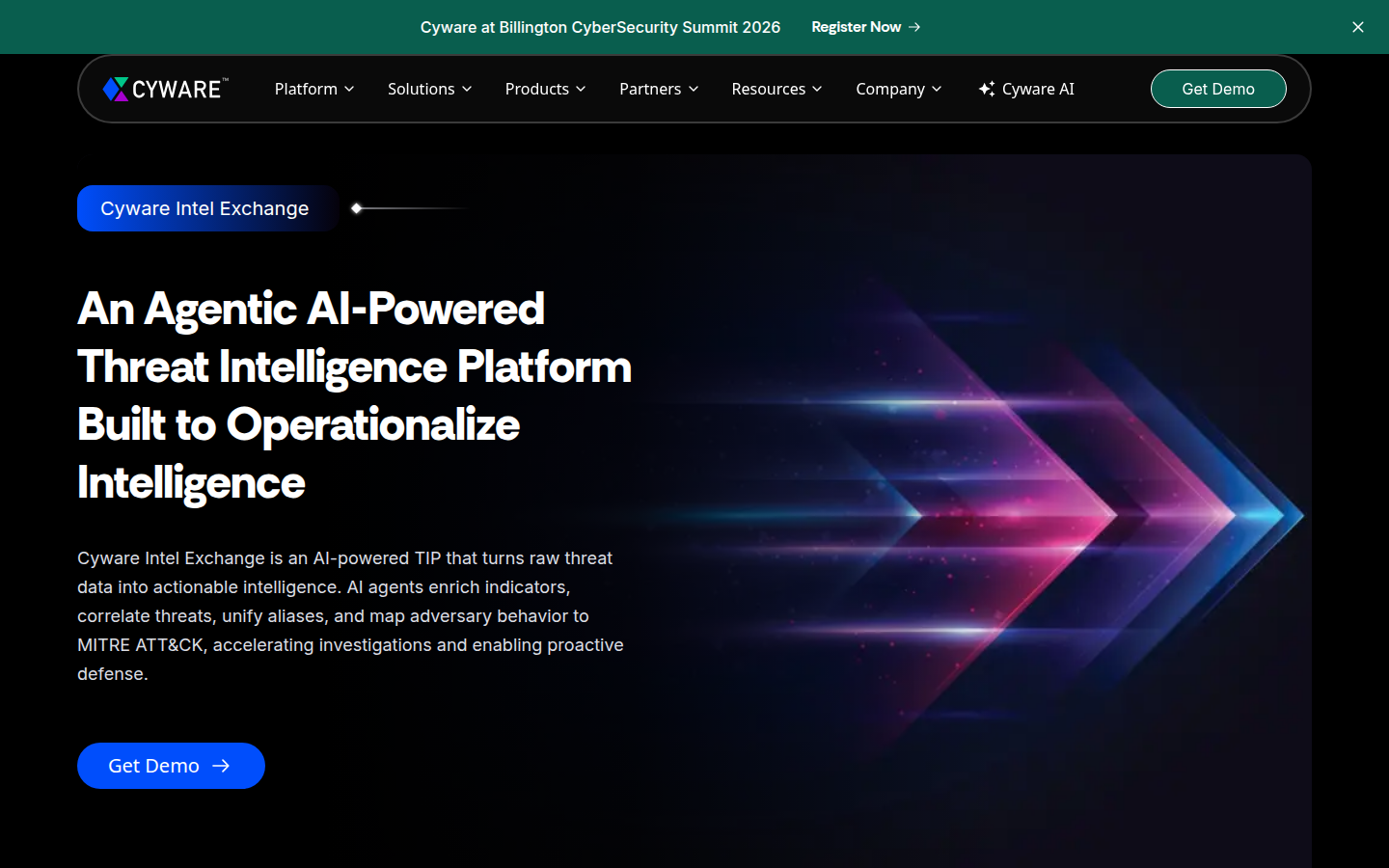
Cyware Intel Exchange is the TIP: ingest any format, deduplicate, enrich, normalize to STIX 2.1, correlate actors and campaigns, then fire playbooks into SIEM, SOAR, and EDR. Sharing is a first-class path (STIX/TAXII and ISAC-style partner exchange). An MCP Server supports natural-language interaction with the TIP. Cyware’s own site compares Intel Exchange with other TIPs. Those blurbs are vendor marketing, not our ranking.
The job is operationalize-and-share, including across partners, not a Mandiant IR desk. The product is still quote. Ask what is in Intel Exchange versus Cyware’s broader orchestration suite so you are not buying a second platform by accident.
Best for: Teams that need to share intel with partners or an ISAC and still push curated indicators into SIEM, SOAR, and EDR.
Key features:
- Ingest any format, dedupe, enrich, and normalize to STIX 2.1
- Playbooks that push intel to SIEM, SOAR, and EDR
- MCP Server for natural-language interaction; partner and ISAC-style sharing
Why we like it: Sharing and actioning are the same seat. A partner can get a STIX bundle while a playbook still hits the SIEM.
Notable limitations:
- Confirm you are quoting Intel Exchange, not the entire Cyware orchestration catalog
- Finished IR research is not the headline. Collection depth for dark-web fraud is not the headline either
- There is no public list rate on the Intel Exchange page
Pricing: Quote. Contact Cyware. There is no public list rate on the Intel Exchange page.
Threat intelligence platform features compared
| Tool | Intel style | Action path | Typical seat |
|---|---|---|---|
| Recorded Future | All-source graph plus Insikt finished research | Integrations and autonomous ops into the stack | Standalone intelligence cloud |
| Anomali ThreatStream | Vendor-neutral aggregation and scoring | Push fused intel into detections and agents | Feed hub / TIP |
| ThreatConnect | Normalized threat library plus Dataminr signals | Playbooks, routing, and RQ | TIP plus orchestration |
| Google Threat Intelligence | Mandiant IR plus VirusTotal plus Google | Unified verdict, SIEM enrichment, hunts | Finished-intel console |
| CrowdStrike | Adversary intel on Falcon telemetry | Hunts, detections, and rules in Falcon | EDR-bundled intel |
| Flashpoint | Primary Source Collection (PSC) for criminal and dark-web intel | Ignite workflows plus API | Collection specialist |
| Cyware | Ingest, enrich, share | STIX sharing plus SIEM/SOAR/EDR playbooks | Sharing-first TIP |
How these threat intelligence platforms deploy
| Tool | Live buy name | Parent | How it lands |
|---|---|---|---|
| Recorded Future | Recorded Future Intelligence Cloud | Mastercard (closed Dec 2024) | Cloud packages, integrations, APIs |
| Anomali ThreatStream | ThreatStream / managed intelligence | Anomali | API-first TIP into the existing stack |
| ThreatConnect | Dataminr for Cyber Defense | Dataminr (closed acquisition) | Suite. Confirm TIP versus TI Ops versus exposure |
| Google Threat Intelligence | Google Threat Intelligence | Google Cloud (Mandiant closed 2022) | Google Cloud console plus API packs |
| CrowdStrike | Falcon Adversary Intelligence / Premium | CrowdStrike | Falcon module, licensed on endpoints or employees |
| Flashpoint | Flashpoint / Ignite | Flashpoint | SaaS platform plus API. Demo path |
| Cyware | Cyware Intel Exchange | Cyware | TIP with sharing and playbooks into the stack |
Strategic Decision Framework
Four questions to ask before you buy. Stay inside this shortlist. If a demo cannot answer these, keep walking.
| Critical question | Why it matters | What to evaluate | Red flag |
|---|---|---|---|
| Do you need finished intel, or a hub that normalizes the feeds you already pay for? | Aggregation is not the same as IR or Insikt-style writing. Buying the wrong one wastes the first year. | Ask what a new campaign looks like on day one: a report with TTPs, or a scored IOC in the library. | The demo is a logo wall of feeds and no finished analysis. |
| Is the job a feed hub that pushes IOCs into SIEM and SOAR? | Volume without a push path is a portal nobody opens during an incident. | Watch an indicator leave the TIP into the detection tool you actually run. | The only export is a CSV the SOC has to paste. |
| Is Falcon already the console, so intel should be an EDR-bundled module? | A standalone TIP next to Falcon is a second login. A Falcon module is a different seat. | Name the EDR on the call. Ask whether hunts run on that telemetry. | The pitch assumes you will replace the EDR in the same quarter as the intel buy. |
| Are you trying to build an open-source TIP instead of buying a seat? | Self-hosted correlation is a staffing decision. It is not a free version of Insikt or Mandiant. | Count who will run ingestion, scoring, and sharing after month three. | The plan is one engineer, nights and weekends, and no sharing policy. |
What usually goes wrong when buying a threat intelligence platform
Most mismatches happen because a SIEM, a feed portal, and a platform seat get treated as the same product, or because a closed acquisition is ignored until the quote arrives with a new logo.
| Problem | Solution |
|---|---|
| You buy a SIEM or XDR add-on and call it a TIP | Keep the split. A TIP has to ingest, enrich, and operationalize. Alert storage is a different product |
| You equate feed volume with action | Ask what happens to a new IOC after it lands. You want a detection, a playbook, or a block, not a bigger library |
| You ignore parent M&A | Treat closed deals as closed. Recorded Future is Mastercard-owned. ThreatConnect is inside Dataminr. Mandiant intel is Google Threat Intelligence. Confirm the name on the paper |
Which threat intelligence platform should you pick
If this is the first CTI hire, start with a hub that can normalize the feeds you already have and push IOCs into the SIEM: Anomali ThreatStream or Cyware Intel Exchange, and Dataminr’s ThreatConnect path if orchestration and risk quant are the reason you are in the room. If Falcon is already on the fleet, start with Falcon Adversary Intelligence rather than a second console. If feed sprawl is the pain, skip the logo dump at threat intelligence tools and buy the aggregation seat.
If the job is criminal-community and fraud coverage, start with Flashpoint. If the job is finished research with an IR or Insikt desk behind it, start with Recorded Future or Google Threat Intelligence. A night-shift detection crew is a different buy. That page is managed detection and response.