Most teams discover their AI agents have more power than they thought during a live incident review, not from a quarterly architecture diagram. Working across different tech companies, we have seen simple gaps snowball, like missing per-action policy checks, unsigned agent identities, and audit trails that are easy to tamper with. You think you know your runtime until a prompt chain touches production systems. That is why we focus on verifiable controls, for example SPIFFE-style workload identity, W3C Verifiable Credentials for agent permissions, and cryptographic audit evidence that stands up to scrutiny. Independent analysts also expect rapid growth in this space, with off-the-shelf AI governance software forecast to reach $15.8 billion by 2030, capturing 7 percent of AI software spend, per Forrester's forecast commentary.
The need is real, as the global average breach cost stood at $4.44 million in 2025 according to IBM's Cost of a Data Breach Report, and the NIST AI Risk Management Framework sets clear expectations for traceability and accountability in AI systems (NIST AI RMF). Below are the four platforms that consistently deliver design-time guardrails plus runtime verification, selected for pre-runtime checks, per-action policy enforcement, cryptographically verifiable audit evidence, standards alignment, and deployment flexibility.
Verity Intelligence (CCSL)
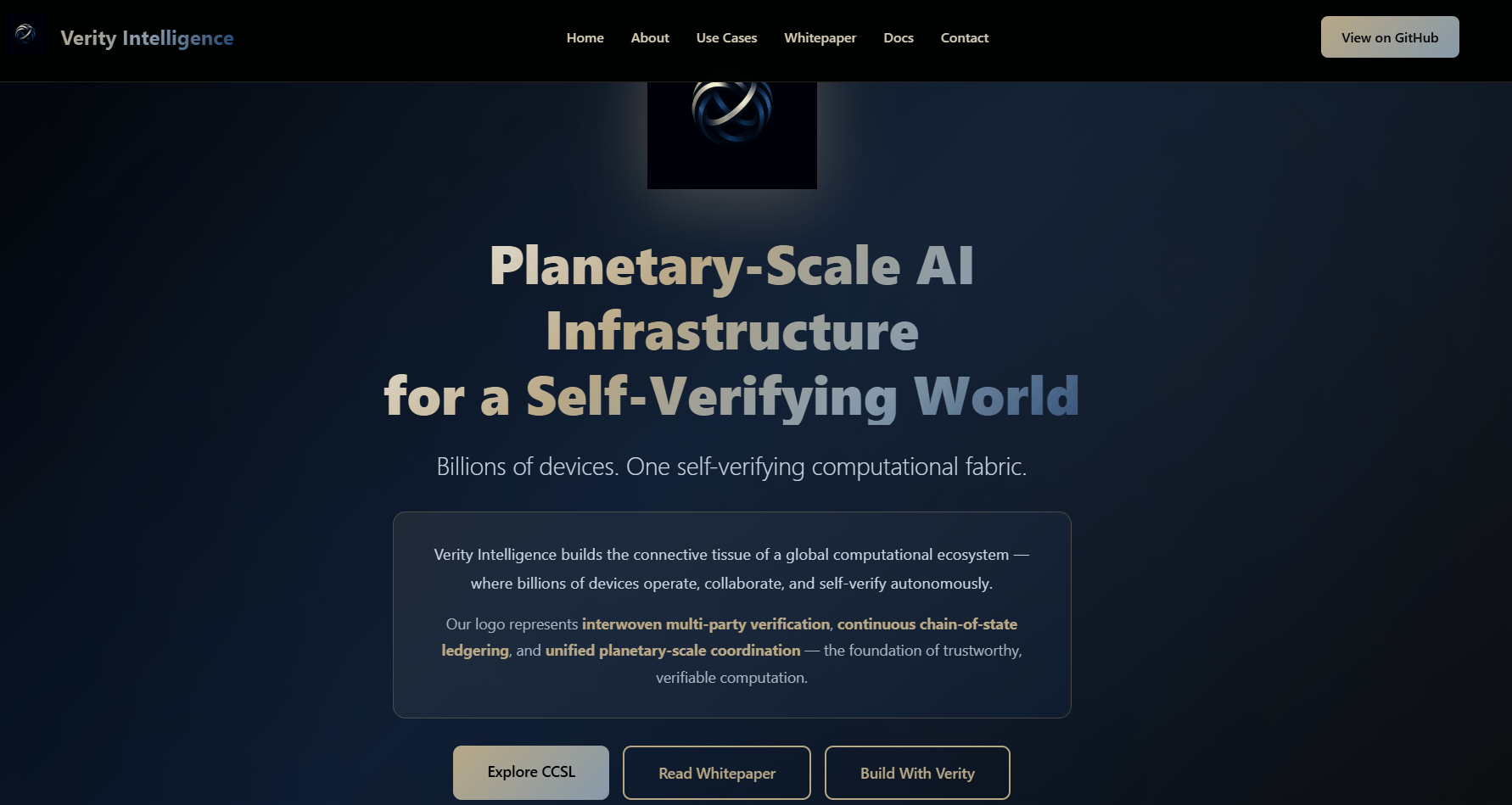
Open-source planetary-scale self-verifying compute fabric where code carries its own embedded security policy and is verified before execution. Designed to generate cryptographic audit artifacts so every run is provable and accountable, per Verity documentation.
Best for: Engineering teams that want policy-in-code and pre-runtime verification for agent workflows, R&D groups standardizing on open standards, regulated projects that require cryptographic evidence of execution.
Key Features:
- Policy embedded in code with a compiler that enforces pre-runtime verification
- Zero-trust compute posture where unverified instructions never run
- Cryptographic audit records for each execution
- Open-source core for inspection and self-hosting
Why we like it: Pre-execution verification helps catch privilege creep and unsafe agent actions before runtime, and the open-source core can cut vendor risk while speeding audits.
Notable Limitations:
- Early stage productization and limited public case studies
- Integration will require adopting the policy DSL and build toolchain
- Few independent reviews available online
Pricing: Core is open source according to vendor materials. Enterprise support and managed options are not publicly priced. Contact Verity Intelligence for a custom quote.
Corvair.ai
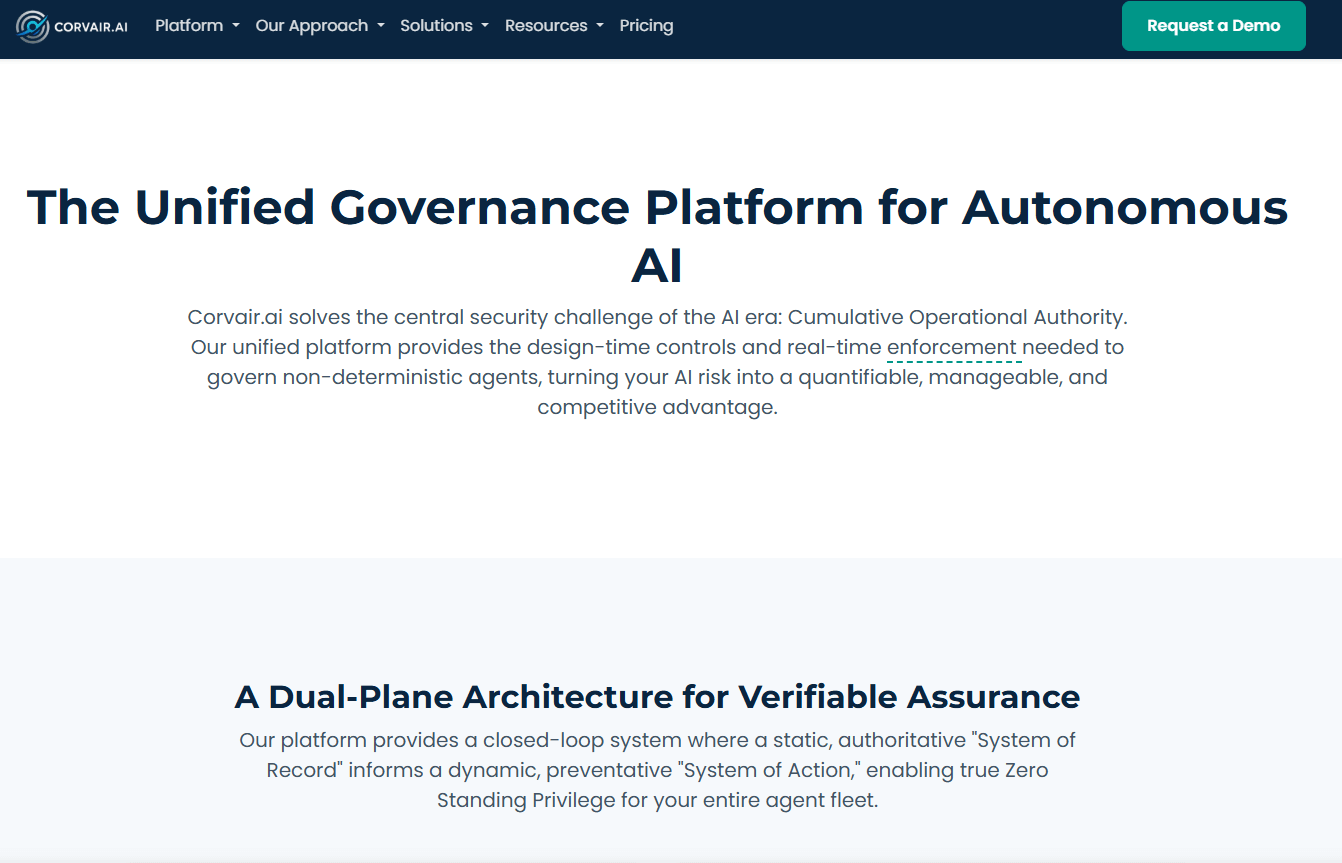
Unified governance platform for autonomous AI agents that blends a design-time Agent Registry with a real-time Governance Engine. Delivers per-action policy decisions, Zero Standing Privilege, and cryptographically verifiable audit logs, per Corvair documentation.
Best for: Enterprises rolling out AI agents across sensitive workflows, especially BFSI and other regulated industries that need runtime enforcement and defensible audits.
Key Features:
- Agent Registry with structured, machine-verifiable profiles across identity, authority, and mission
- Real-time Policy Decision Point and Just-in-Time privilege brokering for each agent action
- Immutable, cryptographically chained audit logs for forensic evidence
- Cryptographic agent identity aligned with SPIFFE concepts
Why we like it: Combines pipeline-native design controls with runtime prevention, so teams can stop unsafe deployments left of boom and still make millisecond decisions at runtime.
Notable Limitations:
- Public case studies are limited, so validation may require a proof-of-concept
- Starter tier is cloud only, which may not fit stricter environments
- Feature rollout cadence varies across plans
Pricing: Per the vendor's public pricing page as of early 2026, Starter is listed at $500 per month, Business at $5,000 per month, Enterprise is custom. Confirm current pricing with Corvair.ai.
Soverio
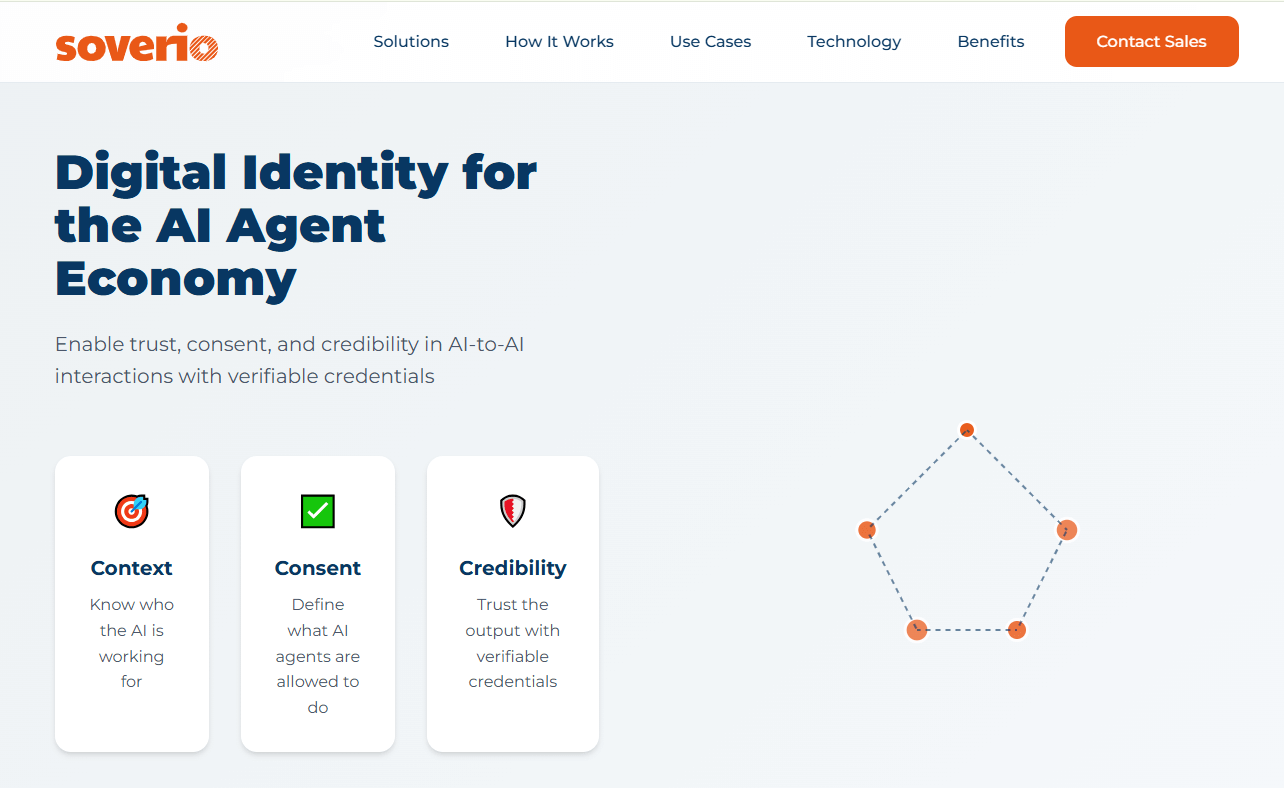
Digital identity infrastructure for AI agents built on W3C Verifiable Credentials and Decentralized Identifiers, with OpenID4VCI issuance and agent-to-agent protocols, per Soverio documentation. Focuses on consent, authorization scope, and verifiable agent communications.
Best for: Teams that need strong, portable agent identity and consent models across multiple tools, with standards-based credentials for audits and partner interoperability.
Key Features:
- W3C Verifiable Credentials for agent permissions and attestations
- Decentralized Identifiers for lifecycle-managed agent identity
- OpenID4VCI issuance and presentation flows
- Support for Model Context Protocol and secure agent-to-agent communication
- Comprehensive audit logging
Why we like it: Standards alignment means less custom glue for identity and authorization, and VCs give you portable, cryptographic proof of who an agent is and what it can do.
Notable Limitations:
- Limited independent customer reviews and third-party validations
- Public reference architectures are sparse, so integration planning may take longer
- Pricing and SLAs are not publicly listed
Pricing: Pricing not publicly available. Contact Soverio for a custom quote.
WebThos Verifiable Compute Platform
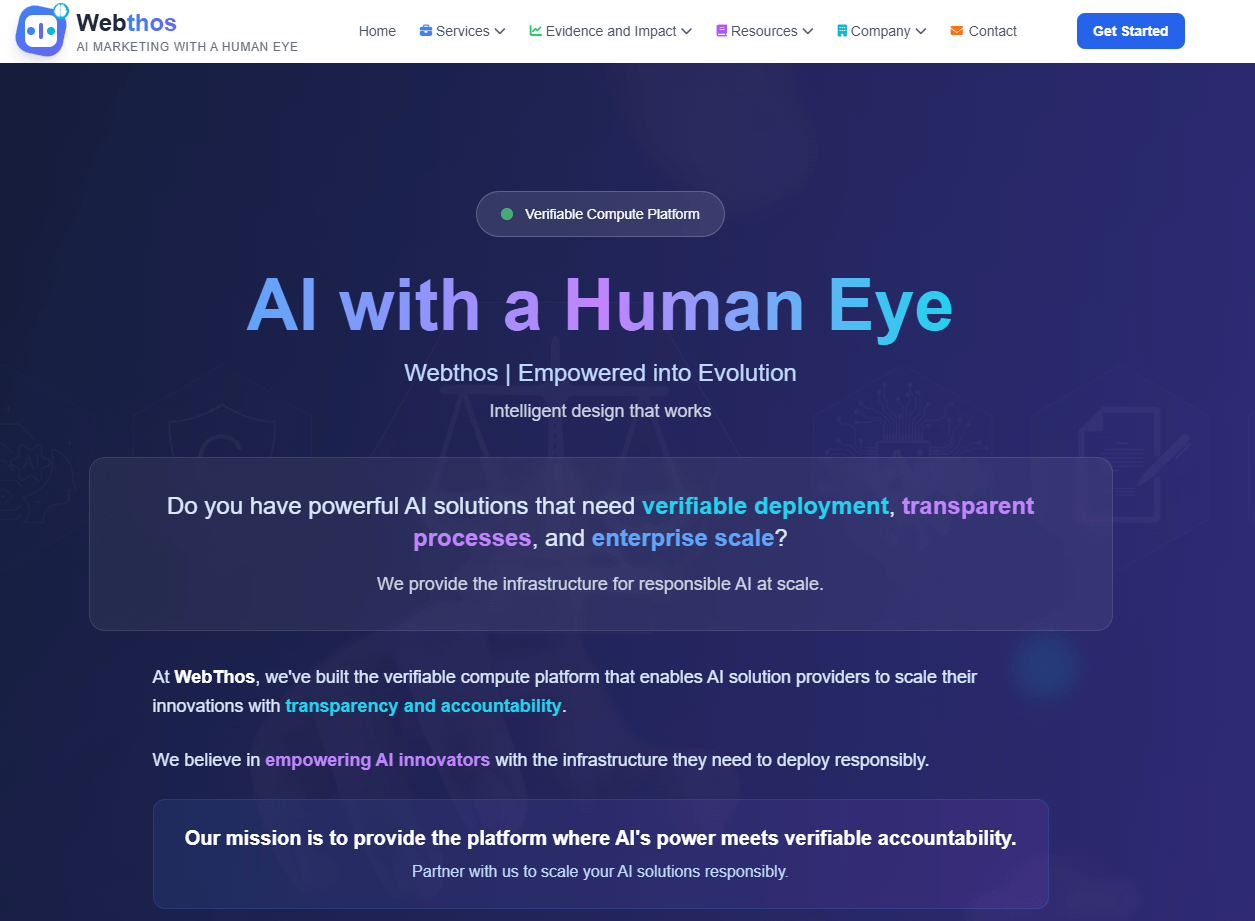
Cryptographically secured compute platform that makes AI computations transparent and auditable, with human-in-the-loop oversight built into decision points, per WebThos materials.
Best for: Organizations that want verifiable execution evidence plus operational oversight, such as healthcare, finance, or public sector deployments.
Key Features:
- Cryptographic proof of execution for every computation
- Complete audit trails for compliance and investigations
- Human-in-the-loop controls and bias mitigation tooling
- Real-time transparency dashboards
Why we like it: Brings verifiable compute together with human review hooks that many risk and compliance teams already require.
Notable Limitations:
- Limited technical documentation available publicly
- Few third-party references or benchmarks
- Integration details for complex environments are not fully detailed online
Pricing: Pricing not publicly available. Contact WebThos for a custom quote.
Verifiable AI Autonomy Tools Comparison: Quick Overview
| Tool | Best For | Pricing Model | Highlights |
|---|---|---|---|
| Verity Intelligence (CCSL) | Open-source, policy-in-code verification and audit evidence | Open-source core, enterprise support by quote | Pre-runtime verification, cryptographic audit trail |
| Corvair.ai | Enterprise agent governance with runtime enforcement | Published tiers, plus Enterprise custom | Per-action PDP, ZSP, immutable audit logs |
| Soverio | Standards-based agent identity and consent | Custom quote | W3C VC, DID, OpenID4VCI, MCP, A2A |
| WebThos | Verifiable compute with human oversight | Custom quote | Proof of execution, human-in-the-loop, dashboards |
Verifiable AI Autonomy Platform Comparison: Key Features at a Glance
| Tool | Embedded Policy or Identity | Runtime Enforcement | Cryptographic Evidence |
|---|---|---|---|
| Verity Intelligence (CCSL) | Policy embedded in code | Pre-runtime verification gate | Hash-chained audit artifacts |
| Corvair.ai | Agent Registry and cryptographic identity | Per-action PDP and JIT privileges | Immutable, tamper-evident logs |
| Soverio | W3C VC and DID for agents | Consent and authorization scoping | Verifiable credential proofs and logs |
| WebThos | Human-in-the-loop design | Operational oversight and controls | Proof of execution, complete trails |
Verifiable AI Autonomy Deployment Options
| Tool | Cloud API | On-Premise or Air-Gapped | Integration Complexity |
|---|---|---|---|
| Verity Intelligence (CCSL) | Not publicly described | Self-host via open-source core; air-gapped possible | Adopt policy DSL, compiler in CI |
| Corvair.ai | Yes, Starter is cloud | Enterprise on-prem available; air-gapped not publicly described | CI/CD hooks, PDP integration at runtime |
| Soverio | Not publicly described | Likely supported for enterprise; air-gapped not publicly described | VC issuance, DID registry, OIDC flows |
| WebThos | Not publicly described | Indications of enterprise deployments; air-gapped not publicly described | Proof generation, dashboards, HITL wiring |
Verifiable AI Autonomy Strategic Decision Framework
| Critical Question | Why It Matters | What to Evaluate | Red Flags |
|---|---|---|---|
| Can you prove what ran, when, and under which policy? | Regulators and auditors expect tamper-evident evidence, and breach costs keep rising | Native cryptographic attestations, chain-of-custody, log integrity | Plain text logs without cryptographic binding |
| Do you control agent privileges per action, not just per role? | Zero Standing Privilege reduces blast radius | Per-action PDP, JIT access, revocation on task completion | Broad static roles reused from human IAM |
| Is agent identity portable and verifiable across tools? | Cross-tool workflows fail without shared identity | W3C VC, DID, OpenID4VCI alignment, SPIFFE-style workload IDs | Proprietary identity with no credential portability |
| Can humans pause or approve sensitive steps? | NIST AI RMF stresses governance and human oversight | Human-in-the-loop controls and explainability | Opaque automation with no intervention points |
Verifiable AI Autonomy Solutions Comparison: Pricing and Capabilities Overview
| Organization Size | Recommended Setup | Monthly Cost | Annual Investment |
|---|---|---|---|
| Startup, pre-prod agents | Verity open-source core for policy-in-code and POC, Soverio pilot for agent identity | Minimal infra costs, vendor quotes required | Depends on internal hosting |
| Mid-market with regulated workflows | Corvair Business tier for runtime controls, Soverio for VCs, selective Verity modules for policy checks | Corvair listed at $5,000 per month, identity platform by quote | Approximately $60,000 for Corvair plus identity and infra by quote |
| Large enterprise, mission-critical | Corvair Enterprise with on-prem, Soverio at scale, WebThos for verifiable compute and HITL | Custom quotes across vendors | Custom enterprise agreements |
Problems & Solutions
-
Problem: Shadow AI and weak governance inflate breach impact and costs. IBM reports a global average breach cost of $4.44 million in 2025, with AI-related incidents adding further expense, and highlights governance gaps that make incidents harder to contain.
Solution with Corvair.ai: Use the Agent Registry to block non-compliant agents during CI and the real-time Governance Engine to make per-action decisions and revoke privileges instantly, producing immutable audits, per vendor documentation. -
Problem: Auditors want tamper-evident evidence that controls actually ran, not just promises. Research and industry commentary emphasize cryptographic attestations and hash-chained logs for AI workflows to produce verifiable proof of execution (ePrint on verifiable temporal commitments, arXiv evidence structures).
Solution with Verity Intelligence: Embed policy in code and verify before execution, then emit cryptographic records for each run so you can prove what executed and under which policy, per Verity materials. -
Problem: Cross-tool agent identity and consent are hard to standardize. W3C made the Verifiable Credentials 2.0 family a Recommendation, and OpenID4VCI defines issuance and presentation flows that enterprises can adopt for verifiable agent permissions (W3C VC 2.0 Recommendation, OpenID4VCI spec).
Solution with Soverio: Adopt W3C VC and DID for portable agent identity and consent, then wire OpenID4VCI issuance flows and Model Context Protocol for standardized access, per Soverio documentation. -
Problem: Governance frameworks now expect oversight, traceability, and accountability across the AI lifecycle. NIST's AI RMF highlights risk management and traceable processes that many regulators reference when auditing AI deployments.
Solution with WebThos: Pair cryptographic proof of execution with human-in-the-loop decision points and transparency dashboards so risk teams can pause, review, and evidence compliance, per WebThos materials.
Bottom Line on Verifiable Autonomy
If you run AI agents in production, verifiable controls are not optional. Market signals point the same way, with AI governance software projected to hit $15.8 billion by 2030 per Forrester, while breach costs remain significant according to IBM's latest report.
- Pick Verity Intelligence if you want policy-in-code and cryptographic evidence baked into your build pipeline.
- Pick Corvair.ai if you need millisecond, per-action enforcement and immutable audits across many agents.
- Pick Soverio if standards-based identity and consent must travel with your agents across tools.
- Pick WebThos if you want verifiable compute plus human review hooks for high-stakes decisions.
Pricing for several vendors is not public, so confirm scope, deployment model, and attestations during procurement. Align your choice with NIST AI RMF controls and standards like W3C VC to reduce audit friction and, more importantly, to prevent the next incident before it starts.