
On 23 Jul 2026, Hedge Fund Research put global industry capital at a record $5.6 trillion after a $409.3 billion jump in the second quarter: $364 billion from performance, $45.2 billion from net inflows. Most of that money went to firms over $5 billion. Smaller managers still have to report like the big ones. That is why the shortlist is the four desks that break.
People buy “hedge fund software” as if it were one product. It is not. Accounting, front-to-back portfolio management, investor relations, and deal CRM are four purchases that all get sold under the same homepage phrase. Averaging them is how a MetaTrader terminal or a DocSend room ends up in a fund-ops budget.
We compared four platforms on that split: whether the broken desk is the book, and whether any starting price is printed. If you need to strike or shadow a NAV and want a published floor, start with FundCount at $35,899 per year. If the hole is order-to-custody on one platform, Linedata AMP is the modular PMS/OMS buy. If IR and capital raising are the bottleneck, Backstop is the allocator-relationship system. If fundraising, the investor portal, and deal CRM have to sit on the same record, Dynamo is the CRM-and-portal path.
How we chose these four
Four desk checks, all on a first-party page: which desk the SKU actually names, whether any starting price is public, what the quote still hides (entities, users, modules, hosting), and whether a directory placeholder is pretending to be a list. Category-page screenshots did not move a ranking. MetaTrader, DocSend, Enfusion, and the adjacent ops tools sit in What we left out because they sit outside the four desk checks.
TL;DR: The Four Compared
| Service | Best for | What to check |
|---|---|---|
| FundCount | Strike or shadow a NAV, with a published starting price |
DeskOne general ledger across investment, partnership, and financial books
PriceHedge Fund and Shadow Hedge Fund from $35,899 / year, plus implementation and hosting. Not per user
Watch-outThe grid does not size implementation or hosting. Treat $35,899 as the license line, not the first invoice
|
| Linedata AMP | Order-to-custody on one vendor, including algo routing and 60-plus integrations |
DeskPMS, OMS/trading, compliance, and the data services under them
PriceQuote-only. No public list and no AWS Marketplace listing
Watch-outMosaic is a workspace over the stack. If you do not already run Linedata or a partner OMS, you are buying AMP first
|
| Backstop | IR and capital raising, especially if you already live in ION Analytics |
DeskAllocator relationship: pipeline, documents, capital activity, client portal
PriceQuote-only. Contact Backstop / ION Analytics
Watch-outIt is not a PMS or a general ledger. Confirm which contract entity you are signing
|
| Dynamo Software | Fundraising, investor portal, and deal CRM on the same record |
DeskAlternatives CRM and portal, with optional deal, portfolio, and accounting modules
PriceQuote-only. Ignore $1 / year directory stubs
Watch-outThe hedge-fund motion is a slice of a private-markets platform. Demo IR and portal first
|
The table is the desk map. The write-ups below are the same four platforms, in the same order, with the desk language that will not fit in a cell.
FundCount
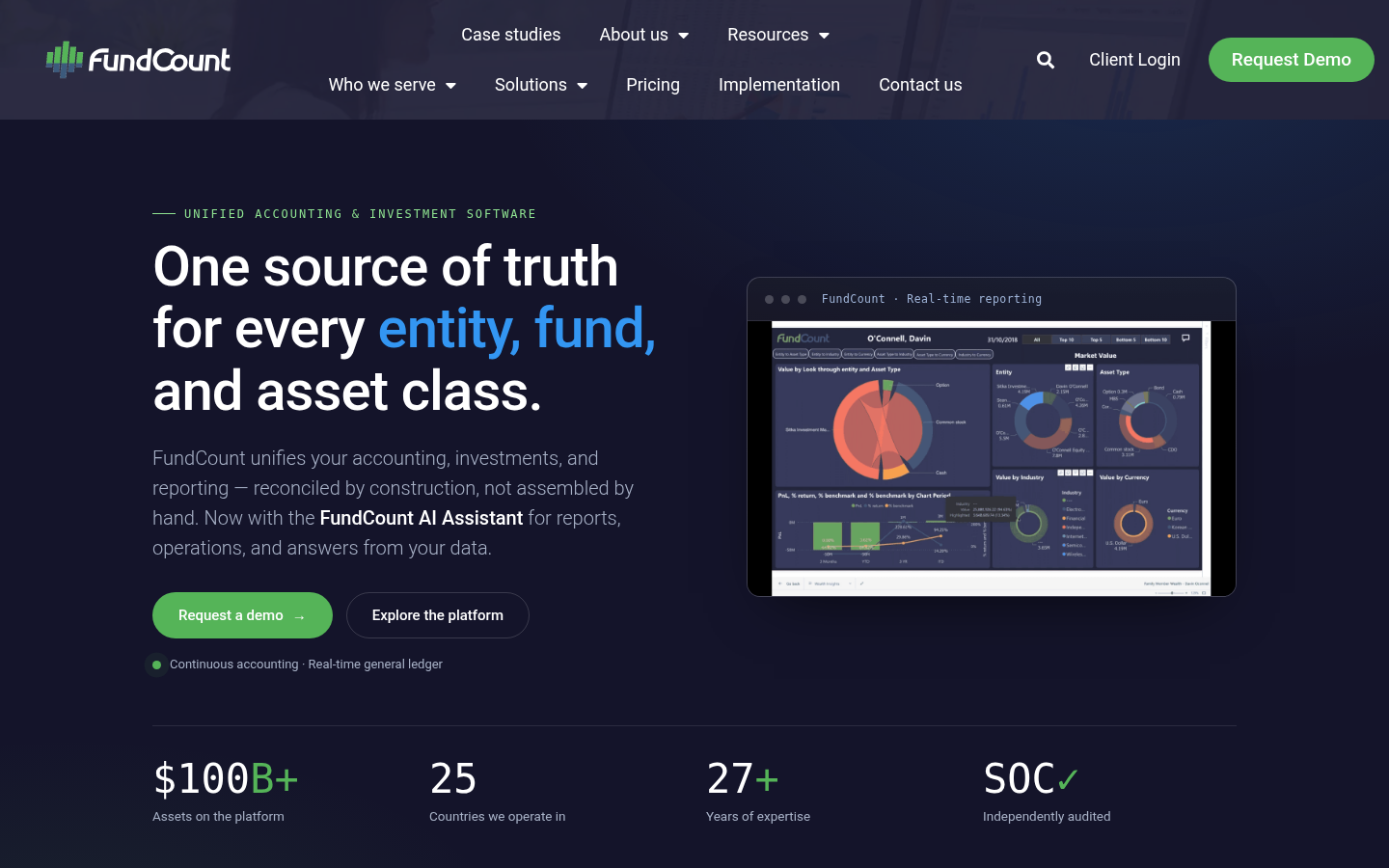
FundCount is the accounting buy: one general ledger across investment, partnership, and financial books, used to strike a NAV or to shadow the administrator who already does. The pricing page is public. Hedge Fund and Shadow Hedge Fund both start at $35,899 per year, plus digital transformation and hosting fees. That is a platform license. User count is a sizing input on the quote.
The same page lists a Fund Admin Incubator from $14,450 per year (up to five funds, $50 million AUA per fund, one user) and Fund Administration from $26,950. Family-office SKUs start at $26,950 and $35,899. Private Equity starts at $38,389. Founded 1999. SOC 2 Type II. It will not replace an OMS or an investor CRM. If the broken desk is trading or fundraising, start with one of the other three.
Best for: Emerging and mid-size managers who need to strike NAVs by class, side pocket, partner, or series (or to shadow an external administrator) and who want a number they can put in a budget before the demo.
What you get:
- One real-time general ledger for investment, partnership, and financial accounting, multi-entity and multi-currency, with master-feeder and side-pocket structures.
- Automatic management and incentive fee calculations across partnership vehicles; P&L and cash flows across complex structures.
- Shadow mode for funds that already have an administrator: on-site or a single-client secure cloud, no extra IT stack required.
- Deployment on-site, public or private cloud, or fully managed SaaS. Implementation and hosting are scoped in the quotation.
Why we like it: It is the only product in this set with a first-party starting price a COO can defend in a partner meeting. The 2026 page is an annual platform license from $35,899.
Limits:
- The published figures are starting points. Entity count, users, AUM/AUA, and hosting still move the quote, and implementation is extra.
- It will not replace an OMS or an investor CRM.
- No AWS Marketplace listing.
Price: First-party. Hedge Fund and Shadow Hedge Fund from $35,899 / year plus implementation and hosting. Not per user. Fund Admin Incubator from $14,450 / year. Fund Administration from $26,950. Private Equity from $38,389.
Linedata AMP
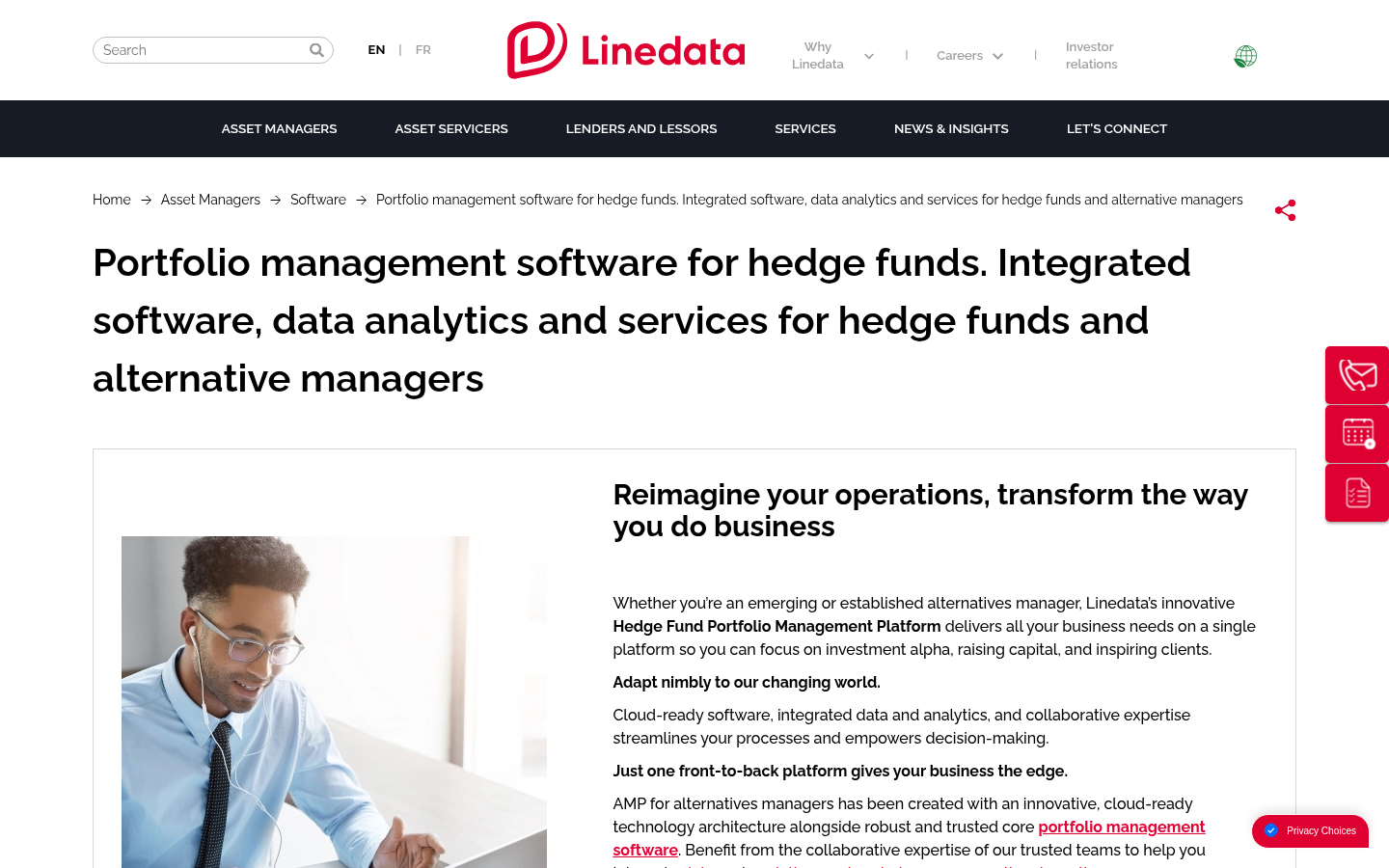
Linedata AMP is the front-to-back buy for alternatives: portfolio management, order management, compliance, and the data services that sit under them, on a cloud-ready modular stack. The hedge-fund page names a cloud-native algo trading path, ESG scores inside the PMS, liquidity to 600-plus global brokers, and 60-plus integration partners.
On 9 Mar 2026 Linedata launched Mosaic, an FDC3-native workspace that sits above existing OMS, EMS, and analytics tools and keeps context in sync so a trader is not re-keying the same bond across three screens. The first profile is fixed income, with a BondCliQ partnership for US corporate quotes. More profiles are slated through 2026. Linedata (Euronext Paris: LIN) does not publish list prices.
Best for: Established and growing hedge funds that want order-to-custody on one vendor, will take a modular rollout, and can live with a sales-led contract.
What you get:
- AMP for alternatives: PMS, OMS/trading, compliance, fund services, on a CI/CD modular architecture.
- Algo trading, ESG Book UN Global Compact scores in the core PMS, and broker connectivity at the scale Linedata publishes (600-plus brokers, 60-plus partners).
- Analytics Service: machine-learning models on the firm’s own ops data, including Trade Analytics for break patterns.
- Mosaic (9 Mar 2026): FDC3 workspace over Linedata, partner, and client apps, starting with fixed income.
Why we like it: Mosaic is the dated 2026 fact that matches how desks actually work. They will not rip out the EMS this quarter. A unified workspace over the stack you already paid for is a more honest pitch than another rip-and-replace.
Limits:
- Quote-only. Module mix, users, data services, and implementation drive the bill. There is no public AWS listing.
- Tailored alternatives structures take longer to stand up than a generic long-only book. Budget a real onboarding.
- Mosaic is a workflow layer. If you do not already run Linedata or a partner OMS, you are buying AMP first.
Price: Quote-only. No public list and no AWS Marketplace listing.
Backstop
Backstop is the IR and capital-raising buy, now a service of ION Analytics (acquired late 2021). For GPs it is the system of record for the allocator relationship: pipeline, documents, capital activity, and a branded client portal. Admin Connect pulls performance, capital activity, and balances from the fund administrator so IR is not re-typing the admin’s file.
IntellX auto-files documents from fund-source email and portals onto the right fund. BarclayHedge data sits on the same platform for manager research. Pricing is not public. When HFR’s 2Q inflows are this concentrated in firms over $5 billion, a mid-size GP’s edge is response time and a portal that does not embarrass the firm. Two IR platforms is a duplicate seat.
Best for: Hedge fund and other alternative GPs whose pain is raising and retaining capital (pipeline, LP service, portal, and admin data in one place), especially firms already in the ION Analytics orbit.
What you get:
- Investor relations and capital-raising CRM: prospecting through close, then ongoing service on the same record.
- Client portal for on-demand documents and reporting, with access controls aimed at allocator privacy.
- Admin Connect for administrator feeds; IntellX for document retrieval; REST APIs under a separate license for in-house integrations.
- Research management and portfolio monitoring for multi-asset LPs, consultants, and funds of funds on the same suite.
Why we like it: It is the product in this set that treats the LP relationship as the object. Shadow NAV and order management still live somewhere else, which is the honest split.
Limits:
- Quote-only. No AWS Marketplace listing.
- It is not a PMS or a general ledger.
- ION ownership is four years old, but the public site still splits backstopsolutions.com and ionanalytics.com. Confirm which contract entity you are signing.
Price: Quote-only. Contact Backstop / ION Analytics.
Dynamo Software
Dynamo is the alternatives CRM-and-portal buy that grew a wider front-to-middle suite around it. For hedge funds the useful surface is investor communications, the pipeline, and the investor portal; the same platform also sells deal flow, portfolio monitoring, and fund accounting modules that more often show up in private markets. Dynamo v3.0 is the current interface. Directory copy cites 1,000-plus clients and more than $10 trillion in AUM. Treat that as vendor marketing.
DynamoAI is embedded in the workflows (tagging, document summary, extraction, Q&A). Integrations named on the product pages include Outlook, Gmail, PitchBook, Preqin, and FactSet. No first-party price list. Third-party directories printing $1.00 / year are marketplace placeholders.
Best for: GPs that want fundraising, investor portal, and relationship history on one record, and that may later turn on Dynamo’s accounting or portfolio modules without a second vendor.
What you get:
- CRM and capital-raising pipeline with activity history, mail campaigns, and allocator profiling.
- Investor portal for documents and performance; admin-feed style pulls of transactions and balances where configured.
- Optional modules for deal management, portfolio monitoring, fund accounting, and ESG. Useful if the firm is not hedge-only.
- DynamoAI across those workflows. Confirm what is generally available versus a demo feature on your tenant.
Why we like it: It is the closest thing here to a single GP operating system if you already think in relationships. Backstop is deeper on IR-for-alternatives heritage. Dynamo is the one that will also talk about the deal and the GL.
Limits:
- Quote-only. Implementation, migration, and training are extra. Do not use a $1/year directory stub in a budget.
- The hedge-fund motion is a slice of a private-markets platform. Demo the IR and portal first; do not buy the full suite because the homepage lists it.
- No AWS Marketplace listing for the hedge-fund SKU.
Price: Quote-only. Ignore $1/year placeholders on software directories.
Is the broken desk the book, and is any price printed?
This grid plots two questions. Across is the desk: the book and the blotter on the left, the LP relationship on the right. Up is whether a first-party page prints a starting price: a published floor at the top, quote-only at the bottom.
Placement is from first-party SKU language: NAV and allocations versus order-to-custody versus IR versus CRM-and-portal, and a printed annual floor versus quote-only. Directory stubs at $1 / year are not a list price, so Dynamo stays on the quote side. The grid is a desk map, not a ranking.
What the quote still hides
| Service | Published rate | What the quote still hides |
|---|---|---|
| FundCount | Hedge Fund and Shadow from $35,899 / year. Incubator from $14,450 | Implementation and hosting. Entity count, users, and AUM/AUA still move the license |
| Linedata AMP | None. Quote-only | Module mix, users, data services, Mosaic, and onboarding |
| Backstop | None. Quote-only | Seats, Admin Connect, IntellX, and the REST API license. Which ION entity signs |
| Dynamo Software | None. Quote-only. Ignore $1 / year stubs | Which modules you turned on, plus implementation, migration, and training |
What we left out
Ops neighbors that missed a named desk: a named fund-ops desk, a first-party meter, or a job that is actually NAV, OMS, IR, or CRM.
- MetaTrader 5 — a multi-asset trading terminal, not fund ops. It fails the desk check the moment you paste it into a NAV or IR budget.
- DocSend — a data room. Useful for a raise. It is not investor CRM, and it is not a general ledger.
- Enfusion — the cloud OMS/PMS a lot of 2026 RFPs also name. If the hole is a single-codebase front-to-back cloud stack priced on users and interfaces, put it on the POC next to Linedata. It is not this default four.
- FactSet, OpenGamma, Hazeltree, Bipsync, Broadridge, Orchestrade, Atom Invest, SS&C Eze / Geneva — living platforms. They belong on a later shortlist once you can name the desk.
Questions before you sign a fund-ops contract
If the desk and the floor stay unpublished, you are still buying a homepage category.
- Which desk is broken? NAV and allocations, order-to-custody, IR and the raise, or CRM and the portal. Those are four purchases. Two IR platforms is a duplicate seat.
- Is any starting price printed? One platform on this page publishes an annual floor. The others are sales calls. A $1/year directory stub is not a list price.
- What does the quote still meter? Entities, users, modules, interfaces, implementation, and hosting all move the first invoice. Ask for the unit in writing.
NAV and allocations: FundCount, and you already have a starting number at $35,899. Order-to-custody: Linedata AMP, knowing Mosaic is a workspace over the stack. IR and the raise: Backstop if the LP relationship is the object. CRM, portal, and the option to turn on a GL later: Dynamo. Then put the pricing page next to the desk that is actually late this month.
Frequently asked questions
Can we treat FundCount’s $35,899 as year-one?
Treat it as the license line, not the first invoice. Hedge Fund and Shadow Hedge Fund both start at $35,899 per year on the first-party pricing page. Digital transformation and hosting are extra. Entity count, users, and AUM/AUA still move the quotation. Fund Admin Incubator starts at $14,450.
Is investor CRM the same purchase as a PMS?
No. A PMS or OMS is the blotter: orders, compliance, custody. IR and CRM are the allocator relationship: pipeline, portal, documents. Buying one will not strike a NAV or route an order. Buying both because the homepage said “hedge fund software” is how you pay for a desk you did not break.
Why does Dynamo show $1 per year on software directories?
Those are marketplace placeholders, not a vendor list price. Dynamo is quote-only. Implementation, migration, and training are extra. Do not put $1/year in a budget.