

You think you know how your agents behave in staging until a real user triggers five tool calls in parallel and your run budget vaporizes. From our experience in the startup ecosystem, the biggest wins come from getting the orchestration layer right early, for example strict tool routing and budgets, per-agent execution traces with replay, and human approval gates on side-effecting actions.
Teams that skip this pay for it in outages and token bills later. A growing body of enterprise research says the adoption curve is steep, but governance and observability decide outcomes, not raw model quality, a point echoed in Gartner's 2026 agentic AI coverage. In Gartner's 2026 CIO and Technology Executive Survey, only 17 percent of organizations had deployed AI agents while more than 60 percent expect to within two years, the most aggressive adoption curve of any emerging technology Gartner tracks. Gartner's Hype Cycle for Agentic AI backs this up.
According to a recent Gartner press release, worldwide AI spending is forecast to reach 2.59 trillion dollars in 2026, up 47 percent year over year, with CIOs expanding pilots into production agents inside core workflows (Gartner newsroom). You will learn which tools fit self-hosted control, cloud task dispatch with cost visibility, and mixed chat or voice automation, plus where third-party validation is still thin.
Tvara
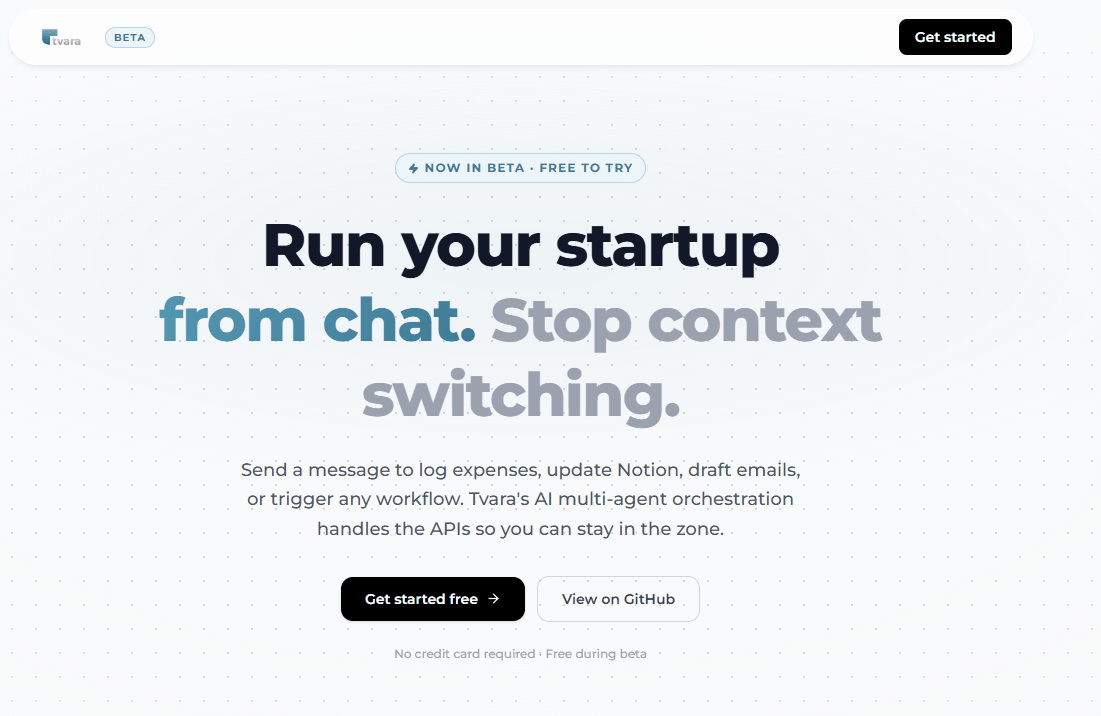
Chat-first multi-agent orchestration that routes tool calls and executes business workflows from a single conversation. Positioned for teams that want to "run the startup from chat," per vendor materials.
Best for:
Founders and ops leads who want chat-centric coordination across tools without wiring a full workflow engine.
Key Features:
- Chat-driven task dispatch and tool selection, per vendor documentation.
- Multi-agent routing with function and API call execution, per vendor documentation.
- Light workflow memory to carry context across steps, per vendor documentation.
Why we like it:
Fast to trial for teams that already run a lot of work in Slack or chat and want a single surface to trigger tools and get traced results.
Notable Limitations:
- No independent reviews on G2, Capterra, or TrustRadius as of June 28, 2026, so external validation is limited.
- Enterprise controls like SSO, detailed RBAC, or audit export are not independently documented by third parties.
- Strategy risk, analyst coverage of agentic platforms warns about vendor lock-in during the next 12 to 18 months (Gartner's Hype Cycle for Agentic AI).
Pricing:
Pricing not publicly available. Contact vendor for a custom quote.
SwarmLab
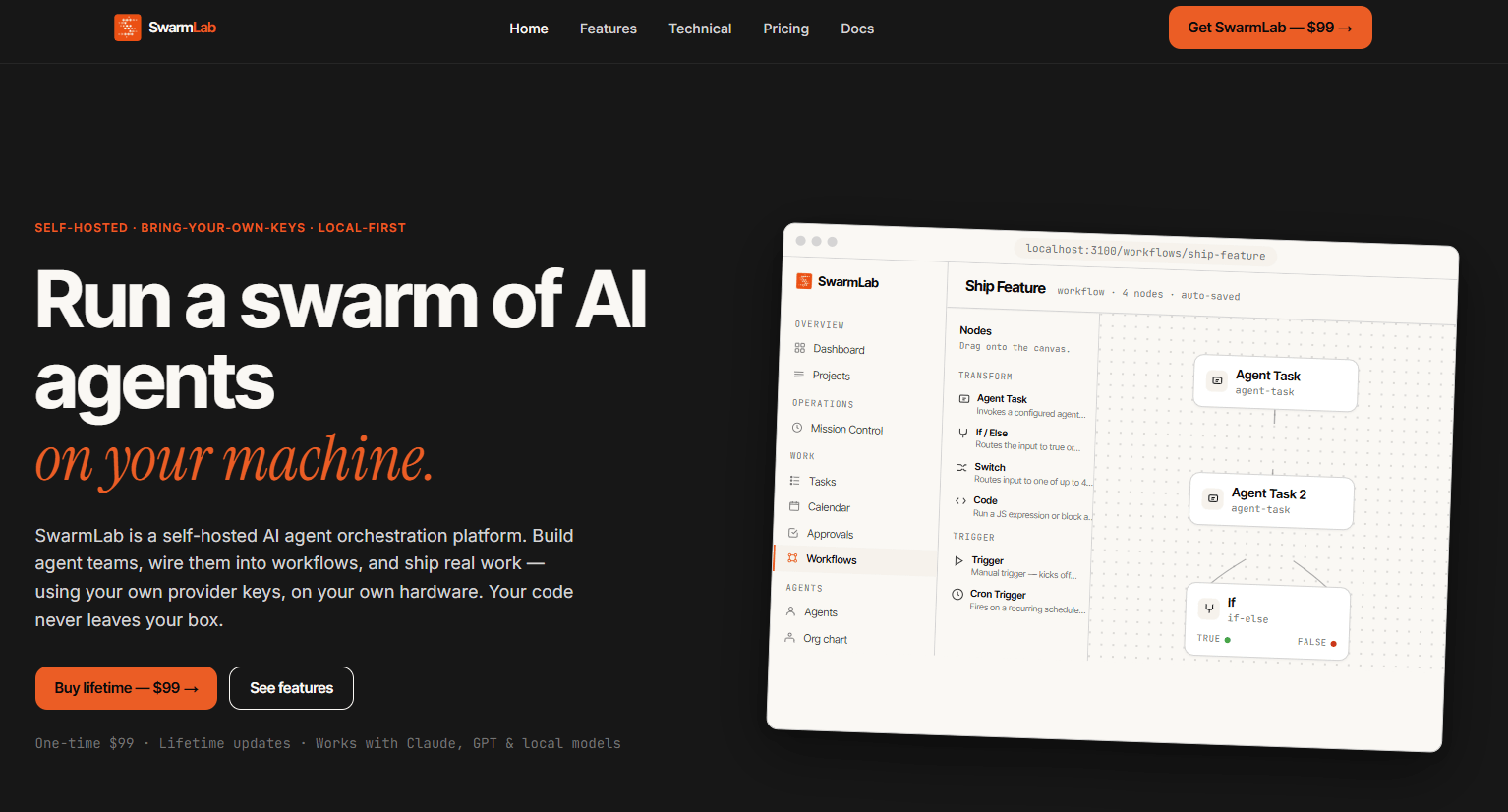
Self-hosted agent orchestration that runs locally, bring your own LLM keys, no vendor cloud in the loop. Visual workflow builder and local observability, per vendor site.
Best for:
Teams that require on-prem or developer-controlled runtime, and want to keep data and traffic local.
Key Features:
- Self-hosted, local runtime with no telemetry collection, per vendor documentation.
- Visual multi-agent workflow canvas with human approval gates, per vendor documentation.
- Bring-your-own keys for OpenAI, Anthropic, and local models, per vendor documentation.
- Kanban-style work tracking for agent tasks, per vendor documentation.
Why we like it:
Strong fit for privacy-sensitive projects where engineers want to inspect and control every agent step without a vendor SaaS in the path.
Notable Limitations:
- No third-party reviews on major platforms at the time of writing, so performance and support quality are not independently rated.
- Self-hosting shifts patching, monitoring, and security hardening to your team, a known adoption barrier in early agentic stacks (Forrester's 2026 state of agentic AI).
- Advanced compliance features and enterprise SSO are not independently verified.
Pricing:
Publicly advertised as a lifetime license model on the vendor's site as of June 28, 2026, verify current pricing directly before purchase.
Orchify
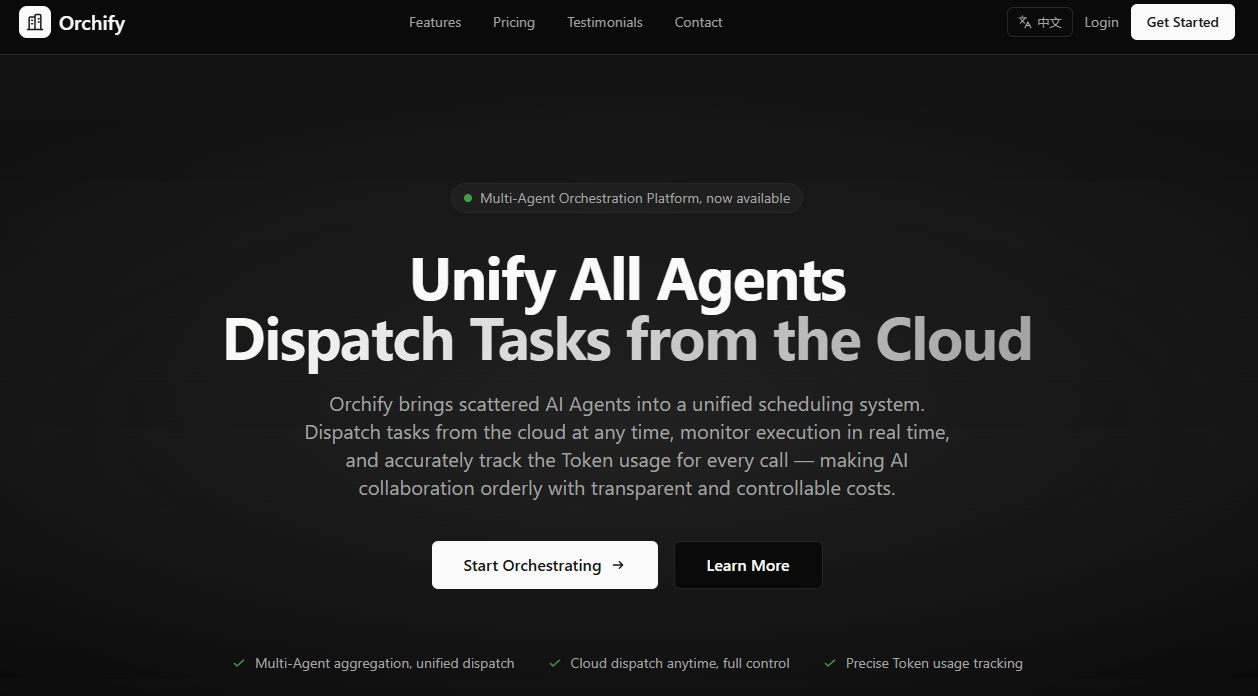
Cloud-based orchestration with unified task dispatch across agents, token usage tracking, and execution traces for cost and outcome visibility, per vendor materials.
Best for:
Product and platform teams that want cloud scheduling, cost tracking, and centralized traces across many agents.
Key Features:
- Unified, cloud dispatch for heterogeneous agents, per vendor documentation.
- Real-time token usage and cost dashboards to curb spend, per vendor documentation.
- Execution traces to review decisions and outcomes, per vendor documentation.
Why we like it:
The focus on token and execution visibility maps to the top failure modes analysts describe, like budget overruns and black-box behaviors (IDC's agentic ecosystem brief).
Notable Limitations:
- Limited third-party coverage or user reviews to benchmark reliability at scale.
- Cloud-only posture may not suit air-gapped or regulated environments.
- No verified marketplace listing for pricing at time of writing.
Pricing: Pricing not publicly available. Contact vendor for a custom quote.
Enactflow
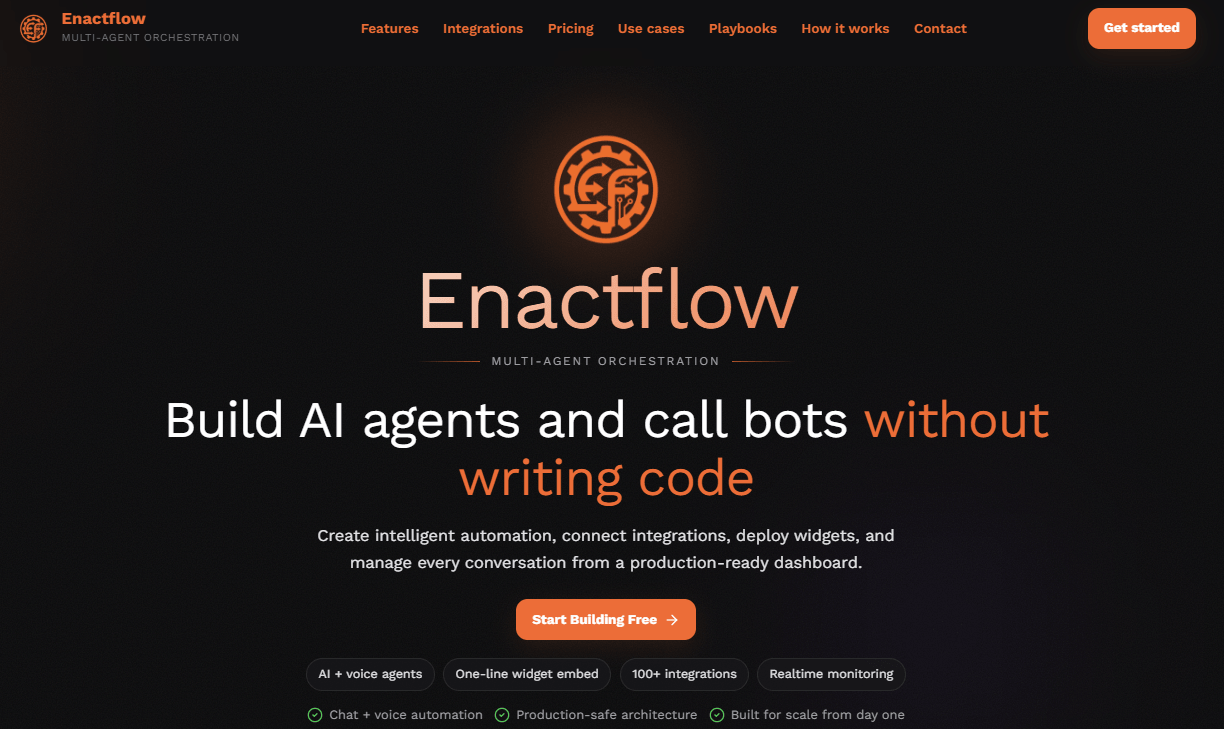
Hosted orchestration with a visual node or graph builder, 100 plus integrations, and chat or voice automation with real-time monitoring, per vendor materials.
Best for:
Operations and CX teams that want to mix chat, voice, and integrations without code.
Key Features:
- Visual graph builder for multi-agent flows, per vendor documentation.
- Chat and voice pipelines with STT, LLM, and TTS, per vendor documentation.
- 100 plus integrations and a one-line embeddable widget, per vendor documentation.
- Real-time session monitoring and conversation review, per vendor documentation.
Why we like it:
Voice plus chat orchestration addresses common contact center and CX handoffs while keeping design low code.
Notable Limitations:
- No independent ratings on G2, Capterra, or TrustRadius found as of June 28, 2026.
- Cloud deployment can complicate strict data residency or air-gapped needs.
- Pricing and enterprise SLAs are not validated by third parties.
Pricing:
Pricing not publicly available. Contact vendor for a custom quote.
Agent Coordination & Multi-Agent Orchestration Tools Comparison: Quick Overview
| Tool | Best For | Pricing Model | Highlights |
|---|---|---|---|
| Tvara | Chat-centric task routing | Not publicly available | Conversational dispatch, light workflow memory, tool routing |
| SwarmLab | Self-hosted control | Publicly listed lifetime model, verify current terms | Local runtime, visual workflows, BYO keys |
| Orchify | Cloud scheduling and spend visibility | Not publicly available | Unified dispatch, token tracking, execution traces |
| Enactflow | No-code chat or voice automation | Not publicly available | Visual graph builder, voice pipelines, 100 plus integrations |
Agent Coordination & Multi-Agent Orchestration Platform Comparison: Key Features at a Glance
| Tool | Unified Dispatch | Spend/Token Tracking | Traces/Observability |
|---|---|---|---|
| Tvara | Yes, via chat-driven routing | Basic budgets, per vendor docs | Basic run history, per vendor docs |
| SwarmLab | Yes, visual canvas | BYO provider billing | Local traces, human approval gates |
| Orchify | Yes, cloud scheduler | Real-time token and cost views | Execution traces across agents |
| Enactflow | Yes, graph builder | Not stated | Live session monitoring and reviews |
Agent Coordination & Multi-Agent Orchestration Deployment Options
| Tool | Cloud API | On-Premise | Integration Complexity |
|---|---|---|---|
| Tvara | Yes | Not stated | Low to Medium, chat-first setup |
| SwarmLab | Optional, runs local | Yes | Medium, developer oriented |
| Orchify | Yes | Not stated | Medium, central scheduler |
| Enactflow | Yes | Not stated | Low, visual builder and widget |
Agent Coordination & Multi-Agent Orchestration Strategic Decision Framework
| Critical Question | Why It Matters | What to Evaluate | Red Flags |
|---|---|---|---|
| Do we need self-hosted control? | Data control and audit often trump speed in regulated teams | On-prem option, local traces, SSO, RBAC | Cloud-only with vague data handling |
| How will we cap run costs? | Token overruns are a top failure mode in agent pilots | Per-run budgets, token dashboards, pre-execution guards | No spend visibility or kill switches |
| What does observability look like? | You need to replay bad runs and fix prompts, tools, or policies | Step-level traces, tool call logs, deterministic routing | Black-box orchestration with no replay |
| Can we exit cleanly in 12 months? | The market is volatile and lock-in risk is real | Data portability, export formats, agent graph interchange | Proprietary graphs with no export, long contracts |
Agent Coordination & Multi-Agent Orchestration Solutions Comparison: Pricing & Capabilities Overview
| Organization Size | Recommended Setup | Monthly Cost | Annual Investment |
|---|---|---|---|
| Startup, privacy sensitive | SwarmLab self-hosted with BYO keys and minimal agent set | Varies by model usage, confirm internally | Varies by usage, confirm internally |
| Product team piloting agents | Orchify for cloud dispatch and spend tracking, or Tvara for chat-first pilots | Vendor pricing not public, factor LLM costs | Vendor pricing not public, factor LLM costs |
| CX or RevOps automation | Enactflow for voice plus chat flows with 100 plus integrations | Vendor pricing not public, factor telephony and LLM | Vendor pricing not public, factor telephony and LLM |
Problems & Solutions
-
Problem: "Black-box" agents and brittle runs. Analysts highlight that few organizations have mature agent observability, which slows scale up to production (Gartner's Hype Cycle for Agentic AI).
- Tvara: Chat-centric dispatch with basic run history makes it easy for operators to diagnose misrouted tool calls.
- SwarmLab: Local execution traces and human approval gates help replay and correct failures before side effects.
- Orchify: Execution traces across agents let platform teams compare decisions and outcomes for the same task.
- Enactflow: Live session monitoring aids prompt and routing adjustments during calls or chats.
-
Problem: Token overruns during production spikes. Cost control is a leading operational gap as pilots move to production (IDC's agentic ecosystem brief).
- Tvara: Simple budgets and approvals, per vendor docs, curb waste on high-risk actions.
- SwarmLab: BYO keys mean you see provider invoices directly and can cap spend at the source.
- Orchify: Real-time token and cost tracking alert owners before budgets are exceeded.
- Enactflow: Visibility into session length and tool usage supports per-flow guardrails.
-
Problem: Cloud versus on-prem control. Many teams require local execution for compliance while analysts still forecast a rapid uptick in agent deployments, creating a near-term tension (Gartner's 2026 spending forecast).
- SwarmLab: Purpose built for local, single-binary deploys that can run disconnected.
- Orchify and Enactflow: Cloud speed for teams without strict data residency needs.
- Tvara: Lightweight path for chat-first teams, but validate data handling for regulated use.
-
Problem: Planning for volatility and lock-in. Gartner projects that more than 40 percent of agentic AI projects will be canceled by the end of 2027 on escalating costs, unclear value, or weak controls, and independent coverage warns that adoption is outpacing the controls needed to manage it (TechRadar analysis).
- All four: Before purchase, demand export of agent graphs, traces, and conversation logs in open formats, and opt for 12 month terms.
Practical Takeaways Before You Buy
- Spend visibility and traces first, model choice second. Budget overruns and lack of replay block production scale more than model accuracy, a theme reflected across recent Gartner and IDC coverage.
- Balance speed and control. Cloud schedulers like Orchify and hosted builders like Enactflow cut time to value, while self-hosted SwarmLab fits teams that need local control.
- Chat-first or workflow-first is a strategic choice. Tvara's chat surface speeds adoption for non-technical teams, while visual canvases can standardize processes across squads.
- Validate pricing and exit. Market momentum is real, but adoption patterns are uneven and lock-in risk is high, so insist on short terms and portable artifacts during 2026 pilots.
Conclusion, How to Pick the Right Orchestrator in 30 Minutes
Shortlist based on deployment constraints, then pick for cost controls and traces. If you need local control, start with SwarmLab. If you want cloud scheduling and spend visibility, look at Orchify. If CX or ops needs voice and chat, Enactflow's graph builder is a fit. If executives want a chat-first command surface, Tvara is a fast path. The market is expanding quickly in 2026, but analyst research emphasizes governance and observability over hype, so anchor your choice on those two factors first (Gartner's Hype Cycle and IDC's ecosystem research).