You think you know where agent projects go off the rails until a real incident forces a rollback because no one tracked tool calls, retries, or context handoffs. From our experience in the startup ecosystem, the biggest wins come from shipping guardrails early, like JSON schema based tool invocation, DAG style task graphs with timeouts, and permission scoped memory stores for retrieval. Market momentum is undeniable, with Gartner predicting that 40 percent of enterprise apps will feature task specific AI agents by 2026, up from less than 5 percent in 2025, which raises the bar on orchestration, governance, and observability needs (Gartner press release).
In this guide, you will learn where each platform shines, the tradeoffs that matter, and how to choose based on team size, security posture, and build versus buy constraints.
Rasa Orchestrator
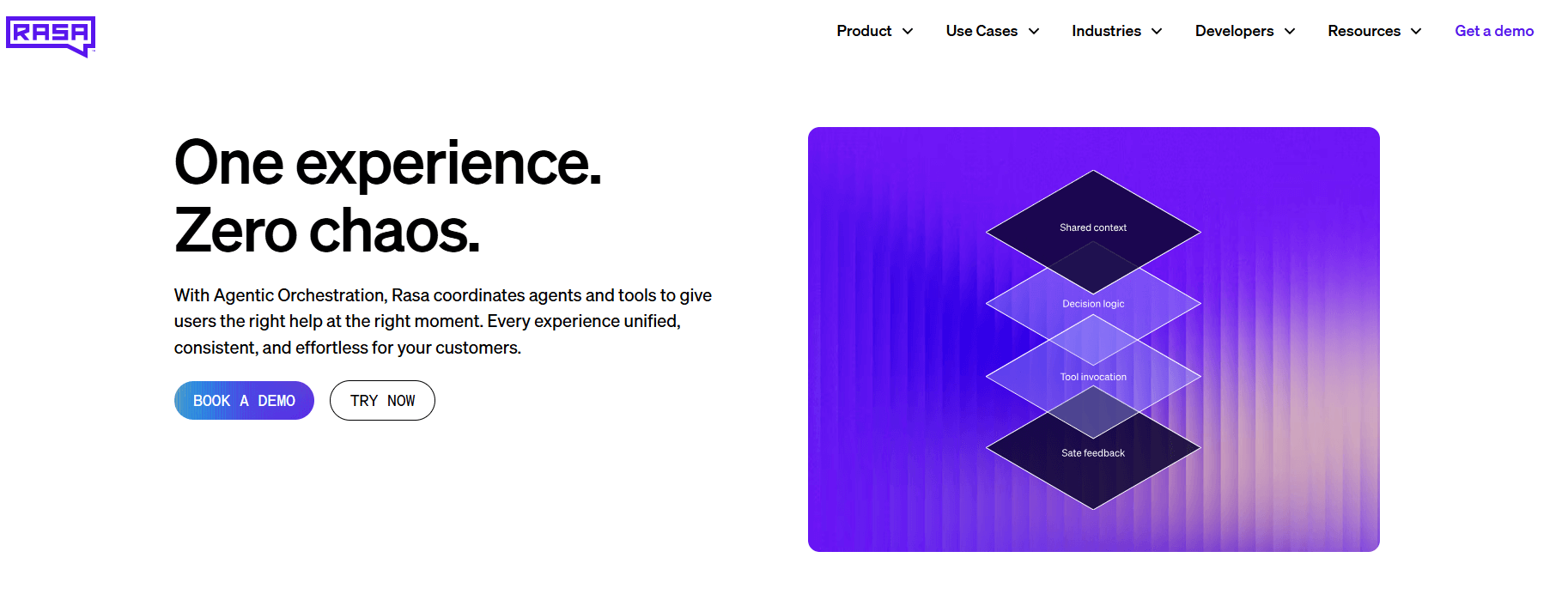
Rasa's orchestration sits inside its LLM native conversational stack, combining structured dialogue control with model driven understanding. The focus is reliable task execution with deterministic flows backed by enterprise deployment choices.
Best for: Regulated or support heavy teams that need deterministic conversations, voice, and strict guardrails.
Key Features:
- CALM dialogue engine that separates business logic from LLM fluency, with flows, guards, and deterministic execution, per Rasa documentation.
- Multimodal and voice pipeline architecture designed for real time turn taking and barge in handling, per Rasa announcements.
- Hybrid retrieval and tool calling with slot mappings, multi provider LLM support, and observability components, per Rasa release notes.
Why we like it: When you must prove who did what and why, Rasa's flow based control, testability, and versioning reduce weekend fire drills.
Notable Limitations:
- Steeper learning curve and need for Python or ML skills, cited repeatedly in third party reviews.
- Teams report complexity for long form or highly flexible conversations without careful flow design, per user feedback on review sites.
Pricing: Pricing not publicly available. Free Developer Edition exists with usage limits per vendor documentation. Contact Rasa for a custom quote.
Glean Agents
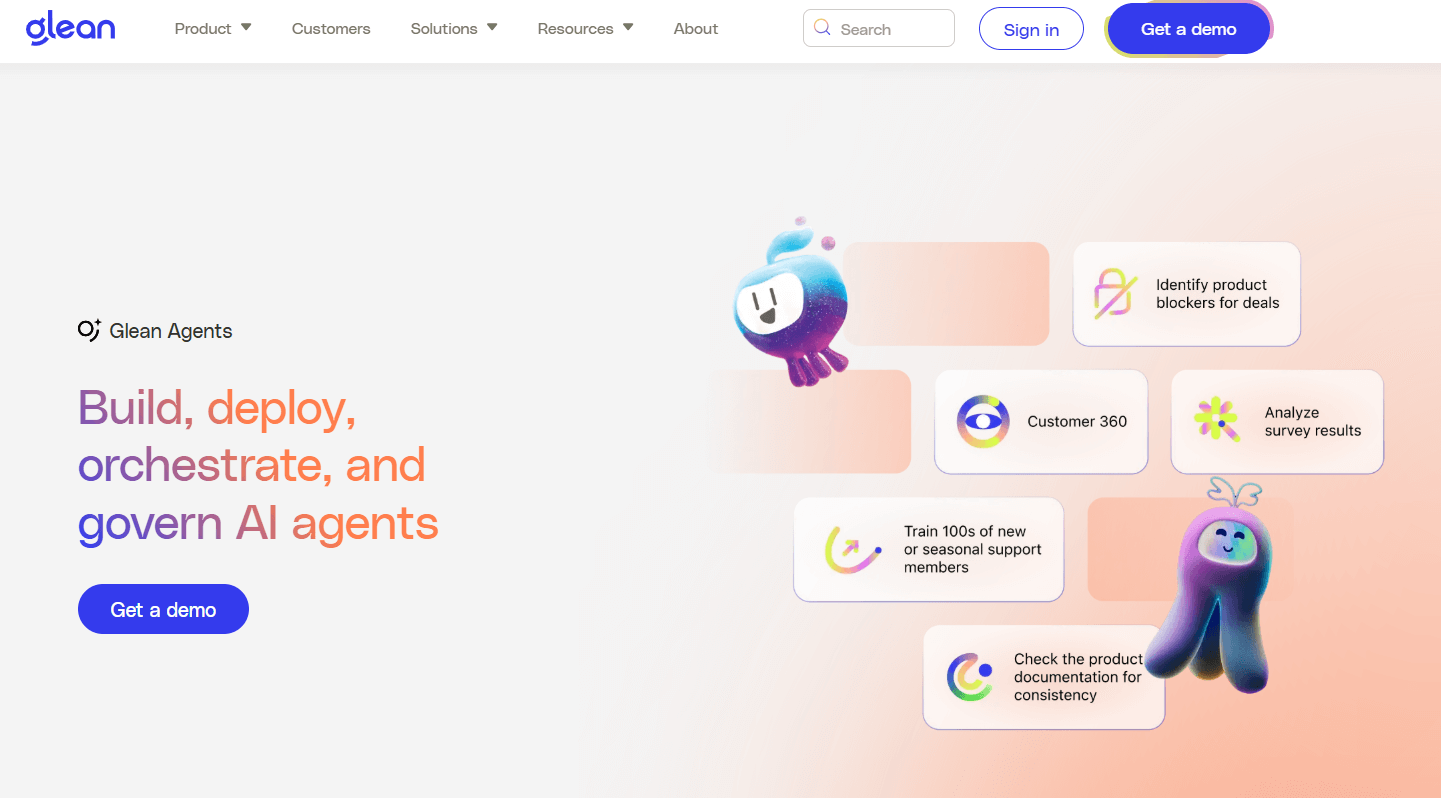
Glean Agents extend an enterprise search and work AI platform into agent building, deployment, orchestration, and governance grounded in org permissions and context.
Best for: Enterprises that want agents grounded in company data, with central governance, evals, and cross app interoperability.
Key Features:
- Visual and API based agent builder with model hub and hosted MCP server for agent interoperability at scale, per press materials.
- Built in guardrails, sensitive content protection, and agent observability and evals, per product announcements.
- On premises option with Dell AI Factory architecture plus hyperscaler model choice, per launch details.
Why we like it: Strong data grounding and governance, plus MCP based interoperability, make it a practical agent fabric across departments.
Notable Limitations:
- Reviews cite relevance variance and desire for finer source controls and filters.
- Pricing transparency is limited and perceived as enterprise first by buyers on third party sites.
Pricing: Pricing not publicly available. Contact Glean for a custom quote.
OrchestrAI
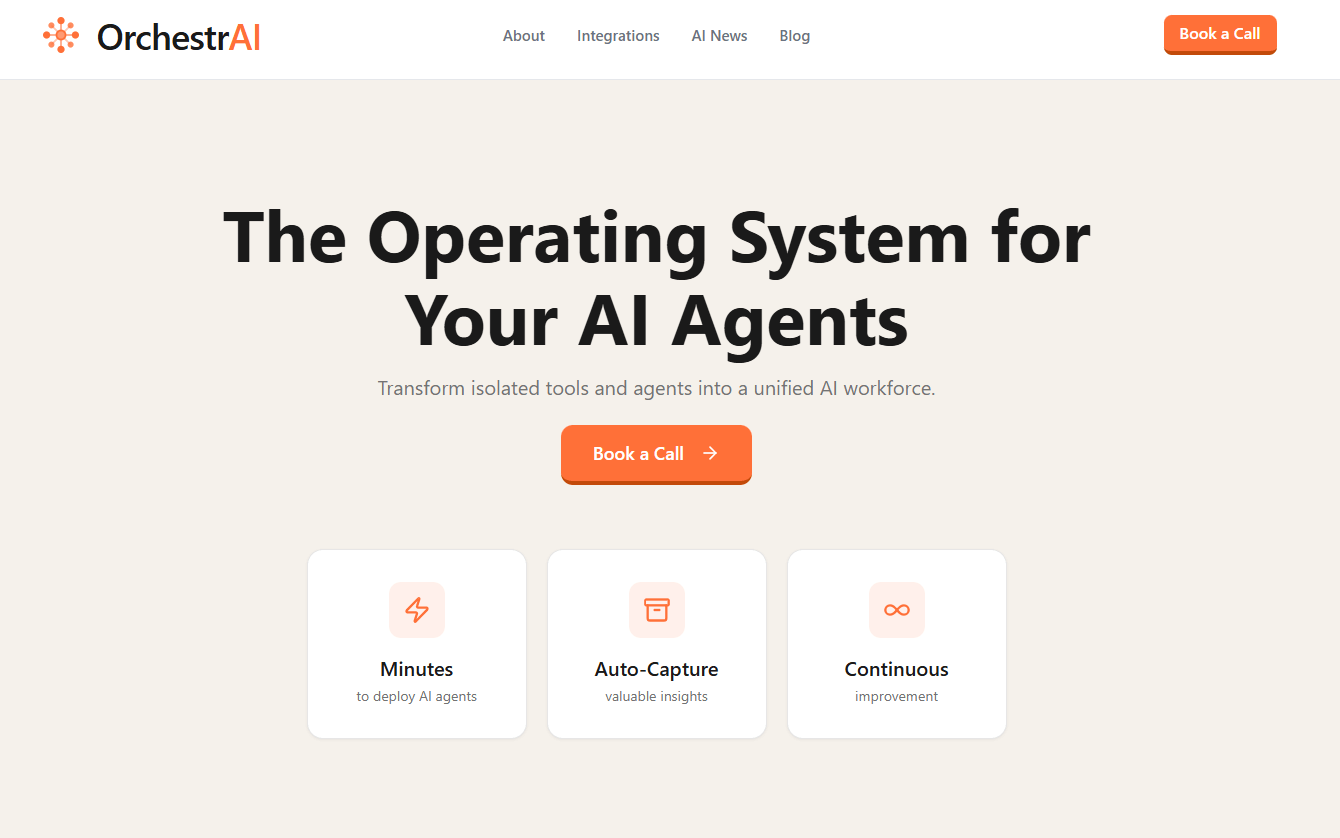
OrchestrAI positions itself as an "AI agent OS," a meta agent that generates specialist agents, orchestrates collaboration, and closes feedback loops.
Best for: Mid market teams seeking a services guided build of a coordinated agent workforce, with an emphasis on rapid custom workflows.
Key Features:
- Meta agent that creates task specific agents and coordinates them with shared context, per vendor materials.
- MCP or API integrations for tool access and workflow automation, per vendor materials.
- Feedback loops and knowledge capture to update agents and prompts over time, per vendor materials.
Why we like it: The managed build approach can cut time to first value when internal bandwidth is tight and you need bespoke multi agent flows.
Notable Limitations:
- Limited independent media coverage and few third party reviews as of early 2026. Validate capabilities and security during a pilot.
- Compliance claims and deployment promises are not widely corroborated by analyst or marketplace listings.
Pricing: Pricing not publicly available. Request a proof of concept and security package before commitment.
Zapier
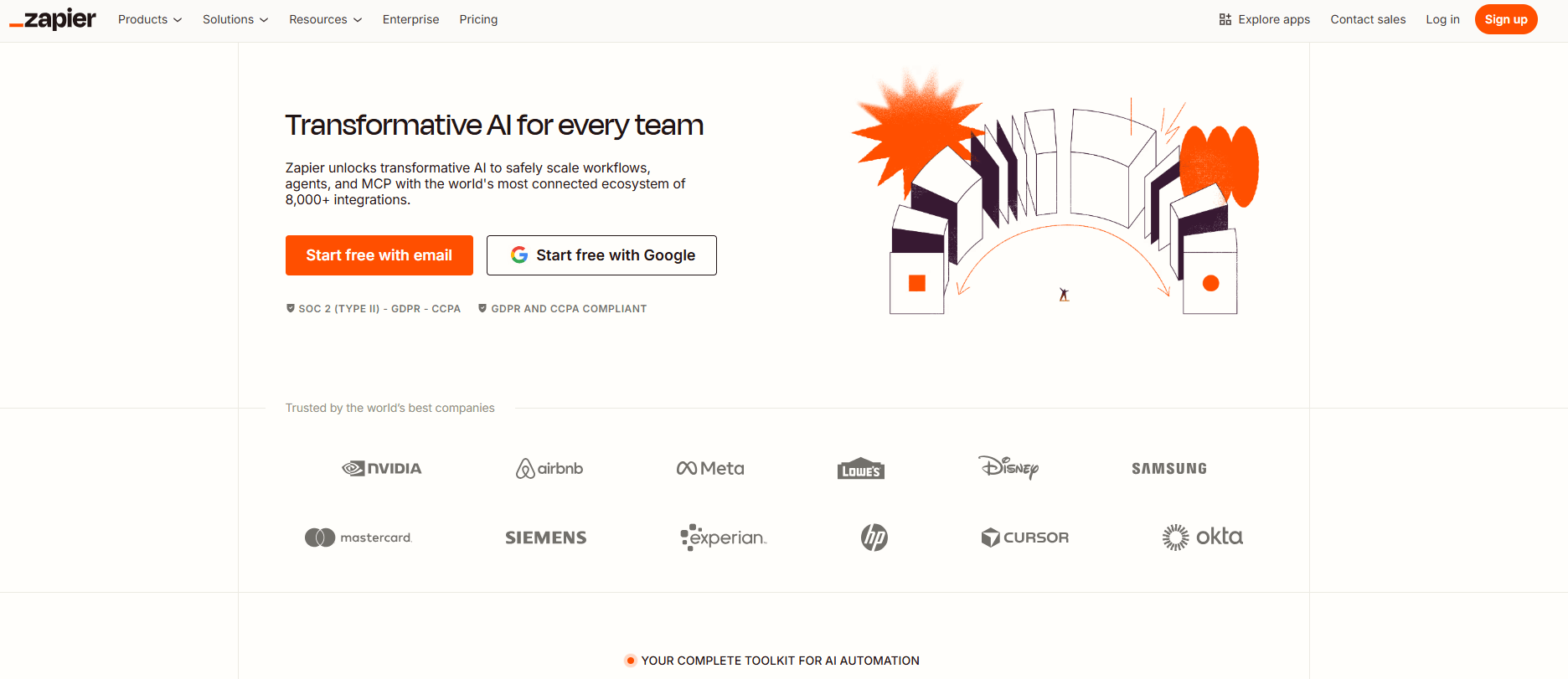
Zapier brings agentic features to its massive integration catalog, pairing agents with Zaps, Tables, Forms, and MCP to turn reasoning into cross app action.
Best for: Teams that want agents to take action across thousands of SaaS apps with low code governance and clear versioning.
Key Features:
- 8,000+ public integration partners and MCP based tool connections that agents can call.
- Agent pods, versioning with draft versus published states, and admin controls introduced across 2025 product updates.
- SOC 2 readiness work and security updates, plus central data export and deletion pathways.
Why we like it: Breadth of integrations makes it the easiest route to get agents doing real work across your stack this week.
Notable Limitations:
- Reviews frequently mention cost that scales with task volume and complexity of advanced branching compared to developer centric tools.
- Two security incidents occurred in 2025: an unauthorized access event in February that touched internal code repositories, and an npm package compromise disclosed in November. Security conscious teams should review current controls and rotate credentials.
Pricing: Free plan available. Published tiers include Professional starting at $19.99 per month billed annually, Team starting at $69 per month billed annually, and Enterprise with custom pricing. Task based billing can increase costs at scale.
Agent Orchestration Tools Comparison: Quick Overview
| Tool | Best For | Pricing | Highlights |
|---|---|---|---|
| Rasa Orchestrator | Deterministic, governed conversations and voice | Enterprise license, custom. Free Developer Edition with limits | CALM flows, guardrails, hybrid LLM control |
| Glean Agents | Data grounded enterprise agents with governance | Enterprise license, custom. No free option | Model hub, MCP interoperability, agent evals, sensitive data protection |
| OrchestrAI | Services guided multi agent builds | Custom services and license. No free option | Meta agent generates specialists, feedback loops, MCP or API connectors |
| Zapier | Cross app agent actions at scale | Tiered subscriptions, task based. Free plan available | 8,000+ integrations, MCP tools, agent pods and versioning |
Agent Orchestration Platform Comparison: Key Features at a Glance
| Tool | Interop Standard | Governance, Evals & Observability | Data Grounding |
|---|---|---|---|
| Rasa Orchestrator | Tool calling, APIs | Flows, guards, role based control, tracing and testing per releases | Retrieval and slot mappings |
| Glean Agents | MCP, model hub | Guardrails, sensitive content protection, permissions inheritance, built in evals and step insights | Index plus universal knowledge, structured and unstructured |
| OrchestrAI | MCP or API, per vendor | Feedback loops, admin controls, vendor described dashboards | Vendor described knowledge capture |
| Zapier | MCP, 8,000+ app actions | Admin policies, versioning, SOC alignment, run history, drafts vs published | Tables, Forms, external data via connectors |
Agent Orchestration Deployment Options
| Tool | Cloud & On-Premise | Air-Gapped | Integration Complexity |
|---|---|---|---|
| Rasa Orchestrator | Cloud API yes, self hosted enterprise options available | Possible with enterprise support | Medium to High |
| Glean Agents | Cloud API yes, Dell AI Factory on-premise option | Enterprise dependent | Medium |
| OrchestrAI | Cloud API yes, claims on-premise available via services | Unverified | Medium |
| Zapier | Cloud API yes, no on-premise | No | Low to Medium |
Agent Orchestration Strategic Decision Framework
| Critical Question | Why It Matters | What to Evaluate | Red Flags |
|---|---|---|---|
| Do we need deterministic control or maximal flexibility? | Regulated flows and money movement need traceability | Flow guards, versioning, testability, rollback plans | Pure prompt chaining with no audit trail |
| How will agents interoperate across tools? | Prevent silos and duplicate logic | MCP support, tool schema validation, rate limit handling | Custom glue code for every tool, no standard |
| Can we ground agents in enterprise data safely? | Reduces hallucinations and data leakage | Permission aware search, PII redaction, lineage | Broad data access without row level permissions |
| What deployment model matches risk posture? | Data residency and vendor risk | On prem options, SOC reports, incident history | Cloud only when data must stay on site |
| How will we measure agent ROI? | Avoid agent washing and shelfware | Built in evals, KPIs for cycle time, QA, cost | No observability or eval harness |
Agent Orchestration Solutions Comparison: Pricing & Capabilities Overview
| Organization Size | Recommended Setup | Monthly Cost | Annual Investment |
|---|---|---|---|
| Startup or SMB | Zapier for cross app actions, optional Rasa for one critical flow | Varies by task volume, Professional or Team tiers | Depends on usage, verify current pricing |
| Mid Market | Glean Agents for governed, data grounded use cases plus Zapier for long tail actions | Pricing not publicly available for Glean, Zapier adds task based costs | Contact vendors for quotes |
| Enterprise, regulated | Rasa for deterministic flows and voice, Glean for horizontal agents, Zapier for non critical automation | All enterprise priced, custom | Contact vendors for quotes and SOC packages |
Problems & Solutions
-
Problem: Agent sprawl with no governance, missed handoffs, and inconsistent outcomes.
- Glean: Open agent interoperability via a hosted MCP server, model hub choice, and built in guardrails and evals directly address enterprise scale orchestration and governance, as described in its general availability announcement on Business Wire.
- Zapier: Agent pods and versioning features, plus admin controls and SOC readiness work, make it easier to operationalize agent changes and keep production stable, per Zapier's late 2025 product updates and help documentation (product update summary, help center note on agent changes).
- Rasa: CALM flows, guards, and deterministic execution keep agents within approved paths during money movement or identity checks, which aligns with Rasa's documentation on dialogue management and CALM (dialogue management concepts, CALM overview).
-
Problem: Voice experiences stall due to latency, transcription errors, and no real time turn taking.
- Rasa: A multimodal voice architecture designed to skip slow speech to text bottlenecks was introduced at CCW Las Vegas, targeting faster turn taking and lower error rates, per the company's newswire announcement on PR Newswire.
-
Problem: Teams need agents that can take action across thousands of SaaS tools without custom glue.
- Zapier: The platform advertises thousands of public integrations and an MCP tool layer, providing a wide action surface for agent workflows, which is reflected in third party integration trackers and Zapier's partner documentation (StackReaction integration catalog size, Zapier partner docs noting 8,000+ partners).
-
Problem: Security reviews flag concerns around agent platforms that recently changed features or had incidents.
- Zapier: In February 2025, an unauthorized access event touched internal code repositories due to a 2FA misconfiguration, as reported by The Verge. A second incident involving unauthorized access to Zapier npm packages was disclosed in November 2025. Prospective buyers should request the current security package and verify credential rotation guidance.
-
Problem: Need a small vendor to co-build multi agent workflows tailored to a niche process with limited internal capacity.
- OrchestrAI: Positions a services guided "agent OS" that generates specialist agents and captures feedback for continuous improvement. Because there is limited third party coverage as of early 2026, run a time boxed pilot with success criteria and require a security packet. Absence of broad external validation is a risk to weigh alongside faster customization.
Conclusion, a pragmatic take
Agent orchestration is moving from pilots to production fast, with Gartner expecting nearly half of enterprise apps to embed task specific agents by 2026. If you need deterministic control and auditability, start with Rasa and invest in flow design and tests. If your goal is broad, governed action across enterprise data, Glean Agents' interoperability and safeguards are compelling per its GA announcement. For fast cross app actions, Zapier's agent features plus massive integrations remain the quickest route, though review task based costs and security history, including the 2025 incidents. Smaller players like OrchestrAI can accelerate bespoke deployments, but insist on a pilot, references, and security artifacts before scaling.