

Most teams discover their agent governance gaps during a production incident, not from a design review. Working across different tech companies, we have watched invoice agents push suspicious vendor changes, on-chain agents route orders to risky pools, and CRM bots sync conflicting records into ERP.
That is why the new wave of trust and explainability layers matters. Recent coverage warns that enterprises are scaling agents faster than governance, with Gartner predicting the average Fortune 500 will run more than 150,000 agents by 2028, up from fewer than 15 in 2025, a growth curve that magnifies risk if you do not verify actions and provenance first (TechRadar Pro).
The market is heating up, with Gartner forecasting that AI governance platform spending will reach $492 million in 2026 and surpass $1 billion by 2030, and highlighting the need for embedded, continuous controls (Gartner press release, Gartner TRiSM analysis).
Four tools consistently delivered verifiable trust signals or clear audit trails: Maiat, Aptosi Agent, Meshly, and Elloe. You will learn where each layer fits, what it is good at, and how to pick based on risk, data residency, and integration constraints.
Maiat
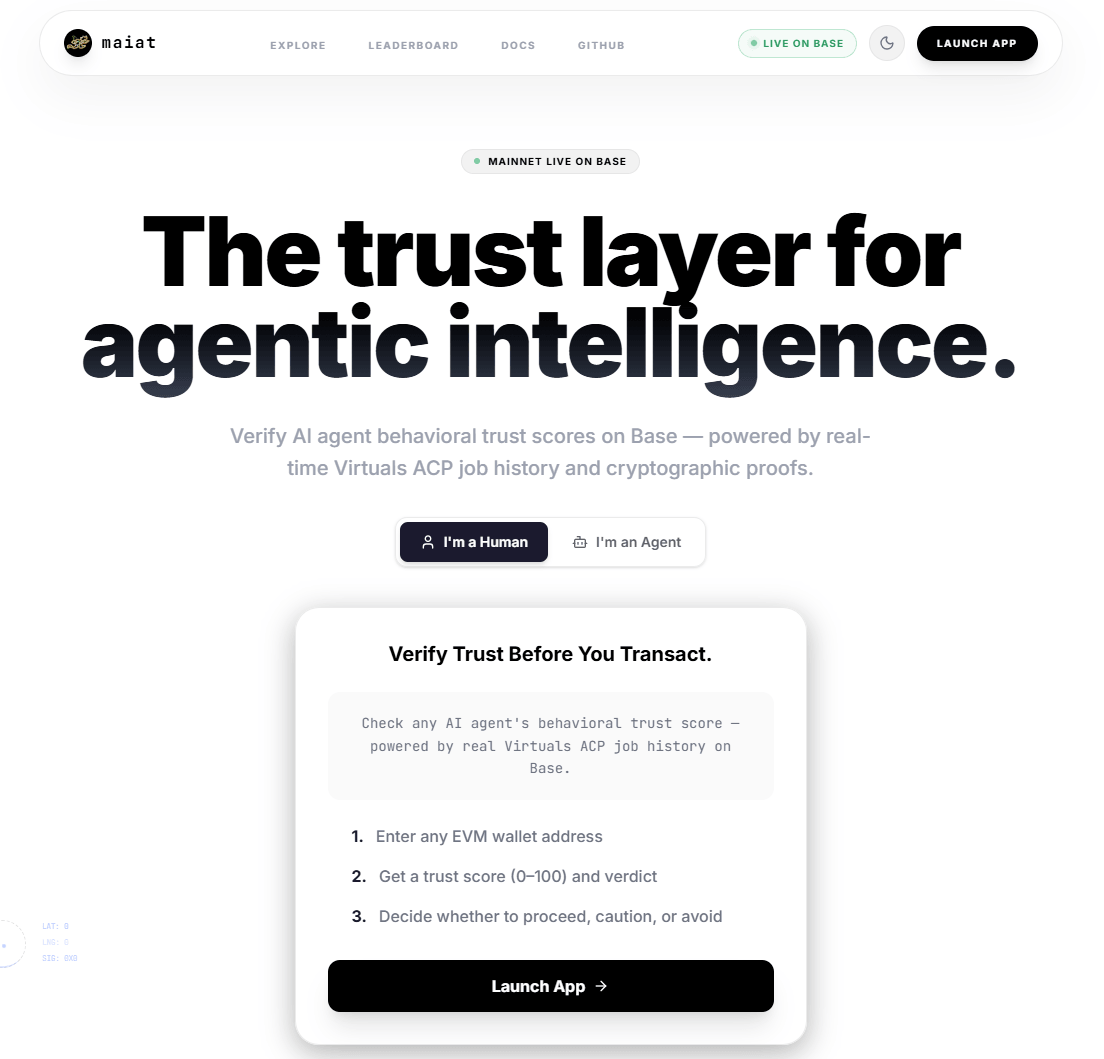
On-chain trust oracle that returns a cryptographic trust score for AI agents before transactions. Built around verifiable signals so smart contracts and apps can gate actions in real time.
- According to vendor documentation.
Best for:
Teams running agentic finance or DeFi workflows that need pre-trade trust checks and contract-level gating.
Key Features:
- On-chain verifiable trust scores on Base for any agent wallet or address.
- Open API with sub-100 ms lookups for high-frequency decisions.
- Smart contract hooks to block or allow agents at the point of execution.
- Public leaderboards to compare agent trust over time.
Why we like it:
Pre-transaction scoring reduces exposure from unvetted agents and aligns with defense-in-depth for on-chain workflows.
Notable Limitations:
Limited independent reviews, early ecosystem coverage, and reputation models can be gamed in immature registries without strong provenance.
Pricing:
Pricing not publicly available. Contact Maiat for a custom quote.
Aptosi Agent
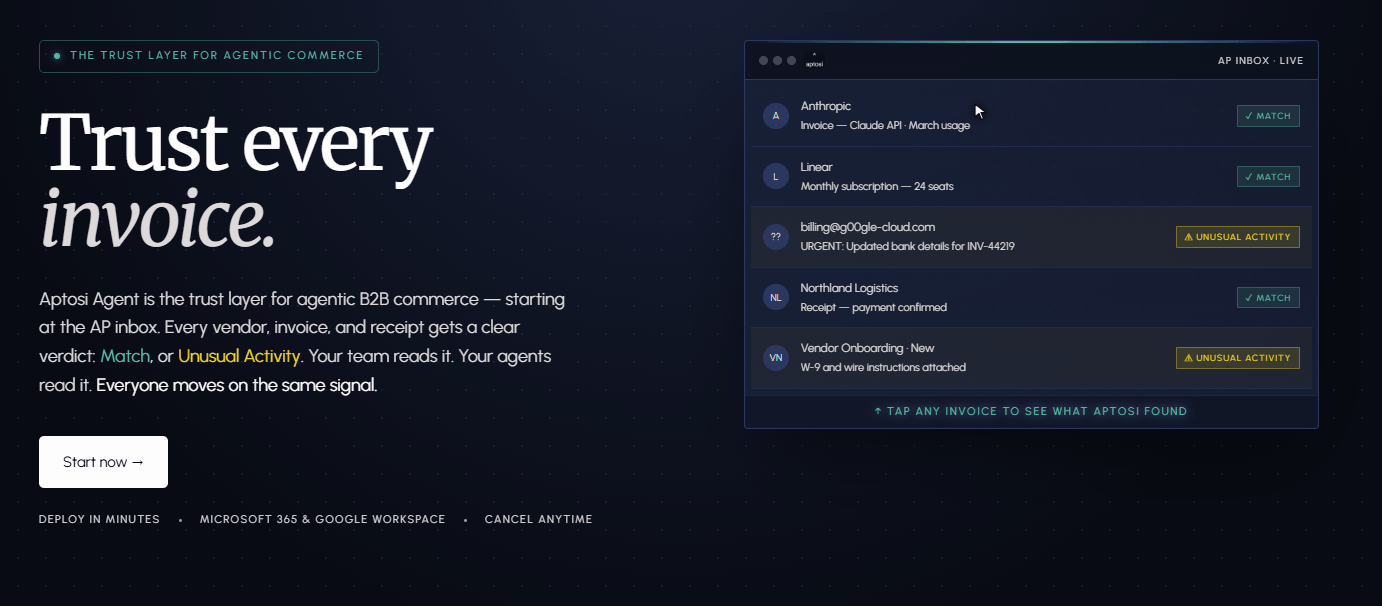
Trust verdicts for agentic B2B commerce starting in the AP inbox, returning a simple "Match" or "Unusual Activity" so humans and agents act from the same signal.
- According to vendor documentation.
Best for:
Finance and operations teams that want a controllable gate for invoices, subscriptions, and vendor changes inside Gmail or Outlook.
Key Features:
- Binary trust verdicts on invoices and receipts.
- Checks against sender domain, vendor history, amount ranges, bank details, and HRIS seat counts where applicable.
- Works inside Microsoft 365 and Google Workspace.
- Flags suspicious patterns for secondary review.
Why we like it:
Tight AP workflow fit with a clear verdict helps cut review time while adding a documented control before payment.
Notable Limitations:
New product category with few third-party reviews, AP fraud evolves quickly so rules and models require frequent tuning, and false positives can create rework if controls are too rigid.
Pricing:
Pricing not publicly available. Contact Aptosi for a custom quote.
Meshly
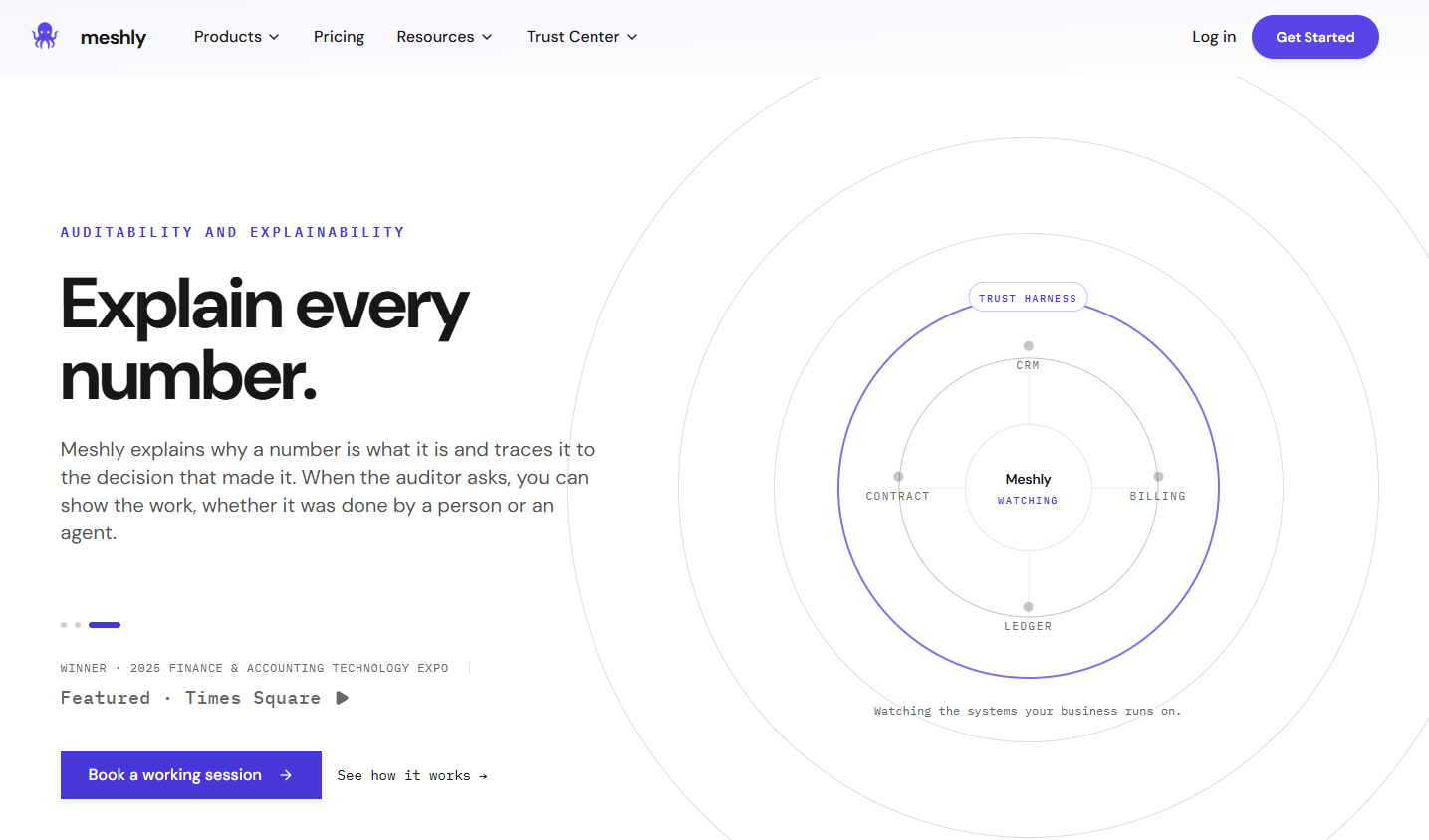
A verification layer between enterprise systems and AI that traces every action back to its source and explains discrepancies.
- According to vendor documentation.
Best for:
Enterprises with complex data flows who need a trust buffer between CRM, ERP, and agent workflows, plus explainable variance checks.
Key Features:
- Verifies each human or agent action to original system of record.
- Detects and explains cross-system mismatches that would confuse agents.
- Operates as a trust layer between enterprise systems and AI.
- Focus on auditability for finance and operations teams.
Why we like it:
This pattern addresses the most common failure mode we see, agents acting on stale or conflicting data across systems.
Notable Limitations:
Integration depth can add implementation time, limited independent user reviews, and success depends on data catalog and lineage maturity.
Pricing:
Pricing not publicly available. Contact Meshly for a custom quote.
Elloe

An enterprise "immune system" for AI, combining explainability, live audits, and governance. Recognized at a major startup event with a focus on audit trails and decision forensics.
- According to vendor documentation and third-party coverage.
Best for:
Regulated industries and any team that needs real-time monitoring, explainability, and audit trails for model outputs.
Key Features:
- TruthChecker for hallucination detection with citations.
- AutoRAG to restrict context to relevant, reliable sources.
- Autopsy for real-time or post-hoc forensics.
- Governance suite mapped to global frameworks and on-prem or VPC options.
Why we like it:
Strong emphasis on explainability and audits maps well to AI TRiSM requirements and regulatory expectations.
Notable Limitations:
Early stage with limited third-party reviews, real-time audits can add compute overhead, and policy libraries still need organization-specific tuning.
Pricing:
Pricing not publicly available. Contact Elloe for a custom quote.
Agentic Trust & Explainability Tools Comparison: Quick Overview
| Tool | Best For | Pricing Model | Highlights |
|---|---|---|---|
| Maiat | On-chain agent trust and DeFi gating | Not disclosed | On-chain verifiable trust score and smart contract hooks |
| Aptosi Agent | AP inbox, invoice and vendor trust | Not disclosed | Clear verdicts, mailbox native, finance-friendly controls |
| Meshly | Cross-system verification and discrepancy explainability | Not disclosed | Traces actions to source systems for audit and fixes |
| Elloe | Real-time explainability, audits, governance mapping | Not disclosed | Hallucination flags, citations, on-prem or VPC deployment |
Agentic Trust & Explainability Platform Comparison: Key Features at a Glance
| Tool | Pre-Action Gating | Explainability | Live Audit Trail |
|---|---|---|---|
| Maiat | Yes, on-chain hooks | Limited, score breakdown | Ledger-style receipts |
| Aptosi Agent | Yes, inbox verdicts | Reason codes on checks | Case history by message |
| Meshly | Yes, policy checks | Cross-system variance reasons | End-to-end action trace |
| Elloe | Yes, policy guardrails | Claim-level citations | Real-time and post-hoc forensics |
Agentic Trust & Explainability Deployment Options
| Tool | Cloud API | On-Premise | Integration Complexity |
|---|---|---|---|
| Maiat | Yes | Not advertised | Low for on-chain, app integrations vary |
| Aptosi Agent | Yes | Not advertised | Low to medium in Microsoft 365 or Google Workspace |
| Meshly | Yes | Not advertised | Medium due to multi-system verification |
| Elloe | Yes | Yes, VPC/on-prem options | Medium to high for regulated stacks |
Agentic Trust & Explainability Strategic Decision Framework
| Critical Question | Why It Matters | What to Evaluate | Red Flags |
|---|---|---|---|
| Do we gate agent actions before execution or only monitor after? | Pre-action gates reduce incident blast radius as agent volume grows (TechRadar Pro). | Contract hooks, inbox verdicts, policy triggers. | Only post-hoc dashboards, no circuit breakers. |
| Can we explain every agent decision with source-level evidence? | Explainability investment is rising as a deployment prerequisite (Gartner). | Claim-level citations, trace IDs, reason codes. | "Black box" output, no reproducible traces. |
| How do we handle cross-system discrepancies that agents inherit? | Poor data quality and lineage gaps sink AI ROI (Gartner data quality). | System-of-record checks, lineage, drift alerts. | Agents write into systems without variance checks. |
| Are fraud and payment risks addressed in AP workflows? | BEC losses remain massive in the US (FBI IC3). | Vendor change controls, pattern checks, dual review. | Invoice automation with no trust layer. |
| Do we need on-prem or VPC deployment for compliance? | Regulated teams need explainability plus residency controls (Gartner TRiSM). | On-prem options, data flow diagrams, audit exports. | Cloud-only with opaque logging. |
Agentic Trust & Explainability Solutions Comparison: Budget & Capabilities Overview
| Organization Size | Recommended Setup | Budget Share Guidance | Rationale |
|---|---|---|---|
| Startup to Series A | Inbox trust verdicts plus basic explainability checks | 10 to 15 percent of AI program spend | Many firms are setting aside explicit trust budgets in 2025-2026 (AlixPartners). |
| Mid-market | Pre-action gating for critical agent tasks, cross-system verification, live audits | 10 to 15 percent of AI program spend | Continuous controls align with AI TRiSM guidance (Gartner). |
| Enterprise, regulated | Full stack, on-prem or VPC explainability and audit, plus policy gating | 12 to 18 percent of AI program spend | Governance complexity and audit readiness drive higher investment (Gartner prediction). |
Problems & Solutions
-
Problem: AP inbox fraud and vendor bank changes. The FBI's Internet Crime Complaint Center reported $2.77 billion in business email compromise losses in 2024, out of $16.6 billion in total reported internet crime losses that year (FBI IC3 annual report). Accounting teams also describe targeted invoice threads that bypass basic controls (Reddit r/Accounting thread on AP phishing).
- How Aptosi helps: A pre-payment trust verdict inside the AP inbox flags unusual activity and forces a second check before money moves. This matches industry recommendations to add verification beyond email metadata and to review first-time vendor payments.
- How Elloe helps: Live audits and explainability provide evidence for compliance teams to document why a payment was paused or approved, aligning with governance practices described by Gartner's AI TRiSM guidance.
-
Problem: On-chain agents interacting with risky counterparties. Governance gaps in agent projects lead to rollbacks, and Gartner warns many enterprises will decommission agents without stronger controls by 2027 (TechRadar Pro). Early research also shows that immature on-chain reputation systems can be manipulated, which limits their value as trust signals (arXiv study of inter-agent trust models including ERC-8004).
- How Maiat helps: A cryptographic trust score checked before a swap or call allows a contract to block unknown or low-trust agents, shrinking blast radius compared to post-incident forensics.
- How Elloe helps: For agents operating off-chain or hybrid, explainable claims and real-time monitors add guardrails to stop unsafe actions when thresholds trip.
-
Problem: Conflicting ERP and CRM records causing bad agent actions. Gartner research highlights that poor data quality and siloed operations inflate costs and stall AI outcomes, making continuous controls and explainability a requirement, not a nice-to-have (Gartner data quality research and AI TRiSM guidance).
- How Meshly helps: It verifies every agent or human action back to the source system, explains mismatches, and gives auditors a trace so they can correct upstream data rather than patch symptoms.
- How Aptosi helps: It applies consistent rules at the inbox edge, preventing conflicting or spoofed vendor data from entering downstream systems.
-
Problem: Proving explainability for high-impact use cases. Gartner expects explainability tooling to be adopted in half of GenAI deployments by 2028 as organizations formalize XAI tracing and CI-based evaluation (Gartner prediction).
- How Elloe helps: Claim-level citations and a forensics engine produce artifacts that satisfy audit and regulatory questions.
- How Meshly and Maiat help: Meshly strengthens provenance across enterprise systems, and Maiat adds verifiable trust receipts in crypto contexts where smart contracts can enforce policy.
Bottom Line: Pick Gates First, Then Add Forensics And Discrepancy Checks
Agent volume is rising, governance is playing catch-up, and the cost of getting trust wrong is already visible in breach and fraud data (IBM breach cost 2024, FBI IC3 2024 data). Start with pre-action gates where money moves or records change, add explainability and live audits for high-impact flows, and close the loop by verifying every action against a trusted source of truth.
If you are deploying many agents by 2026 to 2028, that combination maps cleanly to AI TRiSM guidance on continuous, enforceable controls (Gartner AI TRiSM guidance) while giving finance, security, and compliance teams the evidence they need to move faster with confidence.