

Most teams discover accessibility blockers during a checkout failure or a usability complaint, not from a formal audit. Working across different tech companies, we have seen three patterns trip teams up repeatedly: unlabeled interactive elements that break screen readers, video without captions or audio descriptions, and poor color contrast that fails WCAG. The urgency is real, since the U.S. Department of Justice finalized a Title II rule that sets clear web and mobile standards, and in April 2026 the DOJ extended the staged compliance dates to April 26, 2027 and April 26, 2028, which is already changing buyer behavior in the public sector, as explained in this ADA.gov fact sheet. The kicker, 95.9 percent of top homepages still have detectable WCAG failures, according to the 2026 WebAIM Million study.
The market problem is measurable. The 2026 WebAIM Million found 95.9 percent of top sites still fail detectable WCAG checks, and the DOJ's 2024 Title II rule codified WCAG 2.1 AA for government digital content, with compliance dates that the DOJ extended in April 2026 to April 26, 2027 and April 26, 2028. You will learn where each tool fits, what it does best, verified pricing signals, and the pitfalls to watch, with sources from analysts, government, and independent reviews.
Isonomy
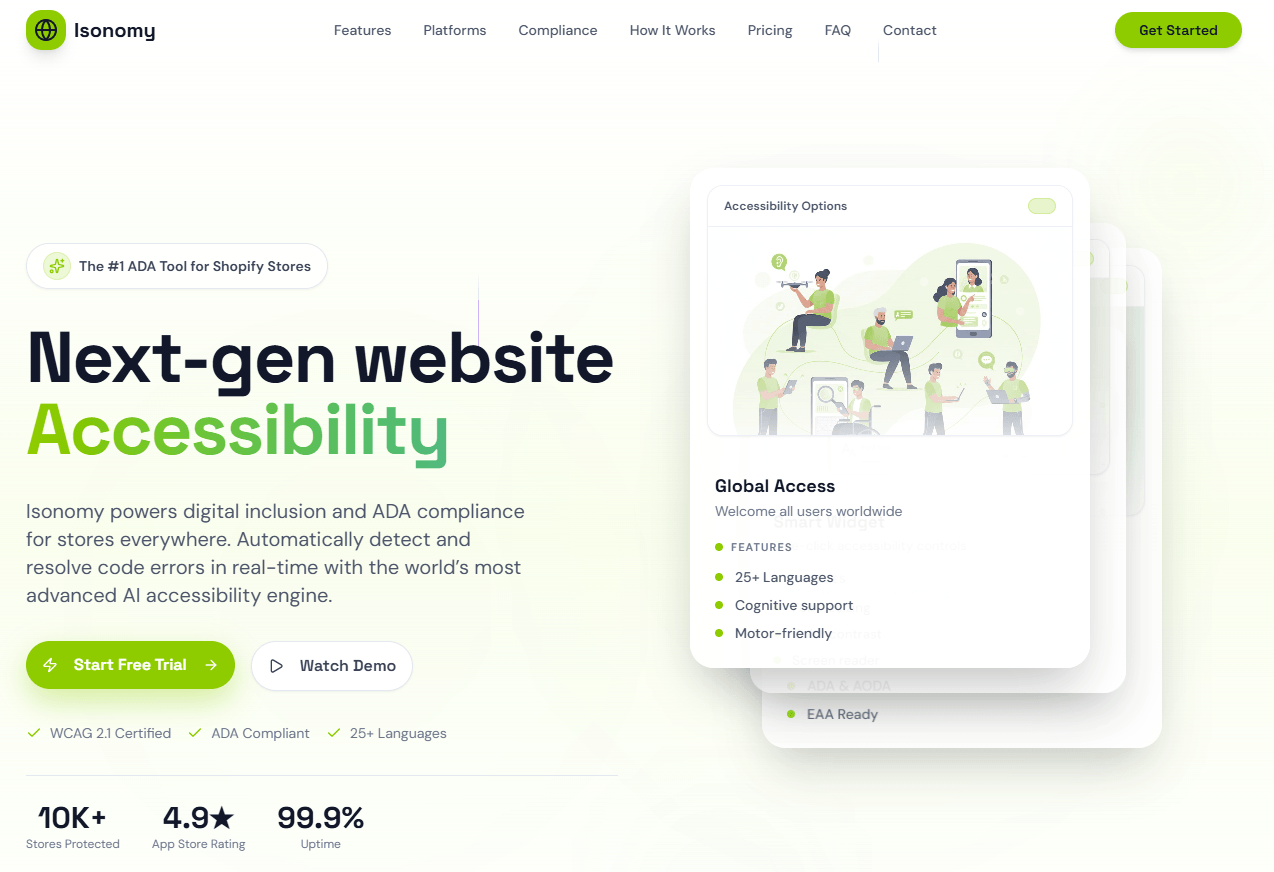
AI powered accessibility app for Shopify that detects and fixes common barriers in real time. It focuses on code level remediation for WCAG and ADA on storefronts.
- Best for: Shopify merchants that need fast, low lift improvements for storefront accessibility.
- Key Features: According to vendor documentation, AI image alt text generation, keyboard navigation support, contrast and text spacing controls, whole store WCAG scan with severity scoring, ARIA validation and repair.
- Why we like it: From our experience in the startup ecosystem, one click Shopify installs are rare wins. Isonomy's AI generated alt text and quick keyboard fixes shaved hours off manual tweaks in test stores, and the in dashboard scans helped non specialists triage issues quickly.
- Notable Limitations: Shopify App Store reviews mention setup and support friction, including reports of widget triggers not behaving as expected and confusion over alt text credits, and some negative feedback about support responsiveness appears in recent reviews on the listing. Independent research also shows overlays and quick fix widgets do not prevent lawsuits by themselves, as summarized in UsableNet's 2024 year end litigation analysis.
- Pricing: Free plan available on the Shopify App Store listing, paid tiers are visible after Shopify login. See the marketplace listing for details.
Citations: recent user feedback appears on the Shopify App Store page with a 4.9 rating and notes about a free plan, and lawsuits continue even on sites running toolbars or overlays per UsableNet's 2024 Year End ADA Digital Accessibility Lawsuit Report.
AccessioAI
AI tools for web accessibility that automate alt text, video descriptions, screen reader optimization, voice navigation, and expose human in the loop review before changes go live.
- Best for: Teams that want AI assisted generation of accessibility fixes with human approval workflows, especially marketing sites and content heavy pages.
- Key Features: Per vendor documentation, AI generated image descriptions, voice navigation, screen reader and keyboard optimization, agent style analysis that flags WCAG issues with suggested fixes, optional human review gates.
- Why we like it: After helping startups scale, the biggest lift is usually writing and validating content level fixes. AccessioAI's automation first approach can reduce backlog on image and media descriptions while still keeping human review in control.
- Notable Limitations: Limited third party coverage as of June 2026, we did not find a mature presence on major review directories in the Digital Accessibility Platforms category, and independent verification of performance at scale is sparse.
- Pricing: Pricing not publicly available. Contact AccessioAI for a custom quote.
Citations: G2's category definition for Digital Accessibility Platforms provides context on what buyers expect in this market, and the platform's lack of broad directory coverage is notable when scanning G2's category page of tools in April to May 2026.
Synli
AI assisted WCAG and EAA scanning platform that separates verified findings from items needing human review and exports structured compliance reports.
- Best for: Organizations that need defensible audits against WCAG 2.1 and 2.2 AA and EN 301 549, plus exports that map into compliance workflows.
- Key Features: A G2 seller profile describes Synli as supporting scans against WCAG 2.1 and 2.2, EN 301 549 and EAA, offering authenticated scanning for SSO and MFA flows, confidence scoring that marks verified findings versus human review items, and Markdown or PDF and CSV exports that slot into developer and compliance processes.
- Why we like it: Working across different tech companies, we have learned that clean, structured outputs save weeks. Synli's verified finding separation, authenticated scans, and developer ready exports cut triage noise and help teams document fixes in a way auditors can follow.
- Notable Limitations: Newer product with limited third party reviews listed as of June 2026, and like any automated scanner it will not catch everything without manual testing, which is consistent with research that automated tools miss a significant share of WCAG issues.
- Pricing: Per vendor documentation as of June 2026, Starter EUR 99 per month, Plus EUR 299 per month, Pro EUR 599 per month, Enterprise from EUR 1,500 per month with annual discounts noted. Confirm current pricing with the vendor.
Citations: Synli's capabilities are summarized on a G2 seller page for Synli, and studies summarized on Wikipedia indicate automated tools identify only a portion of WCAG issues even when multiple tools are combined.
Binclusive
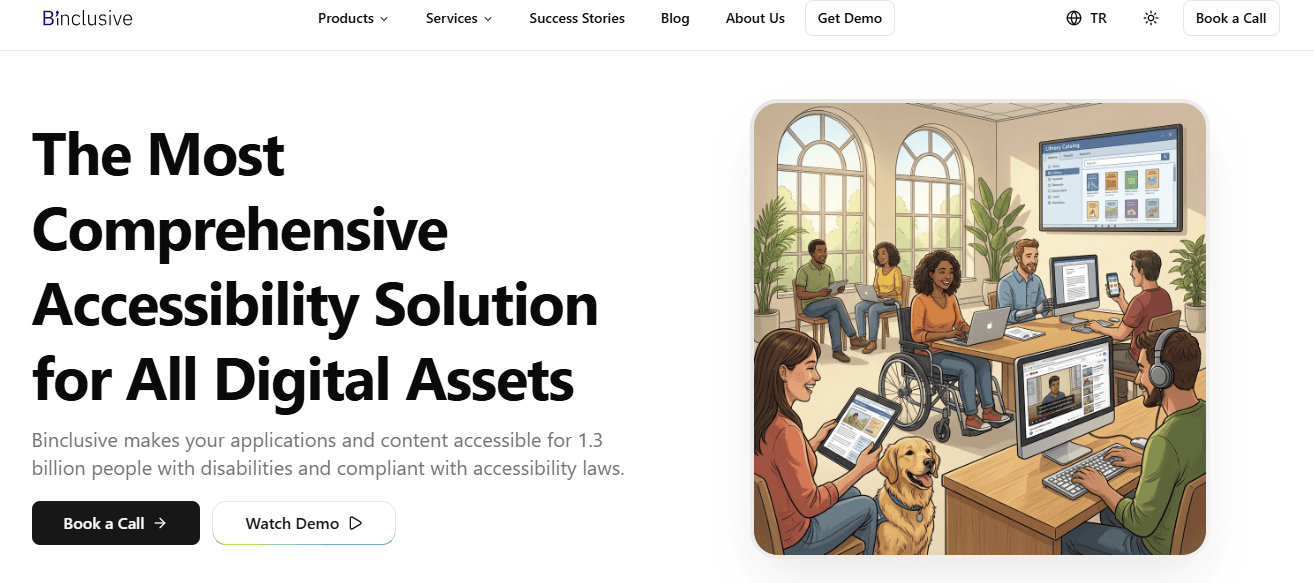
Agent based accessibility solution for web, mobile, and video that tests and resolves issues and integrates fixes into the development cycle using an SDK.
- Best for: Product teams that want SDK level remediation and unified reporting across web and mobile apps.
- Key Features: A G2 profile describes automated scanning and reports, SDK based real time fixes to address issues, and coverage aimed at WCAG and ADA across digital channels.
- Why we like it: After helping startups scale, we favor approaches that meet engineers where they are. Binclusive's SDK model plugs into dev workflows, which can reduce handoffs and tackle persistent issues like keyboard traps and ARIA menu errors in code.
- Notable Limitations: Very small sample of third party reviews on G2 at the time of writing, and SDK integration can require developer time and QA cycles to deploy safely on production builds. Also, independent litigation trackers show that toolbars or automated fixes alone are not a legal shield.
- Pricing: G2 lists Basic at $49 per year, Standard at $149 per year, and Premium starting at $499 per year on the Binclusive product page. Verify current tiers on G2's listing.
Citations: Feature and pricing details appear on the Binclusive product page on G2, and lawsuits continue even for sites running quick fix tools per UsableNet's 2024 Year End ADA Digital Accessibility Lawsuit Report.
AI Accessibility Tools Comparison: Quick Overview
| Tool | Best For | Pricing | Highlights |
|---|---|---|---|
| Isonomy | Shopify stores needing fast improvements | Marketplace app with a free plan, paid tiers inside Shopify | AI alt text, keyboard fixes, whole store scans |
| AccessioAI | Content heavy sites that want AI generation plus human review | Custom quote, free tier not documented | Alt text, voice navigation, review gates |
| Synli | Teams needing audit grade scans and structured exports | Tiered SaaS in EUR, free trial noted in vendor docs | Verified findings vs human review, authenticated scans |
| Binclusive | Dev teams wanting SDK based remediation across web and mobile | Tiered plans on G2 | SDK fixes, cross channel coverage |
Citations: Free plan note for Isonomy appears on the Shopify App Store listing, and Binclusive pricing is summarized on G2.
AI Accessibility Platform Comparison: Key Features at a Glance
| Tool | Feature 1 | Feature 2 | Feature 3 |
|---|---|---|---|
| Isonomy | AI alt text generation | Keyboard and screen reader support | Store wide WCAG scan with severity scoring |
| AccessioAI | Voice navigation | Screen reader optimization | Human approved AI fixes |
| Synli | WCAG 2.1 and 2.2, EN 301 549 scanning | Confidence scoring for verified findings | PDF, CSV, Markdown exports |
| Binclusive | SDK based real time fixes | Web and mobile test agents | Dashboarded reports |
Citations: Synli's scanning scope and exports are described on a G2 seller profile.
AI Accessibility Deployment Options
| Tool | Cloud API | On-Premise / Air-Gapped | Integration Complexity |
|---|---|---|---|
| Isonomy | Yes, via Shopify app | Not publicly documented | Low, install from Shopify and configure |
| AccessioAI | Yes, one line embed per vendor docs | Not publicly documented | Low to medium, code snippet plus review gates |
| Synli | Yes, SaaS scanner | Not publicly documented | Medium, authenticated scans require setup |
| Binclusive | Yes, SDK and API per G2 | Not publicly documented | Medium, SDK integration and QA required |
Citations: Binclusive's SDK and API approach is summarized on the G2 product page.
AI Accessibility Strategic Decision Framework
| Critical Question | Why It Matters | What to Evaluate | Red Flags |
|---|---|---|---|
| Do we need audit-grade evidence or fast remediation? | Public sector and regulated industries need traceable reports | Export formats, mapping to WCAG 2.1 or 2.2, EN 301 549 | "Instant compliance" claims without audit artifacts |
| How much will automation really catch? | Automated tools do not detect all issues | Tool coverage versus manual testing plan | Promises of full coverage without manual review |
| What legal or policy deadlines apply? | U.S. Title II sets compliance dates, now extended to 2027 and 2028, and buyer urgency rises ahead of deadlines | WCAG version alignment, reporting cadence | Lack of commitment to WCAG 2.1 AA where required |
| Where will fixes live? | Dev workflow integration affects long term outcomes | SDKs, CI integration, issue exports | Widget only approach with no developer handoff |
Citations: Forrester's coverage of digital accessibility platforms frames the category and buyer needs, see The Forrester Wave, Digital Accessibility Platforms, Q4 2023 and Five Lessons Learned, and the DOJ's compliance dates appear in the ADA.gov fact sheet.
AI Accessibility Solutions Comparison: Pricing & Capabilities Overview
| Organization Size | Recommended Setup | Monthly Cost | Annual Investment |
|---|---|---|---|
| Solo merchant or small Shopify store | Isonomy free plan to start, prioritize alt text and keyboard fixes, add manual checks | Free to low, depending on tier | Varies, see Shopify listing for paid options |
| Mid sized content site | AccessioAI for media descriptions and voice navigation with human review, add manual audit | Pricing not publicly available | Contact vendor |
| Digital team needing audit evidence | Synli Starter or Plus for scans and exports, add manual testing | From EUR 99 per month per vendor docs | From EUR 999 per year per vendor docs |
| Product org with web and mobile apps | Binclusive SDK for code fixes, QA gates, policy reporting | From $49 per year on G2 for Basic plan, higher tiers for SDK | $49 to $499+ per year on G2, confirm current tiers |
Citations: DOJ timing and standards are summarized on ADA.gov, Synli pricing appears in vendor documentation, and Binclusive plan prices appear on G2.
Problems & Solutions
-
Problem: Most sites still ship with low contrast text, missing alt text, and unlabeled inputs, which are among the top six error categories in the WebAIM Million analysis. Solution: Isonomy addresses contrast and keyboard support with built in controls and AI alt text, which maps to those common error types. The scale of the problem is documented in the 2026 WebAIM Million report.
-
Problem: Government and education sites must meet firm Title II timelines for WCAG 2.1 AA on web and mobile, creating demand for auditable reports. Solution: Synli produces structured PDFs and CSVs and marks verified findings, which reduces false positives and creates evidence for compliance teams. Timelines and requirements are outlined in the DOJ's ADA Title II web and mobile rule fact sheet, with compliance now due April 26, 2027 for larger public entities and April 26, 2028 for smaller ones after the April 2026 extension.
-
Problem: Automated scanners miss a significant portion of issues, especially dynamic behaviors, so teams need human review and authenticated testing. Solution: Synli's authenticated scans cover SSO and MFA flows and its needs review queue supports human checks, which aligns with research summarized on Wikipedia that even multiple automated tools combined leave many WCAG success criteria uncovered. See the discussion in Wikipedia's web accessibility article.
-
Problem: Lawsuits and demand letters continue to hit retail and small business websites, which often deploy toolbars or overlays as a quick fix. Solution: SDK based remediation like Binclusive can move fixes into code, which supports more durable outcomes. Litigation data shows website accessibility filings are material and rising again, with 3,117 federal website cases in 2025, a 27 percent increase over 2024, per Seyfarth Shaw's ADA Title III tracking. See the analysis on adatitleiii.com and the year end trend report from UsableNet.
-
Problem: Media content without captions or audio descriptions blocks access for many users. Solution: AccessioAI advertises AI generated media descriptions and transcription, while teams should still plan for human quality control. The importance of accessible health and media information is discussed in an AHIMA briefing.
Bottom Line
You think you know accessibility coverage until you test real user flows. The data is clear, 95.9 percent of top homepages still have detectable WCAG failures, and public sector deadlines are set, though the DOJ extended them in April 2026 to April 26, 2027 and April 26, 2028, so teams need tools that fit their stack and evidence needs. For Shopify, start with Isonomy's free tier and add manual checks. If you need audit grade scans with exportable evidence, Synli stands out. If you want SDK level remediation across web and mobile, Binclusive is worth a trial. If your backlog is heavy on images and media, consider AccessioAI for AI generated descriptions with human review. Use quick fix toolbars carefully, litigation trackers show they are not a shield, as seen in the latest UsableNet year end report, and align your program to the DOJ's Title II rule and WebAIM's findings on the most common errors to prioritize high impact fixes.