
Every team shipping an AI agent in 2026 has the same blind spot: the agent works in the demo but breaks in production. A hallucinated refund policy, a leaked system prompt, a tool call fed by a poisoned retrieval chunk - any one of these turns a product launch into an incident review. From our experience in the startup ecosystem, the gap between deploying an AI agent and deploying one safely has become the single highest-stakes engineering problem in the space. Deloitte's 2026 AI report found that only 20% of organizations have mature governance models for AI agents, even as 80.9% of technical teams have pushed past planning into active testing or production (Galileo blog). With the EU AI Act's high-risk obligations applying from August 2, 2026, and the OWASP Top 10 for LLM Applications now treated as the canonical taxonomy of risk, guardrail engineering has moved from optional to default infrastructure.
Selection was guided by market validation, production adoption at scale, and verified capabilities across the five attack surfaces that matter in 2026: input rails, output rails, retrieval rails, tool-call rails, and dialog rails. The article covers which platform fits which deployment motion, what to expect on pricing and limitations, and how to avoid common integration snags, anchored by trusted sources like analyst reports, vendor documentation, and review sites (Galileo, The New Stack, TechCrunch, SecurityWeek, WorkOS).
Galileo
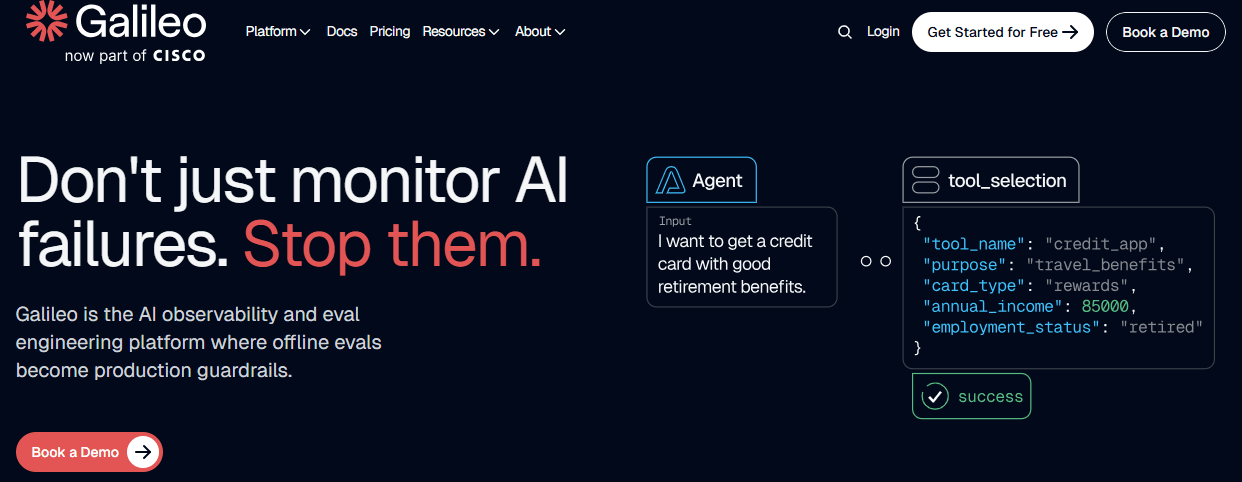
An AI evaluation, observability, and guardrails platform that turns pre-production evaluations into production governance controls, with a centralized open-source control plane for managing agent behavior at scale.
Galileo has raised $68 million in total funding, including a $45 million Series B in October 2024 led by Scale Venture Partners and Premji Invest, and has quadrupled its enterprise customer base with clients including Comcast and Twilio (Tracxn). In March 2026, Galileo released Agent Control, an open-source control plane (Apache 2.0) designed to let enterprises write behavioral policies once and enforce them across all agent deployments, with AWS, CrewAI, and Glean among the first integration partners (The New Stack).
Best for: Enterprise AI teams that need a unified platform covering evaluation, observability, and runtime guardrails across multiple agent frameworks and LLM providers.
Key Features:
- Luna small language models purpose-built for fast, low-cost evaluation of accuracy, safety, and performance, enabling guardrailing on 100% of production traffic rather than sampling, per vendor documentation (Galileo blog).
- Agent Control open-source control plane that enforces behavioral policies across agent deployments, with integrations for LangChain, CrewAI, OpenAI Agents SDK, and other orchestration frameworks (The New Stack).
- Real-time firewalls for hallucinations and threats, plus proactive failure detection from production logs, per Crunchbase product description (Crunchbase).
- Enterprise deployment flexibility including SaaS, VPC, on-premises, and air-gapped options with SOC 2 Type II compliance (Galileo blog).
Why we like it: Galileo is the only platform on this list that bridges the full eval-to-guardrail lifecycle - the same metrics used to test agents before production become the policies enforced in production, which closes the gap most teams struggle with.
Notable Limitations:
- The comprehensive unified platform requires teams to adopt evaluation-driven workflows, which involves a learning curve for organizations new to structured AI evaluation practices (Galileo blog).
- Enterprise-focused positioning means smaller teams or individual developers working on simpler use cases may find lightweight open-source alternatives sufficient for their needs (Galileo blog).
Pricing: Galileo offers a free tier and enterprise plans. Agent Control is open source under Apache 2.0. Contact the vendor for enterprise pricing on the full evaluation and guardrails platform.
NVIDIA NeMo Guardrails
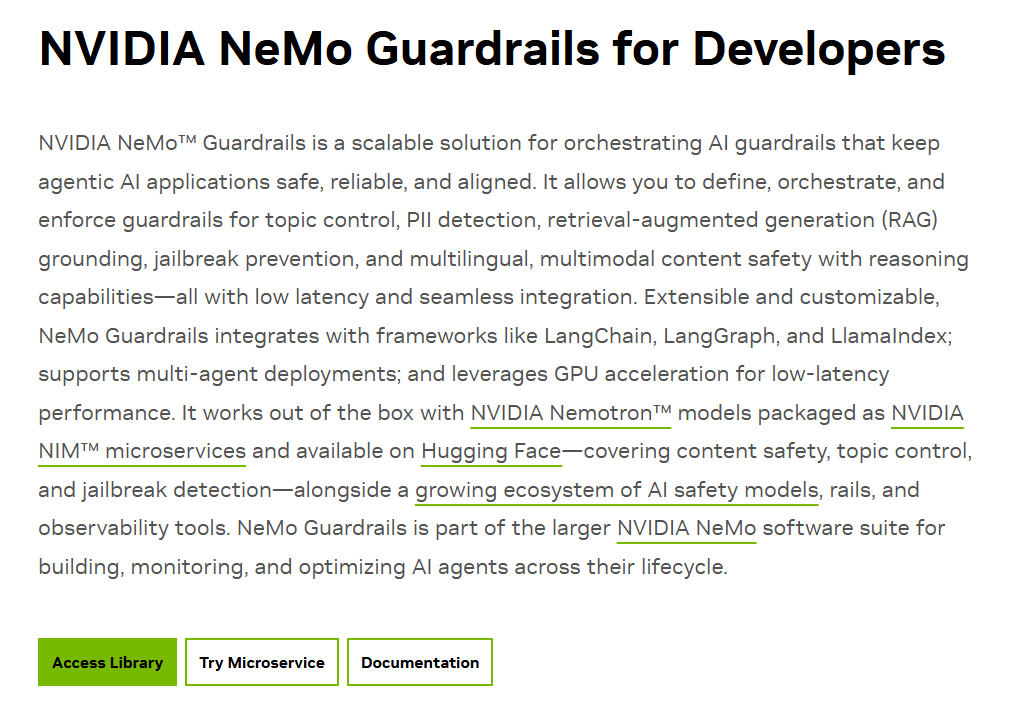
An open-source collection of software tools and NIM microservices for adding programmable safety guardrails to LLM-based applications and AI agents, using NVIDIA's Colang domain-specific language for dialog policy control.
NVIDIA NeMo Guardrails is part of NVIDIA AI Enterprise and has become one of the most widely adopted open-source guardrail frameworks in production. In January 2025, NVIDIA released three new NIM microservices for content safety, topic control, and jailbreak prevention as part of NeMo Guardrails (TechCrunch). The framework has secured integration partnerships with Cisco AI Defense, Zscaler AI Guard, Arize, and DataRobot, establishing it as a foundational safety layer across the enterprise AI stack (Cisco Blogs, Zscaler).
Best for: Teams that need programmable, self-hosted dialog-level guardrails with deep control over conversation flow, topic boundaries, and execution safety - especially in regulated or on-premises environments.
Key Features:
- Colang domain-specific language that lets developers define rails for content safety, topic control, and execution guardrails in a human-readable format, per NVIDIA documentation (NVIDIA NeMo).
- NIM microservices for content safety, topic control, and jailbreak prevention that apply multiple lightweight specialized models as guardrails across complex agentic workflows (TechCrunch).
- NemoClaw runtime stack integrating model services, guardrails, and orchestration for autonomous AI agents with policy-based guardrails and isolated sandboxes (HyperFRAME Research).
- Native integrations with Cisco AI Defense, Zscaler, Arize, and DataRobot for defense-in-depth across enterprise security stacks (Cisco Blogs).
Why we like it: NeMo Guardrails gives compliance reviewers a readable policy artifact through Colang - regulators and legal teams can actually read and audit the guardrail logic, which no other framework on this list provides at the same level.
Notable Limitations:
- Colang has a learning curve, and teams that prefer Python validators or TypeScript code over a domain-specific language may find other frameworks faster to ship, per comparison reviews (FutureAGI comparison).
- Prompt injection detection relies on bring-your-own classifier, while competitors like Lakera and Galileo ship sharper injection detection models out of the box (FutureAGI comparison).
Pricing: NeMo Guardrails is open source (Apache 2.0) for self-hosting. Enterprise support and GPU-accelerated NIM microservices are available through NVIDIA AI Enterprise licensing. Contact NVIDIA for enterprise pricing.
Guardrails AI
An open-source Python framework for validating and correcting AI model outputs using composable validators, with a community-driven Hub of reusable safety checks covering toxicity, PII, hallucinations, and structured output compliance.
Guardrails AI raised $7.5 million in seed funding from Zetta Venture Partners, Bloomberg Beta, and Pear VC in February 2024 and has gained significant traction with 6.8K GitHub stars and over 10,000 monthly downloads as of 2026 (WorkOS). Notable customers include Robinhood, which uses the framework to ensure reliable AI behavior in financial applications. The project also partnered with Andrew Ng on a course for building production-ready, failure-resistant AI applications, per vendor documentation (AppSecSanta review).
Best for: Python-native development teams that want precise, code-level control over validation logic with the ability to run guardrails locally without API dependencies, especially in regulated industries where custom validators are essential.
Key Features:
- RAIL (Reliable AI Markup Language) specification for declaring output schemas with typed fields and per-field validators, enabling structured data generation with safety constraints built in (FutureAGI comparison).
- Guardrails Hub with 100+ community-contributed validators covering toxicity detection, PII anonymization, hallucination detection, profanity filtering, bias detection, and logical consistency checks (WorkOS).
- Validate-and-reask loop that automatically corrects failing outputs rather than just blocking them, enabling self-healing agent behavior, per framework documentation (AppSecSanta review).
- Integrations with LangChain, LlamaIndex, LangGraph, OpenAI, Anthropic, Hugging Face, and self-hosted models, with the latest release v0.10.0 from April 2026 (FutureAGI comparison).
Why we like it: Guardrails AI is the most developer-friendly option on this list - it runs in-process, composes like middleware, and the validate-and-reask pattern means outputs get fixed rather than blocked, which keeps the agent functional instead of just safe.
Notable Limitations:
- The framework focuses primarily on output validation and structured generation rather than input-side prompt injection defense, which means teams typically need to pair it with an input-layer solution like NeMo or Lakera for full coverage (AI Safety Directory).
- Seed-stage funding ($7.5M) versus competitors with deeper enterprise backing means the commercial Guardrails Pro managed service is less mature than alternatives from Galileo or NVIDIA (WorkOS).
Pricing: The open-source framework is free under Apache 2.0. Guardrails Pro (managed service) offers hosted validation, observability dashboards, and enterprise support at custom pricing. Contact the vendor for enterprise quotes.
Lakera Guard (Check Point AI Security)
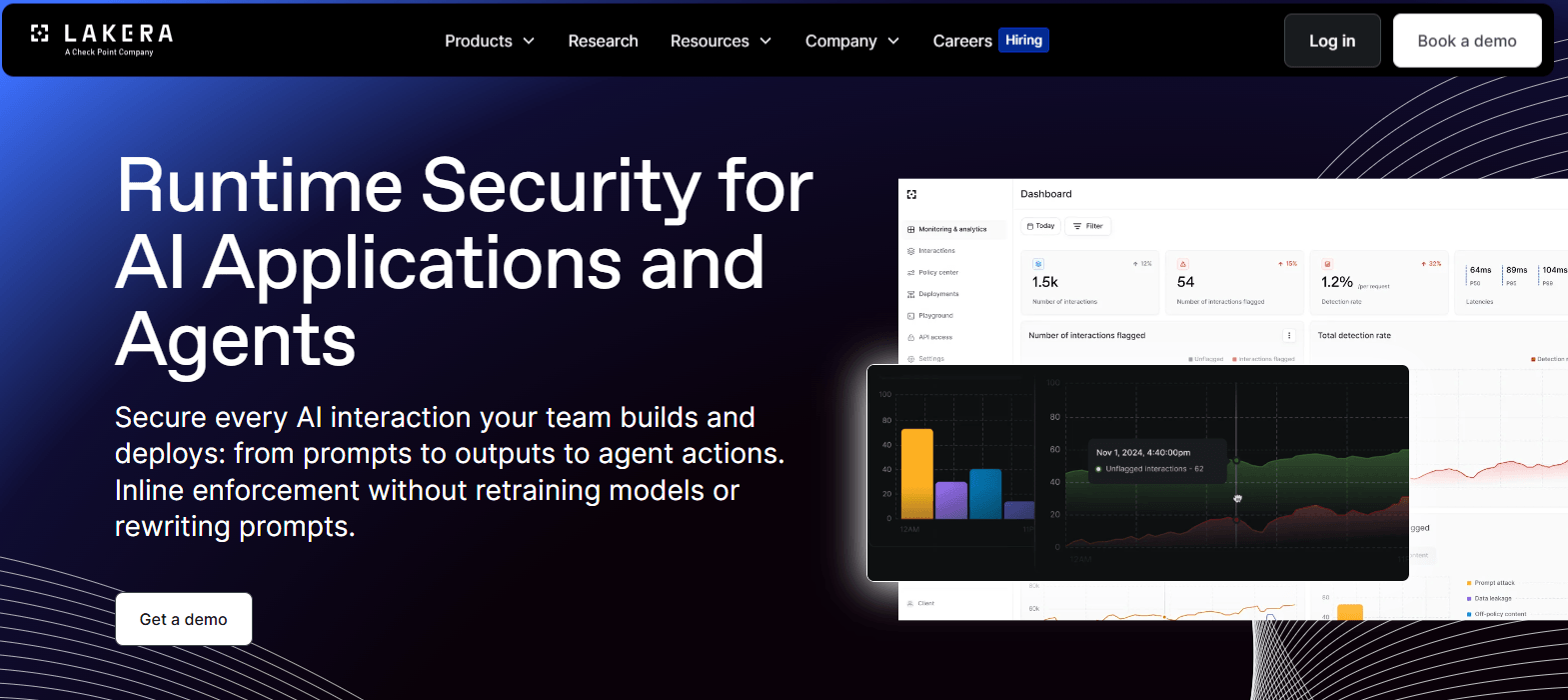
A real-time AI security API that protects LLM applications against prompt injection, jailbreaking, data leakage, and toxic content using purpose-built ML detection models, now operating as the foundation of Check Point's end-to-end AI security platform.
Check Point Software Technologies (NASDAQ: CHKP) completed the acquisition of Lakera in November 2025 for an estimated $300 million, forming the foundation of Check Point's Global Center of Excellence for AI Security in Zurich (SecurityWeek, CXOToday). Lakera Guard delivers 98%+ detection rates with sub-50ms latency and supports 100+ languages, with detection models trained on data from the Gandalf community's 80 million+ adversarial prompts (AppSecSanta Lakera review). Dropbox is among the publicly confirmed enterprise customers using Lakera Guard to secure its LLM-powered features.
Best for: Enterprise security teams that need a managed, low-latency guardrails API with SLA guarantees for protecting production LLM applications, backed by the resources and distribution of a major cybersecurity vendor.
Key Features:
- Real-time prompt injection and jailbreak detection across 100+ languages using purpose-built ML models trained on live threat data from the Gandalf adversarial network, per vendor documentation (AppSecSanta Lakera review).
- API-first integration that screens both inputs and outputs, with configurable policies per project and per-detector threshold controls, cited in independent security reviews (AppSecSanta Lakera review).
- Lakera Red automated red-teaming product that runs attack simulations against LLM applications to identify vulnerabilities before production, with results feeding back into Guard's detection models (AppSecSanta Lakera review).
- Cisco AI Defense integration with NVIDIA NeMo Guardrails plus Check Point Infinity platform for end-to-end AI lifecycle security, including AI BOM, MCP Catalog, and agentic guardrails, per Cisco's February 2026 announcement (Cisco investor relations).
Why we like it: Lakera is the only platform on this list backed by a major cybersecurity vendor (Check Point, $20B+ market cap), which gives enterprise buyers the procurement confidence, SLA guarantees, and global support infrastructure that standalone startups cannot yet match.
Notable Limitations:
- The Check Point acquisition routes new enterprise sales through Cisco and Check Point procurement, which may lengthen buying cycles for teams that previously signed directly with Lakera's startup sales motion (CSO Online).
- Lakera focuses on the security layer (prompt injection, PII, toxicity) rather than evaluation or output quality - teams also need a separate evaluation platform like Galileo or Guardrails AI for hallucination detection and structured output validation (AI Safety Directory).
Pricing: Lakera Guard offers a free tier for testing. Enterprise pricing is available through Check Point AI Defense or directly at platform.lakera.ai. Contact the vendor with expected request volume, deployment region, and on-prem requirements for a custom quote (AppSecSanta Lakera review).
AI Agent Guardrail Platforms Comparison: Quick Overview
| Tool | Best For | Pricing Model | Highlights |
|---|---|---|---|
| Galileo | Enterprise AI teams needing unified eval, observability, and guardrails | Free tier plus enterprise plans | Agent Control open source (Apache 2.0), Luna evaluation models, SOC 2 Type II, AWS and CrewAI partnerships (The New Stack). |
| NVIDIA NeMo Guardrails | Regulated and on-premises environments needing programmable dialog control | Open source plus NVIDIA AI Enterprise licensing | Colang DSL for readable policies, NIM microservices, NemoClaw agent runtime, Cisco and Zscaler integrations (TechCrunch). |
| Guardrails AI | Python-native teams needing code-level output validation | Open source plus Guardrails Pro managed service | 6.8K GitHub stars, 100+ validators, validate-and-reask self-healing, Robinhood customer (WorkOS). |
| Lakera Guard (Check Point) | Enterprise security teams needing managed, low-latency AI security | Free tier plus enterprise (via Check Point) | 98%+ detection, sub-50ms latency, 100+ languages, $300M acquisition by Check Point (SecurityWeek). |
AI Agent Guardrail Platform Comparison: Key Features at a Glance
| Tool | Feature 1 | Feature 2 | Feature 3 |
|---|---|---|---|
| Galileo | Luna SLMs for real-time evaluation on 100% of traffic | Agent Control open-source policy enforcement | Hallucination and threat firewalls with log-based failure detection |
| NVIDIA NeMo Guardrails | Colang DSL for human-readable dialog and safety policies | NIM microservices for content safety and jailbreak prevention | NemoClaw runtime with sandboxed agent execution |
| Guardrails AI | RAIL spec with typed schemas and per-field validators | Guardrails Hub with 100+ community validators | Validate-and-reask loop for self-healing outputs |
| Lakera Guard (Check Point) | Prompt injection and jailbreak detection across 100+ languages | Lakera Red automated red-teaming and attack simulation | Check Point Infinity and NVIDIA NeMo integration |
AI Agent Guardrail Deployment Options
| Tool | Open Source | Self-Hosted / On-Prem | Integration Complexity |
|---|---|---|---|
| Galileo | Agent Control is Apache 2.0; full platform is commercial | SaaS, VPC, on-prem, and air-gapped options | Medium - framework-agnostic, supports LangChain, CrewAI, OpenAI Agents SDK |
| NVIDIA NeMo Guardrails | Apache 2.0 | Fully self-hosted, GPU-accelerated NIM optional | Medium - Colang DSL learning curve, bring-your-own injection classifier |
| Guardrails AI | Apache 2.0 | Fully self-hosted, runs in-process | Low - Python library, integrates in minutes for teams already in Python |
| Lakera Guard (Check Point) | No (proprietary API) | API-based cloud with on-prem options available | Low - single REST API endpoint, OpenAI-compatible message format |
AI Agent Guardrail Strategic Decision Framework
| Critical Question | Why It Matters | What to Evaluate | Red Flags |
|---|---|---|---|
| Do we need input rails, output rails, or both? | Prompt injection attacks input; hallucinations and PII leak from output - covering only one side leaves gaps | Dual-stage validation on both prompts and responses, with per-rail configurability | Platforms that only filter output text (a 2023 pattern) without input-side injection defense |
| Do agents call tools or write to systems? | Tool-calling agents introduce execution risk where a hallucinated argument becomes a real action | Tool-call validation, pre-action authorization, sandboxed execution | No coverage of tool-call rails or agent execution boundaries |
| Do compliance reviewers need to audit guardrail logic? | EU AI Act and SOC 2 require evidence of safety controls, not just trust that they exist | Readable policy artifacts (Colang, RAIL specs), audit logs with timestamp and outcome | Black-box content filters with no audit trail or policy transparency |
| What latency overhead can we tolerate? | Every millisecond of guardrail processing compounds at scale and affects user experience | Inline enforcement under 50ms for real-time apps, async batch options for quality monitoring | Guardrail layers that add 200ms+ per request without async alternatives |
AI Agent Guardrail Solutions: Pricing and Capabilities Overview
| Organization Type | Recommended Setup | Estimated Investment | Key Consideration |
|---|---|---|---|
| Startup shipping first production agent | Guardrails AI open source plus Lakera Guard free tier | Free to start, pay for compute and enterprise tiers as scale grows | Fastest path to production safety with minimal integration overhead |
| Mid-size engineering team with multiple agents | Galileo platform for unified eval-to-guardrail lifecycle | Enterprise pricing, contact Galileo for quote | Bridges pre-production testing and production governance in one platform |
| Regulated enterprise with on-prem requirements | NVIDIA NeMo Guardrails self-hosted plus Galileo or Lakera enterprise | NVIDIA AI Enterprise licensing plus vendor enterprise contracts | Colang gives compliance teams readable, auditable policy artifacts |
| Enterprise security team standardizing AI defense | Lakera Guard via Check Point AI Defense | Enterprise pricing through Check Point procurement | Backed by Check Point's global support, SLAs, and Infinity platform integration |
Problems & Solutions
-
Problem: AI agents pass demos but fail in production because teams test outputs manually before launch and then lose visibility once traffic scales - hallucinations, PII leaks, and prompt injections slip through undetected.
Solution: Galileo's eval-to-guardrail lifecycle turns pre-production evaluations into production governance controls, with Luna models scoring 100% of production traffic in real time rather than sampling, and Agent Control enforcing policies across all agent deployments through a single open-source control plane (The New Stack). -
Problem: Enterprise compliance teams cannot audit or understand how AI safety controls work because most guardrail implementations are code buried in application logic with no readable policy layer.
Solution: NVIDIA NeMo Guardrails uses Colang, a human-readable domain-specific language, to define safety policies that compliance reviewers and legal teams can actually read and audit, producing the kind of policy artifacts that EU AI Act and SOC 2 auditors require (TechCrunch). -
Problem: AI agents in financial and regulated applications produce outputs that are structurally incorrect or violate domain-specific constraints, but traditional content filters only block harmful content rather than fixing malformed outputs.
Solution: Guardrails AI's validate-and-reask loop automatically corrects failing outputs against typed validators, enabling self-healing agent behavior that keeps the system functional rather than just safe - as demonstrated by Robinhood's use of the framework for reliable AI behavior in financial applications (WorkOS). -
Problem: Prompt injection and jailbreak attacks are evolving faster than any single team can track, with new adversarial techniques appearing daily across 100+ languages and targeting multi-agent workflows.
Solution: Lakera Guard's detection models learn from 100,000+ new adversarial samples every day, drawn from the Gandalf community's 80 million+ prompts, delivering 98%+ detection rates with sub-50ms latency - now backed by Check Point's $300 million acquisition and Global Center of Excellence for AI Security (SecurityWeek).
Final Take
AI agent guardrails are no longer a nice-to-have safety layer - they are the runtime infrastructure that determines whether an enterprise AI deployment is defensible or dangerous. The gap between agent deployment velocity and governance readiness is wide: Gravitee's 2026 report found that only 14.4% of agents went live with full security and IT approval, even as over 80% of teams are actively testing or deploying agents (Galileo Agent Control analysis). For enterprise teams that need the full eval-to-guardrail lifecycle under one roof, Galileo's unified platform and open-source Agent Control set the standard. For regulated environments where policy readability and on-premises deployment are non-negotiable, NVIDIA NeMo Guardrails and its Colang DSL give compliance teams what no other framework provides. For Python-native teams that want code-level validator control with self-healing outputs, Guardrails AI is the most developer-friendly path to production safety. For enterprise security organizations that need managed, low-latency threat detection backed by a major cybersecurity vendor, Lakera Guard through Check Point delivers the SLAs, scale, and adversarial intelligence that standalone tools cannot yet match. Choose based on the layer where your agents face the most risk, then stack complementary tools where gaps remain - no single platform covers every attack surface alone.