

Most teams discover that AI engineering bottlenecks come from compute access, production hardening, and GTM proof, not from fancy demos. From our experience in the startup ecosystem, the biggest AI accelerator wins happen when programs help with three technical hurdles fast, for example standing up cost aware inference on GPU clusters, shipping eval driven RAG with offline tests, and wiring agent workflows to CI for safe deploys.
You think you know your constraints until your training run hits a capacity wall and your infra budget spikes. Recent forecasts show AI infrastructure is now the largest slice of AI spend, a shift that favors programs which blend compute access and engineering rigor, as highlighted by Gartner's 2026 spending outlook.
The broader market signal is unmistakable, with IDC projecting AI infrastructure spend near the half trillion mark in 2026 and steep growth beyond that horizon (IDC AI infrastructure analysis, Gartner AI optimized IaaS forecast). Below you will learn when to pick each program, what it is best for, limitations to watch, and how to avoid common traps that waste time and money.
Together AI Startup Accelerator
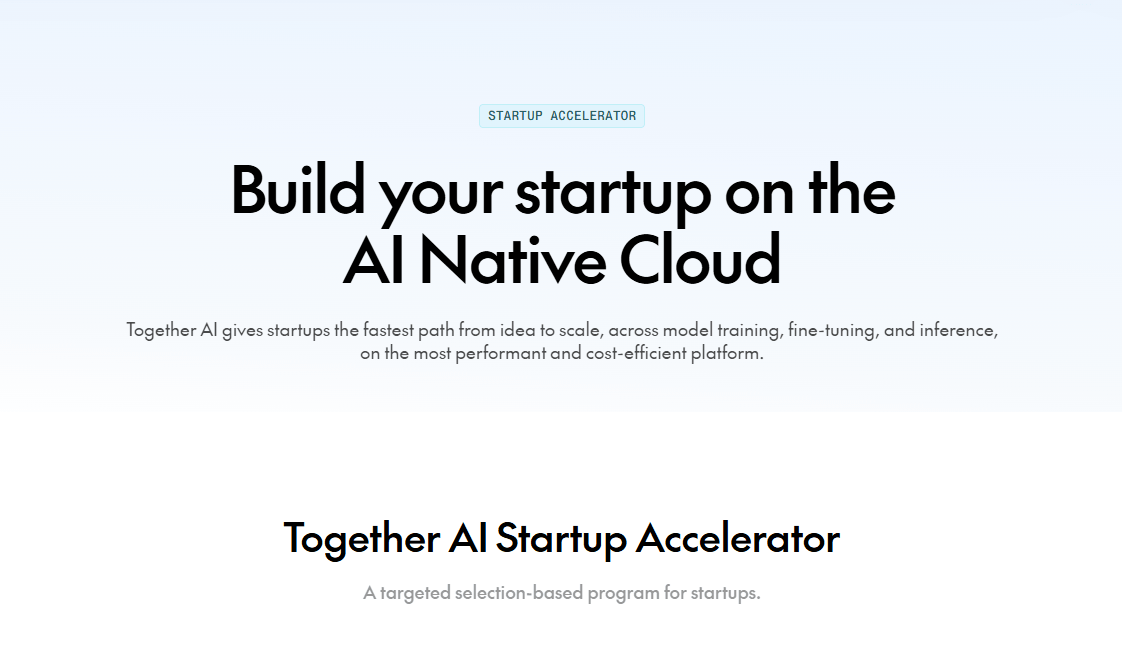
A selection based program for AI startups that pairs compute credits with deep engineering support, patterns, and GTM help. According to vendor documentation, cohorts get technical mentors and access to a network of partners.
- Best for: Teams training or serving open model workloads that need credits plus hands on tuning and deployment help. A recent funding surge underscores its infrastructure focus and ecosystem pull, as reported by TechCrunch in July 2026.
- Key Features:
- Compute credits for model training and inference, per vendor documentation
- Dedicated engineering support on performance tuning and fine tuning, per vendor documentation
- Best practices for high throughput inference and cost control, per vendor documentation
- GTM support and access to a VC and partner network, per vendor documentation
- Why we like it: Strong alignment with the infrastructure wave, plus program design that matches real bottlenecks like throughput, latency, and evals.
- Notable Limitations:
- Selection is competitive and cohorts are small relative to demand, a common accelerator constraint noted across the industry in independent coverage of cohort scale (AWS Impact Accelerator overview).
- Compute supply concentration and rising power constraints can impact timelines and costs, even for well funded providers, as flagged by the Cloud Security Alliance's compute concentration analysis and recent Gartner data center power forecasts.
- Pricing: Pricing not publicly available. Contact Together AI for a custom quote or cohort details.
LobsterCombinator
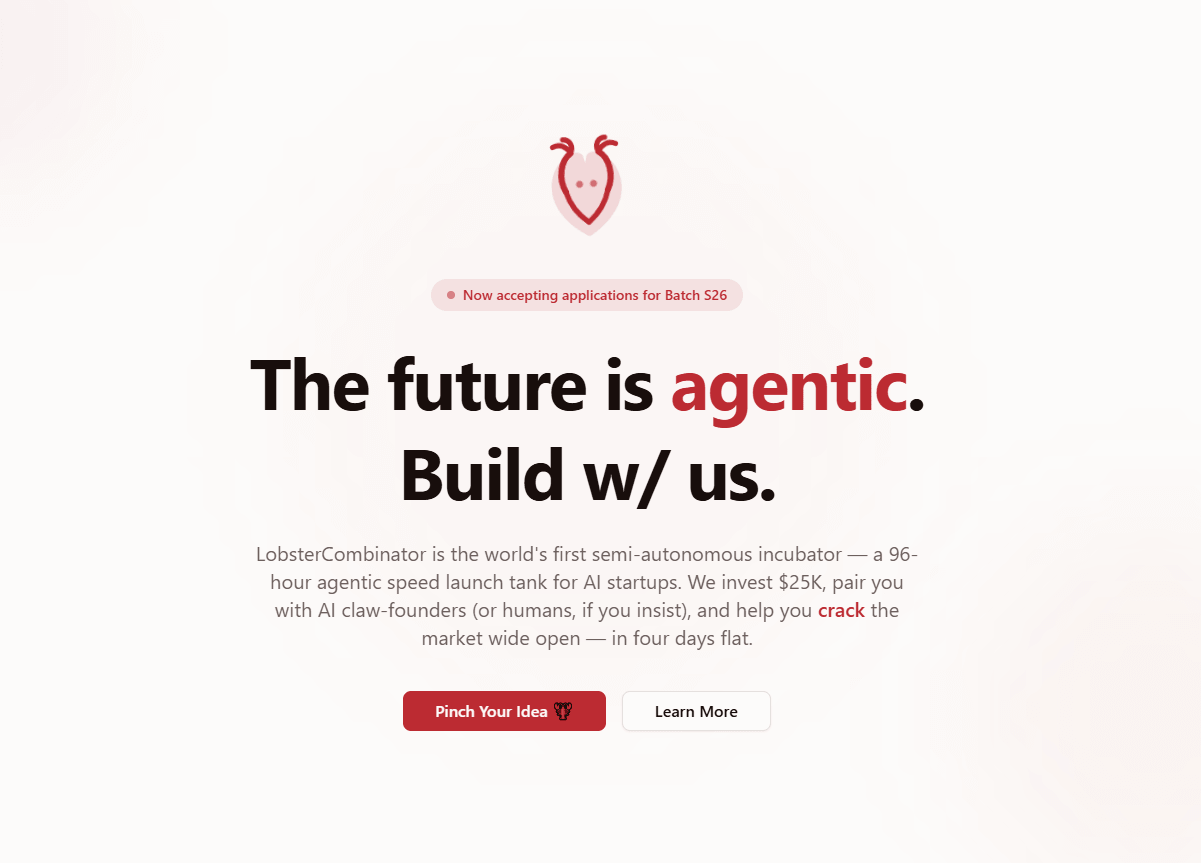
A 96 hour agentic AI incubator with a speed launch format and a stated $25K check. According to program materials, teams sprint from idea to public demo using agent frameworks.
- Best for: Founders testing agentic workflows in days, not weeks, who prefer a concentrated launch window.
- Key Features:
- 96 hour build sprint using agent toolchains, per program materials
- Founder friendly initial investment of $25K, per program materials
- Rapid launch support and public demo rhythm, per program materials
- Why we like it: If you need to validate an agentic UX, event loop reliability, or browser automation in the open, the four day constraint forces signal fast.
- Notable Limitations:
- Extremely short duration compared with typical 8 week accelerators, which may limit depth in enterprise validation, as seen in widely referenced 8 week formats like the AWS Impact Accelerator.
- Independent reviews are scarce as of July 13, 2026, which mirrors broader founder caution about accelerator ROI in community discussions (founder perspectives on accelerators).
- Pricing: According to program materials, investment terms include a $25K check. Independent third party confirmation was not found as of July 13, 2026.
Plank AI Accelerator
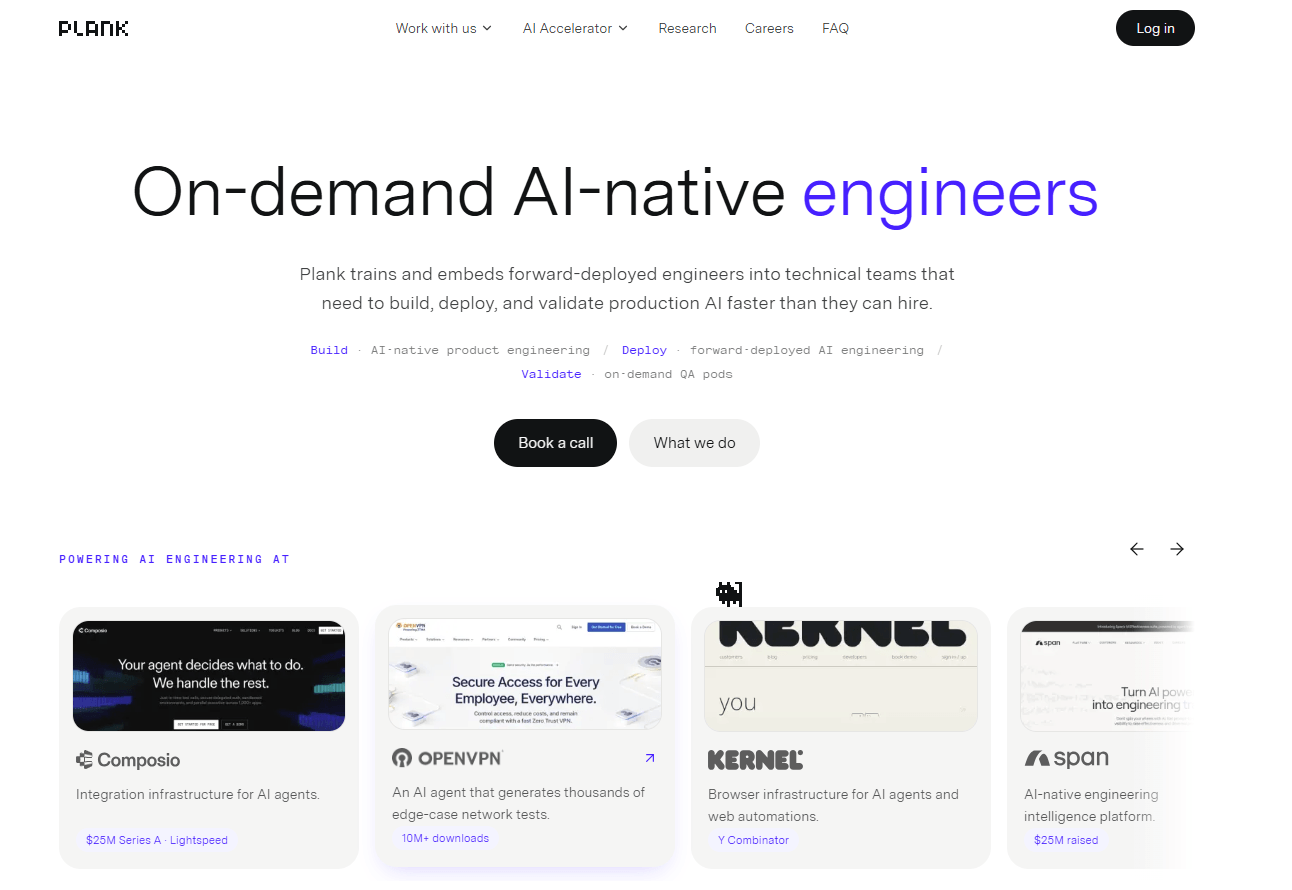
An intensive track that trains AI native engineers in agents, RAG, deployment, and evals, then embeds them as forward deployed engineers on production teams. According to company materials, cohorts use a harness driven SDLC that ties agents to CI, QA, and safe deploys.
- Best for: Product teams that want embedded AI engineering capacity trained specifically on production agent patterns, evals, and reliability.
- Key Features:
- Training on agent systems, retrieval, voice or multimodal, and production deployment, per company materials
- Forward deployment model where engineers embed long term in customer teams, per company materials
- Harness driven SDLC that routes agent output through review, QA, and rollout gates, per company materials
- Why we like it: The forward deployed model maps to real adoption patterns that major services players are also embracing, as shown by Accenture's FDE program announcement.
- Notable Limitations:
- This is closer to talent deployment than a capital investing accelerator, which may not fit founders seeking funding or demo day exposure, a tradeoff that shows up across FDE style programs (Accenture FDE blog).
- Regional availability and cohort timing can limit access, a common constraint for embedded engineering models, reflected across industry hiring and deployment notes in market commentary (IDC servers market context).
- Pricing: Pricing not publicly available. Contact Plank for a custom quote and deployment scope.
StartupBuilder Product Accelerator for AI Startups
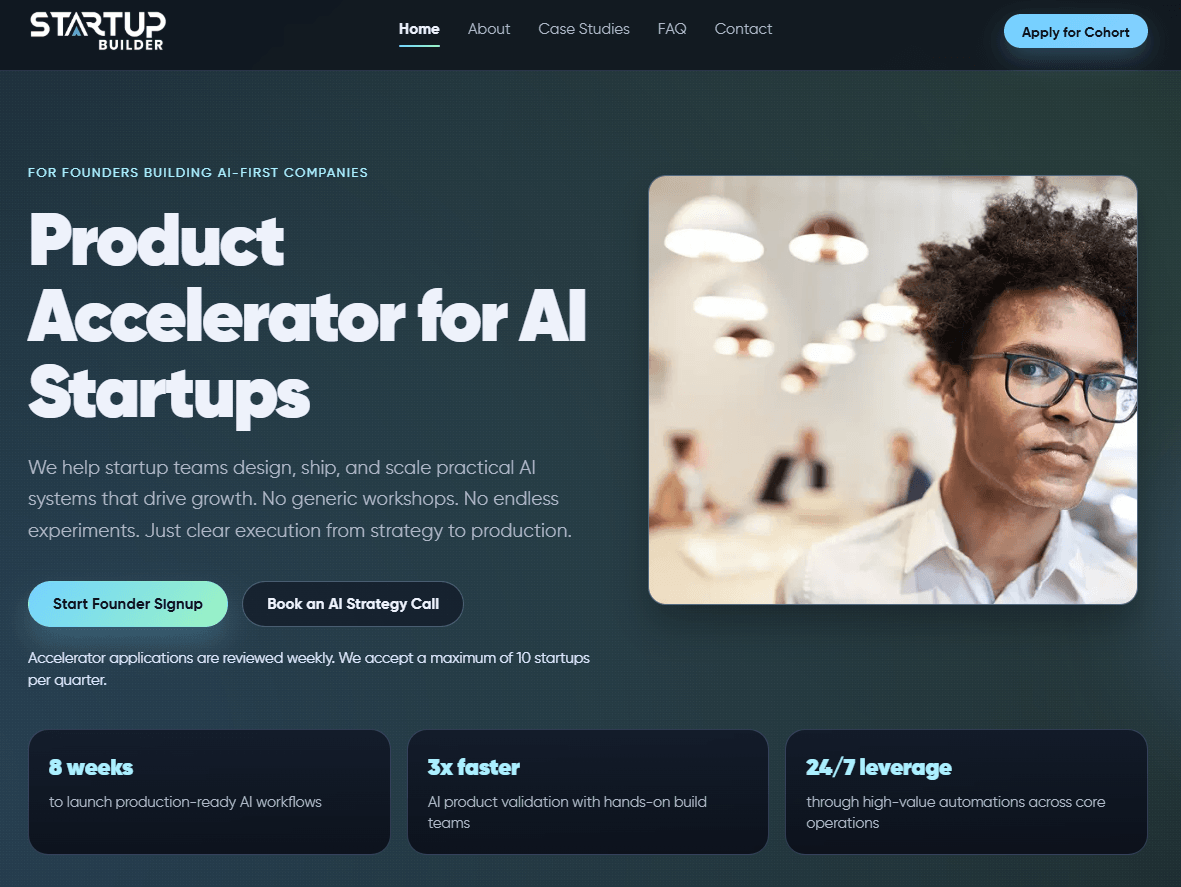
An 8 week product accelerator that helps AI teams design, build, and ship production ready systems with commercialization support. According to program materials, each cohort is outcome focused and blends product, engineering, and GTM.
- Best for: Founding teams that want a structured eight week plan to ship a working AI product with a GTM narrative and metrics.
- Key Features:
- 8 week product, engineering, and commercialization track, per program materials
- Delivery focus on shipping production systems with guardrails and evaluation, per program materials
- Weekly operating cadence plus founder accountability, per program materials
- Why we like it: The eight week cadence matches the most common accelerator rhythm and supports real delivery, which aligns with the way many high velocity cohorts operate, for example in programs like the Startup425 AI intensive.
- Notable Limitations:
- No public evidence of investment capital or equity terms, which places it in the product acceleration and services category rather than a traditional investor led accelerator.
- Independent, third party reviews are limited, a general pattern across niche accelerators that founders frequently flag in public forums (founder perspectives on accelerators).
- Pricing: Pricing not publicly available. Contact StartupBuilder for a custom quote.
AI Engineering Accelerators Tools Comparison: Quick Overview
| Tool | Best For | Pricing Model | Highlights |
|---|---|---|---|
| Together AI Startup Accelerator | Startups training or serving open models needing compute and hands on tuning | Not publicly available | Infra scale plus engineering help, backed by significant recent funding (TechCrunch) |
| LobsterCombinator | Agentic MVPs validated in days | Investment led, per program materials | 96 hour sprint with a stated $25K check, per program materials |
| Plank AI Accelerator | Teams needing embedded AI native engineers | Services engagement | Trains engineers on agents, RAG, deployment, then embeds with customers, per company materials |
| StartupBuilder Product Accelerator | Eight week ship to production with GTM | Services engagement | Outcome focused build plan aligned with common 8 week formats (Startup425) |
AI Engineering Accelerators Platform Comparison: Key Features at a Glance
| Tool | Feature 1 | Feature 2 | Feature 3 |
|---|---|---|---|
| Together AI Startup Accelerator | Compute credits | Engineering support on performance and fine tuning | Partner and VC network |
| LobsterCombinator | 96 hour agentic sprint | Founder friendly initial check | Public launch and demo focus |
| Plank AI Accelerator | Agent and RAG training | Harness driven SDLC with QA | Forward deployed embedding |
| StartupBuilder Product Accelerator | 8 week product build | Production readiness and evals | Commercialization support |
AI Engineering Accelerators Deployment Options
| Tool | Cloud API | On Premise | Integration Complexity |
|---|---|---|---|
| Together AI Startup Accelerator | Yes, via partner platforms and hosted inference, per market coverage | Possible via customer VPC or dedicated capacity in select cases | Medium to High depending on model size and latency targets |
| LobsterCombinator | Yes, typical agent stacks and browser automation | Uncommon | Low to Medium given MVP focus |
| Plank AI Accelerator | Yes, customer clouds and CI | Yes, embeds with existing infra | Medium, mitigated by embedded team |
| StartupBuilder Product Accelerator | Yes | Possible based on customer infra | Medium, tied to product scope |
AI Engineering Accelerators Strategic Decision Framework
| Critical Question | Why It Matters | What to Evaluate | Red Flags |
|---|---|---|---|
| Do you need compute plus tuning help or primarily product acceleration | Infra constraints and eval driven tuning often dominate cost and time, per Gartner and IDC | Access to credits, dedicated engineers, inference throughput | No specifics on credits, vague engineering scope |
| Is an 8 week cadence sufficient or do you need a 4 day proof | Cadence governs depth of validation and security reviews | Cohort length, security testing, user studies | Promises of production in days without risk plan |
| Do you want capital, services, or embedded talent | Model affects runway and ownership | Investment terms, staffing model, IP ownership | Hidden fees, unclear IP or data terms |
| Can the program operate within your compliance and data boundaries | AI infra is concentrated and power constrained, which affects placement options (CSA compute concentration, Gartner power forecast) | VPC or private networking, audit logs, eval harness | Only public endpoints, no policy controls |
AI Engineering Accelerators Solutions Comparison: Pricing & Capabilities Overview
| Organization Size | Recommended Setup | Monthly Cost | Annual Investment |
|---|---|---|---|
| Solo or 2 person founder team | LobsterCombinator for rapid proof, then StartupBuilder for an 8 week ship | Varies | Varies |
| Seed to early Series A | Together AI Startup Accelerator for infra credits and tuning, Plank for embedded delivery | Varies | Varies |
| Mid market with multiple products | Plank embedded pods plus targeted accelerator sprints | Varies | Varies |
Problems & Solutions
-
Problem: Compute scarcity and rising power constraints delay training and increase inference costs.
Solution: Together AI Startup Accelerator aligns with this reality by pairing credits and tuning help so teams can hit throughput and latency targets faster. The underlying constraint is well documented in Gartner's power consumption forecast and in IDC's analysis of surging AI infrastructure spend (IDC insight). -
Problem: Agentic workflows break in production without evals, guardrails, and a deployment harness.
Solution: Plank AI Accelerator trains engineers on agents, retrieval, and a harness driven SDLC, then embeds with teams to operate the system in the real world. The importance of closing the loop on code and issue resolution in agent systems is echoed by recent research on agentic code review (agentic code review research). -
Problem: Teams need fast signal on agent UX and reliability before committing months of runway.
Solution: LobsterCombinator's 96 hour sprint is designed to expose UX fit and runtime failure modes quickly, a useful complement to the more common eight week formats used by many programs like the AWS Impact Accelerator. If the idea cannot survive four days of public iteration, you save months. -
Problem: Shipping a production ready AI feature set while building a credible GTM story is hard within a single sprint.
Solution: StartupBuilder's eight week cadence emphasizes product delivery with commercialization, which aligns with how many regional and corporate accelerators structure practical build windows, for example the Startup425 AI intensive.
The Bottom Line
If you need compute plus deep tuning help, Together AI's program is aligned with where the money and constraints are moving in 2026, as highlighted by Gartner's spending forecast. If you want an agent MVP reality check within days, pick LobsterCombinator, then graduate to an eight week delivery cycle with StartupBuilder.
For organizations that need production results and capacity, Plank's embedded model maps to how enterprises are adopting AI native engineering, which mirrors moves by large services firms in forward deployed programs (Accenture's FDE announcement). Across all four, ask pointed questions about credits, security, and delivery milestones, and prefer programs that publish cohort scope and measurable outcomes.