

Most teams discover their AI gateway gaps during a production incident, not from a design review. From experience in the startup ecosystem, the biggest AI gateway mistakes happen when one model outage, a missed PII redaction, or a runaway prompt loop spikes token spend. Technically, this shows up as provider failover chains that were never tested, token-level budget caps that are missing, or tracing that does not tie prompts to specific users and policies. You think you know your exposure until the audit asks for end-to-end logs. Gartner's latest outlook puts worldwide AI spending at $2.52 trillion in 2026 - a 44% year-over-year increase - which is why this control layer is now board-level infrastructure (Gartner press release).
This guide covers four tools that consistently delivered on multi-provider routing, governance, and cost control, cross-checking analyst notes that now recognize AI gateways as a category (Gartner Market Guide overview). You will learn how each gateway handles compliance, observability, and routing trade-offs, plus where pricing and deployment models fit for startups and enterprises.
TrueFoundry AI Gateway
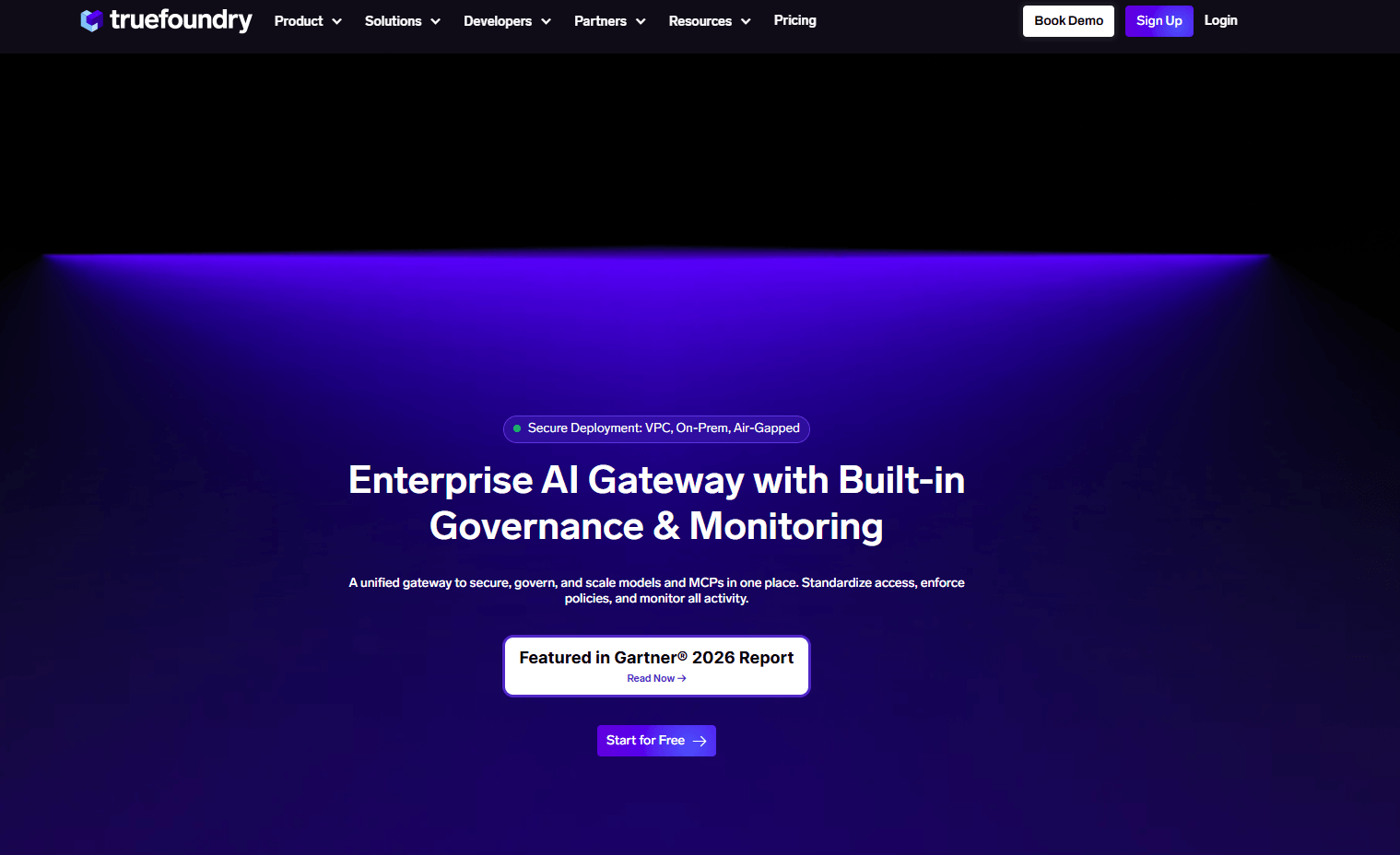
A production-ready control plane for connecting, observing, and governing LLMs, MCP servers, prompts, and agents across teams. Focuses on multi-provider routing, cost governance, and policy enforcement at enterprise scale.
- Best for: Enterprises that need centralized governance and cost controls across many teams and providers.
- Key Features: Unified API to 1000+ models, policy-based access and budgets, observability and tracing, guardrails and prompt management, MCP connectivity for tools and agents.
- Why we like it: The unified control plane reduces integration glue and puts cost, latency, and policy in one place, which shortens incident resolution.
- Notable Limitations: Pricing transparency is limited in public sources; buyers report a sales-led motion. Independent studies show router quality can be uneven across tasks, so you should benchmark routing policies on your own data (LLMRouterBench).
- Pricing: Pricing not publicly available. Business press confirms company traction and recent funding, which signals ongoing product investment (TechCrunch funding coverage, BusinessWire launch coverage).
LLM Gateway
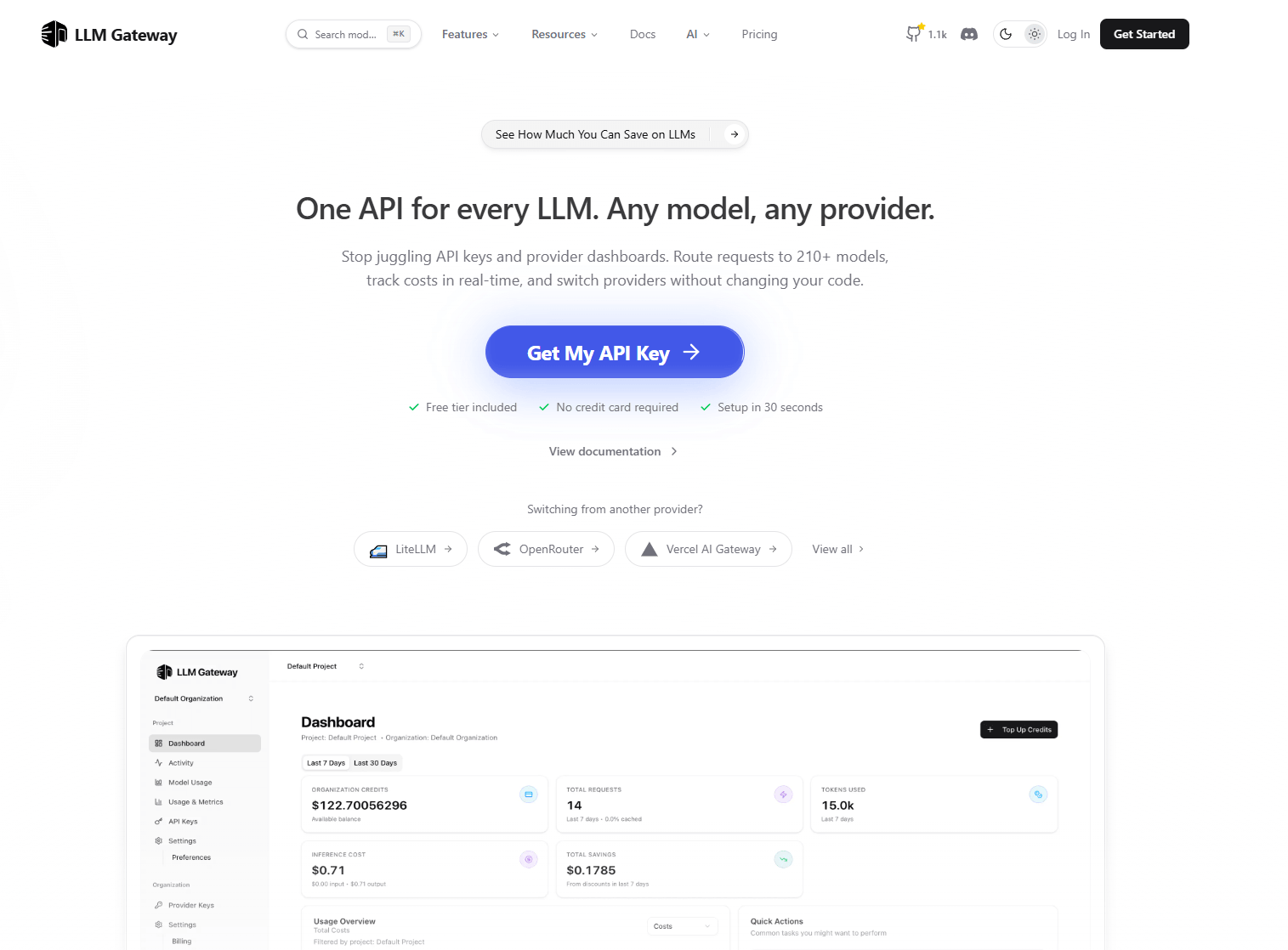
An open-source AI gateway that provides a unified, OpenAI-compatible API to route, manage, and analyze LLM traffic across multiple providers. Offers self-host and a hosted option with project-level analytics.
- Best for: Engineering teams that want a drop-in API layer, self-hosting, and granular cost and error analytics.
- Key Features: Unified API, per-project usage explorer, cost tracking, rate limiting, and observability. Self-hosting guides are widely referenced by the community.
- Why we like it: For mid-size apps, a simple base-URL swap plus cost dashboards removes repetitive provider plumbing without heavyweight platform buy-in.
- Notable Limitations: Community feedback notes gaps like missing or basic caching in some builds and the need for careful trust and privacy reviews for any hosted proxy, so many teams prefer self-host (Reddit discussion, Reddit privacy thread).
- Pricing: Self-host is reported as MIT-licensed and free according to independent tool directories; hosted pricing is not consistently published, verify directly (AITOOLBOOK summary).
MLflow AI Gateway
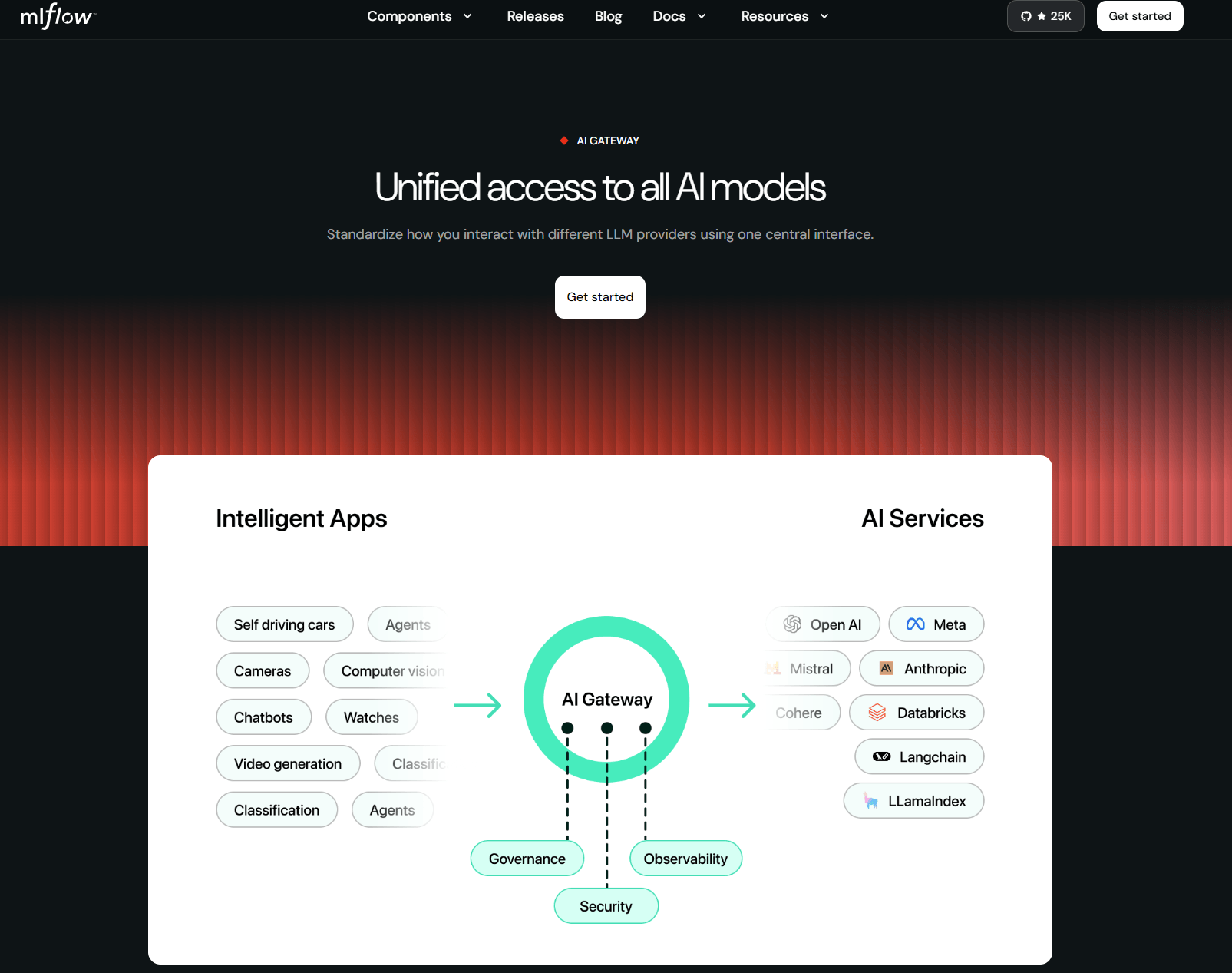
A centralized proxy layer integrated into MLflow that unifies access to LLM providers with credential management, tracking, routing, and governance. Part of the broader open-source MLflow stack for tracing, evaluation, and deployments.
- Best for: Teams standardizing on MLflow for experiments, traces, and model governance who want gateway requests tied to MLflow telemetry.
- Key Features: Unified LLM access, central secret management, routing, and native traces that feed evaluation workflows. Open source under Apache 2.0, with managed options from cloud vendors.
- Why we like it: One platform ties prompts, traces, token costs, and eval runs together, simplifying audits and post-incident analysis (Microsoft Learn overview).
- Notable Limitations: The gateway feature set has evolved across releases, and issues in the Deployments APIs surface as feature requests or breaking changes, so version pinning and migration plans matter (MLflow GitHub issue tracker).
- Pricing: Open source and free under Apache 2.0, verified by neutral summaries (AI Wiki). Managed MLflow is vendor priced by the hosting platform.
SS&C AI Gateway
An enterprise-scale LLM governance platform that centralizes generative AI access with strong security, compliance, monitoring, and auditability. Available with private cloud and on-prem options through SS&C Blue Prism.
- Best for: Highly regulated enterprises that require tight identity controls, audit trails, and multi-provider policies across business units.
- Key Features: Governance-first design with RBAC, audit trails, monitoring and analytics, and private or on-prem deployment options validated in third-party coverage (FinTech Global launch).
- Why we like it: The emphasis on non-repudiable logs and policy controls aligns with internal audit needs. Blue Prism's enterprise footprint and SS&C backing reduce vendor risk (SS&C investor coverage).
- Notable Limitations: Public pricing is opaque and typically enterprise-negotiated, which can slow procurement for smaller teams (Automation Atlas pricing explainer). RPA-centric ecosystems may require additional integration work for non-automation AI stacks.
- Pricing: Pricing not publicly available, contact SS&C for a custom quote. Disclosure: Blue Prism is owned by SS&C and continues to operate under the SS&C Blue Prism brand (acquisition history).
AI Gateway Tools Comparison: Quick Overview
| Tool | Best For | Pricing Model | Highlights |
|---|---|---|---|
| TrueFoundry AI Gateway | Enterprise governance and multi-team cost control | Enterprise license, no public free tier | Control plane for routing, guardrails, budgets, and observability |
| LLM Gateway | Dev teams seeking a drop-in unified API and self-host | MIT open source for self-host; hosted service available | OpenAI-compatible API, usage explorer, cost analytics |
| MLflow AI Gateway | MLflow users needing gateway events tied to traces and evals | Apache 2.0 open source; managed offerings priced by vendors | Centralized proxy with native tracing and evaluation |
| SS&C AI Gateway | Regulated enterprises requiring deep audit and RBAC | Enterprise license, no public free tier | Governance-first controls, private cloud and on-prem options |
AI Gateway Platform Comparison: Key Features at a Glance
| Tool | Unified API | Routing and Fallback | Governance and RBAC |
|---|---|---|---|
| TrueFoundry AI Gateway | Yes | Yes | Yes |
| LLM Gateway | Yes | Yes | Basic to moderate, depends on self-host configuration |
| MLflow AI Gateway | Yes | Yes | Central secret management, role scoping through platform |
| SS&C AI Gateway | Yes | Yes | Enterprise RBAC, audit trails |
AI Gateway Deployment Options
| Tool | Cloud API | On-Premise | Integration Complexity |
|---|---|---|---|
| TrueFoundry AI Gateway | Yes | Customer-managed in VPC reported by users and docs | Medium for enterprises, low for small teams adopting defaults |
| LLM Gateway | Yes, hosted | Yes, self-host | Low to medium, depends on auth and storage choices |
| MLflow AI Gateway | Self-managed | Yes | Medium when wiring providers and evaluation flows |
| SS&C AI Gateway | Yes, private cloud | Yes | Medium to high given enterprise security reviews |
AI Gateway Strategic Decision Framework
| Critical Question | Why It Matters | What to Evaluate | Red Flags |
|---|---|---|---|
| Do we need multi-provider routing on day one? | Outages and price swings can cripple single-provider stacks (community outage lessons). | Supported providers, fallback behavior, routing policies, benchmarking workflow. | Hardcoded single provider, no failover tests. |
| How will we evidence governance and audit? | Regulators expect identity-tied logs and policy controls in AI workflows (FinTech Global launch summary). | RBAC depth, audit trails, redact or block rules, data residency. | No content controls, opaque logging, hosted-only without controls. |
| Can we tie costs to real traces and outcomes? | Finance and engineering need to see why spend changed, not just totals (Microsoft Learn on MLflow). | Token accounting with context, per-user budgets, anomaly alerts. | Aggregate dashboards with no user or trace linkage. |
| What breaks during upgrades? | Rapidly evolving gateways can introduce breaking changes (MLflow issue tracker). | Version policies, migration guides, pinning strategy. | Forced upgrades, unclear deprecation timelines. |
AI Gateway Solutions Comparison: Pricing and Capabilities Overview
| Organization Size | Recommended Setup | Monthly Cost | Annual Investment |
|---|---|---|---|
| Startup, single product | LLM Gateway self-host, add eval and logging as needed | Software free, infra minimal | Software free, infra only |
| Mid-market with multiple teams | MLflow AI Gateway tied to tracing and evaluation | Software free, infra plus managed options | Software free, infra plus managed options |
| Regulated enterprise | SS&C AI Gateway or TrueFoundry AI Gateway with private networking | Pricing not publicly available | Pricing not publicly available |
Problems & Solutions
-
Problem: A regional outage on your primary LLM provider brings down user-facing features.
How these tools help:
- TrueFoundry AI Gateway, LLM Gateway, and MLflow AI Gateway support multi-provider routing and failover so one provider outage does not halt traffic. Community postmortems highlight why central routing with fallback reduces blast radius (Reddit incident lesson).
- SS&C AI Gateway brings governance-first routing and policy enforcement, which helps document and approve fallback paths for audit and risk teams (FinTech Global coverage).
-
Problem: Security teams demand identity-tied audit logs of prompts and responses, with PII redaction and role-based policies.
How these tools help:
- SS&C AI Gateway emphasizes audit trails and RBAC suitable for regulated environments, a need that enterprise coverage repeatedly stresses (MarketBeat investor brief).
- MLflow AI Gateway links gateway requests to traces and evaluation artifacts, which shortens audits by connecting cost, latency, and behavior to specific runs (Microsoft Learn overview).
-
Problem: Costs climb unpredictably because billing models differ across providers, caches, and multimodal endpoints.
How these tools help:
- All four tools provide dashboards or telemetry to break down spending by model and team. Community practitioners warn that pricing math is complex across providers and caches, so gateways that normalize billing details save real money (community cost analysis).
-
Problem: Routing research shows that some routers do not beat simple baselines on real tasks, so blindly trusting an auto-router can degrade quality.
How these tools help:
- TrueFoundry AI Gateway and MLflow AI Gateway let you A/B and evaluate routing decisions on real traffic, which aligns with benchmark findings that emphasize evaluation over claims (LLMRouterBench).
- LLM Gateway's self-host model lets you inject your own heuristics or model selection policies and measure impact.
-
Problem: Fragmented APIs and formats across providers slow down integration and testing.
How these tools help:
- These gateways expose a unified, OpenAI-compatible surface so teams can standardize clients, while new research confirms the need for cross-provider translation schemas in complex environments (LLM-Rosetta research).
The Bottom Line on AI Gateways
If your AI roadmap includes multiple providers, compliance requirements, or agent workflows, you need a gateway strategy. Analyst data shows AI budgets are climbing fast - worldwide AI spending is forecast to reach $2.52 trillion in 2026, a 44% increase year-over-year - which raises the bar for governance and cost controls (Gartner spending forecast). These four tools stood out for different reasons: TrueFoundry for a unified enterprise control plane, LLM Gateway for quick wins and self-host, MLflow AI Gateway for trace-first governance, and SS&C AI Gateway for audit-heavy environments. Start with a pilot that proves failover, PII controls, and trace-linked cost reporting, then scale with clear SLAs and a versioning plan. Finally, benchmark routing on your own workloads because published results rarely match your data and risk profile (LLMRouterBench).