
Most teams discover their diagnostic AI bottlenecks during go-lives and on-call nights, not from glossy demos. Working across different tech companies, we have learned that the biggest mistakes happen when interfaces break under load, HL7 messages map incorrectly, or a new FDA Predetermined Change Control Plan forces validation work you did not plan for. From our experience in the startup ecosystem, the three recurring pain points are: DICOM routing rules for CT triage, scanner and browser validation for digital pathology, and ECG data quality thresholds for cardiology AI. Aidoc's recent multi-indication FDA clearance shows how fast this field is moving, and why implementation details matter (Radiology Business coverage).
The global AI in diagnostics market was approximately 1.97 billion dollars in 2025, with forecasts reaching 5.44 billion dollars by 2030, per Grand View Research. To help you move faster, we narrowed the list to five vendors that show consistent clinical validation, regulatory progress, and deployment at scale. In the next sections you will see where each product fits, what it actually does according to third-party reports, what limitations buyers report, and where pricing is or is not public.
Aidoc
Real-time imaging AI built for triage and workflow orchestration across ED and inpatient radiology. Recently cleared as a comprehensive multi-indication CT triage solution in a single workflow.
Best for: Health systems that want enterprise radiology AI with proven FDA clearances and large network deployments.
Key Features:
- Comprehensive CT triage with 11 newly cleared and 3 prior indications in one workflow, per January 21, 2026 FDA clearance coverage (Radiology Business).
- Broad system rollouts documented at AdventHealth and Advocate Health, including ED triage for PE and ICH (PR Newswire, DOTmed).
- Expansion beyond radiology via aiOS with cross-specialty care pathways at WellSpan Health (DOTmed).
Why we like it: Strong regulatory momentum plus multi-hospital deployments reduce pilot risk. Coverage shows real enterprise traction, not just single-site studies.
Notable Limitations:
- False positives and misses still occur in production. A Mayo Clinic study using a commercial algorithm for incidental PE reported 94 false positives across 14,453 CT exams (AuntMinnie).
- PACS, VNA, and HL7 integration adds complexity and can slow rollouts, a known issue in imaging IT workflows (AuntMinnie, PMCID review).
Pricing: Pricing not publicly available. Contact vendor for a custom quote.
Eko Health
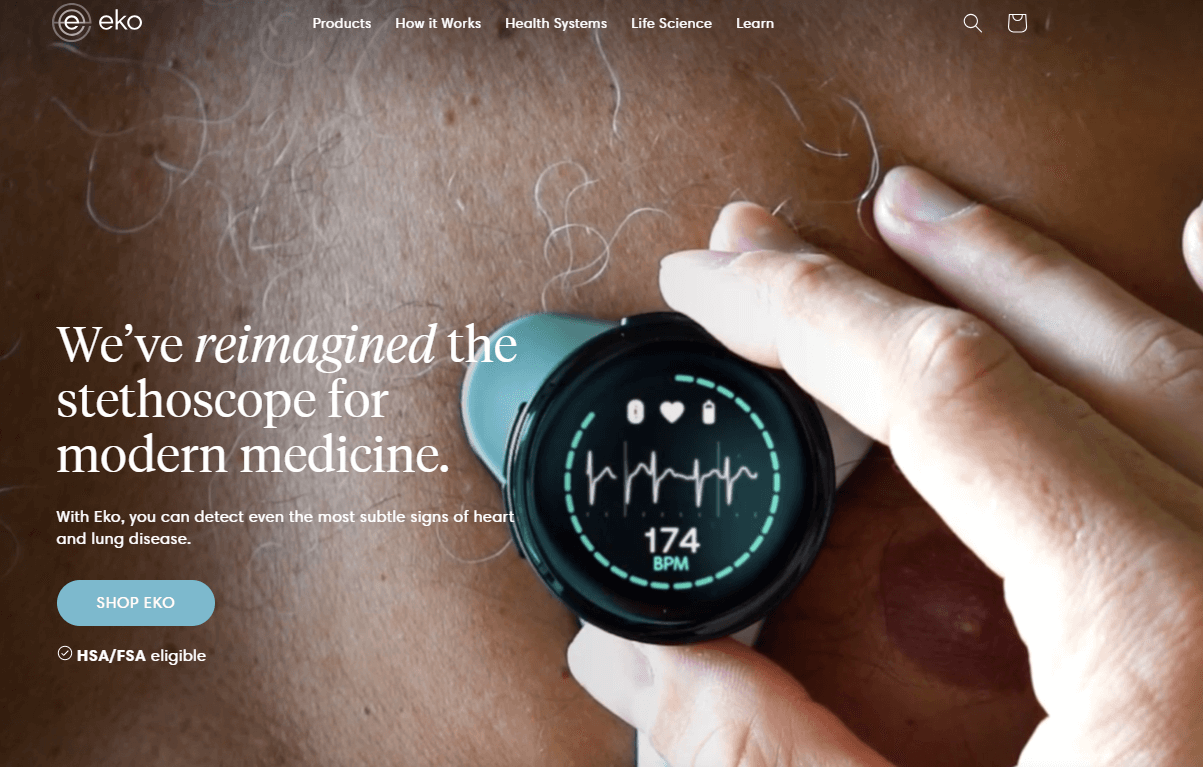
AI-enhanced digital stethoscopes and software for point-of-care detection of cardiovascular and pulmonary signals. Adds AFib, murmur, and low ejection fraction flags to routine exams.
Best for: Primary care, urgent care, cardiology triage, and community clinics seeking low-friction cardiac screening during physical exams.
Key Features:
- FDA-cleared algorithms for AFib and structural murmurs, and later low ejection fraction detection with Mayo Clinic collaboration (Business Wire, PR Newswire, Forbes).
- Real-world performance and adoption reported in UK trials and coverage of rapid bedside detection workflows (The Guardian).
- Hardware options like Littmann CORE and CORE 500 with ECG, available via third-party retailers (DixieEMS pricing).
Why we like it: Minimal workflow change, fast signal capture, and FDA-cleared notifications make it practical for clinics that cannot add imaging capacity.
Notable Limitations:
- Users report subscription feature shifts and service issues in public reviews (Reviews.io).
- AI feature availability and performance can vary by device and country per app store and help center notes (Apple App Store IAP listing).
Pricing:
- Devices commonly retail around 329 to 449 dollars depending on model and reseller (DixieEMS, Klarna price tracker).
- Eko+ subscription shows 12.99 dollars per month or 119.99 dollars per year as in-app purchases (Apple App Store).
PathAI (AISight)
Digital pathology platform, image management system for primary diagnosis with FDA clearance, and pipeline for AI-based biomarkers in research settings.
Best for: Pathology labs moving from pilots to primary diagnosis and academic centers co-developing AI diagnostics.
Key Features:
- AISight Dx received FDA 510(k) for primary diagnosis in June 2025, including a Predetermined Change Control Plan that streamlines future updates (GlobeNewswire press).
- Documented expansion into multiple labs and an academic health system partnership with Northwestern Medicine (GlobeNewswire).
- FDA clearance notes compatibility with specific scanners and displays, which is essential for regulated primary diagnosis workflows.
Why we like it: Regulatory progress for primary diagnosis plus growing real-world lab adoption indicate maturity beyond pilots.
Notable Limitations:
- Digital pathology adoption often faces capital and storage costs, scanner dependencies, and LIS integration work that slow time to value (Pathology News, Today's Clinical Lab, Fortune Business Insights).
- Primary diagnosis clearance applies to specified scanners and conditions, which can limit initial hardware choices.
Pricing: Pricing not publicly available. Contact vendor for a custom quote.
Lunit (INSIGHT and SCOPE)
INSIGHT supports radiology detection for chest and breast imaging, SCOPE enables AI-powered tissue biomarker analysis for trials and translational research.
Best for: Imaging providers scaling mammography and chest AI, and biopharma or academic teams running immuno-oncology biomarker programs.
Key Features:
- CE MDR-certified INSIGHT CXR4 with expanded abnormality detection, and FDA-cleared mammography and tomosynthesis products in the U.S. (PR Newswire, PR Newswire FDA DBT, PR Newswire FDA MMG).
- U.S. rollouts across 150+ DBT sites and 1 million annual mammograms reported after the Volpara acquisition integration (DOTmed, PR Newswire).
- SCOPE collaborations with Roche, Daiichi Sankyo, CellCarta, Labcorp, and NCI for AI biomarkers and digital pathology research (PR Newswire, PR Newswire, PR Newswire).
Why we like it: Strong oncology focus with evidence of U.S. breast imaging scale, plus a growing pharma biomarker footprint.
Notable Limitations:
- Some INSIGHT modules are CE MDR in Europe while select U.S. modules have FDA 510(k), so availability varies by region and indication.
- Imaging AI still requires robust PACS integration and change management, which can extend timelines.
Pricing: Pricing not publicly available. Contact vendor for a custom quote.
Tempus AI
Precision medicine platform spanning oncology testing and clinical data tools, with FDA-cleared cardiology ECG-AI devices and a cardiac MRI platform. Also active in mental health with PGx and clinician tools.
Best for: Systems and large groups standardizing oncology diagnostics and adding AI cardiology and imaging capabilities, plus psychiatric practices that want PGx-informed tooling.
Key Features:
- FDA-cleared ECG-AI devices for AF risk and low ejection fraction (July 2025), and updated FDA-cleared Pixel cardiac MRI platform (September 2025) (MarketWatch, Investing.com, Investor's Business Daily).
- RNA device clearance for research and drug development use supports broader diagnostics and biopharma work (Investor's Business Daily).
- Mental health platform elements include PGx use in psychiatry and an AI notetaker tool covered in industry press, while PGx meta-analyses show improved remission odds in MDD when care is guided by PGx testing (HLTH news, PubMed meta-analysis).
Why we like it: Multi-modality diagnostics with both imaging and ECG devices, plus steady growth in data and applications revenue covered by financial press (Nasdaq/Motley Fool, Barron's).
Notable Limitations:
- ECG-AI devices have specific intended-use populations and are not stand-alone diagnostics, which may limit use cases without confirmatory testing.
- Enterprise rollouts still depend on EHR, imaging, and data integration that can extend timelines, a broad challenge reflected across healthcare AI deployments.
Pricing: Pricing not publicly available for diagnostics and enterprise software. Contact vendor for a custom quote.
AI Medical Diagnostic Tools Comparison: Quick Overview
| Tool | Best For | Pricing Model | Highlights |
|---|---|---|---|
| Aidoc | Health systems needing ED triage at scale | Enterprise license | Recent FDA clearance for comprehensive CT triage, multi-site rollouts reported |
| Eko Health | Clinics adding cardiac screening at the bedside | Device purchase plus optional subscription | FDA-cleared AFib, murmur, low EF algorithms with real-world trial coverage |
| PathAI (AISight) | Labs pursuing primary diagnosis in digital pathology | Enterprise license | FDA-cleared AISight Dx for primary diagnosis with PCCP detail |
| Lunit (INSIGHT, SCOPE) | Imaging networks and oncology biomarker programs | Enterprise license | FDA-cleared mammography/DBT, CE MDR CXR, pharma biomarker collaborations |
| Tempus AI | Oncology, cardiology, imaging, and mental health platforms | Enterprise license, device mix | FDA-cleared ECG-AI and cardiac MRI tools, expanding app ecosystem |
Notes and sources: Aidoc FDA clearance and deployments (Radiology Business); Eko features and pricing (Forbes); PathAI FDA clearance (GlobeNewswire); Lunit regulatory and deployments (PR Newswire); Tempus devices (MarketWatch).
AI Medical Diagnostic Platform Comparison: Key Features at a Glance
| Tool | Imaging Triage | Digital Pathology | Point-of-Care Cardiac AI |
|---|---|---|---|
| Aidoc | Yes, multi-indication CT triage | No | No |
| Eko Health | No | No | Yes |
| PathAI (AISight) | No | Yes, FDA-cleared IMS | No |
| Lunit (INSIGHT, SCOPE) | Yes, chest and breast | Yes, SCOPE for IHC/TME | No |
| Tempus AI | Yes, cardiac MRI platform | No | Yes, ECG-AI |
Regulatory and collaboration sources: Aidoc clearance (Radiology Business), Eko clearances (PR Newswire), PathAI FDA clearance (GlobeNewswire), Lunit news (PR Newswire), Tempus devices (Investor's Business Daily).
AI Medical Diagnostic Deployment Notes
| Tool | Typical Hosting | EHR/PACS/LIS Touchpoints | Integration Considerations |
|---|---|---|---|
| Aidoc | Enterprise deployments with PACS routing | PACS, VNA, EHR | Imaging IT integrations add time |
| Eko Health | Mobile app plus device, cloud services | Minimal EHR unless notes shared | Country-specific feature availability |
| PathAI (AISight) | Cloud-native IMS, regulated environment | LIS, scanners, displays | Scanner and display validation per FDA clearance details |
| Lunit | Cloud and on-prem customer deployments reported | PACS, imaging workstations | Large network rollouts reported in U.S. breast imaging |
| Tempus AI | Enterprise, device plus cloud mix | EHR and imaging for select tools | Rollout timelines influenced by data and device integrations |
AI Medical Diagnostic Strategic Decision Framework
| Critical Question | Why It Matters | What to Evaluate | Red Flags |
|---|---|---|---|
| Which indications and devices are FDA-cleared now? | Avoids pilot dead-ends and supports billing and credentialing | 510(k) summaries, third-party coverage, intended-use scope | "Pilot only" with unclear path to clinical use |
| Can it integrate with our PACS, LIS, or EHR in weeks, not quarters? | Integration often dictates ROI | HL7 v2 message mapping, DICOM tags, viewer compatibility | Vague timelines, no named interface specs |
| What is the false positive profile in studies? | Affects reader trust and workflow | Independent study data, workload impact | Uncited claims, no numbers on flags per study |
| How is pricing structured and what is predictable TCO? | Prevents budget surprises | Device cost, per-exam or subscription, support fees | No ballpark ranges, no public subscription terms |
Citations: false positives and workflow data (AuntMinnie), integration realities (PMCID review).
AI Medical Diagnostic Solutions Comparison: Pricing and Capabilities Overview
| Organization Size | Recommended Setup | Annual Investment |
|---|---|---|
| Solo or small clinic | Eko Health device plus Eko+ app features | Device 329-449 dollars typical, app 119.99 dollars yearly |
| Mid-size imaging center | Lunit INSIGHT for mammography or DBT, or Aidoc for ED CT triage | Contact vendors for enterprise quotes |
| Large health system | Aidoc enterprise triage suite, Tempus cardiac MRI device in cardiology service lines, PathAI AISight for digital pathology | Contact vendors for enterprise quotes |
Retail and subscription references: device and pricing ranges (DixieEMS, Klarna tracker). Enterprise pricing remains undisclosed publicly.
Problems & Solutions
-
Problem: ED imaging backlogs increase door-to-decision times.
Solution: Aidoc's multi-indication CT triage flags urgent cases across several abdominal findings in a single workflow, which third-party coverage says was recently FDA-cleared, aligning with deployments at Advocate Health and AdventHealth that aim to speed prioritization (Radiology Business). -
Problem: Primary care clinics miss silent cardiac dysfunction due to limited access to echo.
Solution: Eko's FDA-cleared low ejection fraction algorithm, plus AFib and murmur detection, adds a screening layer during routine exams without new imaging infrastructure (PR Newswire, Forbes). -
Problem: Digital pathology pilots stall when labs try to scale to primary diagnosis and enterprise volumes.
Solution: PathAI's AISight Dx clearance for primary diagnosis, plus growth in lab deployments, provides a regulated base to expand, while buyers should budget for scanner, storage, and LIS integration per independent market and news sources (GlobeNewswire, Pathology News). -
Problem: Breast imaging networks need higher throughput and consistency across 2D and 3D modalities.
Solution: Lunit's FDA-cleared mammography and DBT tools and CE MDR CXR modules, along with U.S. scale reported after integrating Volpara assets, target accuracy and workload in national rollouts. -
Problem: Cardiology programs want earlier identification without invasive tests, and imaging teams need faster cardiac MRI quantification.
Solution: Tempus' ECG-AF and ECG-Low EF algorithms provide risk notifications from resting 12-lead ECGs, and its Pixel cardiac MRI platform adds automated mapping to speed reads, all with recent FDA clearances covered in the trade press (MarketWatch, Investor's Business Daily).
The Bottom Line
If you run a busy ED or radiology service, start with triage tools that already have broad FDA clearances and documented multi-hospital rollouts. If your biggest bottleneck is cardiac risk detection in primary care, a device-plus-app approach can deliver value now while you evaluate imaging capacity. Labs moving to digital pathology should plan for scanners, storage, and LIS integration long before the go-live. The AI diagnostics market is growing fast, with 2026 revenue near 2 billion dollars and strong growth into the 2030s, which means buyer diligence on integration, intended use, and workload impact is essential (Grand View Research, AuntMinnie).