

Most teams discover their patient engagement workflow gaps during a messy EHR rollout, not from a glossy product demo. From experience in the startup ecosystem, the biggest wins come from getting very specific with the plumbing - for example HL7 FHIR writebacks for scheduling and demographics, real-time voice barge-in under 400 ms for call flows, and PHI-safe audit logging with automated redaction. Leaders now see AI as a core enabler of these use cases, with 91 percent of healthcare executives viewing AI as essential to digital transformation, according to a recent Frost & Sullivan analysis.
Across operations, the avoidable drag is still no-shows and manual outreach. A systematic review found average healthcare no-show rates near 23 percent across specialties - a costly hit to access and revenue - which is why automated reminders and frictionless rescheduling matter so much (ScienceDirect review). Below you will learn where each platform fits, how they differ on voice versus SMS channels, what deployment patterns reduce risk, and which tradeoffs to expect around integrations, governance, and cost.
StackAI
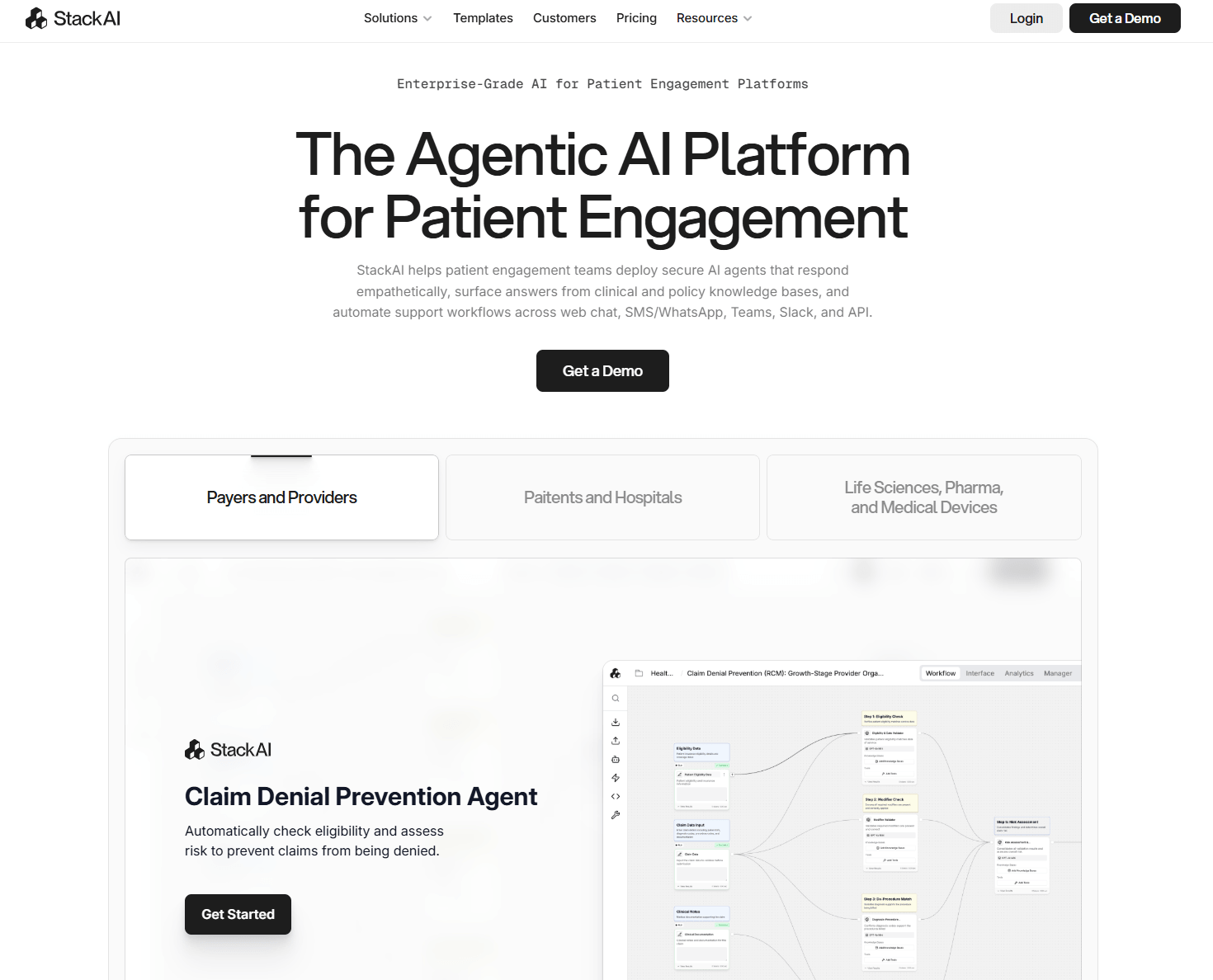
Agentic AI platform that deploys secure, compliant AI agents for patient outreach, chat, triage, and operational workflows across multiple channels. Supports VPC and on-prem options for regulated data per marketplace documentation.
- Best for: Provider groups and health systems that need configurable, multi-channel agents with strict data residency and governance.
- Key Features: HIPAA-aligned agents and audit trails, visual workflow builder and RAG, omnichannel chat and voice, private VPC or on-prem deployment, prebuilt connectors for enterprise apps, per StackAI documentation.
- Why we like it: The combination of visual orchestration plus private deployment models shortens pilots without giving up control of PHI.
- Notable Limitations: Reviews note a learning curve for advanced flows, occasional debugging opacity, and pricing stretch for very small teams, based on aggregated feedback on G2's StackAI page.
- Pricing: Available in the AWS Marketplace listing; specific terms and metering vary by plan. Contact StackAI for a custom quote.
HealthTalk A.I.
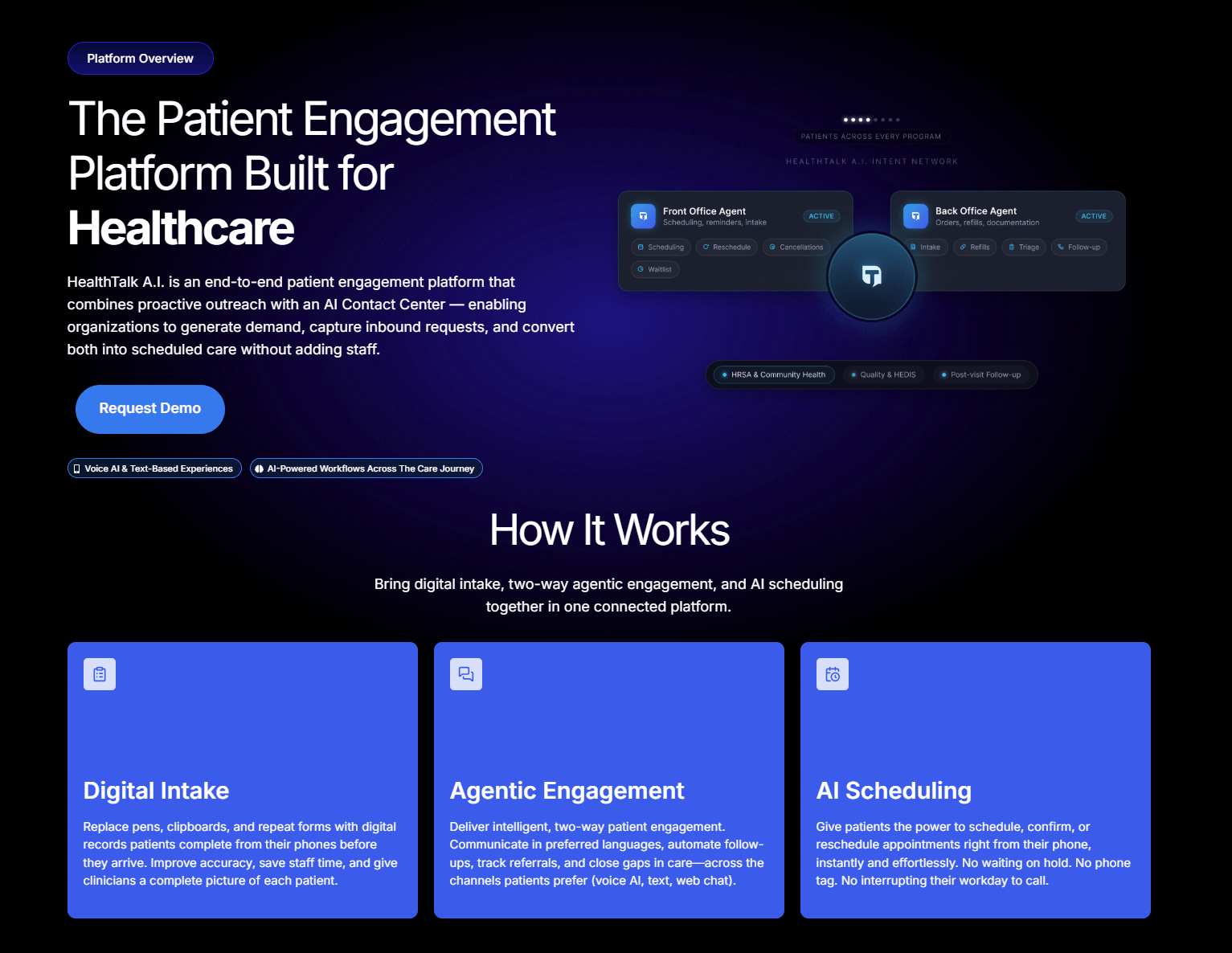
Two-way patient engagement platform that unifies digital intake, outreach, and AI-assisted scheduling with EHR integration. Designed to coordinate care before and after visits through texting and web chat.
- Best for: Ambulatory groups and hospitals prioritizing SMS-first engagement, post-visit follow up, and reputation workflows.
- Key Features: Two-way text messaging at scale, web-based virtual visits, digital intake and surveys, routing to staff for escalation, EHR integration, per HealthTalk A.I. documentation.
- Why we like it: Strong focus on SMS and survey-driven outreach makes it practical for closing feedback loops and reducing phone backlogs.
- Notable Limitations: Very limited third-party review volume makes benchmarking difficult and there is no widely published pricing; see the small sample on G2's HealthTalk A.I. page. Chatbot use in patient engagement also benefits from tight escalation rules, as discussed by TechTarget's coverage.
- Pricing: Pricing not publicly available. Contact HealthTalk A.I. for a custom quote.
Simbie A.I.
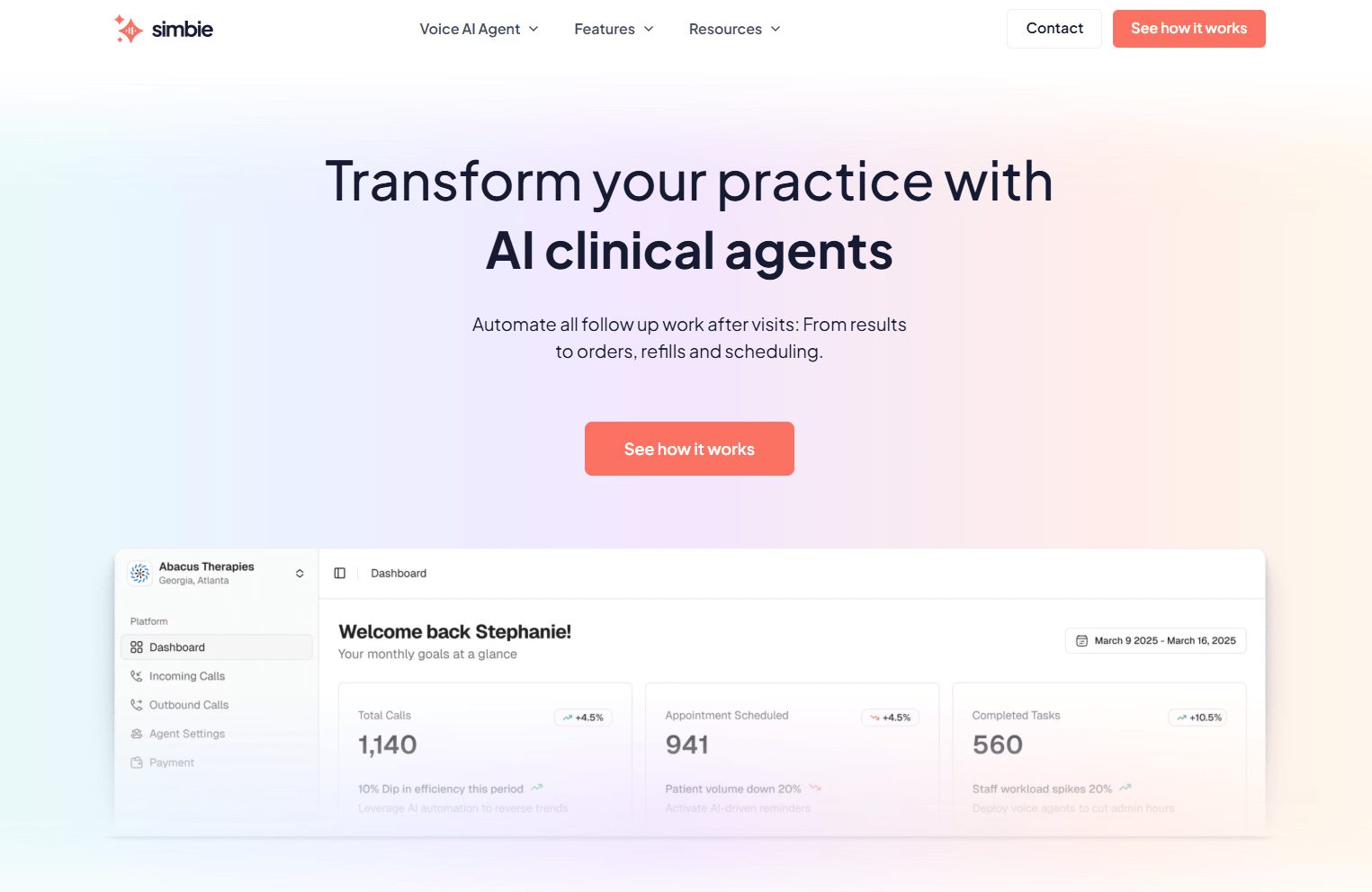
Clinically trained voice agents that act as virtual front-desk staff, handling registration, scheduling, refills, and basic documentation 24/7 for medical practices.
- Best for: Practices that need inbound phone coverage, automated scheduling, and refill handling outside business hours.
- Key Features: Voice agents for intake and scheduling, prescription refill workflows, chart note summaries for review, and EHR-aware tasking, per Simbie A.I. documentation.
- Why we like it: Voice automation for common requests can cut hold times and deflect routine calls without adding portals or apps.
- Notable Limitations: Limited independent reviews to validate performance; voice AI systems can struggle with interruptions, accent variability, and edge-case intents if telephony and EHR integrations are not tuned, a pattern reflected in TechTarget's chatbot analysis.
- Pricing: Pricing not publicly available. Contact Simbie A.I. for a custom quote.
Nextigent
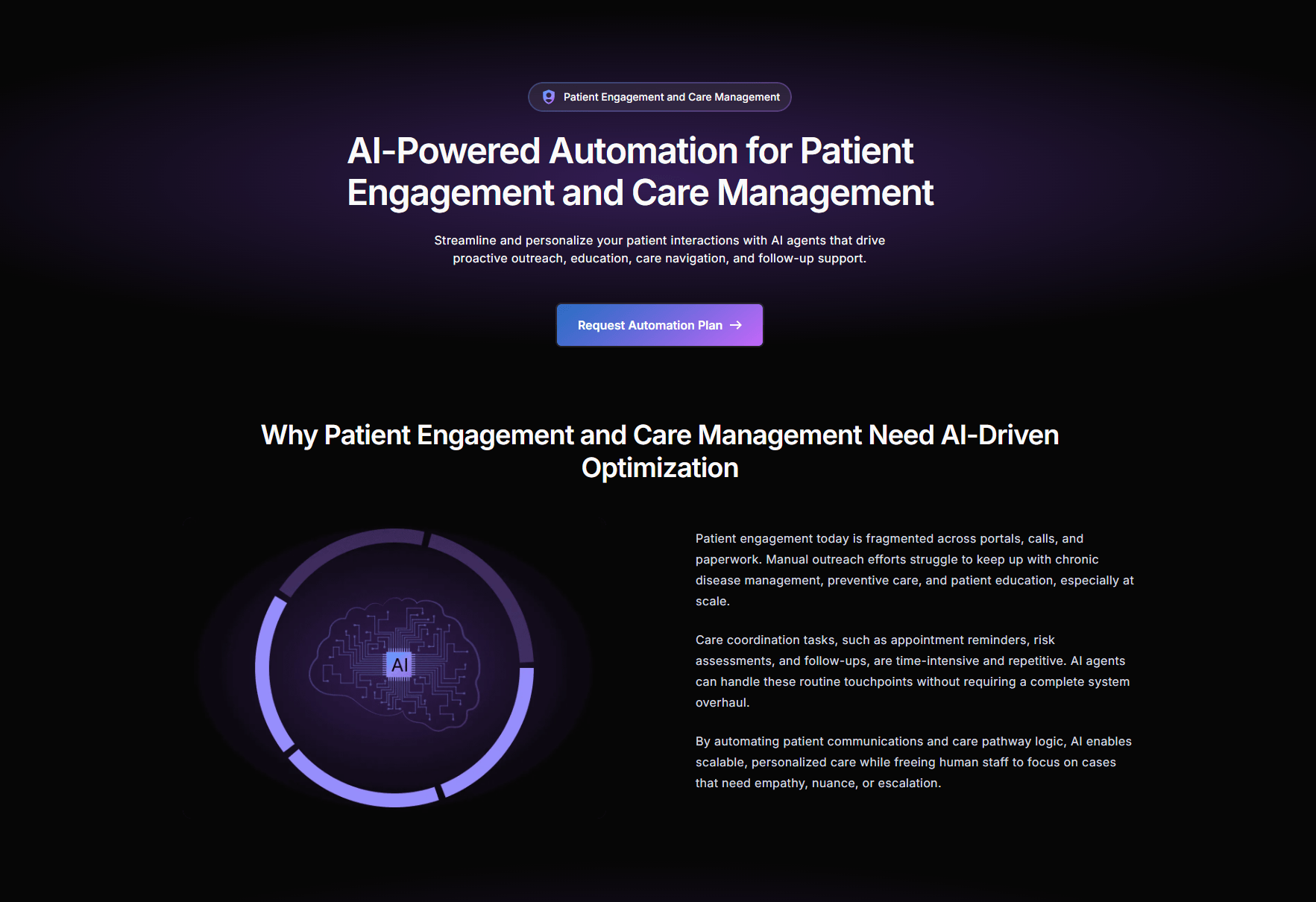
AI-powered automation platform for patient onboarding, proactive outreach, scheduling, referrals, and care coordination integration.
- Best for: Teams standing up multi-step outreach and care navigation workflows that span referrals and education across service lines.
- Key Features: Patient onboarding sequences, proactive reminders and education, referral and scheduling workflows, and care team coordination, per Nextigent documentation.
- Why we like it: Templates for longitudinal outreach make it easier to move beyond single reminders to true care pathways.
- Notable Limitations: Sparse third-party reviews and limited public references make it hard to compare against established incumbents in patient communications and access, which KLAS notes is an area with many niche and platform options (KLAS overview).
- Pricing: Pricing not publicly available. Contact Nextigent for a custom quote.
AI Patient Engagement & Operations Tools Comparison: Quick Overview
| Tool | Best For | Pricing Model | Highlights |
|---|---|---|---|
| StackAI | Health systems needing governed, multi-channel agents | Marketplace or enterprise contract | VPC or on-prem options, visual workflow builder, HIPAA-aligned controls (AWS Marketplace, G2) |
| HealthTalk A.I. | SMS-first outreach, surveys, and follow up | Enterprise contract | Two-way texting at scale, intake, web chat, EHR tie-ins |
| Simbie A.I. | 24/7 inbound voice for scheduling and refills | Enterprise contract | Voice agents for intake, scheduling, refills, documentation summaries |
| Nextigent | Proactive outreach and care navigation workflows | Enterprise contract | End-to-end onboarding, reminders, referrals, per vendor documentation |
AI Patient Engagement & Operations Platform Comparison: Key Features at a Glance
| Tool | Omnichannel Outreach | EHR Write-Back | Voice Automation |
|---|---|---|---|
| StackAI | Chat, SMS, and voice per configuration | Yes, via connectors and APIs | Yes, configurable |
| HealthTalk A.I. | Strong SMS and web chat focus | Yes, per vendor docs | Limited, emphasis on messaging |
| Simbie A.I. | Phone, with SMS follow up optional | Yes for tasks and notes | Primary channel |
| Nextigent | Multichannel outreach | Yes, per vendor docs | Optional, depends on setup |
AI Patient Engagement & Operations Deployment Options
| Tool | Cloud API | On-Premise | Integration Complexity |
|---|---|---|---|
| StackAI | Yes | Yes, VPC or on-prem per AWS Marketplace | EHR plus identity and data connectors, moderate |
| HealthTalk A.I. | Yes | Not publicly stated | EHR, SMS routing, optional survey and telehealth |
| Simbie A.I. | Yes | Not publicly stated | Telephony plus EHR and refill workflows |
| Nextigent | Yes | Not publicly stated | EHR, referral feeds, education content pipelines |
AI Patient Engagement & Operations Strategic Decision Framework
| Critical Question | Why It Matters | What to Evaluate | Red Flags |
|---|---|---|---|
| Do you need 24/7 voice coverage or is SMS enough? | Voice reduces hold times for patients who call; SMS scales outreach for reminders | Real-time barge-in, latency, handoff to humans, SMS deliverability | Voice agents that cannot interrupt or escalate; SMS without opt-out and consent controls |
| How will data write back to the EHR? | Closed loops need accurate documentation and scheduling updates | Supported HL7 v2, FHIR, and API patterns, audit logs, PHI handling | One-way messaging with no reliable write-back or audit |
| What deployment controls are required? | Many organizations need VPC or on-prem to meet risk and residency needs | Private networking, key management, logging, BAA terms | Only public SaaS with no clear BAA or residency controls |
| Can the system reduce no-shows measurably? | Average no-shows are near 23 percent, shrinking this unlocks capacity and revenue | Multi-touch reminders, easy rescheduling, channel preferences | One-touch reminders with no reschedule link or call deflection (systematic review) |
| Is there independent validation? | Third-party benchmarks reduce risk of pilot fatigue | Analyst coverage, marketplace listings, verified reviews | No reviews, no references, unclear security posture |
AI Patient Engagement & Operations Solutions Comparison: Pricing & Capabilities Overview
| Organization Size | Recommended Setup | Monthly Cost | Annual Investment |
|---|---|---|---|
| Single specialty clinic | Simbie A.I. for inbound voice plus HealthTalk A.I. or equivalent for SMS reminders and intake | Varies by vendor, pricing not publicly available | Varies by vendor, pricing not publicly available |
| Multi-site ambulatory group | HealthTalk A.I. or Nextigent for outreach and surveys, optional StackAI workflows for ops automation | Varies by vendor, pricing not publicly available | Varies by vendor, pricing not publicly available |
| Integrated health system | StackAI for governed multi-agent workflows with VPC or on-prem, pair with messaging and voice modules | Marketplace and enterprise terms vary, see AWS Marketplace | Enterprise contract, request a custom quote |
Problems & Solutions
-
Problem: High no-show rates hurt access and throughput. Evidence shows average no-shows around 23 percent across specialties (systematic review on ScienceDirect) and telehealth access has been shown to reduce missed visits in several settings (JAMA Network Open study synopsis).
- StackAI: Build multi-touch reminder flows with SMS plus call deflection and instant reschedule, then write results back to the EHR, per vendor documentation.
- HealthTalk A.I.: Use two-way texting with quick links to confirm or reschedule, plus post-visit surveys to close loops, per vendor documentation.
- Simbie A.I.: Place automated reminder calls that can reschedule in real time by voice, then send confirmation by text, per vendor documentation.
- Nextigent: Run proactive outreach cadences for chronic care and referrals to prevent drop-off before appointments, per vendor documentation.
-
Problem: Overflow call volumes and long hold times frustrate patients. Experts note chatbot and assistant limits, especially when escalation paths are unclear (TechTarget analysis).
- StackAI: Orchestrate voice and chat agents with clear human handoffs and routing rules, per vendor documentation.
- HealthTalk A.I.: Shift routine questions to SMS and web chat with staffing alerts for exceptions, per vendor documentation.
- Simbie A.I.: Provide 24/7 voice coverage that can interrupt, route, and complete common tasks like refills and scheduling, per vendor documentation.
- Nextigent: Deflect basic questions with education messages and callback scheduling, per vendor documentation.
-
Problem: Staffing shortages and burnout make manual outreach unsustainable. The most recent AAMC report (March 2024) projects the U.S. could face a physician shortage of up to 86,000 by 2036, increasing pressure to automate nonclinical tasks (AAMC report).
- StackAI: Automate routine operational workflows, capture structured outcomes, and route only edge cases to staff, per vendor documentation.
- HealthTalk A.I.: Use surveys and templated messages to gather data asynchronously and reduce back-and-forth calls, per vendor documentation.
- Simbie A.I.: Offload after-hours calls and daytime peaks to voice agents that complete tasks end to end, per vendor documentation.
- Nextigent: Standardize longitudinal outreach so teams can manage larger panels with less manual effort, per vendor documentation.
-
Problem: Security and data residency constraints stall AI projects. Buyers often need private networking and full audit.
- StackAI: Offers VPC or on-prem deployment paths documented in the AWS Marketplace listing.
- Other tools: Confirm BAAs, logging, and data residency terms before go-live. Limited public detail means requesting security documentation early, which KLAS encourages when evaluating patient communications platforms (KLAS blog).
Bottom Line
If you need governed, multi-agent workflows and private deployment, start with StackAI, validated by its AWS Marketplace presence and verified user feedback on G2. If SMS-led engagement is your priority, HealthTalk A.I. aligns to two-way texting and survey use cases, though independent reviews are still sparse (G2 summary). For 24/7 phones, Simbie A.I. targets real scheduling and refills but, like all voice assistants, benefits from clear escalation design, a point echoed in TechTarget's reporting. Finally, Nextigent fits proactive pathways across referrals and education, which KLAS highlights as a growing focus in patient communications strategy (KLAS overview).