

Most teams discover that proposals fail long before pricing, during qualification and first draft handoffs, not from a post-mortem. From our experience in the startup ecosystem, the fastest wins come from three technical levers: webhook triggered PDF generation from your CRM, RFP spreadsheet auto responders that map to a content library, and proposal engagement analytics like scroll depth and time on page to guide follow ups. Gartner forecasts worldwide AI spending of $2.59 trillion in 2026, up 47% year over year, which explains why proposal generation is rapidly embedding AI into sales workflows. You will learn when to pick lightweight marketplace helpers versus end-to-end proposal platforms, how to cut drafting time without hurting win rates, and what to validate before you pay.
Gartner sales research also links AI guided next best actions to a 2.6x higher likelihood of commercial growth, while 31 percent of CSOs still struggle to prove AI ROI, a reminder to buy for workflows not buzzwords.
Wonit
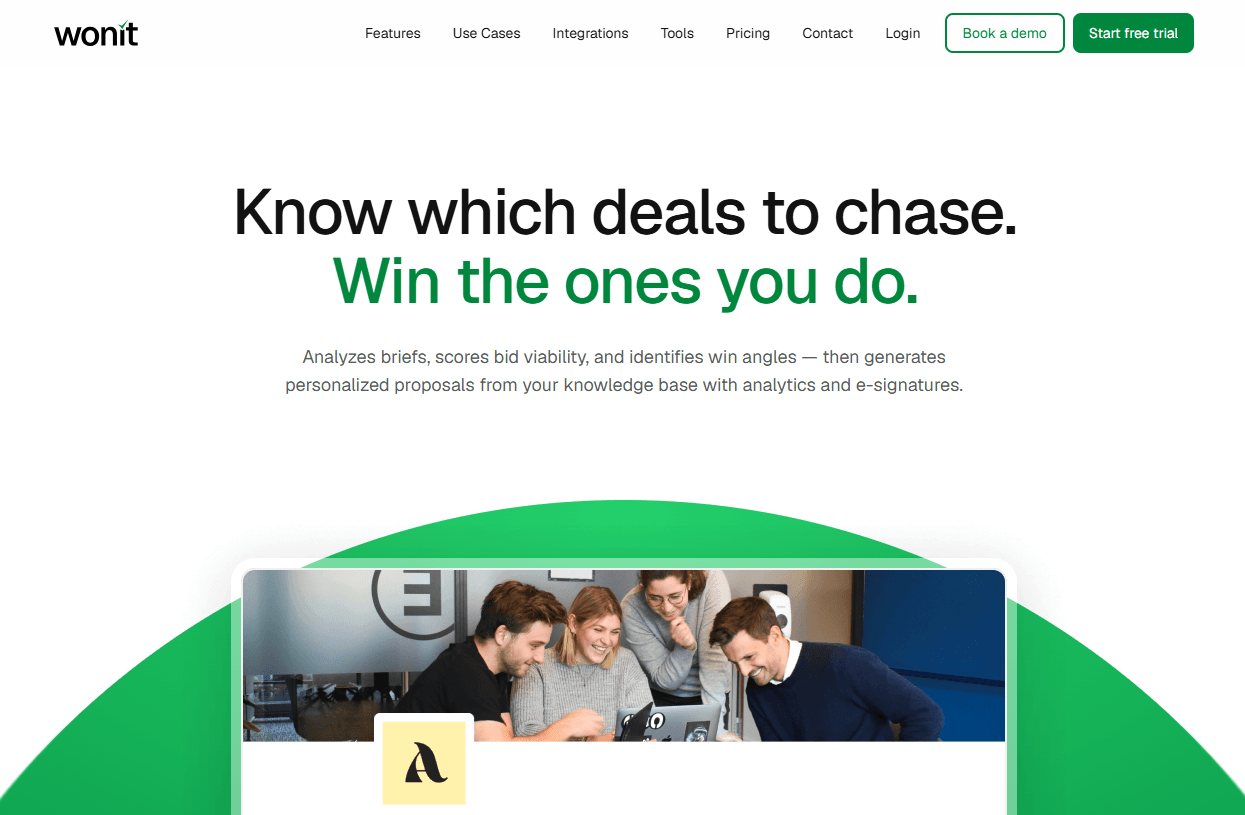
AI proposal and RFP automation focused on qualifying opportunities and generating web proposals in seconds. Emphasizes fit scoring, knowledge base grounded drafting, and detailed engagement analytics with e-signatures.
Best for: Agencies and B2B teams that need go/no-go analysis and AI drafting tied to their content library.
Key Features:
- Brief and RFP analysis with fit scoring and risk flags
- AI proposal generation from an internal knowledge base
- Web proposals with engagement analytics (opens, scroll depth, time-on-section) and e-signatures
- RFP questionnaire auto responder for spreadsheets
- HubSpot, Salesforce, Pipedrive, Slack integrations
Why we like it: Bid qualification plus drafting in one place saves hours before a single sentence is written, and the engagement data makes follow ups specific.
Notable Limitations:
- Limited third party reviews as of June 2026, plan a pilot before rollout
- Behavioral tracking may require client consent in some industries
- No published on-prem or air gapped option
Pricing: Starter $19 per user per month, Pro $49 per user per month, Enterprise custom, per vendor documentation. Pricing details change, confirm current tiers. For context on the market spend growth that often drives price changes, Gartner expects worldwide IT spending to reach $6.31 trillion in 2026, up 13.5%.
Quote Engine
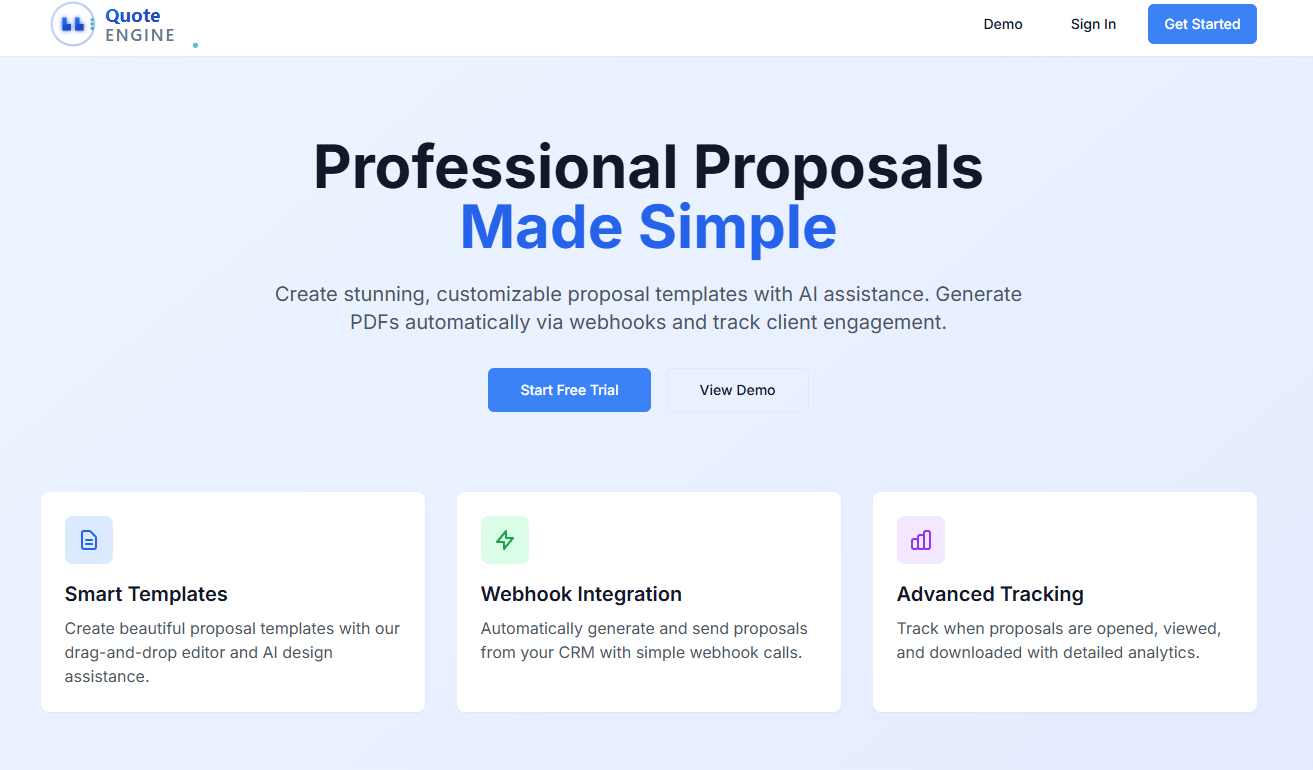
Developer friendly proposal generator that creates customizable templates, automates PDF generation via webhooks, and tracks client engagement.
Best for: Product and RevOps teams that want to trigger proposals from internal systems with minimal UI overhead.
Key Features:
- Drag and drop, AI assisted template builder
- Webhook and SDK options for CRM, form, or app triggered PDFs
- Open and view analytics on delivered proposals
- Examples for Next.js with Sanity, Python plus Flask, and React workflows
Why we like it: Clean, API first approach that plugs into existing workflows without forcing a wholesale tool switch.
Notable Limitations:
- Pricing not publicly available as of June 2026
- Few independent reviews or analyst mentions, budget time for proof of concept
- Requires in-house ownership of automation, not ideal for teams wanting a full UI suite
Pricing: Pricing not publicly available. Contact vendor for a custom quote. If you are comparing total cost of ownership, G2's overview of RFP and proposal software notes these tools often show time to ROI within months when adopted across the workflow, which can frame your payback model.
Proposal Genie
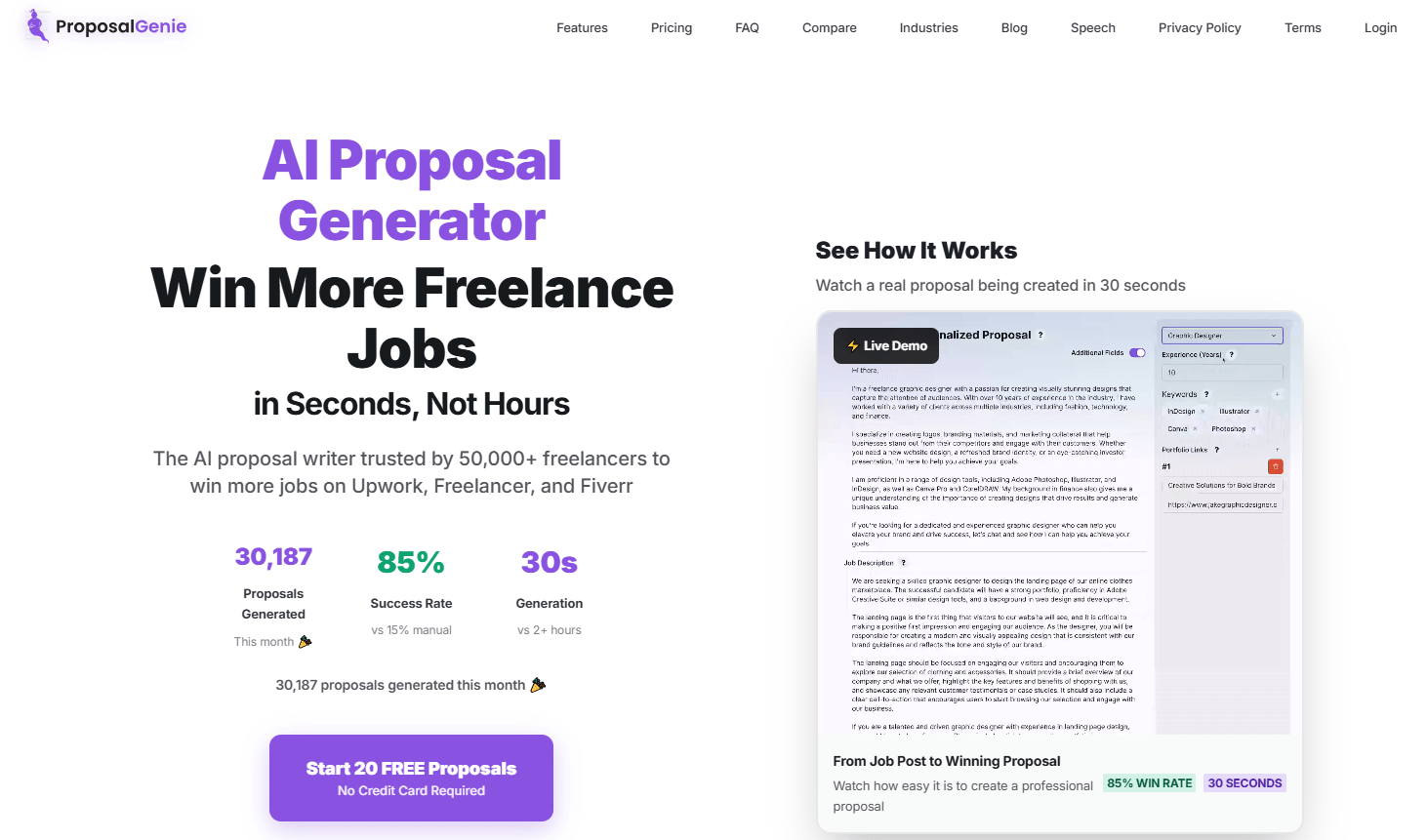
Generates tailored freelance proposals in seconds for platforms like Upwork, Fiverr, and Freelancer, with simple plans for high volume submissions.
Best for: Freelancers who need fast, platform specific proposals and do not want to wire up custom automations.
Key Features:
- One minute proposals optimized for marketplace job posts
- Proposal editing for tone and skills, plus bookmarking
- Chrome extension, skill profiles, and multi tier plans
- Focus on Upwork and similar gig marketplaces
Why we like it: It removes blank page anxiety for marketplaces where speed and clarity often beat lengthy proposals.
Notable Limitations:
- Sparse third party reviews; G2 lists the product but without enough data for buying insight
- Marketplaces now ship their own AI drafting features, which can reduce differentiation
- Generic outputs risk if you do not feed specific past wins and metrics
Pricing: Per vendor documentation, a free trial with 20 proposals, a Basic plan at $7.99 per month for 100 generations (about $3.99 per month billed annually), and Premium at $9.99 per month for 300 generations, with annual discounts available. Upwork now includes its own AI draft proposals and automation guidance, so weigh native options against third party tools.
Proposar
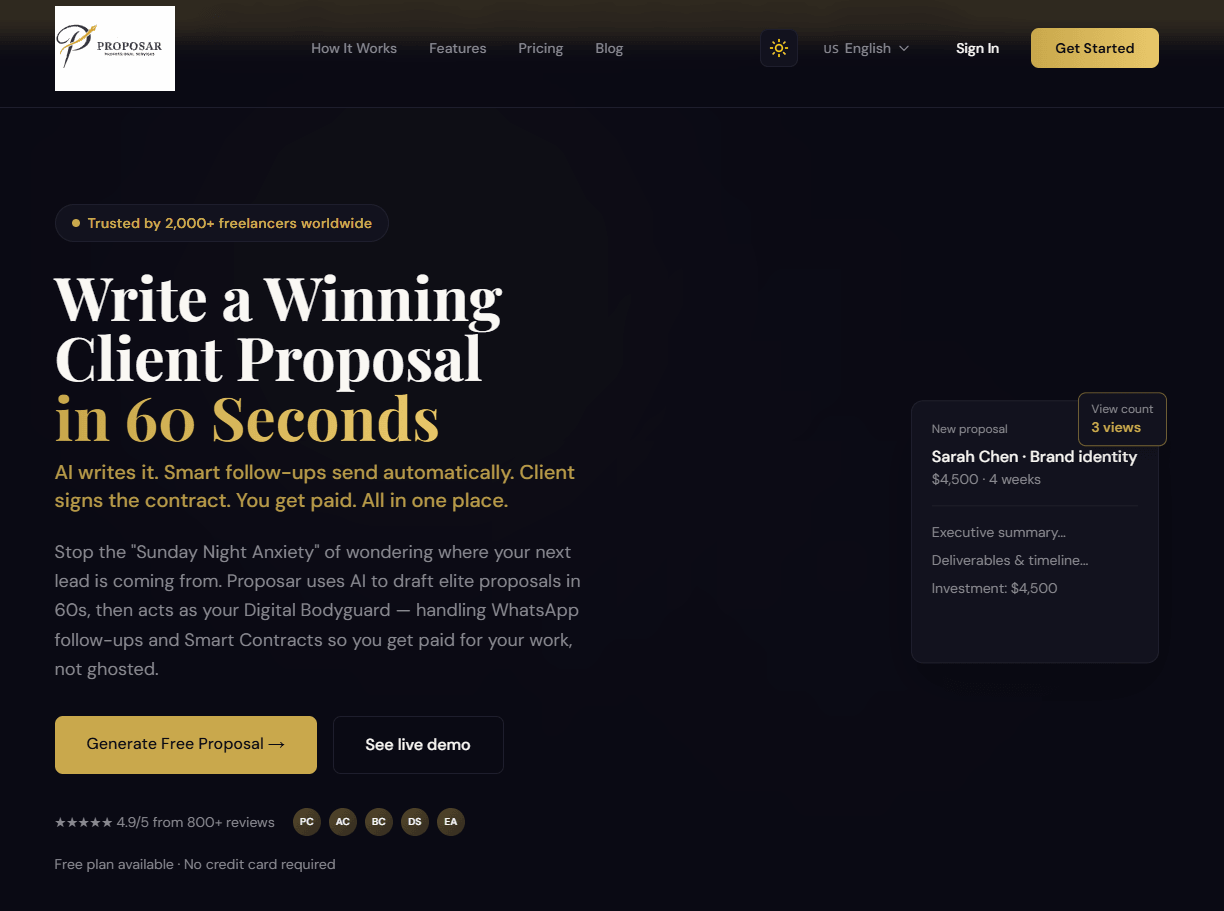
AI powered proposal platform for freelancers and small agencies that adds client facing workflows like follow ups, simple contracts, and a lightweight portal.
Best for: Solo freelancers and boutique agencies that want proposals, follow ups, and basic contracting in one tool.
Key Features:
- AI proposal generation with unlimited templates on higher tiers
- Branded web proposals with engagement tracking and PDF export
- Follow up automations, client dashboard, and smart contracts
- Team features and API on higher plans
Why we like it: Thoughtful freelancer first packaging, proposals that look modern, and helpful post send nudges to reduce ghosting.
Notable Limitations:
- Early stage footprint, limited independent reviews as of June 2026
- No published on-prem or air gapped deployment
- Advanced CPQ features, complex pricing logic, and deep ERP hooks are not the focus
Pricing: Per vendor documentation, a Free plan with 3 proposals per month, Starter $19 per month, Pro $29 per month with unlimited proposals, and Agency $79 per month for teams, with a 14 day trial. If you prefer a benchmark on web proposal plus e-signature value, user reviews of established tools highlight web proposals with integrated eSign as a core buyer expectation.
AI Proposal Generator Tools Comparison: Quick Overview
| Tool | Best For | Pricing Model | Highlights |
|---|---|---|---|
| Wonit | Agencies and B2B teams needing bid qualification plus drafting | Per user monthly, starter to enterprise, trial available | Fit scoring, RFP auto response, scroll and time analytics |
| Quote Engine | Teams automating proposals from their own systems | Custom or usage based, not public | Webhook to PDF, SDKs, developer examples |
| Proposal Genie | Freelancers on Upwork, Fiverr, Freelancer | Monthly plans, free tier with limited generations | One minute marketplace proposals |
| Proposar | Freelancers and small agencies | Monthly plans by tier, free tier | Unlimited proposals on Pro, follow ups, basic contracts |
AI Proposal Generator Platform Comparison: Key Features at a Glance
| Tool | Qualification/Scoring | RFP Spreadsheet Auto Response | Engagement Analytics |
|---|---|---|---|
| Wonit | Yes | Yes | Opens, scroll depth, time-on-section |
| Quote Engine | No | No | Open and view tracking |
| Proposal Genie | No | No | Basic send history |
| Proposar | No | No | Open, scroll, and reminders |
AI Proposal Generator Deployment Options
| Tool | Cloud API | On-Prem / Air-Gapped | Integration Complexity |
|---|---|---|---|
| Wonit | Yes | Not published | Moderate, CRM plus Slack |
| Quote Engine | Yes, webhooks and SDKs | Not published | Low to moderate for developer teams |
| Proposal Genie | Limited, browser extension | Not published | Low |
| Proposar | API on team plan | Not published | Low |
AI Proposal Generator Strategic Decision Framework
| Critical Question | Why It Matters | What to Evaluate | Red Flags |
|---|---|---|---|
| Do we need bid qualification or just faster drafting | Prevents writing into low probability deals | Fit scores, risk flags, go/no-go rules | Only templates, no qualification logic |
| Where will proposals be triggered from | Aligns to current stack with minimal change management | Webhooks, SDKs, CRM and form triggers | Manual exports, no automation path |
| How will we follow up | Drives conversion without adding busywork | Built in reminders, analytics, scroll depth | No engagement data, only open notifications |
| What compliance or privacy guardrails apply | Reduces risk when tracking behavior | Consent, data storage location, audit trails | Opaque tracking or no admin controls |
| What is the realistic ROI window | Separates hype from lift | Baseline proposal cycle time, targets, adoption plan | No pilot plan or time to value metrics |
AI Proposal Generator Solutions Comparison: Pricing and Capabilities Overview
| Organization Size | Recommended Setup | Monthly Cost | Annual Investment |
|---|---|---|---|
| Solo freelancer | Proposal Genie or Proposar Starter | $8 to $29 | $96 to $348 |
| Small agency, 3 to 10 staff | Proposar Pro or Wonit Starter for selective RFPs | $29 to $190 | $348 to $2,280 |
| Mid market sales team | Wonit Pro for proposals, developer led Quote Engine for system triggers | $49 per user plus integration time | Varies by seats and scope |
Problems & Solutions
-
Problem: Teams waste cycles drafting into low probability RFPs, then struggle to prove AI ROI.
Solution: Pair bid qualification and next best action guidance with proposal drafting. Gartner reports that sales orgs using AI enabled next best actions are 2.6x more likely to achieve growth, which supports adopting scoring and guided actions before writing. Wonit's model of brief analysis and fit scoring aligns to this guidance, so run a two week pilot to measure fewer starts and higher finish rates. -
Problem: Proposal creation from CRM or internal apps is manual, which slows speed to send.
Solution: Use a webhook or SDK driven generator, then attach analytics. Developer first approaches lower friction for RevOps teams, and G2 notes many buyers see ROI within months when proposal work is centralized and automated. Quote Engine's webhook to PDF pattern fits teams that want automation without migrating their document stack. -
Problem: Freelance marketplaces are saturated with look alike AI proposals, and platforms ship their own AI drafting.
Solution: Treat third party generators as drafting assistance, then personalize with specific metrics and past wins. Upwork's help center now describes AI assisted proposal drafting and even AI video screening, which means differentiation comes from human edits and credentials, not speed alone. Proposal Genie is still useful for first drafts, but wins depend on tailoring. -
Problem: Buyers bounce between proposal PDFs and separate e-signature tools, which adds friction.
Solution: Send web proposals with integrated signing. Third party reviews consistently call out web based proposals with built in eSign as a buyer expectation. Proposar and Wonit include web proposals and signatures, which shortens the last mile.
The Bottom Line
Working across different tech companies, we have learned that proposal speed only pays when it is paired with qualification and telemetry. Market momentum is real, with AI spend projected to hit $2.59 trillion in 2026, yet leaders still demand workflow level ROI, not another tab in the seller's browser. If you want bid intelligence plus drafting, start with Wonit. If automation from your own stack is the priority, pilot Quote Engine. Marketplace contractors can move fastest with Proposal Genie, and freelancer agencies should test Proposar's proposals and follow ups. Whichever you choose, baseline today's cycle time, enforce a checklist for inputs like past wins and metrics, and require engagement data in every send, then review lift after 30 days.