

Most teams discover production fragility during a cascading on-call, not from clean dashboards. Working across different tech companies, we have learned that reliability breaks at handoffs, like when a canary deploy masks a noisy dependency, when a Kafka consumer silently starves, or when a Kubernetes HPA masks a memory leak until a failover. From our experience in the startup ecosystem, the biggest time wins come from three patterns: pre-deploy checks that stop bad releases, multi-signal investigations that stitch code, CI/CD, and infra, and automated rollback with human approval.
AIOps is no longer niche. An earlier IBM summary of Gartner's Market Guide pegged the AIOps market at roughly $1.5 billion with about a 15 percent CAGR across 2020 to 2025, the front edge of an adoption curve that has since accelerated sharply as SRE automation went mainstream. You will learn where each tool fits by stack, risk posture, and budget, and how to avoid black box traps that industry watchers have raised in coverage of agentic SRE, such as the trust and governance themes highlighted by TechTarget.
Alloi
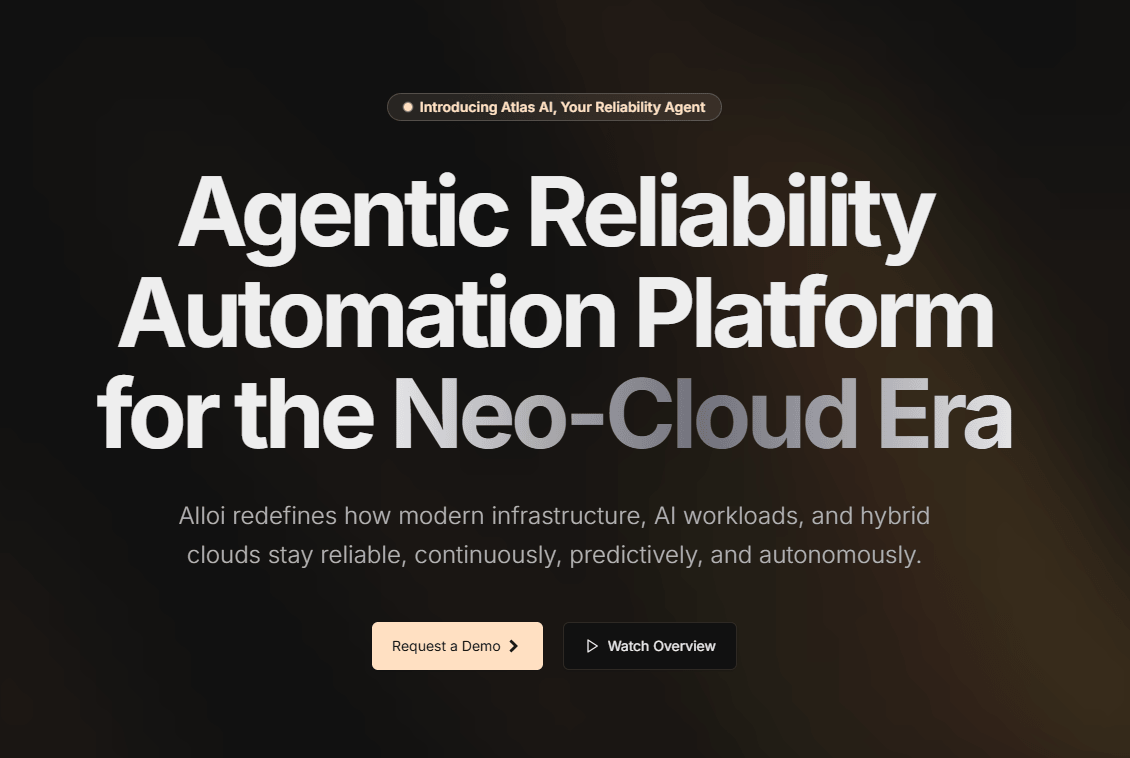
Agentic reliability automation that monitors modern infrastructure and AI workloads, correlates signals, and proposes or auto-applies fixes. Positioned for environments that need private-by-default operations.
According to vendor documentation, Alloi focuses on predictive detection and autonomous remediation across cloud, hybrid, and AI pipelines without moving data outside your network.
Best for: Teams that need private deployments and strict data boundaries, for example regulated or air-gapped environments.
Key Features:
- Agentic investigations that correlate infra, app, and AI workload signals, per vendor documentation.
- Predictive detection, incident suppression, and auto-remediation with human approval gates, per vendor documentation.
- "Data never leaves your network," implying on-prem or private deployment patterns, per vendor documentation.
- Support for hybrid and AI-specific reliability workflows, per vendor documentation.
Why we like it: In risk-sensitive orgs, keeping telemetry and actions inside your network reduces vendor exposure. In our experience, this shortens legal review and speeds proofs of value.
Notable Limitations:
- Insufficient third-party reviews to assess recurring drawbacks as of June 2026, so plan a proof-of-value with clear exit criteria.
- No verified analyst coverage we could cite publicly, so reference architectures must be validated in your own stack.
- Black box agent risks apply to this category, a concern echoed in independent research on AIOps attack surfaces like "When AIOps Become 'AI Oops'".
Pricing: Pricing not publicly available. Contact Alloi for a custom quote.
Adps AI
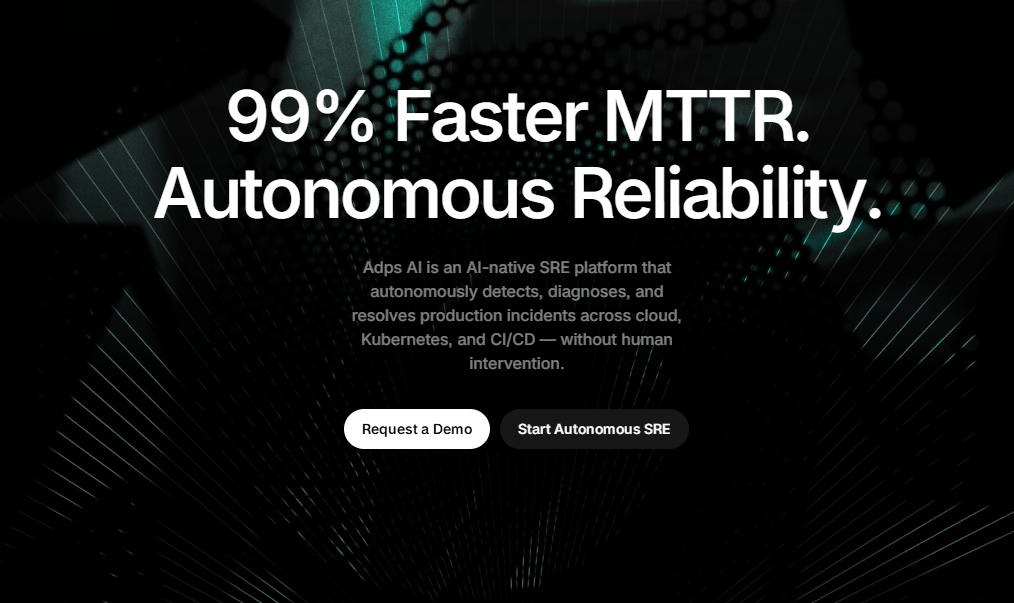
AI-native SRE platform that autonomously detects, diagnoses, and resolves production incidents across cloud, Kubernetes, and CI/CD. Designed around specialized agents that coordinate detection, analysis, and remediation.
According to vendor documentation, Adps AI targets closed-loop incident workflows spanning telemetry, change events, and deployment signals.
Best for: Teams with heavy Kubernetes and CI/CD footprints that want AI-driven triage and remediation.
Key Features:
- Multi-agent SRE that watches cloud, Kubernetes, and pipelines end to end, per vendor documentation.
- Automated root cause analysis with suggested or automated actions, per vendor documentation.
- Integrations for incident chat and ticketing flows, per vendor documentation.
Why we like it: For high-change systems, tying code, deploy, and runtime data into one agent loop reduces handoff latency and shrinks the first investigation window.
Notable Limitations:
- Public third-party reviews are scarce as of June 2026, which limits independent validation; plan a time-boxed pilot.
- Category risk of opaque agent decisions is real, as industry coverage stresses the need for agent observability and guardrails.
- Research has also flagged manipulation risks in AI-driven ops pipelines, so require change approvals and rollback paths.
Pricing: Pricing not publicly available. Contact Adps AI for a custom quote.
Bacca
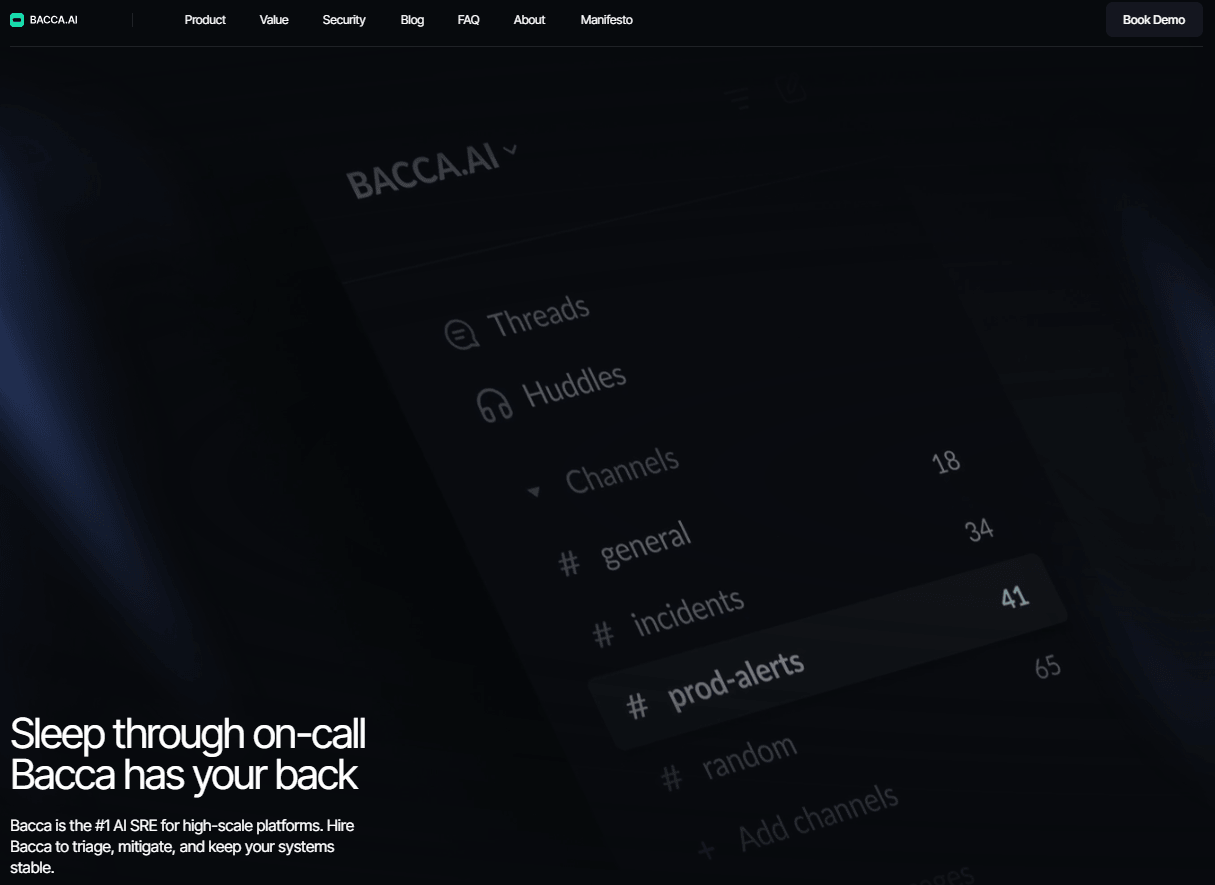
Virtual AI SRE that contextualizes alerts, identifies root causes, and streamlines incident handling to reduce MTTR. Available through major cloud marketplaces.
Marketplace materials describe Bacca as a triage, investigation, and coordination teammate integrated with common observability and on-call tools.
Best for: Teams that prefer marketplace procurement, want quick setup with Slack or PagerDuty, and value clear pricing guardrails.
Key Features:
- Alert enrichment and incident coordination, including deduping and investigation memory, per marketplace description.
- Root cause hints from logs, traces, and metrics, with workflow steps to resolution, per marketplace description.
- Cloud and on-prem deployment options highlighted in product materials.
Why we like it: Marketplace buying simplifies vendor onboarding and budgeting, which saves cycles for lean SRE teams.
Notable Limitations:
- As of June 2026 the AWS Marketplace listing shows zero published customer reviews, so independent validation is limited, see the AWS Marketplace listing details.
- The listing highlights contract plus usage credits, which can add cost variance under load.
- Community sentiment around AI SRE black boxes suggests demanding auditability and rollback plans, a theme echoed across industry discussions.
Pricing: Offered on AWS Marketplace, and also on Google Cloud Marketplace, as a 12 month contract plus usage-based AI credits. Reported terms put the annual contract near $60,000 with per-credit overage charges, but the public listing shows contract-plus-usage pricing rather than a fixed rate, so confirm current figures before you buy.
Dalton
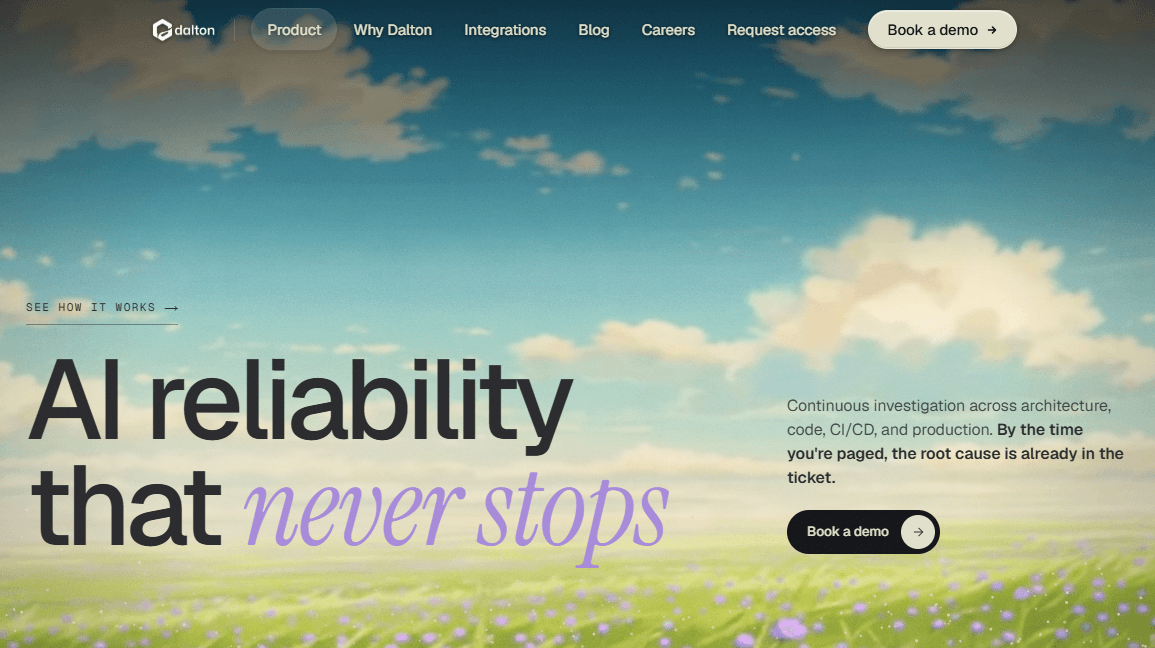
AI reliability platform that continuously investigates across architecture, code, CI/CD, infrastructure, and production signals. Emphasizes pre-deploy validation, production investigation, and safer remediation.
According to vendor materials, Dalton operates read-only by default with human-in-the-loop control and enterprise security controls.
Best for: Engineering teams that want one system to correlate code changes, pipeline events, and runtime anomalies before issues become incidents.
Key Features:
- Full-lifecycle coverage, from architecture review and pre-deploy checks to production incident response, per vendor documentation.
- Correlates code, CI/CD, infra, and runtime signals to spot risky deltas early, per vendor documentation.
- Read-only default and human approval workflows, per vendor documentation.
Why we like it: In change-heavy orgs, early correlation across code and pipelines catches regressions before they explode into weekend pages.
Notable Limitations:
- G2 currently reports "not enough reviews to provide buying insight," so third-party validation is limited, see the G2 Dalton reviews page.
- Integration depth will drive value, and complex rollouts often require dedicated engineering time, a common theme in buyer feedback on AI agents.
- As with all agentic systems, require audit logs and guardrails, an approach supported by safety research in SRE agents like SREGym.
Pricing: Pricing not publicly available. Contact Dalton for a custom quote.
AI SRE Tools Comparison: Quick Overview
| Tool | Best For | Pricing Model | Highlights |
|---|---|---|---|
| Alloi | Private or regulated environments that need data to stay in-network | Custom quote | Agentic reliability with on-prem or private deployment emphasis, per vendor documentation |
| Adps AI | Kubernetes plus CI/CD shops seeking closed-loop remediation | Custom quote | Multi-agent incident detection, RCA, and remediation, per vendor documentation |
| Bacca | Teams that prefer marketplace procurement and quick chat-centric workflows | Contract plus usage credits | Available via AWS and Google Cloud Marketplace with contract-plus-usage pricing |
| Dalton | Change-heavy orgs that want early correlation across code, pipelines, and runtime | Custom quote | Read-only default, human approvals, full-lifecycle reliability coverage, per vendor documentation |
AI SRE Platform Comparison: Key Features at a Glance
| Tool | Multi-signal RCA | Human-in-the-loop | Pre-deploy checks |
|---|---|---|---|
| Alloi | Yes, per vendor documentation | Yes, approval gates | Yes, for AI and app workflows, per vendor documentation |
| Adps AI | Yes, cloud, K8s, CI/CD | Yes | Stated focus on CI/CD integration, per vendor documentation |
| Bacca | Yes, via logs, traces, metrics | Yes | Not explicitly documented in third-party sources |
| Dalton | Yes, architecture to prod | Yes, read-only default | Yes, pre-deploy validation emphasized |
AI SRE Deployment Options
| Tool | Cloud API | On-Prem / Air-Gapped | Integration Complexity |
|---|---|---|---|
| Alloi | Yes | Indicated by "data never leaves your network," per vendor documentation | Connects to observability, CI/CD, and infra tools |
| Adps AI | Yes | Not publicly stated | Connects to cloud, K8s, CI/CD, per vendor documentation |
| Bacca | Yes | Marketplace materials reference flexible deployment | Hooks into Slack, Datadog, PagerDuty per marketplace description |
| Dalton | Yes | Not publicly stated | Requires code, CI/CD, infra, and runtime integrations |
AI SRE Strategic Decision Framework
| Critical Question | Why It Matters | What to Evaluate | Red Flags |
|---|---|---|---|
| Can agents explain actions and show evidence trails | Trust and auditability are essential for ops | Agent observability, change logs, replay of actions | Opaque RCA, no change audit, no rollback story |
| How do models behave under adversarial or noisy telemetry | AIOps pipelines can be manipulated | Guardrails, allow lists, least privilege, canary plus rollback | Agents with write access without approvals |
| Does it reduce MTTR in your stack, not demos | Real gains come from your topology and failure modes | Time-boxed pilot with baseline MTTR and noise metrics | Only vendor benchmarks, no pilot data |
| Can it operate privately when required | Data sovereignty and risk posture | Deployment in VPC or on-prem, data residency | Mandatory data egress to vendor clouds |
| What is the total cost under load | AI credit burn can spike during incidents | Contract terms, usage pricing, throttling | Uncapped usage fees during major incidents |
AI SRE Solutions Comparison: Pricing & Capabilities Overview
| Organization Size | Recommended Setup | Monthly Cost | Annual Investment |
|---|---|---|---|
| Startup to Mid-market | Bacca via marketplace for fast triage, or Dalton pilot for early correlation | Bacca around $5,000 per month based on a reported annual contract, usage extra | Bacca near $60,000 per year plus usage credits, confirm on the listing. Dalton pricing not publicly available |
| Regulated Enterprise | Alloi pilot in private deployment, add Bacca or Adps AI for workflow breadth | Custom quote | Custom quote |
| High-change Platform Teams | Dalton for code to prod correlation, optionally layer Bacca for chat-first triage | Custom quote | Custom quote |
Problems & Solutions
-
Problem: Alert floods and slow root cause analysis in complex systems. Industry coverage shows buyers demanding agent transparency and security to build trust in AI-driven incident response.
Solution:- Alloi correlates infra and AI workload signals then proposes gated remediations, per vendor documentation.
- Adps AI's multi-agent loop pairs detection with remediation across cloud, K8s, and CI/CD, per vendor documentation.
- Bacca enriches alerts and coordinates incident steps so responders see context earlier, per its marketplace listing.
- Dalton connects architecture, code, pipelines, and runtime so risky deltas surface before they become incidents, per vendor documentation.
-
Problem: Misconfigurations and change-driven outages. Observability analysis identified configuration change as a frequent real-world trigger, with examples across major SaaS and cloud incidents, summarized by ThousandEyes.
Solution:- Alloi and Dalton emphasize pre-deploy checks that catch configuration drift earlier, per vendor documentation.
- Adps AI monitors CI/CD events and runtime metrics to localize change-related regressions, per vendor documentation.
- Bacca streamlines incident declaration and coordination, helping teams shorten time from change detection to rollback, per marketplace description.
-
Problem: Governance, safety, and data residency for agentic ops. Research has flagged manipulation and safety concerns in AI-driven operations pipelines, which makes approvals and rollback essential.
Solution:- Alloi stresses private-by-default operations, appealing where data residency is strict, per vendor documentation.
- Bacca can be procured and governed through cloud marketplaces with line-item usage controls.
- Dalton advertises read-only defaults with human-in-the-loop, which aligns to safety guidance in current research, per vendor documentation.
- Adps AI's autonomous posture should be paired with strong change approval and rollback policies, as recommended across industry coverage.
Choosing Confidently, Shipping Safely
Bottom line, AI SRE is maturing fast but remains an exercise in engineering trust. The category's relevance is supported by credible market context around AIOps growth and by the focus on agent governance in industry reporting. If you are stack-sensitive, begin with Dalton for code and pipeline correlation. If you want clarity and procurement speed, Bacca's marketplace listing provides concrete contract terms. If you operate in regulated or air-gapped contexts, Alloi's private-by-default stance is attractive. For teams chasing closed-loop remediation in Kubernetes-heavy estates, Adps AI is worth a structured pilot. Whichever path you choose, insist on agent observability, approval gates, and rollback, then measure MTTR reductions against your real incidents.