

Most teams discover their SDK choice is the bottleneck during the first production incident, not from a launch demo. Working across different tech companies, we have learned that the biggest wins come from small engineering levers, like structured tool calling with typed schemas, streaming token responses over SSE for low-latency UX, and smart model fallbacks when a provider rate limits. You think you know where time and money go until a real incident forces a rebuild. According to recent market tracking, worldwide AI spending is racing ahead, which makes early platform choices hard to unwind later.
The AI market is expanding fast, with worldwide AI spending forecast to reach 2.52 trillion dollars in 2026, according to Gartner. Below, you will learn when a TypeScript-first SDK beats framework-native tooling, how to manage tool schemas for safer function calling, and where enterprise routing makes financial sense.
NeurosLink SDK
An enterprise AI development platform with a unified TypeScript SDK and CLI that abstracts multiple model providers behind one interface. Per vendor documentation, it adds smart model routing, governance features, and MCP based tool integrations.
Best for: Teams that want a single SDK, smart routing across providers, and enterprise-style controls.
Key Features:
- Unified TypeScript SDK and CLI across OpenAI, Anthropic, Google, Bedrock, Azure, and others, per vendor documentation.
- Smart model routing and fallbacks designed to balance speed, quality, and cost, per vendor documentation.
- Model Context Protocol integrations with built-in and external tools, plus conversation memory and streaming, per vendor documentation.
Why we like it: For orgs juggling multiple AI providers, a routing layer can cut integration time and reduce incidents when a single model degrades.
Notable Limitations:
- Independent third-party reviews are limited as of mid 2026, so plan a proof of concept before committing.
- Pricing and long-term roadmap depth are not widely covered by analyst reports, which may slow procurement.
- Newer platform risk, so teams should treat the SDK abstraction as a dependency that needs vendor due diligence.
Pricing: Pricing not publicly available. Contact NeurosLink for a custom quote.
TanStack AI
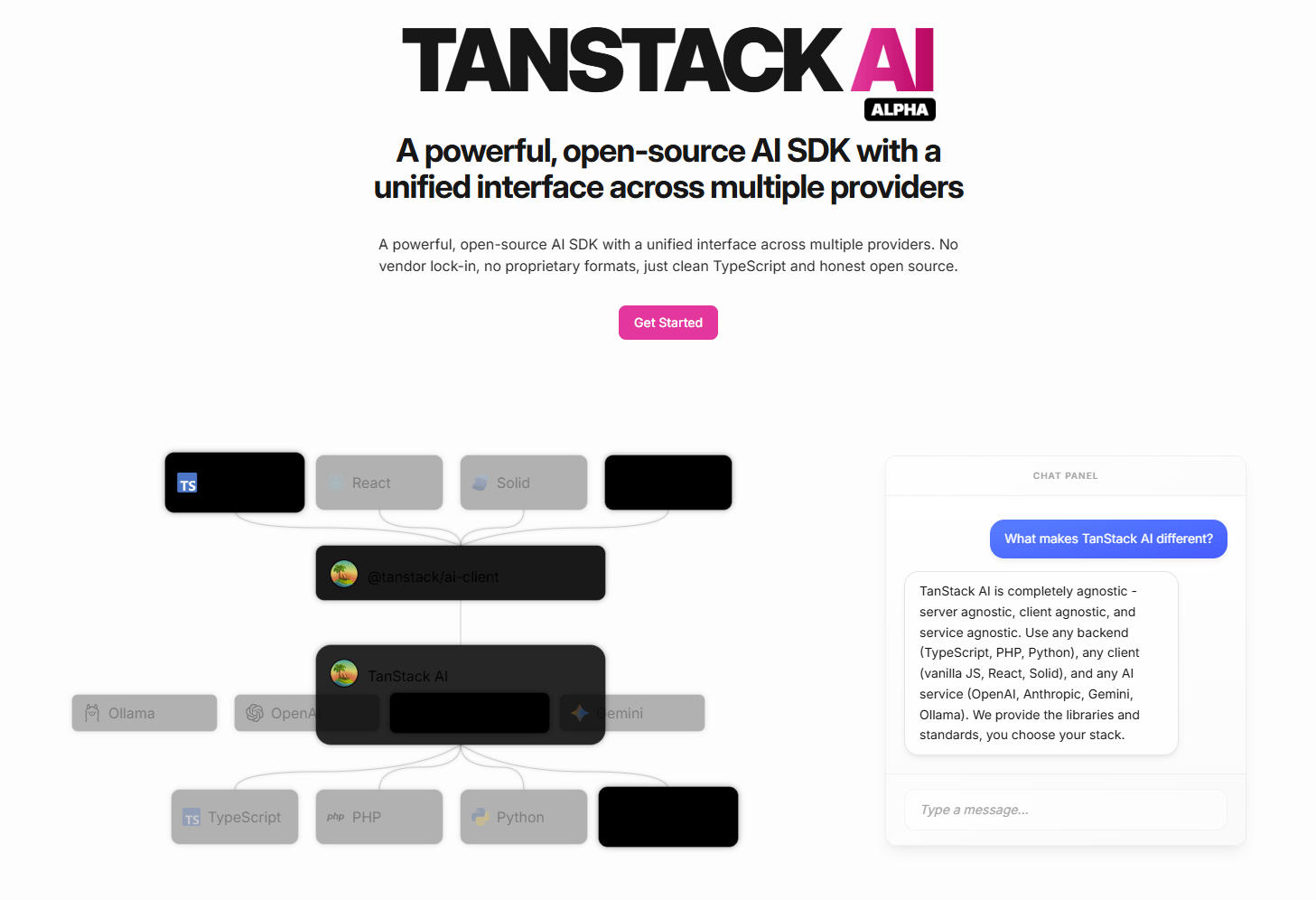
An open source, framework-agnostic AI SDK that offers a unified TypeScript interface, isomorphic tool definitions, and adapters for popular providers. It positions itself as vendor neutral with type safety at the core.
Best for: Frontend and full-stack TypeScript teams that want provider flexibility and strong typing without a hosted platform.
Key Features:
- Unified interface across OpenAI, Anthropic, Gemini, and Ollama adapters, with framework-agnostic client libraries, as covered by InfoQ.
- Isomorphic tools defined once, then implemented on server or client, plus schema support via Zod or JSON Schema, per InfoQ's coverage and the JSON Schema specification.
- Type-safe per-model options and devtools for debugging LLM behavior, per InfoQ.
Why we like it: The isomorphic tool system plus Zod or JSON Schema brings sanity to tool calling and makes refactors safer across providers.
Notable Limitations:
- The project launched in alpha and the API can evolve, with no migration path from earlier versions, per InfoQ's report.
- Early ecosystem, so you may need to compose pieces for advanced use cases, as reflected in community coverage like the Better Stack guide.
Pricing: Open source with no platform fees, you connect directly to model providers, per InfoQ. API usage is billed by each provider separately.
Laravel AI SDK
The first-party Laravel package for building AI-native apps in PHP, covering text, images, audio, embeddings, agents, tool calling, streaming, and structured outputs. It is documented in Laravel's official docs and shipped production-stable with Laravel 13 in March 2026.
Best for: Laravel and PHP teams that want a batteries-included package, official APIs, and testing support inside the Laravel ecosystem.
Key Features:
- First-party Laravel package with a consistent API for multiple AI providers, plus agents, memory, tools, and structured outputs, per Laravel News.
- Built-in fakes for testing AI behaviors and straightforward provider swapping in one line, per Laravel News.
- Supports text, images, audio, transcription, embeddings, reranking, vector stores, and search integrations, per Laravel News.
Why we like it: First-party alignment cuts glue code and gives PHP teams a clear path to production with familiar testing patterns.
Notable Limitations:
- Community posts note PHP 8.3 minimum requirements and version alignment issues when upgrading legacy apps, as discussed on Reddit.
- Questions persist about non default provider support such as Bedrock or Vertex AI, which may need workarounds, per community threads on Reddit.
Pricing: Pricing not publicly available. The SDK is a first-party Laravel package, and typical costs come from the model providers you choose, per Laravel News.
AI Software Development Kits (SDK) Tools Comparison: Quick Overview
| Tool | Best For | Pricing Model | Highlights |
|---|---|---|---|
| NeurosLink SDK | Enterprise teams seeking multi-provider routing and governance | Quote based | Unified SDK and CLI across providers, smart routing, MCP tooling |
| TanStack AI | TypeScript teams that want open source, provider-agnostic control | No platform fees, provider API costs | Isomorphic tool system, Zod or JSON Schema typing, adapters for major providers |
| Laravel AI SDK | Laravel and PHP shops shipping AI features inside existing apps | Not publicly listed, provider API costs | First-party package, agents and tools, structured outputs, testing fakes |
AI Software Development Kits (SDK) Platform Comparison: Key Features at a Glance
| Tool | Unified Interface Across Providers | Typed Tool Calling | Streaming Support |
|---|---|---|---|
| NeurosLink SDK | Yes, per vendor documentation | Yes, per vendor documentation | Yes, per vendor documentation |
| TanStack AI | Yes, per InfoQ | Zod and JSON Schema, per InfoQ and JSON Schema | Supported, see examples in the Better Stack guide |
| Laravel AI SDK | Yes, per Laravel News | Structured outputs and tools, per Laravel News | Yes, per Laravel News |
AI Software Development Kits (SDK) Deployment Options
| Tool | Cloud API | On-Premise | Integration Complexity |
|---|---|---|---|
| NeurosLink SDK | SDK and CLI that connect to third-party providers, per vendor documentation | Application side integration | Medium for first integration, higher with custom routing |
| TanStack AI | Library connects directly to chosen provider APIs, per InfoQ | Application side integration | Low to medium in TypeScript apps |
| Laravel AI SDK | Package connects directly to providers, per Laravel News | Application side integration | Low to medium for Laravel teams |
AI Software Development Kits (SDK) Strategic Decision Framework
| Critical Question | Why It Matters | What to Evaluate | Red Flags |
|---|---|---|---|
| Do you need provider portability today? | Reduces lock-in and keeps pricing leverage | Adapters, routing, typed options by provider | Tightly coupled APIs that block easy swaps |
| How will you define and validate tools? | Typed tools cut runtime errors | Zod or JSON Schema support, server or client execution paths | Opaque schemas, no validation steps |
| Can your stack stream tokens reliably? | Streaming improves UX for chat and long outputs | SSE support, backpressure handling, retry strategies | Full response blocking until completion |
| What is your testing approach? | AI variance makes tests harder | Built-in fakes, reproducibility, seed controls | Manual mocks, no strategy for flaky outputs |
AI Software Development Kits (SDK) Solutions Comparison: Pricing and Capabilities Overview
| Organization Size | Recommended Setup | Monthly Cost | Annual Investment |
|---|---|---|---|
| Startup, 1-5 devs | TanStack AI or Laravel AI SDK, connect directly to one provider | Varies by provider usage, no platform fees for OSS | Varies by usage |
| Mid-market, 6-30 devs | Laravel AI SDK for PHP stacks or TanStack AI for JS stacks, add typed tools and streaming | Varies by provider usage | Varies by usage |
| Enterprise, 30+ devs | NeurosLink SDK evaluation for routing and governance plus team-specific SDKs | Pricing not publicly available | Pricing not publicly available |
Problems & Solutions
-
Problem: Provider fragmentation slows teams that want to avoid lock-in.
- Why it matters: Vendor portability protects budgets and lets you match models to tasks, a theme highlighted when TanStack AI positioned itself as vendor neutral, per InfoQ.
- Solutions:
- TanStack AI, use its unified adapters and type-safe per-model options to switch providers without rewriting app code, per InfoQ.
- Laravel AI SDK, keep a single Laravel API and swap providers as needed, per Laravel News.
- NeurosLink SDK, per vendor documentation, route tasks dynamically across providers for cost, speed, and resiliency.
-
Problem: Tool calling can break in production without typed schemas or consistent execution paths.
- Why it matters: Schema validated tools cut invalid outputs and make agents safer to ship, and JSON Schema is a standard many teams already know, per the JSON Schema specification.
- Solutions:
- TanStack AI, define tools with Zod or JSON Schema, then run server or client implementations with isomorphic tools, per InfoQ.
- Laravel AI SDK, use structured outputs and official testing fakes to validate tool behavior before release, per Laravel News.
- NeurosLink SDK, per vendor documentation, ship tools via MCP integrations and typed interfaces for consistent orchestration.
-
Problem: Chat UX feels slow without true streaming.
- Why it matters: Streaming over SSE reduces perceived latency for long responses, a pattern well covered in web standards and developer docs, like MDN's overview of Server Sent Events.
- Solutions:
- TanStack AI, stream responses with its TypeScript helpers demonstrated in the Better Stack guide.
- Laravel AI SDK, first-party streaming support is documented in its launch coverage, per Laravel News.
- NeurosLink SDK, per vendor documentation, stream tokens across providers through a single CLI or SDK call.
The Bottom Line
If you want open source control in a TypeScript stack, TanStack AI is a strong bet for typed tools and provider flexibility, as highlighted by InfoQ's coverage. If your team is all in on PHP, the Laravel AI SDK gives you a first-party path to agents, tools, and streaming, per Laravel News. If your organization needs multi-provider routing and governance from day one, NeurosLink's value proposition is compelling, though you should run a pilot since independent reviews are still limited. The broader market will only get busier, with AI spending accelerating past 2.5 trillion dollars in 2026, according to Gartner, so choosing an SDK that preserves optionality is the safest long-term call.