

You think you know which analysts matter until your first evaluation window opens and you realize half your briefings went to the wrong subcoverage. Most AR teams discover their data is scattered during a Gartner or Forrester cycle, not from an internal dashboard, and the fix is always the same three things: standardize interaction tracking, automate briefing books, and pull vendor placements out of reports systematically instead of by hand.
The pressure on AR has changed shape in 2026. Forrester's State of Business Buying, 2026, based on a survey of roughly 18,000 global business buyers, found that generative AI search is now where B2B buying starts, and that buyers then turn to their networks to validate what the AI told them. The typical decision now involves 13 internal stakeholders and nine external influencers.
Analysts sit squarely in that external group, which means AR is no longer just about the report; it is about whether your positioning survives being retold by an AI, then checked by nine people you never briefed. The spending backdrop makes the stakes concrete: Gartner's April 2026 forecast puts worldwide IT spending at $6.31 trillion for the year, up 13.5 percent.
This guide compares three options AR teams actually shortlist: ARchitect for interaction truth, Spotlight Oz for insight and influence signal, and Daymark AR for hands-on program execution. You will see what each does best, where it falls short, and how to match one to your team size and evaluation calendar.
Analyst Relations Tools at a Glance
| Tool | Best for | Pricing model | Standout |
|---|---|---|---|
| ARchitect (ARInsights) | AR teams that need a system of record at scale | Per-seat annual subscription, quoted | Analyst database of 10,000+ profiles plus briefing books |
| Spotlight Oz | Insight-driven AR teams tracking influence beyond analysts | Custom quote | Maps 2,000+ categories across Gartner, Forrester, and IDC |
| Daymark AR | Enterprise vendors needing hands-on AR execution | Custom quote | Senior-practitioner services model, not software |
How We Evaluated These Tools
AR tooling is judged on whether it holds up during an evaluation cycle, not on how it demos in a quiet quarter. Every option here was assessed on:
- System of record depth: whether interaction history, projects, and events survive staff turnover and stay usable a year later.
- Analyst and category coverage: how many analysts and research categories the platform tracks, and who maintains that data.
- Insight extraction: how much of a briefing, report, or evaluation gets turned into structured intelligence without manual note-wrangling.
- Reporting and proof of impact: whether AR leaders can answer "what did this program change" with metrics rather than activity counts.
- Signal breadth beyond analysts: peer reviews, media, and AI-surfaced mentions, which now shape the same buying decision analysts do.
- Services versus software fit: whether you are buying capacity, a platform, or both, and what still needs an internal owner.
The 3 Best Analyst Relations Tools
1. ARchitect (by ARInsights)
ARchitect is a mature AR system of record for analyst and B2B influencer programs, built to centralize contacts, interactions, and coverage. Founded in 2004, ARInsights has made ARchitect the backbone of many enterprise AR workflows.
Best for: Mid-market and enterprise AR teams that need a system of record for interactions, events, and reporting.
Key features:
- Analyst and influencer database covering more than 10,000 profiles, with interaction tracking, projects, and event management
- Briefing book creation for executive prep, cited repeatedly in TrustRadius and G2 user reviews
- Outlook, Google, and Slack integrations, plus Smart Email Capture, so interactions land in the record without manual entry
- Interactive analytics pages built on Power BI for traction reporting and competitive benchmarking
- Complementary products including AR Connect analyst portals and a Premium Content research subscription
Why we like it: It behaves like a purpose-built CRM for AR, so teams stop losing context between evaluations. Reviewers consistently point to dependable interaction history, usable briefing materials, and dramatically shorter month-end reporting, which is exactly where large AR programs bleed time.
Limitations:
- Reviewers note the Finder search and some project workflows feel clunky next to modern UX, per TrustRadius feedback
- Users want deeper project management and easier insight reporting inside the platform
- Pricing is not published, and third-party listings show no rate card
Pricing: Not publicly available. ARInsights prices ARchitect per user seat on an annual subscription, with optional add-ons for the Analyst Portal and Premium Content, per Vendr's marketplace analysis. Contact ARInsights for a quote.
2. Spotlight Oz
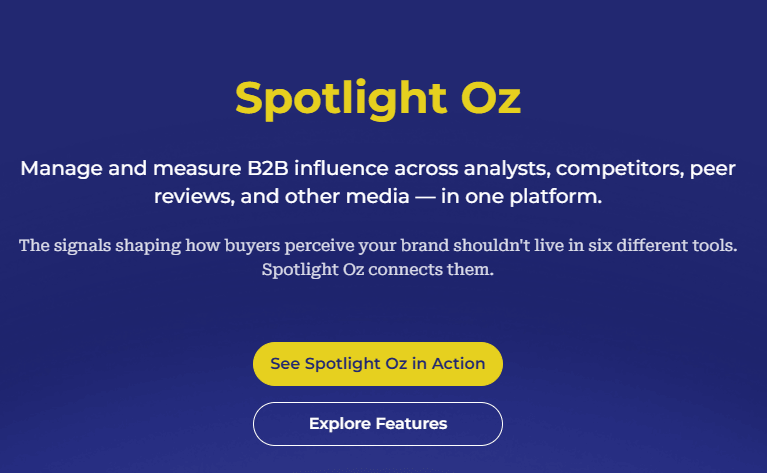
Spotlight Oz is the platform arm of Spotlight, an insights-driven AR firm that centralizes analyst coverage, peer reviews, and AI-extracted insights in one workspace. Following Spotlight's February 2026 acquisition of customer advocacy consultancy Captivate Collective, Oz sits at the center of what the company calls Influence Orchestration.
Best for: AR leaders who want one place to monitor coverage, tie peer-review and AI-visibility signals to analyst narratives, and brief executives quickly.
Key features:
- Real-time insights feed and central workspace for interaction planning, tracking, and post-briefing debriefs
- Category mapping across more than 2,000 technology categories spanning Gartner, Forrester, and IDC
- Around 30 out-of-the-box metrics plus customizable dashboards and Spotlight's Analyst Perception sentiment methodology
- Peer review and media mention data integrated alongside analyst coverage, so influence is measured across sources
- Human-vetted analyst profiles and planned research curated by Spotlight's Research and Intelligence team
Why we like it: The platform treats AR intelligence as a living signal rather than a quarterly task, and it is one of the few tools that connects analyst opinion to peer reviews and AI-surfaced recommendations. That matters when nine external influencers shape a single deal, and when the first stop in the buying journey is a chatbot rather than a Magic Quadrant.
Limitations:
- Reviewers on G2 describe search inside Oz as an area still being improved, and one enterprise reviewer called it a one-size-fits-all tool that large programs can stretch past its intent
- Because Spotlight pairs consultancy with software, staff transitions on the account can affect momentum
- The platform is sold alongside services, so evaluating it purely as standalone software is harder than with a pure SaaS vendor
Pricing: Not publicly available. Public marketplaces and third-party listings show no standardized pricing as of July 2026. Contact Spotlight for a custom quote.
3. Daymark AR
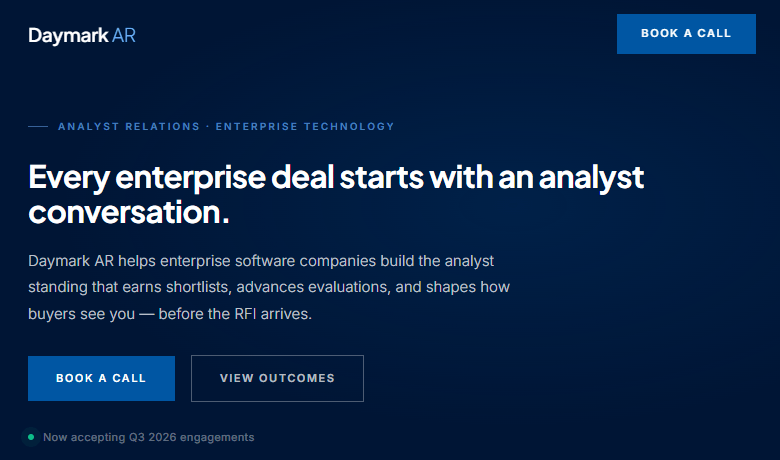
Daymark AR is a boutique AR practice for enterprise technology vendors, focused on year-round positioning, category mapping, and evaluation readiness. It is senior-practitioner led and built for complex, analyst-evaluated categories.
Best for: Enterprise software teams that need hands-on AR strategy and execution around Gartner and Forrester evaluations, not just tooling.
Key features:
- AR program design tied to evaluation cycles and go-to-market calendars
- Analyst landscape mapping, message testing, and executive briefing preparation
- Senior-practitioner delivery model that favors depth over scale
Why we like it: AR outcomes are shaped between cycles, not during RFI windows. A focused services partner helps hold cadence and narrative steady across the growing set of stakeholders Forrester's buyer research describes, which is difficult for a two-person internal team to sustain alone.
Limitations:
- Boutique capacity means engagements may be constrained at peak demand, a tradeoff worth clarifying during scoping
- Not a software platform, so teams will still need a system of record for interactions
- Minimal public footprint: no third-party reviews, analyst coverage, or independent references were verifiable as of July 2026, so buyers should ask for direct client references
Pricing: Not publicly available. No standardized pricing has been published on third-party listings as of July 2026. Contact Daymark AR for a custom quote.
Feature Comparison
| Tool | System of record | Insight and sentiment | Signals beyond analysts |
|---|---|---|---|
| ARchitect | Full interaction, project, and event tracking | Traction reporting and competitive benchmarking via Power BI analytics | Premium Content research and coverage alerts |
| Spotlight Oz | Interaction planning, tracking, and debriefs | Analyst Perception sentiment plus roughly 30 built-in metrics | Peer reviews, media mentions, and AI visibility |
| Daymark AR | Not applicable, services engagement | Delivered as analyst landscape mapping and message testing | Handled through consulting rather than a data feed |
Deployment and Delivery
| Tool | Delivery model | Integrations | Setup effort |
|---|---|---|---|
| ARchitect | SaaS platform, per-seat licensing | Outlook, Google, Slack, email and web content capture | Moderate, based on enterprise reviewer feedback |
| Spotlight Oz | Cloud platform bundled with AR services | Peer review and media data sources, email tooling | Moderate, with onboarding support from the Spotlight team |
| Daymark AR | Consulting engagement, no platform | Not applicable | Scoping and discovery rather than implementation |
Strategic Decision Framework
| Critical question | Why it matters | What to evaluate | Red flags |
|---|---|---|---|
| Do we need a system of record or an insights layer first? | AR programs collapse without reliable history or coverage signals | Volume of interactions, evaluation cadence, executive briefing load | Spreadsheets as the only record heading into MQ or Wave cycles |
| How will AI in buyer discovery affect our AR plan? | GenAI search is now the starting point for B2B research | Whether the platform connects analyst coverage, peer reviews, and AI visibility | No plan to monitor AI search surfaces or peer reviews alongside analyst research |
| What scale of services do we need? | Nine external influencers per decision is more surface than a small team can cover | Internal capacity versus consultancy support, seniority on the account, timelines | Overreliance on last-minute RFI prep instead of between-cycle engagement |
| Can we prove program impact? | AR budgets get cut when the output is an activity count | Out-of-the-box metrics, sentiment tracking, dashboards executives will read | Reporting that takes days to assemble each month |
| Who maintains the analyst data? | Stale profiles send briefings to the wrong subcoverage | Database size, refresh cadence, whether humans vet the entries | Static contact lists with no coverage or research tracking |
Problems & Solutions
-
Problem: Briefing chaos during evaluation windows, with no single view of analyst history.
Solution: ARchitect is repeatedly cited for interaction tracking, event scheduling, and briefing book creation that cut scramble time, with reviewers reporting monthly reports dropping from hours to minutes. That matters because analyst content is one of the external validation sources buyers reach for after their initial AI research. -
Problem: Hard to see how peer-review momentum and analyst opinion connect, especially as AI reshapes discovery.
Solution: Spotlight Oz centralizes AR insights and pulls peer reviews, media mentions, and AI visibility into the same intelligence layer, which is the shape of the problem Forrester's 2026 buying research describes. -
Problem: Strong products still underperform in Magic Quadrants or Waves because cadence, message, and references were not set between cycles.
Solution: A senior-led AR practice like Daymark AR maintains a year-round narrative, a services model that maps to multi-stakeholder buying. Pairing a platform with a consultancy is now a common pattern, reinforced by market moves such as Spotlight's acquisition of Captivate Collective in February 2026, its first add-on under private equity backer Stone-Goff Partners. -
Problem: Leadership asks what AR actually contributed and the answer is a list of briefings.
Solution: Both platforms ship reporting built for that question, ARchitect through Power BI analytics on traction and competitive position, Spotlight Oz through built-in metrics and its Analyst Perception sentiment scoring.
The Bottom Line
Treat AR as a continuous signal, not a quarterly scramble. If your immediate problem is that nobody can reconstruct what was said to which analyst last quarter, start with ARchitect as the operational backbone and get the record clean before you buy anything else.
If the record is already solid and the gap is understanding how analyst opinion, peer reviews, and AI-generated recommendations combine into a market position, Spotlight Oz is the layer built for that question in 2026.
If the constraint is capacity rather than tooling, a senior services partner such as Daymark AR keeps cadence between cycles, though it complements a system of record rather than replacing one.
The spending environment rewards vendors who earn analyst trust early. With $6.31 trillion in IT spending in play and nine external influencers shaping the average decision, the AR programs that win budget are the ones that can explain impact across the buyer network, not just count activities.