You think you know your processes until a quarter-end rush exposes brittle handoffs, silent API failures, and a dozen shadow spreadsheets. Working across different tech companies, we have seen teams stumble on the same pitfalls: idempotent webhooks that are not, OAuth token drift during peak traffic, and retry logic without dead-letter queues. Most teams discover these problems during a go-live, not from a design review. According to Gartner, integration software technologies grew 10.9 percent in 2024 to 34.8 billion dollars, with iPaaS exceeding 9 billion dollars, up over 23 percent year over year, which signals rapid adoption of orchestration backbones across enterprises (Gartner market share, 2025).
Below, we narrow to Kestra, n8n, Workato, Celigo, and Maisa AI, so you can quickly match use cases to the right stack. You will learn where each tool shines, the pricing reality, and red flags from real user feedback and independent reports.
Kestra
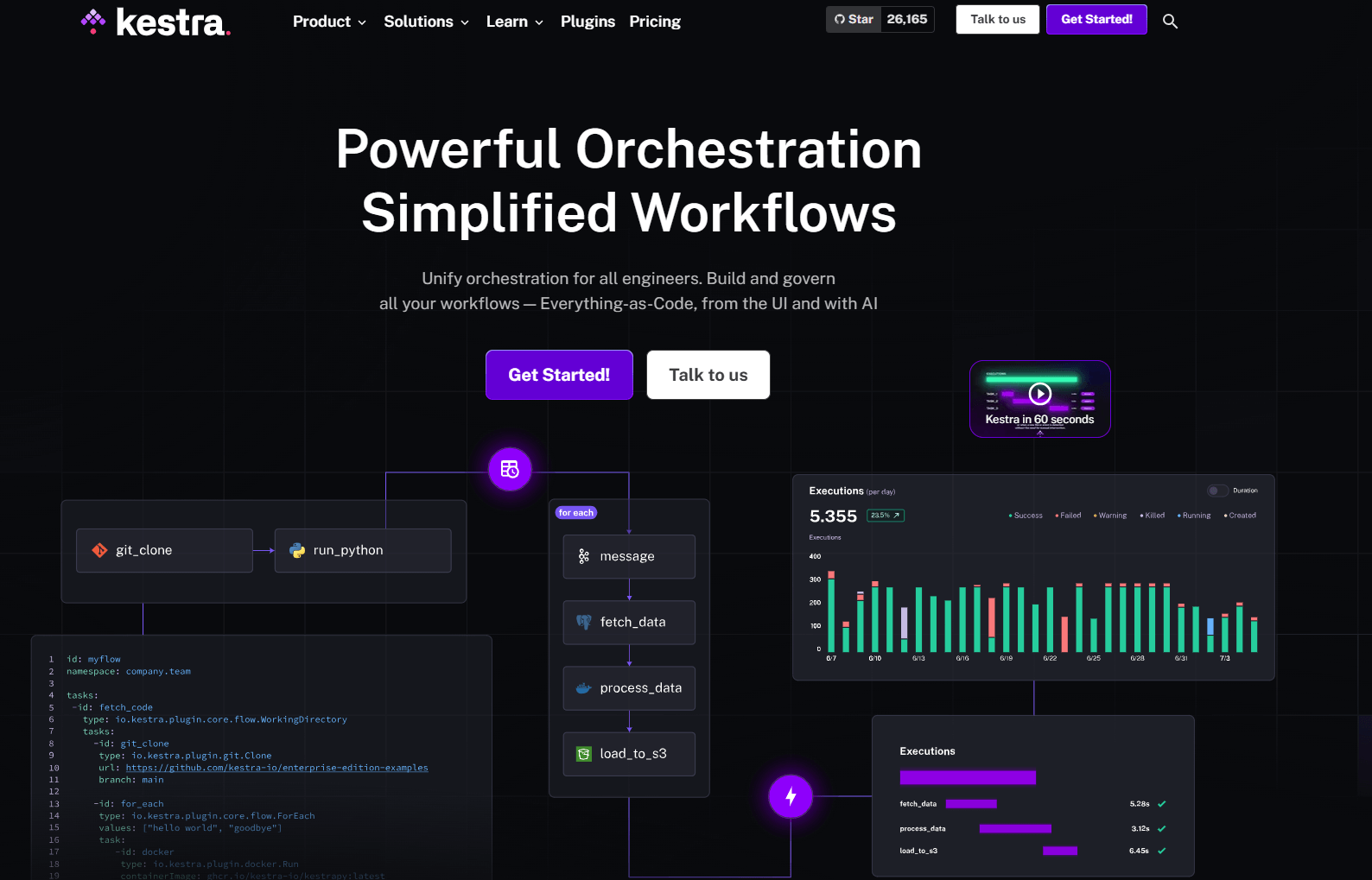
Open source, declarative workflow orchestration focused on event triggers, Everything-as-Code, and a visual editor synchronized with YAML. Recent 1.0 LTS raised its profile with enterprise features and long-term support, per industry press coverage in September 2025 (PR Newswire launch).
Best for: Engineering-led teams that want self-hosted control, Git-synced workflows, and event-driven orchestration across data, AI, and infra.
Key Features:
- Declarative YAML flows plus a synchronized UI editor, with Git workflows and CI/CD patterns referenced by community and press.
- Plugin and blueprint ecosystem for data tools, AI agents, and infra tasks discussed in third-party forums and reviews (G2 listing snapshot).
- Terraform-style rollout patterns, version control, and namespace isolation highlighted in community discussions (Reddit discussion, Sept 2025).
Why we like it: From our experience in the startup ecosystem, Kestra offers a rare balance of code control and team-friendly UI, which shortens onboarding while keeping everything auditable in source control.
Notable Limitations:
- Younger ecosystem and fewer peer reviews compared to incumbents, as seen in limited third-party reviews.
- Enterprise pricing feedback suggests high entry points in some quotes, per community reports.
- Fewer public implementation benchmarks versus long-standing data orchestrators.
Pricing: Open source core, enterprise pricing not publicly available. Contact vendor for a custom quote. Independent user feedback mentions higher enterprise entry costs, but official pricing is not disclosed publicly.
n8n
Source-available, fair-code workflow automation with a visual node editor, 400 plus integrations, and growing AI orchestration features. The company positions its Sustainable Use License as fair-code rather than OSI open source (n8n docs on SUL, Wikipedia overview).
Best for: Teams that want a self-hosted, visual automation tool with strong community momentum and a low entry price for cloud.
Key Features:
- Visual flow builder with nodes for APIs, data, and logic, confirmed across third-party profiles (G2 product page).
- Hybrid deployment options and self-hosted community edition noted in public docs and G2 (G2 pricing page).
- Emerging AI capabilities and agent features mentioned by users in recent reviews.
Why we like it: After helping startups scale, we value n8n for fast proof-of-value with the option to harden on self-hosted infrastructure when data residency matters.
Notable Limitations:
- Licensing is fair-code with commercial restrictions, which some teams misinterpret as open source (IsItReallyFOSS review).
- Debugging and error clarity can lag for complex flows, per consistent user feedback.
- Cloud costs can rise with heavier usage compared to self-hosting, per buyer comments.
Pricing: Cloud Starter listed at 20 euros per month and Cloud Pro at 50 euros per month on G2, with Enterprise by quote. Free self-hosted community edition is available.
Workato
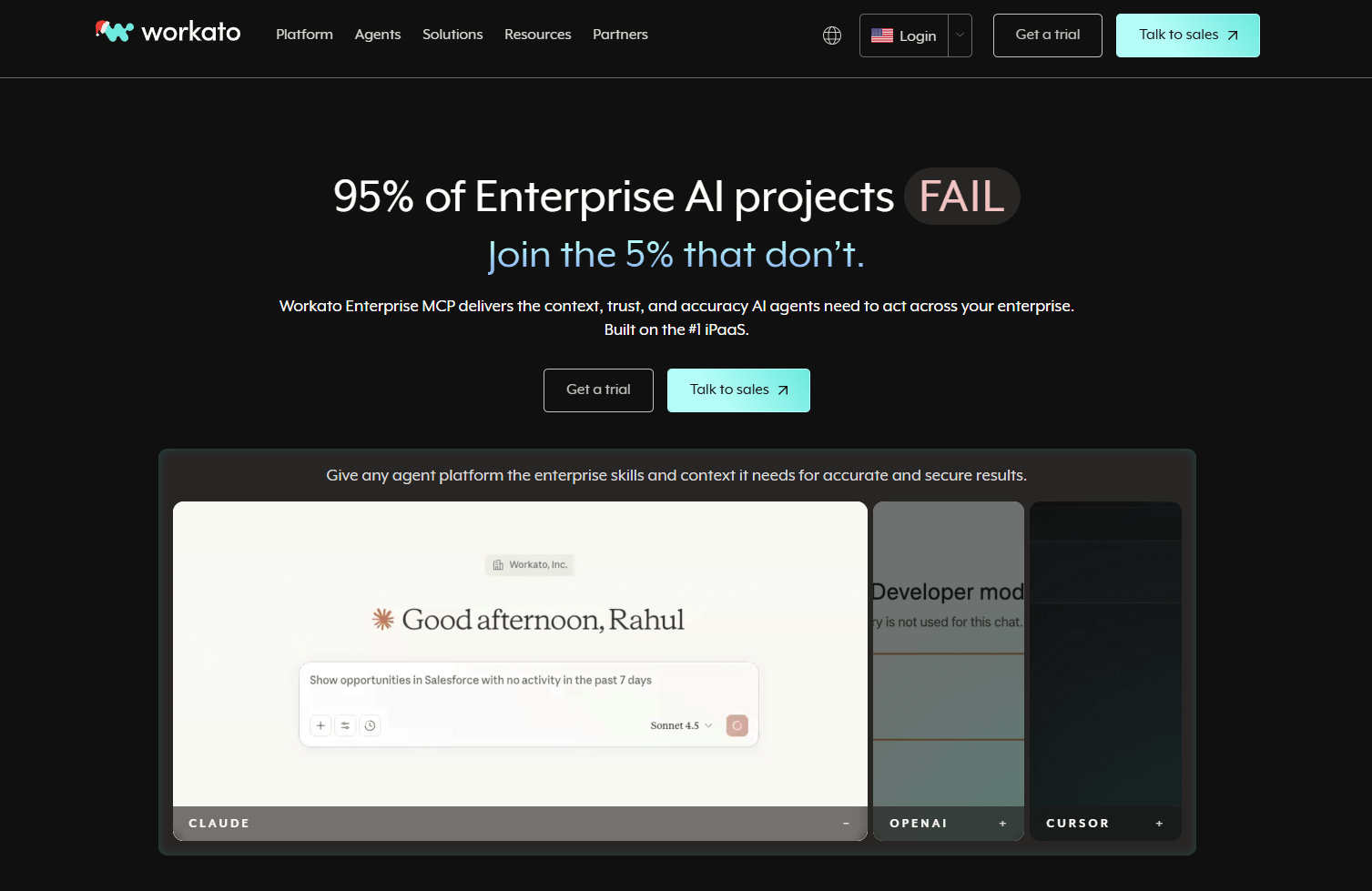
Enterprise automation and integration platform with low-code "recipes," extensive connector catalog, and AI initiatives like Workato One and Agentic orchestration expansions covered in 2025 news (Business Wire, Mar 2025, Business Wire, Aug 2025).
Best for: Mid-market to large enterprises that need governed, cross-department orchestration and on-prem connectivity without running their own platform.
Key Features:
- Recipe-based low-code automation, prebuilt connectors, and enterprise governance validated across reviews (G2 product page).
- Usage-based pricing model described in independent summaries and buyer guides (CreativeAdvisor review).
- On-premise Agent for secure access to internal systems is widely referenced by partners and community resources (Applaud Support overview).
Why we like it: Working across different tech companies, we have seen Workato deliver predictable time to value for enterprise teams, especially where governance, SSO, and change control are non-negotiable.
Notable Limitations:
- Pricing is not publicly listed and perceived as premium by many buyers, per review data and pricing pages (TrustRadius pricing page).
- Learning curve for complex recipes and dependency analysis is a recurring theme in user feedback.
- Kubernetes-native OPA deployment and activation workflows can add friction, per user reviews.
Pricing: Pricing not publicly available. Contact Workato for a custom quote. Third-party sources describe a usage-based model and note premium total cost for enterprise deployments.
Celigo
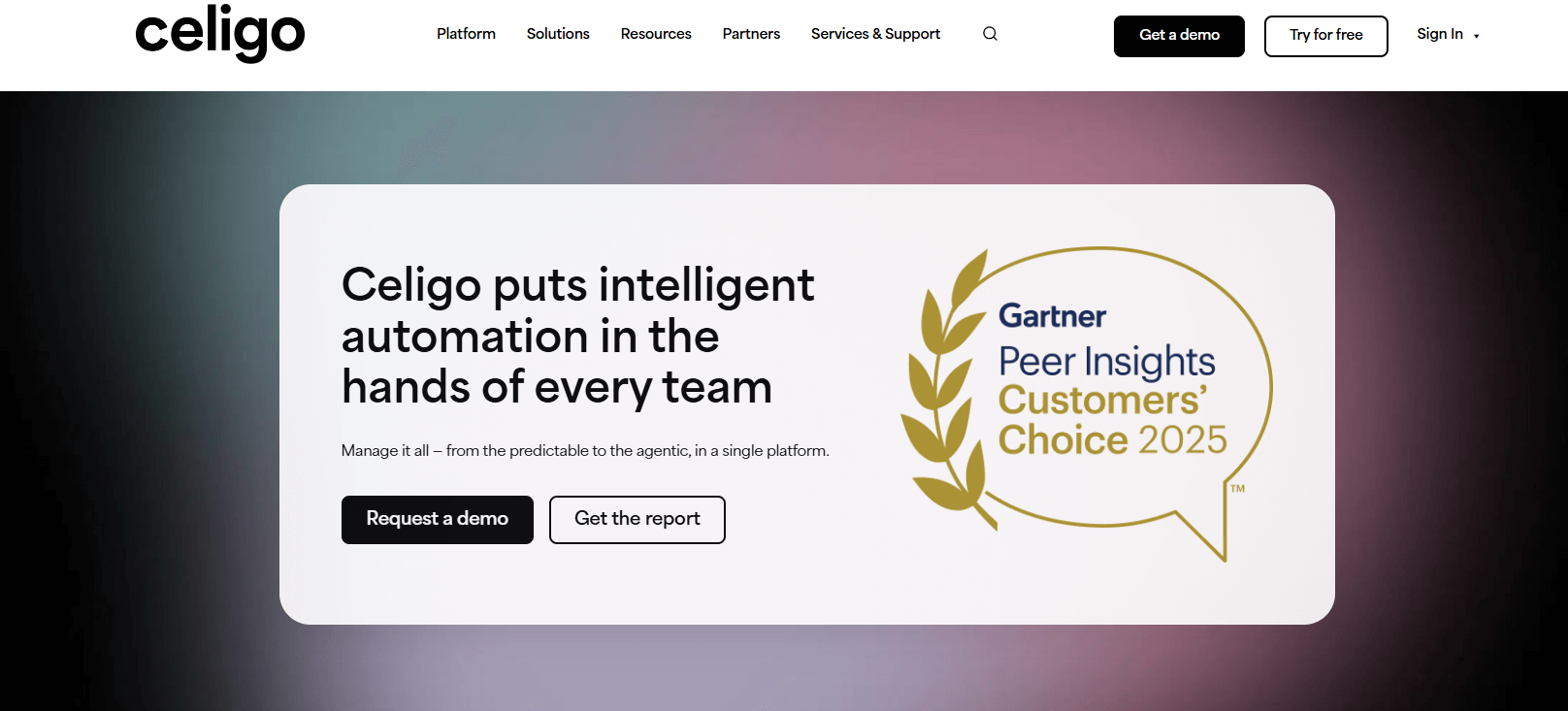
An intelligent iPaaS focused on business orchestration across SaaS and APIs, recognized repeatedly by G2 and noted by Gartner as a Visionary in iPaaS in 2024 and 2025 (Business Wire Jan 2025, Business Wire May 2025).
Best for: Business and IT teams that want fast time-to-value on common processes, with AI-assisted error handling and broad SaaS coverage.
Key Features:
- Repeated #1 iPaaS ranking on G2 across multiple quarters, signaling strong user satisfaction (Business Wire Apr 2025).
- AI-driven error management is highlighted in coverage and user discussions (G2 reviews).
- Private cloud edition announced for enterprises needing stricter deployment controls.
Why we like it: For order-to-cash and eCommerce-ERP patterns, Celigo's templates and error tooling can cut delivery time and support load for lean teams.
Notable Limitations:
- Several users report challenges with deep customization and debugging for edge cases like refunds or inventory timing.
- Community anecdotes flag sandbox-to-prod migration friction in some scenarios (Reddit NetSuite thread, another NetSuite thread).
- Connector coverage is broad but not universal for all EDI variations, per user comments (Reddit EDI thread).
Pricing: G2 lists a free option for a starter flow, with Standard, Professional, and Enterprise as contact-for-pricing tiers (G2 pricing page).
Maisa AI
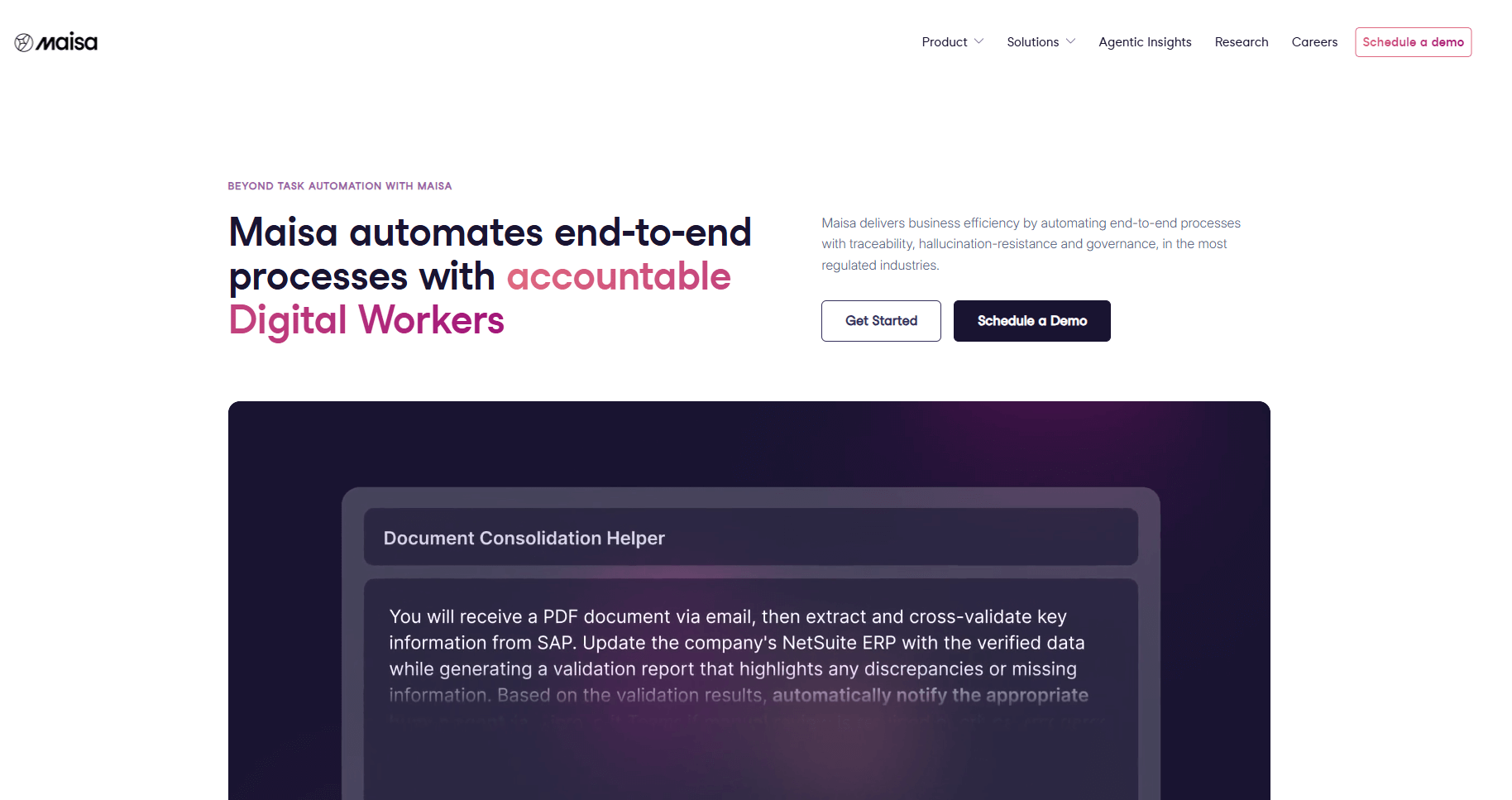
Agentic process automation platform that positions "Digital Workers" to run complex, auditable workflows with a chain-of-work approach. Funding and analyst mentions accelerated in 2025 (TechCrunch funding report, Business Wire analyst mention).
Best for: Early adopters exploring agentic AI for regulated, document-heavy processes that require traceability and auditability.
Key Features:
- Natural-language configuration of Digital Workers aimed at end-to-end processes, per independent coverage.
- Emphasis on hallucination resistance and auditable execution, noted in press reports.
- Target industries include banking, insurance, energy, and manufacturing, per media coverage (EU-Startups funding article).
Why we like it: For teams piloting agentic orchestration with governance needs, the chain-of-work approach can reduce audit risk while letting business users describe processes in plain language.
Notable Limitations:
- New vendor with limited public references compared to incumbents.
- Integration breadth and enterprise deployment patterns still maturing relative to established iPaaS players, per current public information.
- Pricing and large scale production benchmarks are not broadly published.
Pricing: Pricing not publicly available. Contact vendor for a custom quote. Independent coverage does not include list pricing.
BOAT Tools Comparison: Quick Overview
| Tool | Best For | Pricing Model | Highlights |
|---|---|---|---|
| Kestra | Engineering-led, event-driven orchestration | OSS core plus enterprise quote | Declarative YAML, synchronized UI, LTS 1.0 release |
| n8n | Self-hosted visual automation with community traction | Cloud tiers plus enterprise, fair-code | Visual builder, hybrid options, growing AI features |
| Workato | Enterprise orchestration and governance | Usage-based by quote | Recipes, broad connectors, OPA for on-prem |
| Celigo | Business orchestration across SaaS and APIs | Tiered, contact sales | G2 #1 iPaaS across multiple quarters, Visionary in Gartner MQ |
| Maisa AI | Agentic Digital Workers with audit trails | Enterprise quote | Chain-of-work, hallucination-resistance narrative, 2025 funding |
BOAT Platform Comparison: Key Features at a Glance
| Tool | Visual Builder | AI Orchestration | Governance & Audit |
|---|---|---|---|
| Kestra | Yes, synced with YAML | Yes, AI agent workflows noted in materials | Namespaces, versioning, CI/CD patterns discussed in community |
| n8n | Yes | Mentioned by users in 2025 reviews | Role controls and versioning vary by deployment |
| Workato | Yes, recipes | Yes, Workato One and agentic capabilities in 2025 news | Enterprise approvals, environments, SSO noted in reviews |
| Celigo | Yes | AI error management repeated in coverage | Recognized by G2 and Gartner MQ mentions |
| Maisa AI | Yes | Core positioning: agentic Digital Workers | Emphasis on audit trails, chain-of-work |
BOAT Deployment Options
| Tool | Cloud API | On-Premise | Integration Complexity |
|---|---|---|---|
| Kestra | Self-hosted API, cloud program noted in community reviews | Yes, self-hosted is the default, LTS 1.0 covered in press | Moderate for infra and data teams, lower with blueprints |
| n8n | Managed cloud available | Yes, self-hosted community edition | Low to moderate, increases with complex logic |
| Workato | Yes, SaaS | On-prem connectivity via OPA, not a full on-prem platform | Moderate to high for advanced recipes and hybrid connectivity |
| Celigo | Yes, cloud iPaaS | Private cloud edition announced in 2025 | Low to moderate for common patterns, higher for edge cases |
| Maisa AI | Yes | Enterprise deployments not broadly detailed, contact vendor | Varies, early stage for agentic rollouts in regulated orgs |
BOAT Strategic Decision Framework
| Critical Question | Why It Matters | What to Evaluate |
|---|---|---|
| Can we keep governance and audit intact as we scale automation? | Orchestration often crosses systems, data domains, and teams | RBAC, SSO, approval workflows, change control and drift detection |
| Do we need self-hosted control for data residency? | Regulated industries often require this | Self-hosted options, private cloud, network boundaries |
| What is our real TCO under load? | Task or usage spikes can surprise budgets | Usage models, cost dashboards, tiering, and optimization levers |
| How quickly can we recover from API or schema changes? | APIs change silently and break flows | Error handling, AI-assisted troubleshooting, rollback and versioning |
BOAT Solutions Comparison: Pricing & Capabilities Overview
| Organization Size | Recommended Setup | Monthly Cost | Annual Investment |
|---|---|---|---|
| Startup to SMB with engineers | Kestra self-hosted or n8n self-hosted for core automations | Kestra OSS: Free. n8n OSS: Free | OSS free, plus infra cost. Cloud optional at 20 to 50 euros per month for n8n |
| Mid-market ops teams | Celigo cloud for SaaS-first patterns, n8n or Kestra for niche workflows | Celigo tiers by quote. n8n Cloud 20 to 50 euros per month for light teams | Celigo by quote, n8n cloud a few hundred dollars per year for light usage |
| Enterprise with hybrid estate | Workato for governed orchestration plus OPA, Celigo for packaged flows | Workato by quote, premium per reviews | Workato not publicly listed, third-party sites note enterprise-level spend with usage-based pricing |
| Early agentic pilots in regulated sectors | Maisa AI for Digital Workers with audit trails | By quote | Not publicly available, see funding and analyst reports for positioning |
Problems & Solutions
-
Problem: Order-to-cash and eCommerce-ERP sync breaks on refunds, promotions, and inventory timing.
- Celigo: Strong for Shopify-NetSuite templates and business-user controls, but users note customization and debugging limits in edge cases, so plan for advanced mapping and test data coverage.
- Workato: Use recipes with explicit error handling, dependency reviews, and OPA when private ERPs are involved. Buyers value governance, though complexity grows with advanced flows.
- Kestra: Model idempotent tasks with retries and dead-letter flows in YAML, then backtest with recorded events before cutover. Community reports point to enterprise-readiness improvements after 1.0 LTS.
-
Problem: Data residency and security teams block cloud-only automation.
- n8n: Self-host the community edition to keep data inside your network while retaining a visual builder, as reflected on public listings.
- Workato: Keep Workato in the cloud, but access internal systems through OPA without inbound firewall changes, per partner guidance.
- Kestra: Default self-host takes this off the table for many security reviews, which is helpful for regulated environments.
-
Problem: Execs want AI in the core processes, not demos in a sandbox.
- Workato: 2025 announcements focus on agentic orchestration in production, KPI tracking, and enterprise context via Workato One, which is relevant to outcome-based rollouts.
- Maisa AI: Digital Workers emphasize verifiable, auditable execution and hallucination resistance, a fit for regulated processes that need traceability.
-
Problem: Budget predictability under load.
- Workato: Usage-based pricing and consumption dashboards are frequently noted by third parties, but buyers should model spikes and high-volume recipes during peak seasons.
- n8n: Cloud tiers are transparent on G2, while self-hosting trades subscription for infra costs and ops time.
- Celigo: Tiered pricing by quote, with multiple G2 reports highlighting time-to-value and ROI for standard flows, so prioritize highest volume processes first.
The Bottom Line
If you need enterprise guardrails with hybrid connectivity, start with Workato and budget time for recipe design and usage modeling, as echoed in independent reviews and news. SaaS-first teams can get fast wins on Celigo, then layer custom logic where needed, mindful of debugging visibility for edge cases. Engineering-driven groups with data or infra workloads should evaluate Kestra's self-hosted model and declarative approach, now steadied by a 1.0 LTS path. For rapid self-hosted automation with a visual editor and a low entry price, n8n remains a pragmatic pick, with clear licensing tradeoffs to understand up front. If you are piloting agentic AI in regulated processes, Maisa's Digital Workers and chain-of-work focus are worth a proof-of-concept in 2026 roadmaps. And remember the macro trend: integration and automation markets are still expanding quickly, per Gartner's 2024 and 2025 figures, so the capability you deploy this quarter will compound in value across next year's initiatives.