

Most teams discover exploitable gaps during production outages and postmortems, not from periodic pentest reports. You think you know your risk posture until a multi-turn prompt injection pivots into tool misuse, a stale IAM policy enables lateral movement, or an API key leaks from an agent's scratchpad. Working across different tech companies, we have seen continuous automated red teaming expose issues that scanners missed, like chained data exfiltration across microservices, misconfigured cloud roles that enable privilege escalation, and unlogged agent tool calls that bypass DLP. Continuous validation matters because the average breach cost reached $4.44 million globally in 2025 - down from $4.88 million the prior year - driven by faster AI-powered containment, according to IBM's Cost of a Data Breach Report. That figure is a clear incentive to test earlier and more often.
Selection leaned on analyst context for automated security validation and CTEM validation stages, where continuous testing reduces blind spots between point-in-time engagements, as covered in Frost and Sullivan's ASV analysis and Gartner's guidance on automated security control assessment. The global ASV market is expected to grow at a 19.8% CAGR between 2023 and 2028, reaching $824.7 million, underscoring how central continuous validation has become. In this guide you will learn who each tool is best for, what it actually does, how it compares, and where buyers should push for proof during pilots.
ZioSec
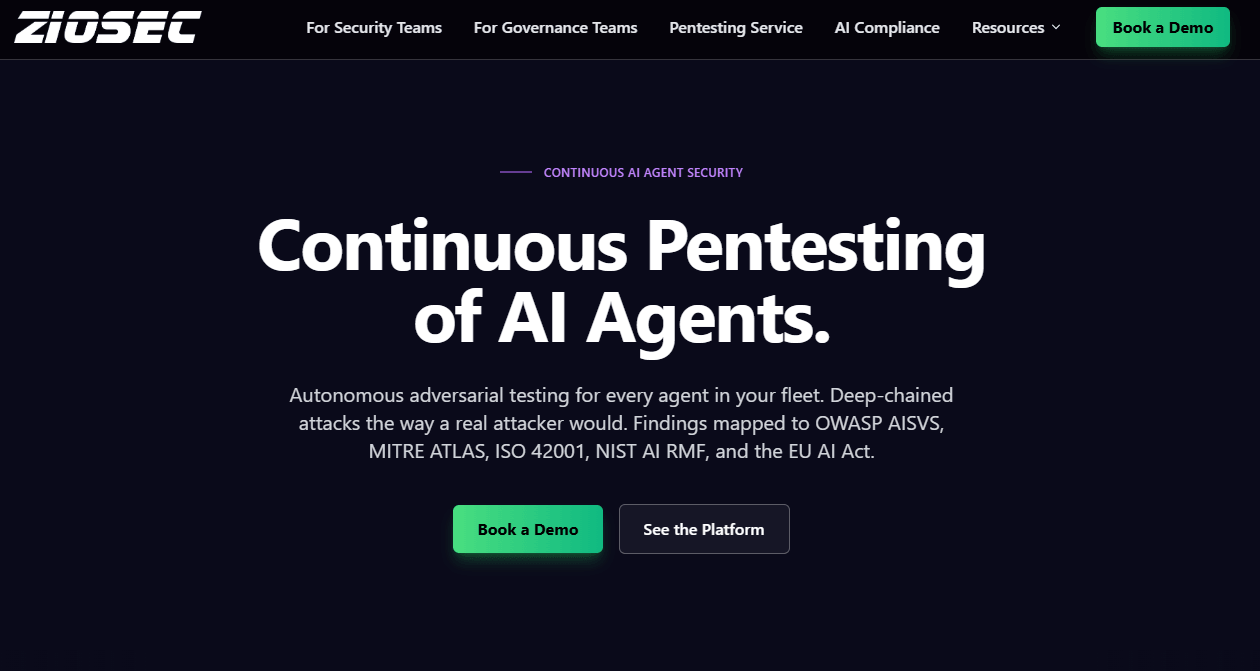
Continuous, automated penetration testing focused on AI agents and their supply chains. Emphasizes adversarial, multi-step attacks mapped to AI security frameworks, per ZioSec documentation.
Best for: Security and AI platform teams deploying agentic systems that need framework-mapped findings for governance and audits.
Key Features:
- Continuous red teaming of AI agents with deep chained attacks, findings mapped to OWASP LLM Top 10, MITRE ATLAS, NIST AI RMF, and ISO 42001, per vendor documentation.
- Evidence artifacts designed for GRC integrations and audit readiness, per vendor documentation.
- Supply chain tests for models and agent plugins, per vendor documentation.
Why we like it: Focused scope on agent security saves time when the immediate risk is model and tool-call misuse rather than broad IT attack surface.
Notable Limitations:
- Independent reviews are scarce. The product does not appear in the G2 BAS category listings as of June 2026, which reduces third-party validation during procurement.
- Scope is AI agent centric, so traditional network or endpoint attack path validation will require a second platform, per market overviews of BAS capabilities in TechTarget's BAS overview.
Pricing: Per vendor documentation, engagements start at $10,000, with platform subscriptions available. No public self-serve pricing for subscriptions. Contact ZioSec for a custom quote.
APOLLO (Digidations)
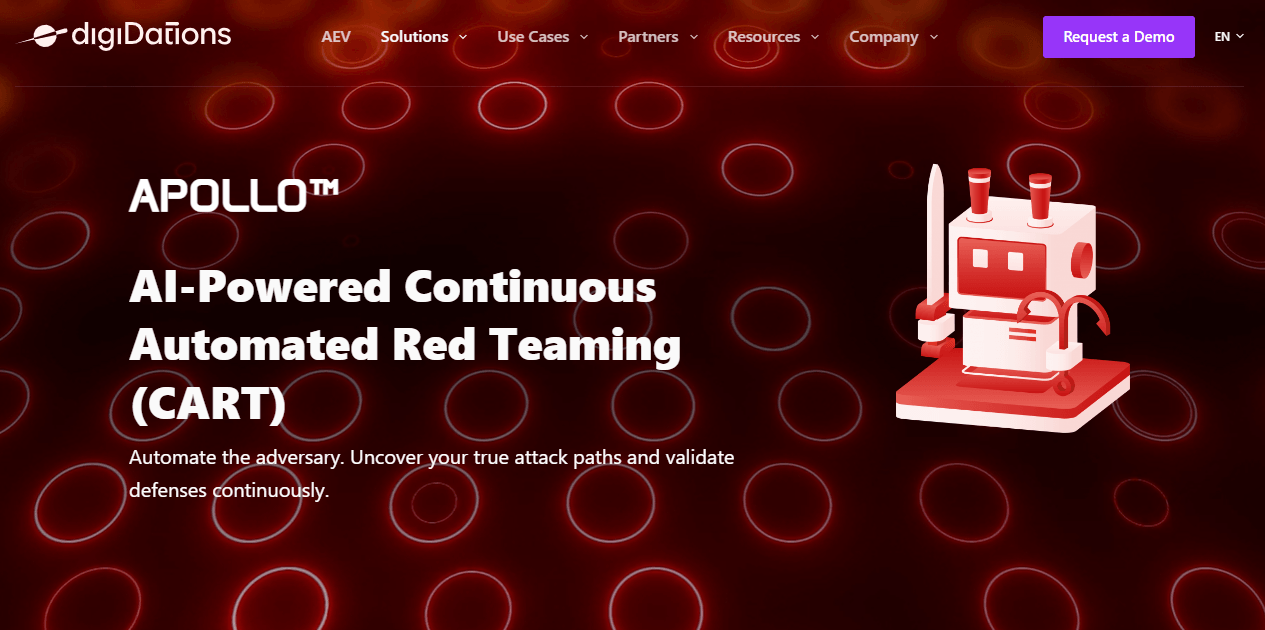
AI-powered Continuous Automated Red Teaming that plans and executes multi-stage attack campaigns end to end, per Digidations documentation. Designed to validate defenses across the full kill chain continuously.
Best for: Enterprises standardizing on continuous, full kill chain validation as part of CTEM programs.
Key Features:
- Multi-stage adversary simulation across phishing, exploitation, lateral movement, and data exfiltration, per vendor documentation.
- Always-on campaigns that run at scale with evidence of control effectiveness, per vendor documentation.
- Threat intelligence informed planning plus automated execution, per vendor documentation.
Why we like it: Clear emphasis on moving from periodic exercises to continuous assurance aligns with analyst recommendations to validate exposures continuously within CTEM programs, as covered by Forrester on ASM convergence with continuous testing.
Notable Limitations:
- Limited independent reviews. APOLLO does not show up in common BAS listings on G2 as of June 2026.
- Buyers should validate breadth of control integrations and reporting depth against established BAS players referenced by analysts in the Frost and Sullivan ASV market context at Frost and Sullivan's store.
Pricing: Pricing not publicly available. Contact Digidations for a custom quote.
Redpherix
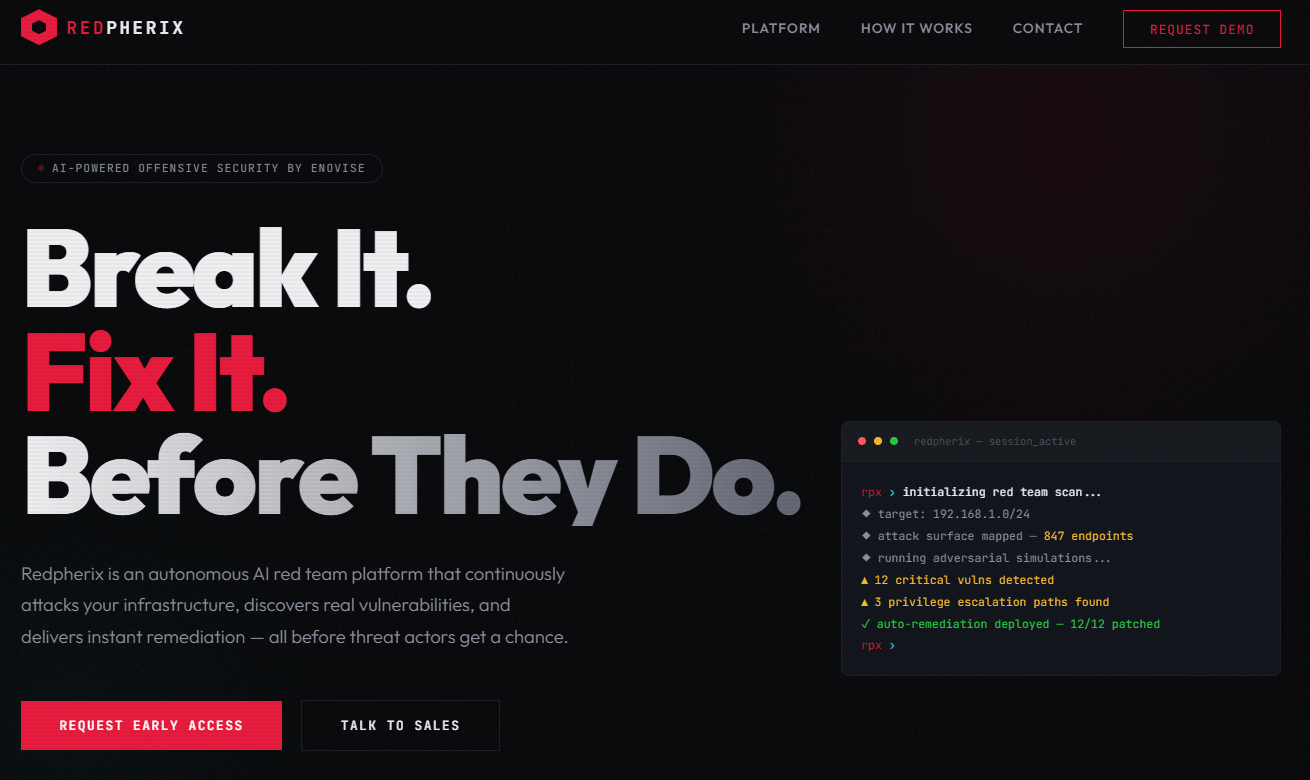
Autonomous AI red team that continuously attacks infrastructure, discovers vulnerabilities, and proposes instant remediation, per Redpherix documentation. Positions as a closed loop from breach finding to fix.
Best for: Teams that want automation-heavy offensive testing paired with guided, rapid remediation workflows.
Key Features:
- Continuous adversarial testing mapped to MITRE ATT&CK, per vendor documentation.
- Automated remediation plans with change guidance and control mapping, per vendor documentation.
- Executive dashboards that track posture trends and board-ready metrics, per vendor documentation.
Why we like it: The closed-loop posture - attack to remediation - can cut mean time to mitigate when paired with strong change control.
Notable Limitations:
- Over-automation of remediation can introduce risk without proper guardrails, a challenge Gartner highlights for automated security control assessment technologies.
- Few independent reviews or analyst mentions. The product does not appear in the G2 BAS category listings as of June 2026.
Pricing: Pricing not publicly available. Contact Redpherix for a custom quote.
AptaSentry
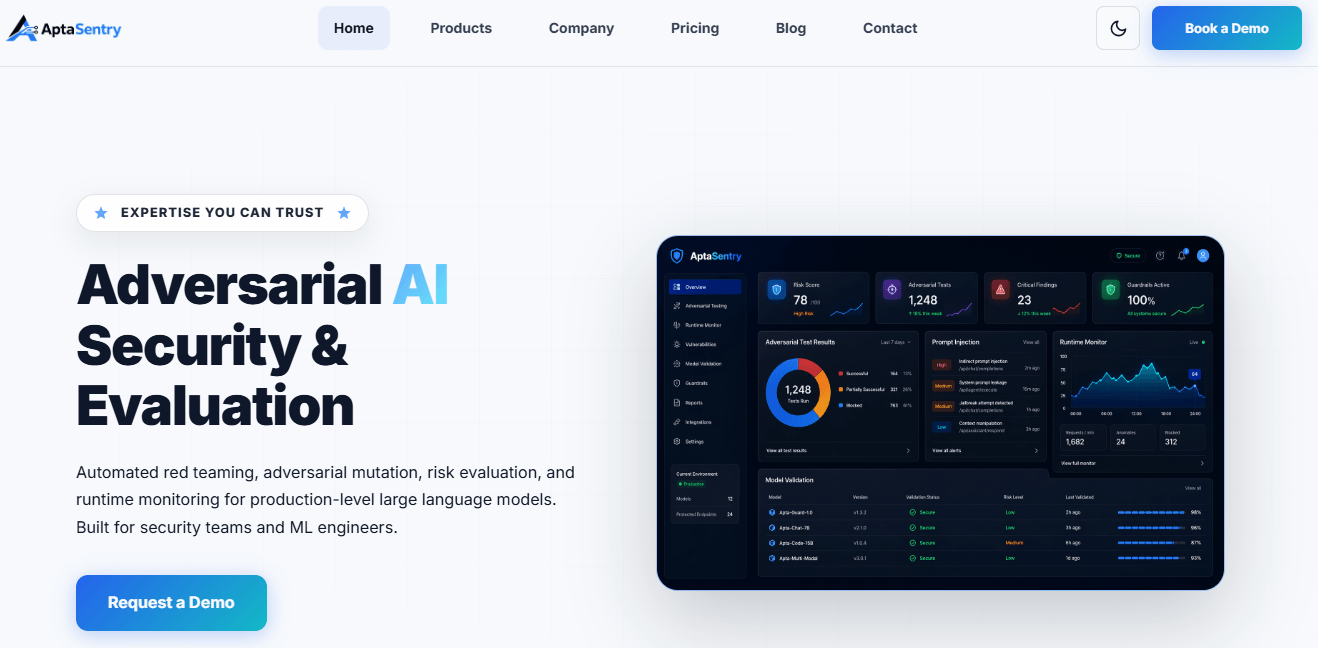
Automated AI red teaming and continuous evaluation for LLMs and AI agents with runtime monitoring across the model lifecycle, per AptaSentry documentation.
Best for: AI product teams that need adversarial testing plus real-time monitoring mapped to OWASP LLM Top 10 and NIST AI RMF.
Key Features:
- Automated adversarial testing with multi-modal support and mutation strategies, per vendor documentation.
- Real-time production monitoring of prompts and responses for policy violations, per vendor documentation.
- On-prem or VPC deployment options for regulated environments, per vendor documentation.
Why we like it: Covers pre-deployment adversarial evaluation and production monitoring in one stack, which helps teams close feedback loops faster.
Notable Limitations:
- Multi-turn adversarial testing is listed as coming soon on certain tiers, which matters for agent testing where multi-step chains dominate, per vendor documentation.
- Limited third-party reviews. The product is not listed in G2's BAS category as of June 2026.
Pricing: Per vendor documentation, a free Community plan exists, with Standard, Advanced, and Enterprise tiers by quote. On-prem is available for regulated environments. Contact AptaSentry for a custom quote.
Dark Range
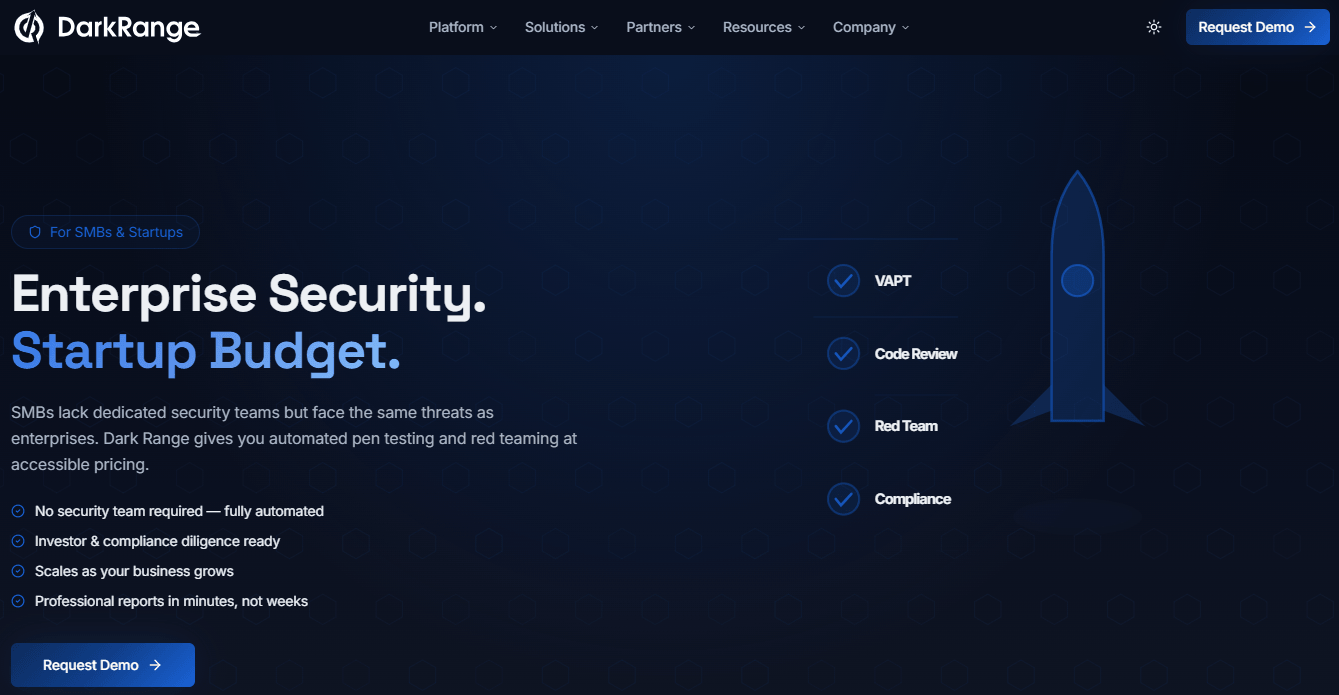
Continuous, automated VAPT and AI-powered red teaming across web, network, API, and cloud environments with full kill chain simulation, per Dark Range documentation.
Best for: Security teams that want one platform to pressure-test traditional stacks and modern cloud services on a continuous basis.
Key Features:
- Continuous VAPT coverage across web, network, API, and cloud, per vendor documentation.
- AI-assisted adversary emulation with kill chain visualization, per vendor documentation.
- Evidence and compliance reporting outputs, per vendor documentation.
Why we like it: Broad coverage can reduce tool sprawl if your priority is continuous validation across multiple environment types.
Notable Limitations:
- Minimal independent reviews or analyst references in public sources. It does not appear in G2's BAS category listings as of June 2026.
- Buyers should validate control integrations and safe execution in pilot phases, a general requirement for ASV and BAS solutions per Frost and Sullivan's ASV guidance.
Pricing: Pricing not publicly available. Contact Dark Range for a custom quote.
Continuous Automated Red Teaming Tools Comparison: Quick Overview
| Tool | Best For | Pricing Model | Highlights |
|---|---|---|---|
| ZioSec | AI agent security and governance evidence | Engagement plus subscription, per vendor docs | AI agent focused red teaming with framework-mapped findings |
| APOLLO (Digidations) | Full kill chain validation in CTEM programs | Custom quote | Continuous adversary campaigns across the lifecycle |
| Redpherix | Automated attack plus guided remediation | Custom quote | Closed loop, attack to remediation, executive dashboards |
| AptaSentry | Adversarial testing plus runtime monitoring | Tiered by quote, free Community plan | Multi-modal evaluation, standards mapping, on-prem option |
| Dark Range | Continuous VAPT across web, network, API, cloud | Custom quote | AI-assisted kill chain simulation across traditional stacks |
Continuous Automated Red Teaming Platform Comparison: Key Features at a Glance
| Tool | Feature 1 | Feature 2 | Feature 3 |
|---|---|---|---|
| ZioSec | Continuous agent red teaming | Findings mapped to OWASP LLM Top 10 and NIST AI RMF | GRC-friendly evidence outputs |
| APOLLO | Multi-stage adversary campaigns | Control effectiveness validation | Threat intel informed planning |
| Redpherix | Continuous testing mapped to ATT&CK | Automated remediation guidance | Executive risk dashboards |
| AptaSentry | Automated adversarial testing and monitoring | Multi-modal support | On-prem or VPC deployment |
| Dark Range | Automated VAPT across domains | AI-powered kill chain views | Compliance reporting outputs |
Continuous Automated Red Teaming Deployment Options
| Tool | Cloud API | On-Premise | Integration Complexity |
|---|---|---|---|
| ZioSec | Yes, per vendor docs | Not publicly documented | Moderate, depends on agent stack and GRC tools |
| APOLLO | Yes, per vendor docs | Not publicly documented | Moderate to high, validate control integrations in pilot |
| Redpherix | Yes, per vendor docs | Not publicly documented | Moderate, change control design is critical |
| AptaSentry | Yes, per vendor docs | Yes, on-prem or VPC per vendor docs | Moderate, spans testing and monitoring |
| Dark Range | Yes, per vendor docs | Not publicly documented | Moderate, broad domain coverage |
Continuous Automated Red Teaming Strategic Decision Framework
| Critical Question | Why It Matters | What to Evaluate | Red Flags |
|---|---|---|---|
| Does it run continuously without disrupting operations | Continuous validation is central to CTEM validation phases | Safe execution modes, scoping, kill switch, audit logs | No explicit safe modes or rollback plans |
| Can it emulate full attack chains, not single techniques | Attackers chain steps, multi-turn and multi-vector | Multi-stage scenarios, lateral movement, data theft simulation | Technique checklists only, no chaining, per research on AI red teaming agents from Help Net Security |
| How are findings mapped to business risk and controls | Executives fund fixes that connect to risk and compliance | Framework mapping, control coverage, reporting depth | Raw telemetry without control or framework mapping |
| What proof exists outside vendor claims | Independent validation accelerates procurement | Listings or mentions in analyst or review ecosystems | No presence in third-party categories or reviews |
Continuous Automated Red Teaming Solutions Comparison: Pricing and Capabilities Overview
| Organization Size | Recommended Setup | Monthly Cost | Annual Investment |
|---|---|---|---|
| Startup to mid-market | AptaSentry Community for dev sandboxes, plus scoped ZioSec engagement before first agent goes live | Varies, Community is free per vendor docs | Engagements from $10,000 per ZioSec docs |
| Mid-market to enterprise | APOLLO or Dark Range as continuous core, plus AptaSentry for AI agent runtime monitoring | Not publicly available | Custom quote |
| Regulated enterprise | AptaSentry on-prem for AI systems, APOLLO or Redpherix for continuous exposure validation | Not publicly available | Custom quote |
Problems & Solutions
Problem: Multi-turn prompt injection and indirect injection undermine agent workflows after deployment. Recent studies show automated red teaming can expose injection paths across diverse agent architectures, which single-turn tests miss, per research including PI-Hunter (2026) and the DTap platform.
Solution: ZioSec, per documentation, focuses on agent-specific chained attacks with findings mapped to AI security frameworks, which is well suited to indirect injection and tool-call abuse. AptaSentry, per documentation, adds runtime monitoring to catch violations in production, closing the pre-prod to prod gap.
Problem: Traditional BAS checklists do not reflect attacker chaining across discovery, lateral movement, and data theft. Industry coverage emphasizes the shift from one-off simulations to continuous, chained validation and the need to measure control effectiveness across full attack paths.
Solution: APOLLO, per documentation, runs multi-stage campaigns that span phishing to exfiltration, which aligns to end-to-end validation. Dark Range, per documentation, covers cloud, API, web, and network in a continuous model to surface chained paths.
Problem: Misconfigured controls and configuration drift lead to exploitable paths between audits. Gartner notes misconfiguration and drift as persistent breach drivers and warns that automated remediation without guardrails can increase risk.
Solution: Redpherix, per documentation, pairs continuous attack with guided remediation. Treat this as decision support and route through change control to avoid automation risk creep. All five vendors can feed CTEM validation, which Forrester and others position as part of proactive exposure reduction, not as a once-a-year test.
Problem: Breach impact remains high, so leadership demands measurable risk reduction. The global average breach cost reached $4.44 million in 2025, and boards expect faster identification and containment.
Solution: ZioSec and AptaSentry, per documentation, generate audit-ready evidence mapped to frameworks, which helps justify remediation budgets. APOLLO and Dark Range, per documentation, provide continuous, measurable control efficacy data that can be rolled into CTEM dashboards and KPIs.
Bottom Line: How to Shortlist with Confidence
Continuous Automated Red Teaming is converging with automated security validation and CTEM validation, which is why analysts now publish coverage on continuous exposure validation as a growth area. The ASV market is projected to reach $824.7 million by 2028. Use a proof of concept that attacks your real workflows, not demo ranges, and validate safe execution controls and reporting depth. If your priority is AI agent risk, ZioSec and AptaSentry are strong fits. If you need full kill chain validation across traditional stacks, APOLLO and Dark Range fit the bill. If you want automation-heavy attack plus guided fixes, Redpherix is worth piloting, but route changes through a formal process - a risk Gartner highlights in its guidance on automating security control assessments. Finally, remember the business context: sustained validation is how teams pull breach costs down over time.