


Most teams discover contractor misclassification risk during a painful tax review or financing diligence, not from a glossy vendor demo. Working across different tech companies, we have seen small choices create big penalties - for example using one generic contract for 15 countries, skipping local tax registrations for recurring contractors, or paying invoices from a founder's bank to save fees. The biggest compliance mistakes happen when fast-growing teams centralize invoices but ignore local rules and worker status. From our experience in the startup ecosystem, the right Contractor of Record stack prevents rework by standardizing classifications, localized contracts, and payments from day one.
The EOR and related COR segment has grown rapidly, with the market valued at approximately USD 6.82 billion in 2025 and projected to reach USD 7.45 billion in 2026, growing at a roughly 9 percent CAGR through 2035, according to Custom Market Insights. For context on regulatory pressure, the U.S. Department of Labor's 2024 independent contractor rule took effect on March 11, 2024, but the DOL stopped enforcing it in May 2025 and proposed a new rule in February 2026 to formally rescind and replace it with a framework similar to the 2021 rule, refocusing classification on two core factors - control over work and opportunity for profit or loss. The comment period for the proposed rule closed April 28, 2026, and the regulatory landscape remains in flux.
Paismo
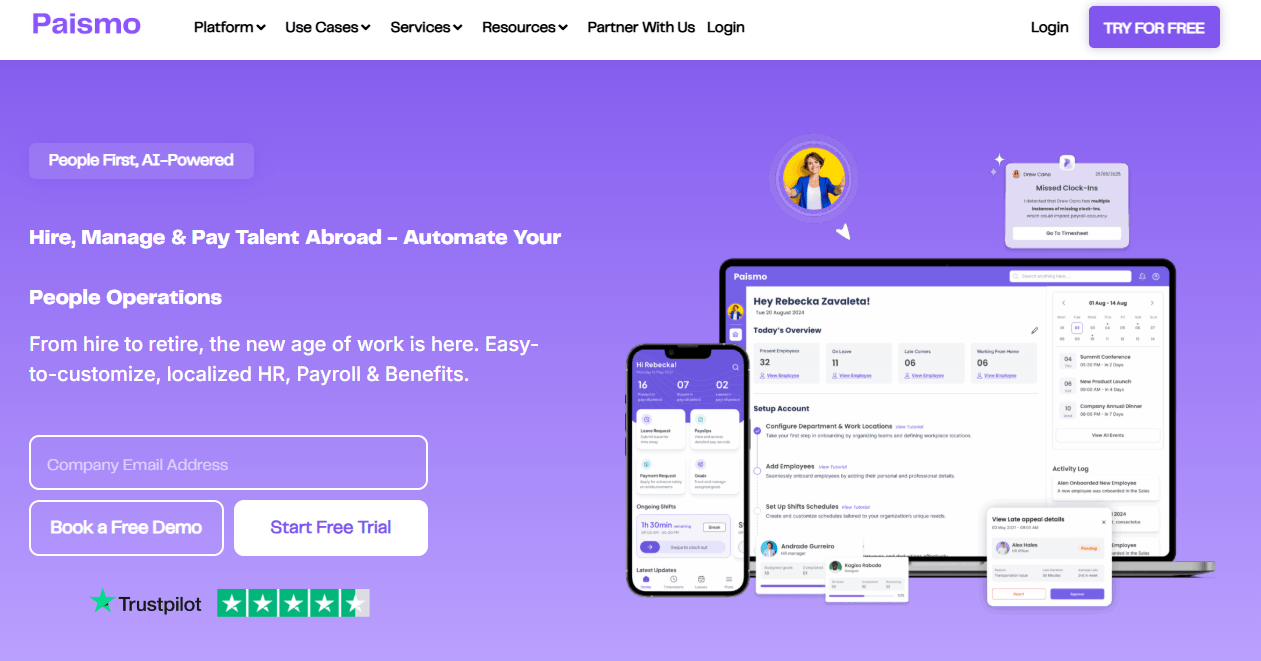
Paismo offers a Contractor of Record service focused on compliant onboarding, localized contracts, and consolidated payments across a broad country footprint, paired with HR features. Per vendor documentation, coverage targets 150 plus countries with country-specific classification rules.
Best for: Startups and SMBs that want COR plus an all-in-one HR layer to run time, leave, and payroll workflows alongside contractor engagements.
Key Features:
- Country-localized contractor agreements and onboarding checklists
- Centralized invoices and multi-currency payments
- HRIS functions like time tracking, leave, and basic payroll connectors
Why we like it: The platform design targets early-stage operators who need contractor compliance and basic HR in one system, reducing tool sprawl.
Notable Limitations:
- Limited independent reviews and analyst coverage at this stage, with very few third-party ratings visible online (for example, a small footprint on G2 and a handful on Trustpilot).
- Fewer public references or case studies compared to larger incumbents, so buyers should request references and sample localized contracts.
Pricing: Pricing not publicly available. Contact Paismo for a custom quote.
4dev.com

4dev.com positions itself as a global Contractor of Record operations platform that standardizes contractor workflows, documentation, and invoicing across 150 plus countries, with an emphasis on audit-ready records and API integration.
Best for: Product and operations teams that need structured contractor workflows, IFRS-ready document trails, and API hooks for internal systems.
Key Features:
- Country-specific workflows with built-in documentation and compliance controls
- Centralized invoice generation and export for finance and audits
- API integration to sync contractor data and documents
Why we like it: The operations-first design helps teams that care about documentation quality, audit trails, and reducing spreadsheet-driven risk as volume scales.
Notable Limitations:
- Sparse independent reviews and limited analyst visibility; what exists is early and small sample size, for example a short run of feedback on Trustpilot.
- Public product information indicates a 1 to 3 percent service fee model (with no subscriptions), which can be cost-sensitive for high-value contractors, so teams should model total landed cost carefully.
Pricing: Per vendor documentation, the service fee is 3 percent or less per payout, scaling down with volume. No subscriptions or hidden charges. Confirm current rates and volume tiers with 4dev.com.
Remote Contractor of Record (by Remote)
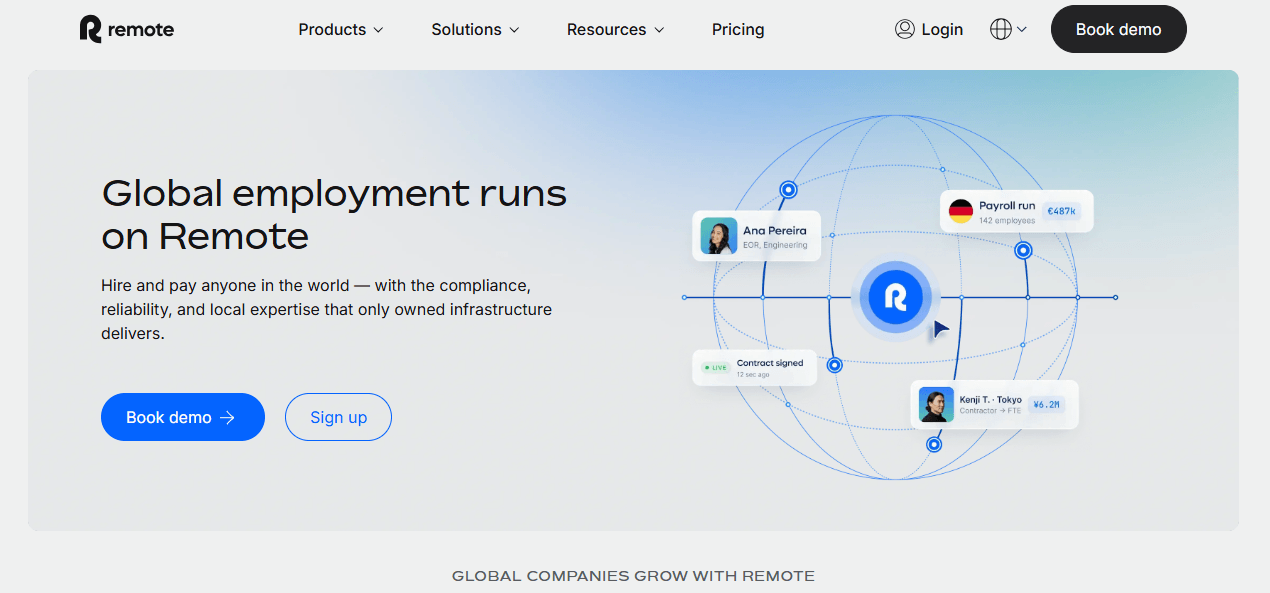
Remote added a Contractor of Record service to contract directly with international contractors, handling onboarding, invoicing, tax-related administration, and payments to reduce misclassification exposure. The COR launch and scope are documented in Remote's Wikipedia entry.
Best for: Teams that want a mature global HR vendor with wide country coverage, and that may later add EOR or payroll on the same platform.
Key Features:
- COR engagement where Remote contracts with the contractor and handles invoicing and payouts
- Localized contracts and record keeping to reduce misclassification risk
- Upgrade path to EOR and global payroll on the same platform
Why we like it: Remote is broadly known in EOR and contractor management, so COR can slot into a larger global employment roadmap with one vendor.
Notable Limitations:
- Pricing and product catalog can feel complex for buyers, as noted by third-party coverage of Remote's plans and add-ons in a TechRadar review.
- Mixed online commentary on support responsiveness and billing disputes, which prospective buyers should probe during diligence, as reflected in community experiences.
Pricing: Remote's COR pricing is $325 per contractor per month, as confirmed by multiple independent sources in 2026. Basic contractor management starts at $29 per contractor per month for lighter needs. Confirm with Remote for current COR rates and any volume discounts.
Contractor of Record Tools Comparison: Quick Overview
| Tool | Best For | Pricing Model | Highlights |
|---|---|---|---|
| Paismo | Early-stage teams needing COR plus HR basics | Custom quote | Single system for contractor onboarding, contracts, and payments |
| 4dev.com | Ops-heavy teams prioritizing documentation and audits | 1-3% service fee per payout | Country workflows, audit-ready docs, API hooks |
| Remote COR | Teams that may scale into EOR or payroll later | $325 per contractor per month | Broad footprint, add-on path to EOR and payroll |
Contractor of Record Platform Comparison: Key Features at a Glance
| Tool | Localized Contracts | Centralized Invoicing | API Availability |
|---|---|---|---|
| Paismo | Yes | Yes | Yes, per vendor docs |
| 4dev.com | Yes | Yes | Yes, per vendor docs |
| Remote COR | Yes | Yes | Yes, with third-party connector references like Apideck |
Contractor of Record Deployment Options
| Tool | Cloud API | On-Premise | Integration Complexity |
|---|---|---|---|
| Paismo | Yes | No public indication | Low to medium, depends on HRIS and finance stack |
| 4dev.com | Yes | No public indication | Low to medium, API available per vendor docs |
| Remote COR | Yes | No public indication | Medium, larger catalog may require careful scoping |
Contractor of Record Strategic Decision Framework
| Critical Question | Why It Matters | What to Evaluate | Red Flags |
|---|---|---|---|
| Who is the legal counterparty to the contractor, you or the COR? | Determines misclassification risk posture and indemnities | Contract structure, indemnity caps, who issues invoices | You remain counterparty while vendor markets COR-like services |
| How are country rules reflected in contracts and workflows? | The DOL's 2026 proposed rule and similar global regimes keep classification scrutiny high | Localized agreements, record keeping, audit logs | One generic contract for all countries, thin audit trail |
| What is the total landed cost at your volumes? | Percent or minimum fees can spike TCO | Per-contractor minimums, percentage on invoice, FX and payment fees | Headline price ignores minimums, FX spreads, or invoice fees |
| Can you prove compliance during due diligence? | Investors and buyers review contractor records | Document templates, approvals, time and SOW linkage | Spreadsheets, missing contracts, or inconsistent records |
Contractor of Record Solutions Comparison: Pricing and Capabilities Overview
| Organization Size | Recommended Setup | Monthly Cost | Annual Investment |
|---|---|---|---|
| 1 to 10 contractors | Single COR vendor with localized contracts and consolidated invoicing | Remote COR at $325 per contractor per month; Paismo and 4dev.com are custom or percentage-based | Model at today's headcount and expected growth |
| 11 to 50 contractors | COR plus API to sync invoices to ERP, add internal approvals | Validate per-contractor minimums or percentage fees against average invoice size | Budget for integration and potential FX costs |
| 50 plus contractors | Formalized SOW workflows, audit-ready records, finance integrations | Seek volume discounts or alternative fee structures | Annualize using realistic country mix and contractor rates |
Problems & Solutions
Problem: "We pay contractors in five countries with one generic contract. Are we exposed under current U.S. classification rules?"
Solution: A true COR engages as the legal counterparty and maintains localized contracts and records to match each jurisdiction's standards, which helps reduce misclassification exposure. While the DOL's 2024 rule is being formally rescinded under a 2026 proposed rulemaking, the underlying economic reality test - which examines control over work and opportunity for profit or loss - remains the standard for enforcement. Buyers should prioritize documented, country-specific workflows regardless of which version of the rule is in effect. Remote's COR handles onboarding, invoicing, tax management, and payments for contractors.
Problem: "Finance needs clean, audit-ready records for diligence next quarter, but our invoices and SOWs live in email threads."
Solution: Platforms that standardize SOWs, approval logs, and invoice generation reduce diligence friction. 4dev.com's positioning focuses on audit-ready documentation and workflow standardization. Also assess API availability to push invoices and metadata to your ERP, which third-party connector catalogs document for larger vendors like Remote.
Problem: "We want to consolidate vendors but still engage contractors compliantly in many countries."
Solution: Shortlist platforms with both breadth and documented COR controls. The EOR market continues to expand, which aligns with buyers consolidating under a few global vendors. For younger vendors like Paismo, validate depth with pilot engagements and reference calls, and note limited third-party reviews so far.
Bottom Line
COR is worth doing right. The segment continues to grow, with market analysts projecting steady expansion through the mid-2030s, and regulatory scrutiny remains high even as the U.S. DOL shifts its classification framework under the proposed 2026 rule. If you want an all-in-one HR plus COR approach, trial Paismo with a small country mix and request localized templates. If you need audit-grade documentation and API-driven workflows, 4dev.com is designed for that operations profile, but model percentage fees carefully and ask for references. If you prefer a broader vendor with an upgrade path to EOR and payroll, Remote's COR is a fit, though you should clarify exact COR pricing and support SLAs during diligence.