

Most teams discover their ecosystem is only as strong as its weakest integration during partner onboarding week, not from an architecture diagram.
Programs stall over the same three things every time: missing trust anchors, brittle bi-directional syncs, and internal knowledge that AI agents cannot query. Registries, discovery, and governance get treated as afterthoughts, then become the reason a launch slips two quarters.
The numbers say this is now the central problem rather than a plumbing detail. MuleSoft's 2026 Connectivity Benchmark Report, based on 1,050 IT leaders, found that 88 percent of organizations are on track for partial or full agentic transformation, but half of all AI agents currently operate in isolation rather than as part of a cohesive system, and 86 percent of IT leaders warn that without proper integration, agents add more complexity than value. On the market side, Gartner put the iPaaS segment at $8.5 billion in 2024 after 23.4 percent growth, and forecasts it to pass $17 billion by 2028.
The catch is that "digital ecosystem platform" describes four different jobs. This guide covers one strong option for each layer: Raidiam Connect for cross-organization trust, EcosystemOS for multi-stakeholder program operations, Boost.space for unified data, and eXo Platform for the workplace surface where humans and agents actually meet the knowledge.
Digital Ecosystem Platforms at a Glance
| Platform | Layer it solves | Pricing model | Standout |
|---|---|---|---|
| Raidiam Connect | Cross-organization trust and API discovery | Custom contracts, managed service | Powers Open Banking UK and Open Finance Brasil |
| EcosystemOS | Multi-stakeholder program operations | Custom contracts | Shared data model built for regional innovation ecosystems |
| Boost.space | Unified data layer for AI and automation | Self-serve tiers plus custom enterprise | Bi-directional sync across 2,400+ apps with MCP access |
| eXo Platform | Digital workplace and knowledge surface | Free Community Edition plus paid editions | Open-source and self-hostable with native AI in 7.2 |
How We Evaluated These Platforms
Ecosystem platforms fail in ways that only surface under multi-party load. Every option here was assessed on:
- Governance depth: whether the platform can enforce roles, permissions, and revocation across organizations, not just authenticate users inside one.
- Sync directionality and conflict handling: one-way pipes are easy; bi-directional sync with sane conflict resolution is where architectures break.
- Deployment control: cloud, private cloud, on-premise, and what regulated or sovereignty-bound teams can actually run.
- Agent readiness: whether AI agents can query the platform's data through a supported interface rather than scraping it.
- Standards conformance: OpenID Federation, FAPI, PKI, and independent certification, which decide whether you can join an existing ecosystem or must build your own.
- Evidence of scale: production deployments with public evidence, since ecosystem software is bought on precedent more than features.
The 4 Best Digital Ecosystem Platforms
1. Raidiam Connect
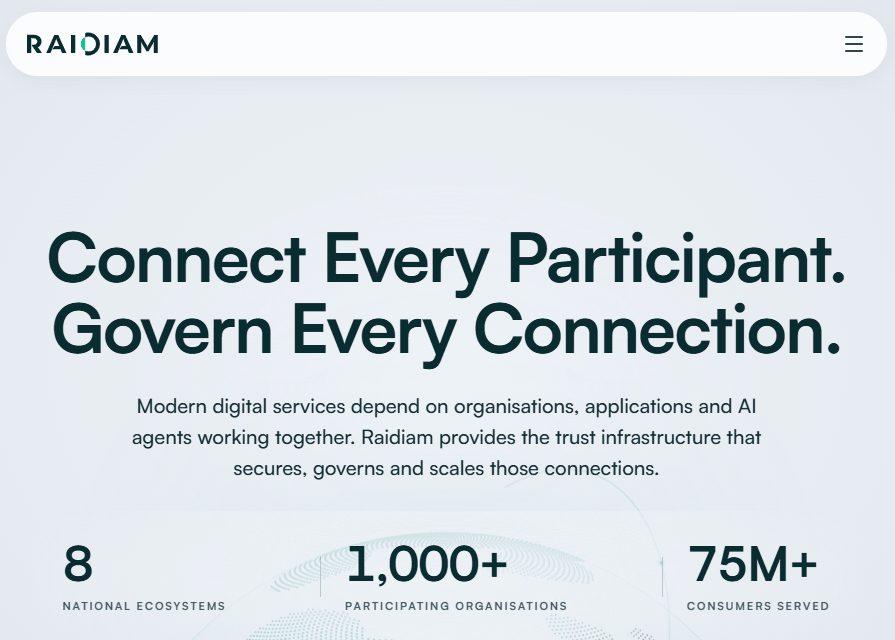
Raidiam Connect is a standards-based trust and directory platform for regulated and large-scale data-sharing ecosystems, delivered as a managed service. It provides the registry, discovery, and governance layer that lets organizations and AI agents connect under policy rather than under bilateral agreements.
Best for: National open banking or open finance programs, regulated data spaces, and cross-organization trust frameworks in finance, energy, identity, and government.
Key features:
- Federated directory of accredited organizations, software clients, and APIs, with role-based metadata and discoverability
- Embedded PKI with credential lifecycle management covering automated issuance, rotation, and revocation
- OpenID Federation support in both trust anchor and intermediate models, letting one authority govern an ecosystem or delegate scopes
- Conformance to FAPI and PKI best practices, with integration into API gateways and authorization servers for end-to-end access control
- Real-time ability to suspend or revoke a participant centrally when a risk emerges
Why we like it: This is the layer almost everyone underestimates. Connect underpins Open Banking UK and Open Finance Brasil, and the vendor reports use across more than 1,000 financial institutions globally handling billions of API calls per month. That precedent matters more than any feature list, because regulators and central banks buy trust infrastructure on evidence of prior national-scale operation. In March 2026 Raidiam also signed on to the OpenID Foundation's independent conformance test program, launching in Q2 2026, which is a meaningful signal for anyone betting on verifiable credentials.
Limitations:
- Public end-user reviews are scarce, so evaluation depends on reference calls and published program documentation rather than peer ratings
- Adoption requires formal governance and compliance workstreams, which means legal and policy effort alongside the technical build
- Fit is strongest in regulated verticals; this is not a general-purpose iPaaS and will not solve ordinary app-to-app integration
- Published ecosystem scale figures vary across the vendor's own pages, so pin down current numbers during due diligence
Pricing: Not publicly available. Delivered as an out-of-the-box managed service, priced per engagement. Contact Raidiam for a quote.
2. EcosystemOS
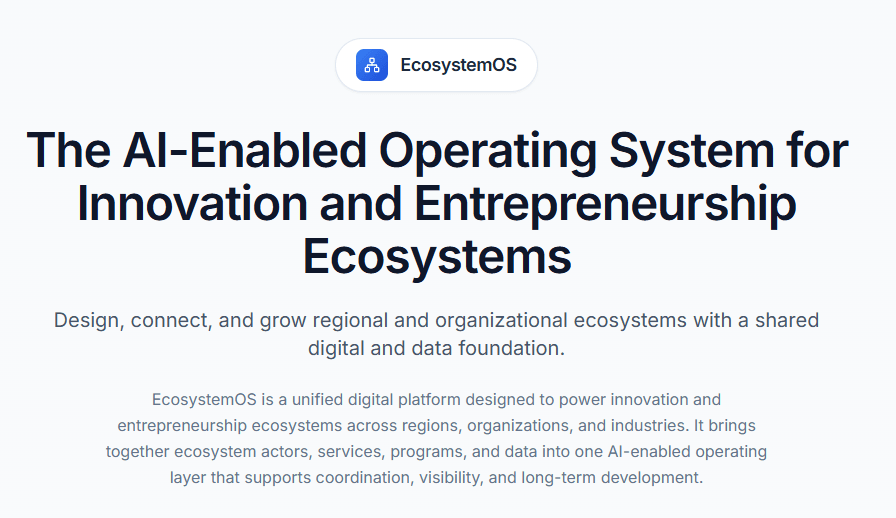
EcosystemOS is an integrated digital ecosystem platform from Startup Commons, designed to enable data flow within and across applications for organizations that coordinate innovation ecosystems. It targets economic development leaders and the operational units responsible for moving data between startups, investors, and other stakeholders.
Best for: Economic development agencies, accelerators, universities, and public-private partnerships coordinating startup or regional innovation ecosystems.
Key features:
- Common data model and shared repository for ecosystem data across organizations
- Stakeholder and program management for accelerators, cohorts, and support providers
- Analytics and reporting across ecosystem nodes for program-level and ecosystem-level KPIs
- Serverless service architecture with an application marketplace for connected apps built by third-party developers
- Integration hooks to connect tools that ecosystem participants already run
Why we like it: Ecosystem coordination is a genuinely different problem from company workflow, and almost nothing is built for it. When success depends on an accelerator, a university, and a municipal agency agreeing on what counts as a tracked company, a shared data model does more work than another CRM. Startup Commons brings real domain grounding here, having advised more than 30 national and local governments on ecosystem development.
Limitations:
- Limited independent reviews in major software directories, so there is little third-party validation to lean on
- Enterprise security, SSO, and compliance details are not well documented publicly
- Deployments typically require consulting and data-model alignment work rather than self-serve onboarding
- The platform is closely tied to Startup Commons' broader consulting and training business, so evaluate the software and the services engagement together
Pricing: Not publicly available. Contact Startup Commons for a custom quote.
3. Boost.space
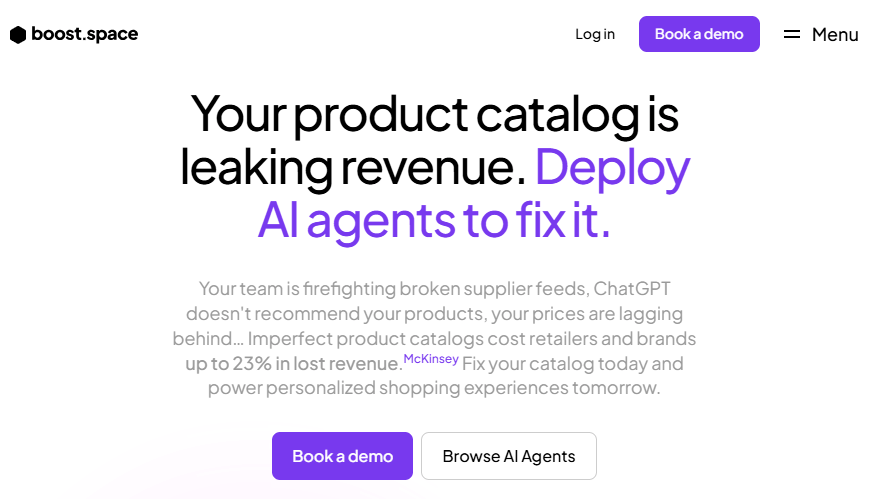
Boost.space is a no-code unified data layer that consolidates fragmented SaaS data into a single source of truth, then exposes it to AI agents and automations. The company now positions it as an AI memory layer: an active, read-write data foundation rather than a passive warehouse.
Best for: Mid-market and enterprise teams that need bi-directional sync across a large app estate and a central data grid to feed AI, analytics, and workflows.
Key features:
- Bi-directional synchronization across more than 2,400 apps, powered by the Make.com integration engine
- Persistent data grid acting as a single source of truth, with granular data mapping and error handling
- MCP connectivity so Claude, OpenAI, Gemini, and Mistral models can query the unified data directly
- Runs alongside Make, n8n, Zapier, and Workato rather than replacing them, plus REST APIs, SDKs, and a sandbox
- Six ready-made AI agents for product catalog operations, in production with customers including Decathlon and Stada Pharma
Why we like it: When AI agents hallucinate because the data layer is a mess, this is the substrate that fixes it. The read-write distinction is the important one: agents can act on the data and write results back into source systems, which is what separates a useful agent from a chatbot with a database attached. Reviewers consistently rate the integration breadth and the single-source-of-truth model highly.
Limitations:
- Steep learning curve and complex setup are the most frequently cited drawbacks in reviews, with onboarding time scaling with data volume and integration count
- Because the automation engine is Make-based, some plans require your own Make API key, which creates two separate bills to track
- Credit consumption can climb sharply on complex automations, pushing teams to higher tiers sooner than budgeted
- Published pricing differs across third-party trackers and promotional campaigns, so verify current rates on the vendor's own page
Pricing: Self-serve tiers with a free option, plus custom enterprise pricing. Third-party trackers place entry pricing somewhere between roughly $39 and $59 per month depending on billing terms and when the snapshot was taken, so treat those as a starting range rather than a quote.
4. eXo Platform
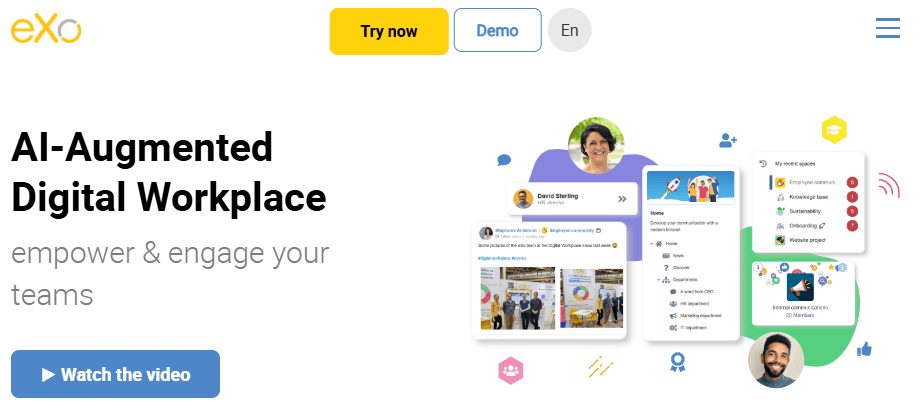
eXo Platform is an open-source digital workplace that unifies collaboration, communication, and knowledge management in one stack. The French vendor has been building it for over 20 years, and reports more than a million employees using it worldwide.
Best for: Organizations that want an open-source digital workplace with private cloud or on-premise control, plus extensibility for internal apps and AI.
Key features:
- Enterprise social networking, shared spaces, document and knowledge management, chat, tasks, and intranet publishing in one platform
- Version 7.2, released mid-2026, natively integrates multi-model AI across the workplace, extending AI to on-premise deployments rather than cloud editions only
- Modern technical base including JDK 21, Tomcat 10, Spring 6, Spring Boot 3, Elasticsearch, and OnlyOffice document editing
- Matrix-powered chat, branded PWA for mobile and desktop, and no-code configuration for administrators
- Free Community Edition on the same technical base as the commercial editions
Why we like it: It addresses the "where does knowledge live" problem, and it can run fully on-premise, which matters for regulated or air-gapped teams. The digital sovereignty positioning is not marketing filler in 2026: European public bodies and regulated firms are actively looking for alternatives they can host and audit themselves, and eXo is one of the few platforms in this category offering that with AI included rather than bolted on through a third-party cloud.
Limitations:
- Reviewers note that self-configuration is difficult without vendor support, and higher-end plans can be costly
- AI capabilities arrived first in the cloud and Enterprise editions, with on-premise support following in 7.2, so verify which features your intended deployment actually gets
- Enterprise pricing is not listed on major directories, requiring a quote
- The breadth is a double-edged sword; teams that only need an intranet will be configuring around features they do not want
Pricing: Community Edition is free and open source. Enterprise and hosted editions are quote based, with pricing not published on major directories.
Capability Comparison
| Platform | Core function | Governance model | AI and agent access |
|---|---|---|---|
| Raidiam Connect | Trust anchor, directory, credential lifecycle | Roles, permissions, real-time revocation across orgs | Governs which agents and software may participate |
| EcosystemOS | Common data repository and program operations | Data-model alignment across participating orgs | Not publicly documented |
| Boost.space | Bi-directional sync and unified data grid | Data mapping, error handling, access by workspace | Native MCP access for major model providers |
| eXo Platform | Collaboration, knowledge, and intranet surface | Enterprise user and permission management | Native multi-model AI from version 7.2 |
Deployment Options
| Platform | Cloud | Self-hosted or on-premise | Integration effort |
|---|---|---|---|
| Raidiam Connect | Yes, managed service | Not publicly documented | Varies with governance scope |
| EcosystemOS | Yes, serverless architecture | Not publicly documented | Varies with data-model alignment |
| Boost.space | Yes | Not publicly documented | Varies with number of connected systems |
| eXo Platform | Yes, including eXo Hubs | Yes, including on-premise and private cloud | Varies with customization depth |
Strategic Decision Framework
| Critical question | Why it matters | What to evaluate | Red flags |
|---|---|---|---|
| Do you need a governed trust layer or basic integration? | Regulated ecosystems need registry, discovery, and policy enforcement, not just data pipes | Federation models, PKI support, policy and audit trails | No registry or participant governance features |
| How many systems must sync bi-directionally? | High-volume two-way sync changes both architecture and cost | Connector coverage, conflict resolution, volume limits | One-way sync only, manual conflict handling |
| Must teams self-host for compliance or sovereignty? | Some sectors require on-premise or air-gapped operation | Deployment models, container support, where AI inference runs | Cloud-only with no private option |
| Will AI agents query live organizational knowledge? | Half of AI agents currently run in isolation from the rest of the stack | Agent-accessible interfaces such as MCP, access control, retrieval patterns | Knowledge trapped in chat and files without structure |
| Can you exit without rebuilding? | Ecosystem platforms accumulate governance state that is painful to migrate | Data export, open standards, licensing terms | Proprietary trust or data models with no documented export path |
Problems & Solutions
-
Problem: "We need cross-organization trust and controlled API discovery for open banking style data sharing."
Solution: Use a trust framework with a directory and policy governance rather than negotiating bilateral integrations. Raidiam Connect operates exactly this pattern at national scale, running the directory behind Open Banking UK and Open Finance Brasil, where accreditation, certificate governance, and interoperability are centralized so data exchange stays decentralized. The model is now well enough established that regulators in new markets increasingly specify it rather than invent one. -
Problem: "AI pilots stall because data is siloed across SaaS, APIs, and teams."
Solution: Consolidate into a single bi-directional data layer before you buy more agents. This is the majority experience, not an edge case: MuleSoft's 2026 research found 82 percent of IT leaders citing data integration among their biggest AI challenges. Boost.space unifies data across a large connector estate and exposes it to models through MCP, so agents read consistent, current data and write results back rather than operating on a stale snapshot. -
Problem: "Distributed teams cannot find the right process or page, so knowledge never reaches AI or new joiners."
Solution: Deploy a digital workplace that combines intranet, collaboration, and knowledge management in one place, with AI that can search across all of it. eXo Platform does this in an open-source stack you can host yourself, which keeps both the knowledge and the AI inference inside your boundary. That combination is the practical answer for organizations that cannot send internal documentation to a third-party cloud. -
Problem: "Regional innovation leaders need a shared operating layer across accelerators, universities, and partners."
Solution: An ecosystem operating system with a common data model and stakeholder management aligns programs and reporting across organizations that do not share an IT department. EcosystemOS is built for that specific coordination problem, and paired with an integration layer and a workplace surface it gives an ecosystem a workable foundation for shared KPIs and services. -
Problem: "We built the integrations, but nobody can tell which partner is allowed to call what."
Solution: This is a governance gap, not an integration gap, and it is the failure mode that turns a working pilot into an audit finding. A trust layer with role-based metadata and central revocation answers it directly. If your ecosystem is internal rather than regulated, the equivalent discipline is enforcing access control at the data layer instead of inside each individual sync.
The Bottom Line
There is no single digital ecosystem platform, and treating these four as competitors is the fastest way to buy the wrong one. They occupy different layers, and most real programs need more than one.
Start from your binding constraint. If you operate in a regulated, multi-stakeholder environment, the trust and directory layer comes first, because everything else you build without it will need reworking once a regulator asks who authorized which participant.
If your problem is fragmentation rather than governance, lead with the unified data layer and add a workplace surface so humans and agents can act on what it holds. If your challenge is coordinating independent organizations toward shared outcomes, an ecosystem operating layer is the piece nothing else replaces.
With half of AI agents still running in isolation and integration cited as the top barrier to AI value, the organizations that get ahead in 2026 will be the ones that fixed the substrate before buying more agents. Use the framework above to find your governance gaps before they become program-level blockers.