

Most teams discover their dock schedule breaks when a carrier shows up early and three others are already at the gate, not from a demo or an RFP. From our experience in the startup ecosystem, the fastest wins come from three moves: enforcing time slot rules by equipment type, giving carriers self service portals, and wiring appointment data into your TMS or WMS in real time. The push toward automation is accelerating, with Gartner predicting that half of new warehouses in developed markets will be human-optional by 2030, a shift that raises the bar for digital scheduling and yard visibility.
The short list below focuses on platforms that repeatedly delivered measurable results in third-party reviews. Expect to learn which tools fit small sites versus multi-facility networks, how pricing compares, and what real users flag as limitations, backed by sources like G2, Forrester, and Trimble documentation.
GoRamp
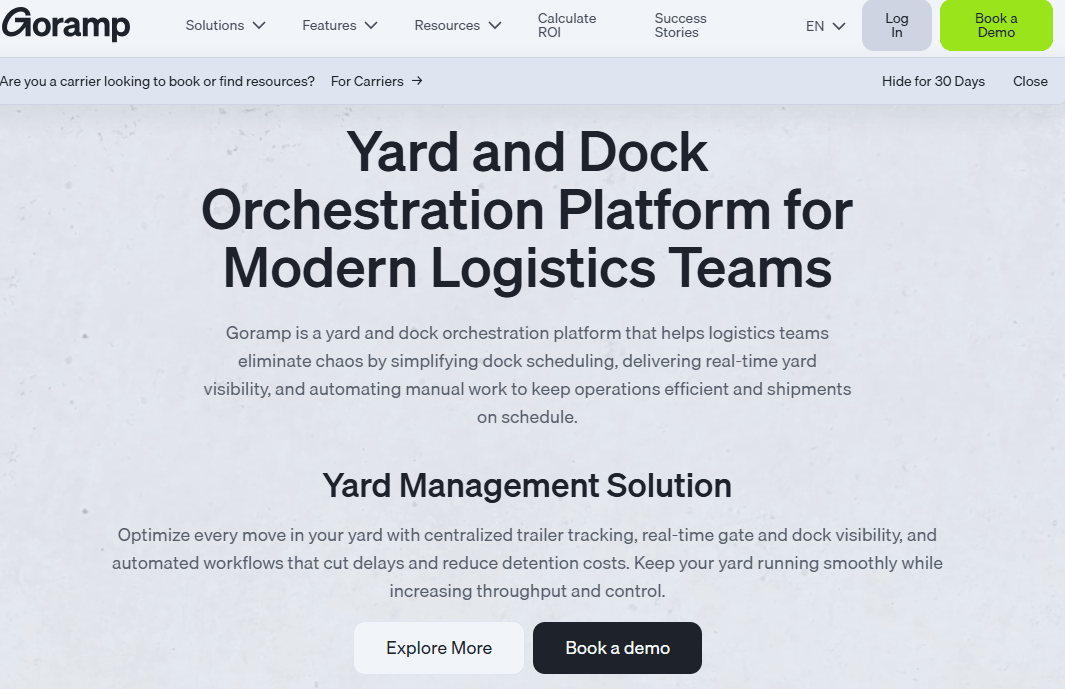
Cloud based dock scheduling and yard orchestration focused on automated time slotting, carrier self booking, and real time yard visibility. According to vendor documentation, it offers API or EDI connectivity to WMS, TMS, and ERP.
Best for: Mid sized warehouses and 3PLs that want quick time slot control and a carrier portal without a long IT project.
Key Features:
- Time slot management with carrier self service booking
- Real time yard and dock views, plus performance dashboards
- Two way integrations with WMS or TMS, per vendor documentation
- Reviewers cite fewer emails and calls once portals are live, as noted in G2 reviews
Why we like it: Teams often report rapid adoption and tangible reduction in manual coordination in G2 feedback, which maps to faster detention dispute resolution and cleaner dock calendars.
Notable Limitations:
- Some users want more flexible scheduling and personalization
- One review notes the desire for native iOS or Android apps at the time of writing
- A few features may take longer to implement, according to reviewers
Pricing: Starting at $249 per month, per the G2 pricing card.
Velostics
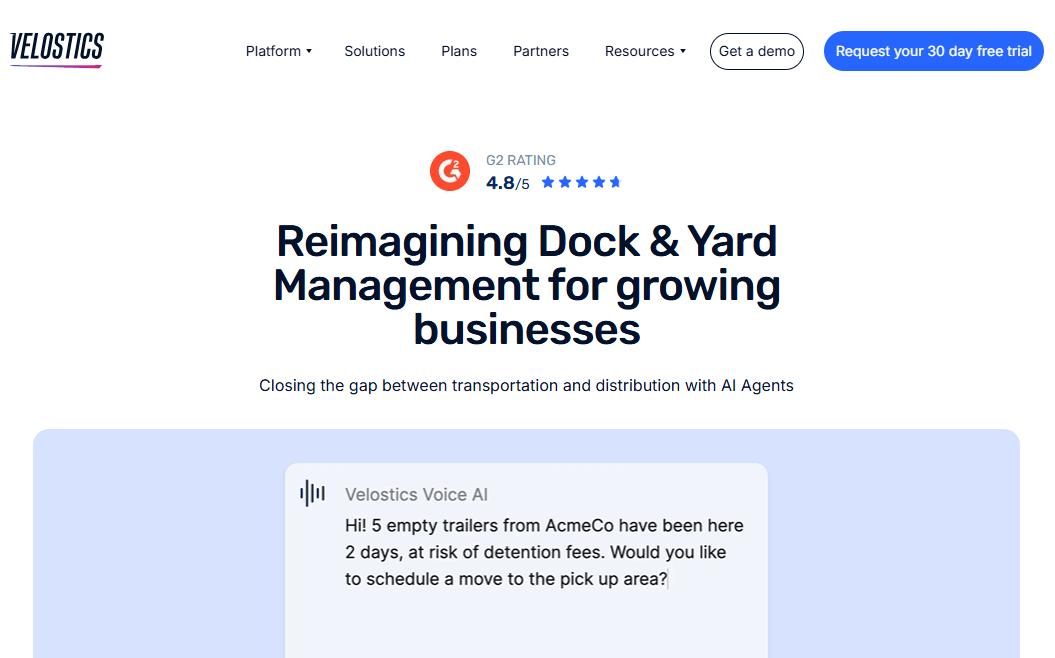
AI powered yard and dock scheduling built for modern logistics operations, with rapid deployment and voice AI options for appointment workflows. The platform emphasizes WMS and TMS integrations and contactless driver check in.
Best for: Manufacturers and 3PLs running multi site networks that want AI assisted scheduling and fast time to value.
Key Features:
- Appointment scheduling with AI aided dock assignments, as described in the G2 overview
- Drop and hook scheduling, contactless check in, and scorecards
- Integrations with major TMS and WMS suites cited by users
Why we like it: Reviews consistently mention straightforward onboarding and the ability to turn on features as needs grow, which reduces IT lift while improving throughput.
Notable Limitations:
- Some fixed workflows require SOP workarounds, per users
- One reviewer notes friction moving appointments across buildings without cancel and reschedule steps
Pricing: Starting at $4,500 per year, per the G2 pricing card.
DataDocks
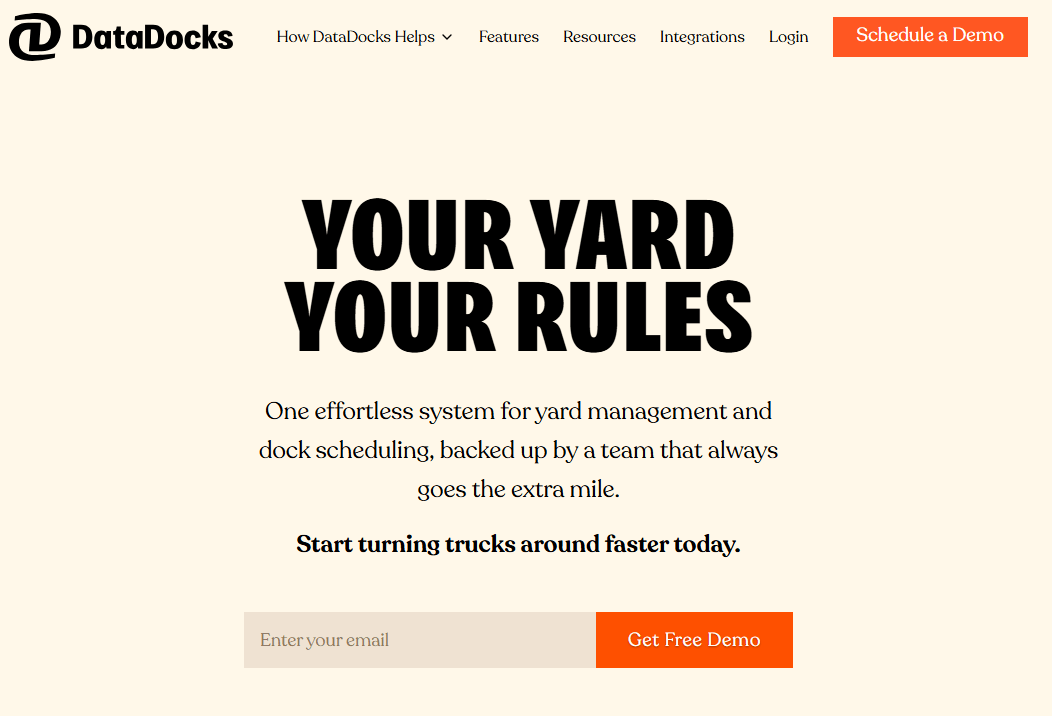
Modern dock scheduling and yard management with online carrier booking, live check in and check out tracking, and analytics. Reviews highlight ease of use and helpful support for small and mid sized teams.
Best for: Facilities that need self service booking, real time appointment tracking, and practical analytics without enterprise complexity.
Key Features:
- Online scheduling with customer or carrier access, as noted on G2
- Live status, check in tracking, and rule based scheduling
- Configurable workflows and reporting, plus API availability per vendor documentation
Why we like it: Buyers call out quick setup, strong support, and control over rules, along with one appointment per dock protections that cut double booking risk.
Notable Limitations:
- One review cites limited depth of API integrations versus expectations
- Smaller public review footprint than some incumbents, though Capterra shows growing activity
Pricing: Pricing not publicly available on G2 at the time of review. Contact DataDocks for a custom quote.
Dock Scheduling Tools Comparison: Quick Overview
| Tool | Best For | Pricing Model | Highlights |
|---|---|---|---|
| GoRamp | Mid sized warehouses and 3PLs | Subscription | Time slot rules, carrier portal, yard visibility, strong G2 feedback |
| Velostics | Multi site manufacturers and 3PLs | Subscription | AI assisted scheduling, contactless check in, fast onboarding per reviews |
| DataDocks | SMB to mid market facilities | Subscription | Online booking, live status, rules and analytics cited by users |
Dock Scheduling Platform Comparison: Key Features at a Glance
| Tool | Self Service Booking | Real Time Dock/Yard View | Noted Integrations/APIs |
|---|---|---|---|
| GoRamp | Yes, per reviews | Yes | API or EDI to WMS/TMS per vendor documentation and Gartner Peer Insights |
| Velostics | Yes | Yes | Integrates with major TMS and WMS suites per G2 overview |
| DataDocks | Yes | Yes | API available per vendor documentation, reviews mention integration scope |
Dock Scheduling Deployment Options
| Tool | Cloud API | On-Premise | Integration Complexity |
|---|---|---|---|
| GoRamp | Yes | No public offer | Typical WMS or TMS API or EDI patterns, per vendor documentation and public help center |
| Velostics | Yes | No public offer | Reviews describe straightforward onboarding and integrations |
| DataDocks | Yes | No public offer | API available per vendor documentation, one review flags depth limits |
Dock Scheduling Strategic Decision Framework
| Critical Question | Why It Matters | What to Evaluate |
|---|---|---|
| Do carriers actually self book, or does staff still call and email? | Real savings come from shifting booking work to carriers | Look for live portals and user feedback about reduced calls |
| Can your tool reflect dwell and detention risks? | Detention has safety and cost impacts, as FMCSA research shows | Color coded rules, arrival SLAs, scorecards |
| How well does it plug into WMS or TMS? | Siloed scheduling undermines labor planning and shipping | Proven API or EDI patterns and references |
| What is the go live path? | Faster rollouts cut soft costs | Customer quotes about onboarding speed |
| Is multi site governance supported? | Standard rules reduce chaos across sites | Per facility rules, reporting, and controls |
Dock Scheduling Solutions Comparison: Pricing and Capabilities Overview
| Organization Size | Recommended Setup | Monthly Cost |
|---|---|---|
| Small facility, 1-2 docks | Pilot GoRamp entry plan to validate process changes | From $249, based on G2 pricing for GoRamp entry |
| Mid market, 3-15 docks | GoRamp or DataDocks with carrier portals and analytics; pilot integrations to WMS/TMS | From low hundreds; exact DataDocks pricing not public |
| Multi site, 15+ docks | Velostics across facilities with AI scheduling and contactless check in, staged rollout | From approximately $375 per month equivalent at $4,500 per year entry |
Problems & Solutions
Problem: Detention and dwell times drive cost and safety risk. FMCSA research found drivers experienced detention on roughly 1 in 10 stops with 1.4 hours beyond the two hour window, and later updates continue to track detention's operational impact.
Solution: How GoRamp helps - Time slot rules and carrier self booking reduce bunching and late arrivals, with reviewers reporting fewer calls and clearer schedules.
Solution: How Velostics helps - Contactless gate check in and AI based dock assignment target lower dwell, with users citing throughput gains after fast onboarding.
Solution: How DataDocks helps - Live check in and one appointment per dock protections curb double booking and idle time, per user reviews.
Problem: Endless emails and calls to make appointments. Case studies and reviews show that moving to online booking portals reduces manual back and forth and centralizes the calendar, as the Loadsmart Opendock case example demonstrates.
Solution: GoRamp, Velostics, and DataDocks all support carrier self service booking, repeatedly cited by users as a driver of fewer emails and calls.
Problem: Limited yard and dock visibility makes labor planning guesswork. Analyst notes point to rapid automation and the need for live operational data to orchestrate resources.
Solution: How GoRamp and Velostics help - Real time yard maps and dock status are central capabilities in third party overviews.
Solution: How DataDocks helps - Reviews highlight live status tracking and rules that prevent overlapping appointments.
Bottom Line: Pick Scheduling That Matches Your Dock Reality
You do not need a giant YMS to fix appointment chaos. If you are mid market, GoRamp and DataDocks bring carrier self booking, rules, and analytics that reduce dwell and calls, with clear third party feedback on outcomes. Multi site operations that want AI assisted workflows and contactless gate flows should look at Velostics' rapid deployment profile and reported throughput improvements in reviews. All of this is happening as warehouses trend toward higher automation, which makes accurate dock calendars and live yard data a foundation for labor and robot orchestration, not a nice to have.