Most teams discover their developer experience gaps during an incident postmortem, not from quarterly planning. Working across different tech companies, we have seen platform teams stall on simple tasks like golden path scaffolding with Terraform modules, enforcing SLO scorecards across services, and wiring on-call ownership into incident workflows. You think you know your estate until a 2 a.m. outage forces you to ask who owns a hot path API, where the runbook lives, and whether the last deployment met production readiness checks. From our experience in the startup ecosystem, the right Internal Developer Portal pays for itself by reducing cognitive load and standardizing delivery.
Gartner projects that by 2026, 80 percent of software engineering organizations will establish platform teams to provide reusable services and tools, a clear signal that IDPs will be table stakes for most engineering groups (Gartner newsroom press release, Nov 28, 2023). In this guide you will learn when each option fits, what to watch out for, and how to avoid hidden costs and failed rollouts backed by third-party sources.
Cortex
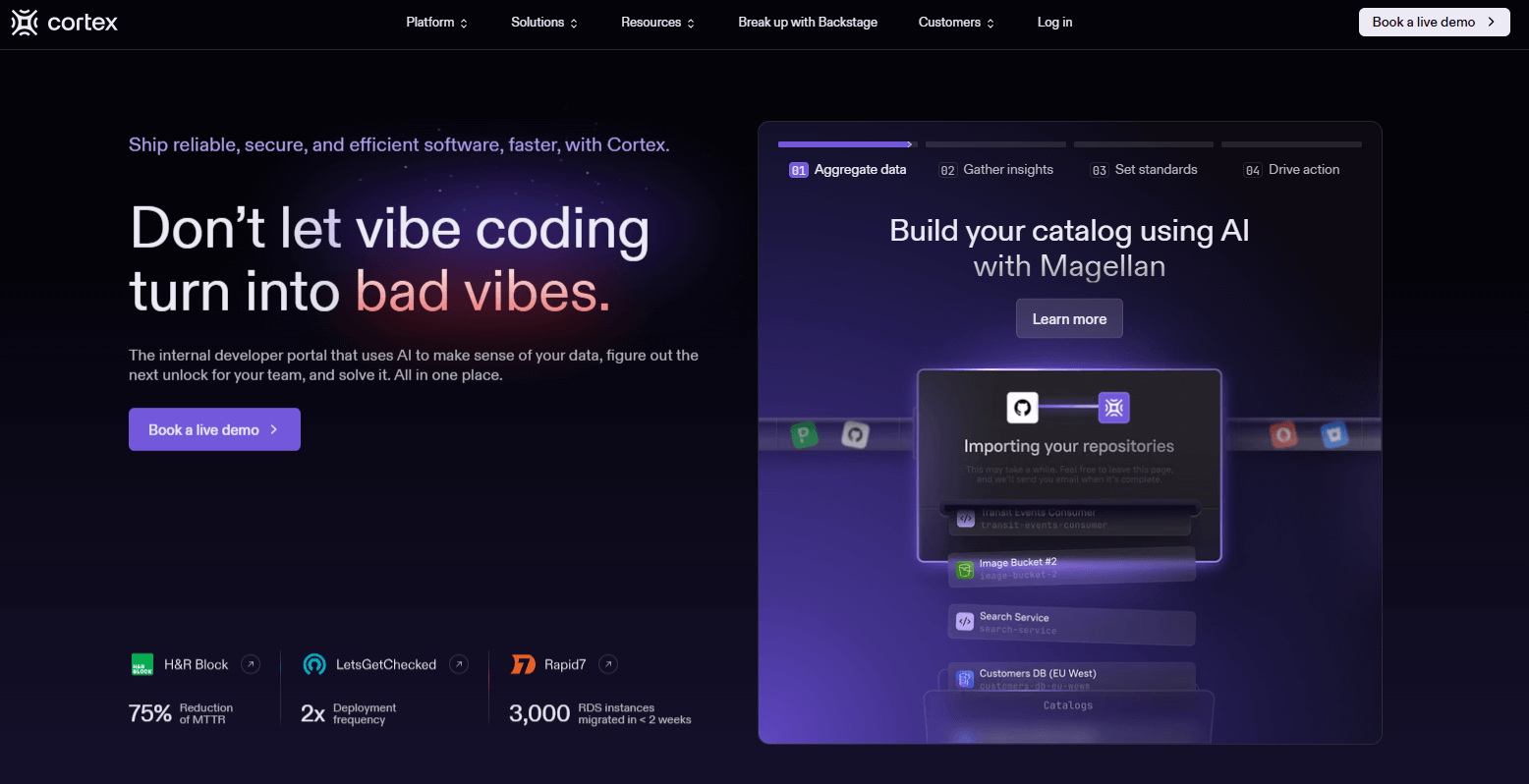
AI-powered internal developer portal focused on service and resource catalogs, engineering scorecards, and self-service workflows.
Emphasis on insights that reveal gaps in ownership, production readiness, and team maturity, plus guardrails and automation to fix them.
Best for: Platform teams that want an opinionated IDP with strong scorecards, automation workflows, and reporting without adopting Backstage.
Key Features:
- Service and resource catalogs with ownership and dependency mapping, per vendor documentation.
- Scorecards and Initiatives to codify standards like production readiness, SLOs, and security checks, per vendor documentation and confirmed by independent coverage that highlights "scorecards" and "scaffolding service" in Cortex's product scope (TechCrunch coverage of Cortex's Series B).
- Scaffolding and actions for golden paths and repeatable service creation, referenced in the same report.
- Broad third-party integrations to pull operational data into the portal, cited in funding news (Business Wire).
Why we like it: After helping startups scale, we have seen Cortex reduce the need for spreadsheet scorecards and ad-hoc standards checks by moving them into a governed system with measurable outcomes and nudges.
Notable Limitations:
- Fewer public peer reviews than incumbents, which can make third-party validation harder for enterprise buyers (Gartner Peer Insights vendor profile).
- As a proprietary IDP, extensibility and portability are inherently more limited than open source frameworks, and vendor lock-in risk should be weighed, a general caution raised in independent analyses of proprietary portals vs Backstage (The New Stack, "Is Open Source Enough?").
- Some competitor analyses point to learning curve and data model rigidity in parts of the ecosystem, so teams should run a proof of value with real scorecards and workflows before committing (third-party comparison article).
Pricing: Pricing not publicly available. Available via private offers and contracts, including marketplace procurement paths, which note contract-based pricing terms (AWS Marketplace listing summary). Contact Cortex for a custom quote.
Roadie
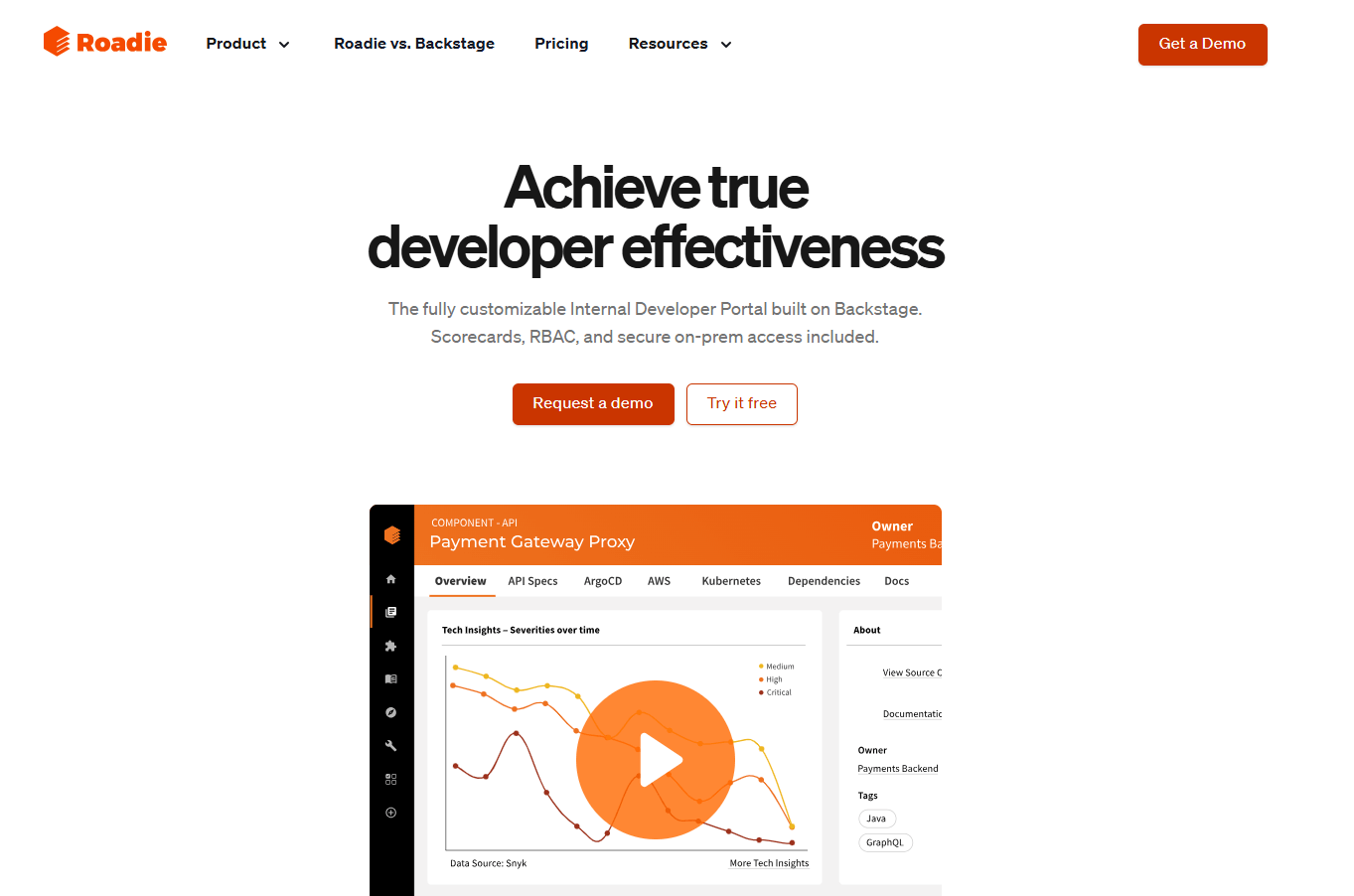
Managed internal developer portal built on Backstage.
Delivers the Backstage catalog, templates, plugin ecosystem, RBAC, and optional scorecards, without the self-hosting overhead.
Best for: Teams that want Backstage's ecosystem and plugin breadth but prefer a managed service that handles upgrades, plugins, and guardrails.
Key Features:
- Backstage service catalog with docs and API specs, plus curated plugin support, per vendor documentation.
- Software templates for golden paths and consistent service creation, per vendor documentation.
- Optional scorecards add maturity and standards tracking on top of Backstage, validated by a GA announcement that details how Roadie's "Tech Insights" implements scorecards and checks (PRWeb announcement).
- Managed upgrades and support to reduce maintenance burden typical of self-hosted Backstage, a pain called out in independent analyses (The New Stack on hidden costs).
Why we like it: Working across different tech companies, the teams that struggled with DIY Backstage often lacked React and plugin maintenance capacity. Roadie removes that tax so platform engineers can focus on patterns, scorecards, and onboarding.
Notable Limitations:
- Deep customization still follows Backstage's plugin model, which can require React skills and create maintenance overhead, a known trade-off highlighted by independent sources (The New Stack, Red Hat on Backstage plugin complexity).
- Catalog freshness and plugin quality vary across the community when self-hosted. Managed services mitigate this, but success still depends on process and adoption, a recurring theme in industry commentary.
Pricing: Published entry tier lists per-developer pricing starting around $20-22 per developer per month as of February 2026. Verify current pricing and seat thresholds directly with Roadie. If you require a formal quote, contact the vendor.
Datadog Internal Developer Portal
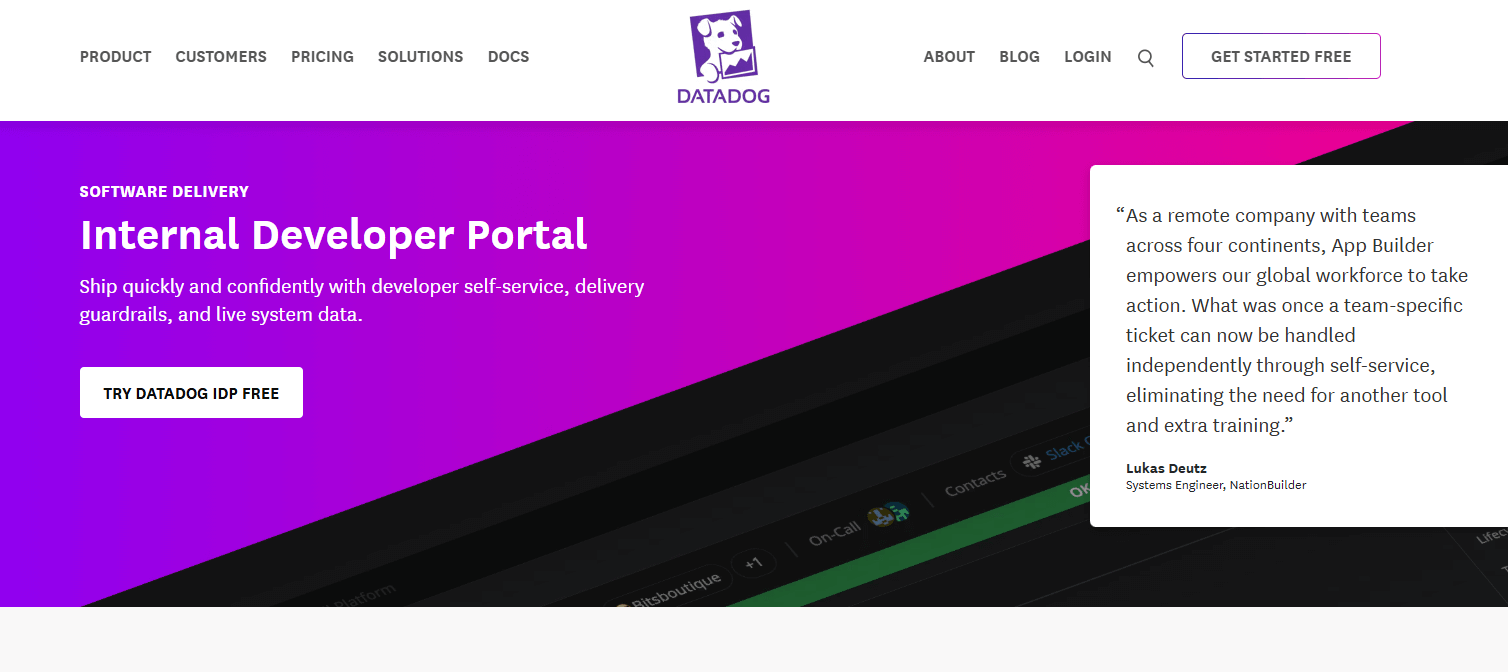
Datadog's IDP integrates a software catalog with live observability data, self-service actions, and scorecards inside the Datadog platform.
Ideal for orgs already standardized on Datadog APM, logs, and workflows that want a portal backed by real-time telemetry.
Best for: Engineering leaders already using Datadog who want a portal tied to production signals, scorecards, and workflow automation.
Key Features:
- Software catalog built on live telemetry, which automatically maps services and dependencies and surfaces owners, on-call, and runbooks (Nasdaq press release syndication).
- Self-service actions to scaffold services, provision resources, or trigger remediation with pre-approved templates (KBI.Media coverage).
- Scorecards to track reliability, security, observability, cost, and other standards across services and teams (Investing.com coverage).
Why we like it: If Datadog is already your observability backbone, the ability to gate self-service with live production standards, plus a catalog that never goes stale, shortens time to value.
Notable Limitations:
- Pricing complexity and cost escalation are frequently cited concerns in public reviews of the broader Datadog platform, especially as log volume and custom metrics grow (G2 review summary, independent pricing analysis).
- Best fit is for customers committed to Datadog's stack, since the IDP's strengths depend on native telemetry and workflows, per launch coverage.
Pricing: Pricing for the IDP product is not publicly listed. Contact Datadog for a custom quote. General Datadog pricing exists for other modules, but IDP is not broken out on public third-party price sheets (G2 pricing overview).
Platform Engineering & IDP Tools Comparison: Quick Overview
| Tool | Best For | Pricing Model | Highlights |
|---|---|---|---|
| Cortex | Opinionated IDP with scorecards and workflows | SaaS, contract based | Strong scorecards and initiatives, broad integrations, automation focus |
| Roadie | Managed Backstage without self-hosting burden | SaaS per developer | Backstage catalog, templates, curated plugins, optional scorecards |
| Datadog IDP | Datadog customers wanting live-data catalog and guardrails | Datadog platform add-on | Live telemetry catalog, self-service actions, scorecards |
Platform Engineering & IDP Platform Comparison: Key Features at a Glance
| Tool | Catalog | Scorecards | Self-Service |
|---|---|---|---|
| Cortex | Yes | Yes | Yes |
| Roadie | Yes | Optional add-on | Yes, via Backstage templates |
| Datadog IDP | Yes, live data | Yes | Yes |
Platform Engineering & IDP Deployment Options
| Tool | Cloud API | On-Premise | Integration Complexity |
|---|---|---|---|
| Cortex | Yes | Not publicly documented | Medium, depends on integrations, run a proof with scorecards and workflows |
| Roadie | Yes | Managed SaaS, supports secure connections to on-prem systems | Medium, reduced vs DIY Backstage, plugin depth still matters |
| Datadog IDP | Yes | No, SaaS | Low to medium if already on Datadog, adoption tied to Datadog modules |
Platform Engineering & IDP Strategic Decision Framework
| Critical Question | Why It Matters | What to Evaluate | Red Flags |
|---|---|---|---|
| Are we already standardized on Datadog? | Live telemetry simplifies catalog freshness and guardrails | Coverage of APM, logs, on-call, workflow automation | Parallel tools that duplicate Datadog raise cost and complexity |
| Do we have React and plugin skills in-house? | Backstage customization often needs frontend work | Team capacity, maintenance plan, upgrade cadence | DIY Backstage without dedicated ownership leads to stale portals |
| Is vendor lock-in acceptable for our IDP layer? | Portability and extensibility differ by platform | Data model portability, open APIs, exit plan | Proprietary models without export paths or open plugins limit future choices |
| Can scorecards drive measurable change here? | Standards fail without measurement and nudges | OOTB checks, integration coverage, initiative tracking | Static dashboards with manual upkeep lose trust quickly |
Platform Engineering & IDP Solutions Comparison: Pricing & Capabilities Overview
| Organization Size | Recommended Setup | Monthly Cost | Annual Investment |
|---|---|---|---|
| 50 developers | Roadie Teams to avoid DIY Backstage overhead | Estimate $20-22 per developer per month, confirm current rate directly with vendor | ~$12,000-$13,200, verify with vendor before committing |
| 100-500 developers | Cortex or Roadie, run a proof with 2-3 critical scorecards and one golden path | Custom, pricing not publicly listed for Cortex, Roadie has per-developer tiers with volume terms, confirm directly | Custom, contract based |
| 500+ developers on Datadog | Datadog IDP integrated with existing APM, logs, workflows | Custom, IDP price not publicly listed, expect platform contract negotiations | Custom, contract based |
Note: All pricing figures are estimates or vendor-published list structures as of February 2026, always request a formal quote.
Problems & Solutions
-
Problem: Stale catalogs erode trust and kill adoption.
- Why it happens: Manual YAML updates and fragmented plugins make portals drift quickly, especially with open source builds.
- How Datadog helps: Its catalog is backed by live telemetry, which continuously maps services, dependencies, and owners so entries do not go stale.
- How Roadie helps: Managed Backstage reduces the maintenance burden of self-hosting and upgrades that often break plugins, a known friction area for DIY Backstage.
- How Cortex helps: Cortex positions scorecards and workflows to reveal and close data and ownership gaps centrally, with third-party coverage citing catalog, scorecards, and scaffolding as core product pillars.
-
Problem: Standards exist on paper, not in production.
- Why it happens: Teams lack a measurable way to encode production readiness and security checks.
- How Datadog helps: Scorecards track compliance across reliability, security, observability, and cost, gating delivery where needed.
- How Roadie helps: Tech Insights adds scorecards to Backstage so teams can codify checks and nudge remediation at scale.
- How Cortex helps: Scorecards and Initiatives prescribe paths to improvement with dashboards leadership can use to track maturity, cited in independent news and funding briefs.
-
Problem: DIY Backstage rollouts stall due to plugin debt and slow upgrades.
- Why it happens: Each plugin adds dependency risk, conflicting versions, and rebuild friction, which slows time to production and adoption.
- How Roadie helps: Provides managed upgrades and a curated plugin set so platform teams can focus on templates and standards rather than frontend and plugin plumbing.
- Alternative fit: If your org is already on Datadog, the IDP consolidates catalog and guardrails without a separate plugin ecosystem to maintain.
-
Problem: Executive sponsors need proof that an IDP moves business metrics.
- Why it matters: Without ROI, platform engineering gets deprioritized.
- What to measure: Adoption of golden paths, production readiness pass rates, lead time for changes, and mean time to restore, all areas scorecards can quantify. Gartner's prediction on platform engineering mainstreaming underscores the need to measure impact as adoption grows.
Bottom Line
If you already live in Datadog, its IDP gives you a live, telemetry backed catalog and guardrails without another platform to run, which solves the most common catalog staleness failure mode. If you want Backstage's ecosystem but not the maintenance tax, Roadie is the pragmatic path, and you can add scorecards when you are ready. If you want an opinionated IDP that centers scorecards, automation, and maturity tracking, Cortex is worth a proof, backed by independent coverage of its catalogs, scorecards, and scaffolding. Start with one golden path and two production readiness scorecards, measure adoption monthly, and expand from there.