

Every enterprise shipping sensitive data to the cloud in 2026 confronts the same uncomfortable truth: encryption protects data at rest and in transit, but the moment computation begins, everything gets decrypted - and every decryption point is a breach surface. Fully homomorphic encryption eliminates that gap by enabling computation directly on encrypted data without ever exposing the plaintext. From our experience in the startup ecosystem, FHE has finally crossed the threshold from academic curiosity to production infrastructure, driven by post-quantum security mandates, AI model privacy requirements, and regulatory pressure from frameworks like GDPR, HIPAA, and the EU AI Act. The global homomorphic encryption market is valued at approximately $251 million in 2026 and is projected to grow at a CAGR of over 20% through 2035, with the BFSI sector alone representing close to 30% of adoption (360 Research Reports). By 2026, 88% of cybersecurity-focused companies are projected to expand homomorphic encryption deployments, signaling that encrypted computation is moving from niche cryptographic research into a commercially relevant security layer (Global Growth Insights).
Selection was guided by market validation, production readiness, and verified capabilities across the dimensions that matter for enterprise FHE adoption: scheme support, developer accessibility, performance benchmarks, and real-world deployment evidence. The article covers which platform fits which use case, what to expect on licensing and limitations, and how to navigate the tradeoffs between performance overhead and cryptographic guarantees, anchored by trusted sources like academic publications, vendor documentation, and industry reports (IEEE Spectrum, Microsoft Research, TechCrunch, Roots Analysis).
Zama
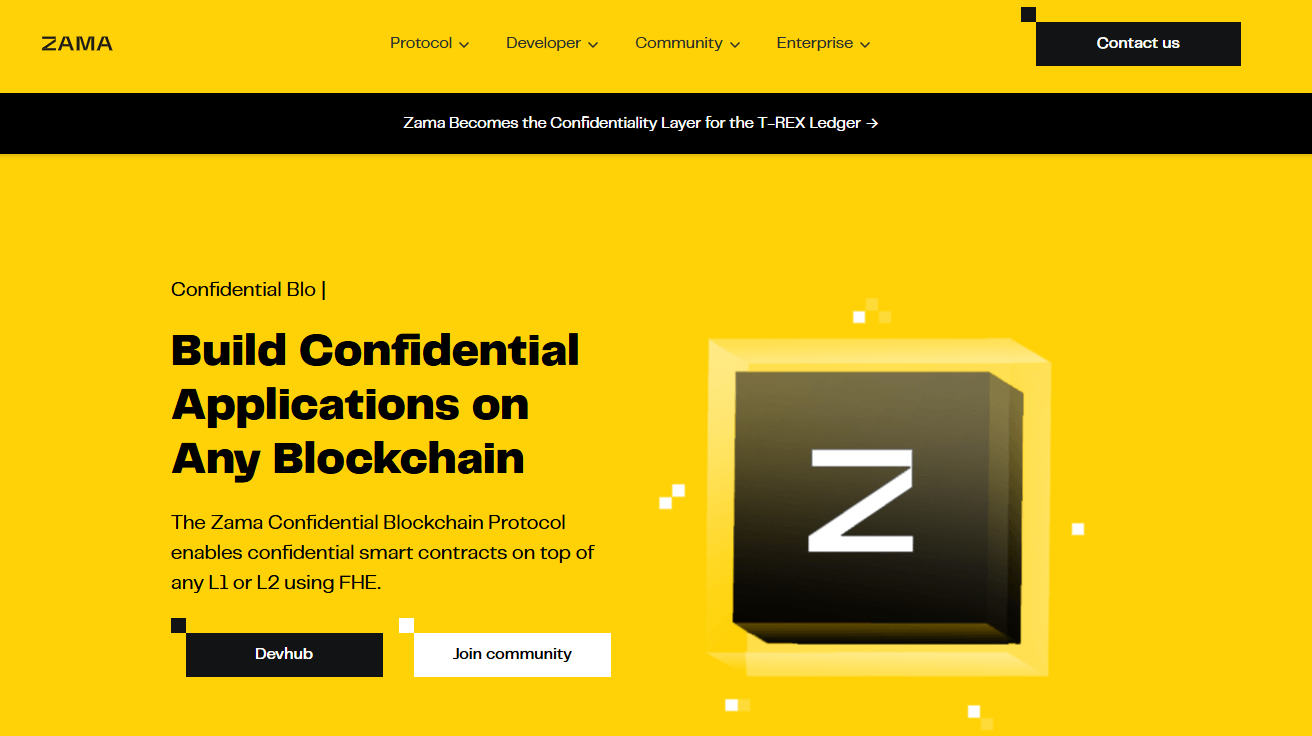
A full-stack FHE development platform that makes encrypted computation accessible to developers without cryptography expertise, offering a TFHE compiler, a machine learning framework for encrypted inference, and a confidential smart contract protocol for blockchain applications.
Zama has raised $130 million in total funding and became the world's first FHE unicorn in June 2025 after a $57 million Series B co-led by Pantera Capital and Blockchange Ventures at a valuation approaching $1 billion (MEXC blog). The company has assembled the world's largest FHE research team and has attracted over 5,000 developers to its open-source ecosystem, representing approximately 70% market share in blockchain FHE (BlockEden analysis). Since inception, Zama has improved the speed of its FHE scheme by a factor of 20x, with a roadmap targeting 100x and hardware-accelerated throughput of 500 to 1,000 TPS by end of 2026 via GPU migration.
Best for: Development teams building privacy-preserving AI, confidential blockchain applications, or encrypted SaaS products who need a full-stack FHE toolkit without requiring deep cryptography expertise.
Key Features:
- TFHE-rs, a pure Rust FHE library with GPU acceleration via CUDA and FPGA support through AMD Alveo hardware, supporting encrypted integers up to 256 bits with arithmetic, comparisons, and conditional branching (BlockEden analysis).
- Concrete compiler built on LLVM/MLIR infrastructure that transforms standard Python programs into FHE-equivalent circuits, making encrypted computation accessible to developers without cryptography PhDs (Zama master plan).
- Concrete ML for privacy-preserving machine learning inference on encrypted data, compatible with scikit-learn and PyTorch workflows, per vendor documentation (Whales Market Zama overview).
- fhEVM protocol for confidential smart contracts on EVM-compatible blockchains, with Fhenix and Inco both building on Zama's underlying technology (BlockEden analysis).
Why we like it: Zama is the only platform on this list that covers the entire FHE stack from low-level library to compiler to ML framework to blockchain protocol - and its position as infrastructure supplier to competing FHE blockchain projects means it captures value regardless of which protocol wins.
Notable Limitations:
- Commercial use of Zama's open-source code requires purchasing a separate patent license, which adds procurement complexity versus pure MIT or Apache-licensed alternatives (GitHub Zama Concrete).
- Current CPU-based throughput is estimated at 20 TPS, with GPU-accelerated targets of 500 to 1,000 TPS still on the roadmap for late 2026 - production-scale applications may need to wait for hardware acceleration (BlockEden analysis).
Pricing: Open source under BSD 3-Clause Clear license for development, research, and prototyping. Commercial use requires Zama's patent license. Contact hello@zama.ai for commercial pricing (GitHub Zama Concrete).
Microsoft SEAL
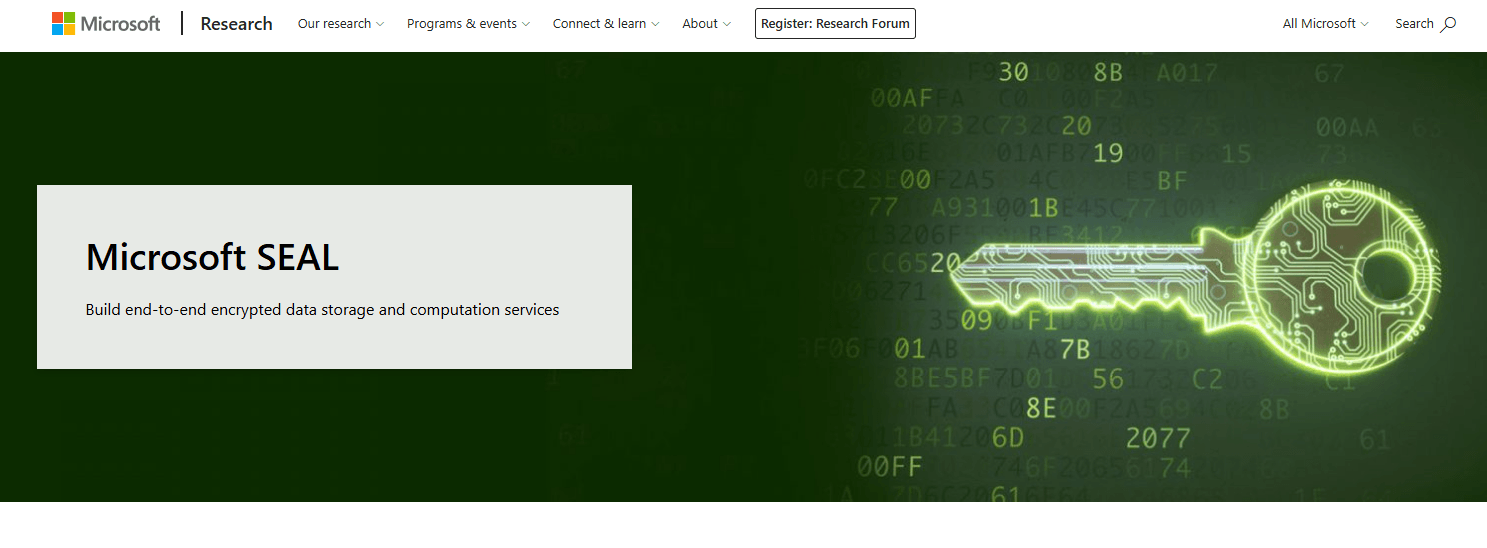
An open-source homomorphic encryption library developed by Microsoft Research that provides the foundational building blocks for computing on encrypted data, supporting multiple encryption schemes and powering production deployments across cloud, healthcare, and financial services.
Microsoft SEAL (Simple Encrypted Arithmetic Library) is developed by the Cryptography Research Group at Microsoft and is MIT-licensed, making it one of the most permissively licensed FHE libraries available. As of 2026, SEAL is at version 4.3 and integrates with Azure Machine Learning, supporting GPU acceleration for high-performance computing workloads (DasRoot technical analysis). The library has been adopted in production deployments including Intel's neural network compiler nGraph and across financial services where privacy-critical cloud computation is required (Microsoft Research). SEAL-Embedded extends the library to IoT and resource-constrained devices.
Best for: Software engineers and research teams who need a well-documented, permissively licensed FHE foundation for building custom encrypted computation applications, especially those already operating in Azure or Microsoft ecosystems.
Key Features:
- Support for BFV and BGV schemes for modular arithmetic on encrypted integers, and CKKS scheme for approximate arithmetic on encrypted real or complex numbers, per official documentation (GitHub Microsoft SEAL).
- MIT-licensed open source with modern C++ implementation that compiles and runs across Windows, macOS, Linux, and Android on IA-32, x86-64, and ARM64 architectures (Wikipedia Microsoft SEAL).
- Azure Machine Learning integration with SEAL version 1.4, optimized for enterprise-scale AI workloads with GPU acceleration support (DasRoot technical analysis).
- SEAL-Embedded variant for IoT and embedded devices, implementing CKKS encoding and encryption with small code and memory footprint for Azure Sphere ARM A7 processors (GitHub SEAL-Embedded).
Why we like it: SEAL's MIT license means there are zero patent or commercial licensing hurdles - teams can embed it into proprietary products without restriction, which is a critical differentiator versus Zama's dual-license model for commercial deployments.
Notable Limitations:
- SEAL is a low-level cryptographic library, not a high-level platform - it requires developers to understand scheme selection, parameter tuning, and noise management, which creates a steep learning curve for teams without cryptography expertise (GitHub Microsoft SEAL).
- The library supports only additions and multiplications on encrypted data; operations like comparison, sorting, and regular expressions are not feasible, which limits the range of computations that can be performed without significant workarounds (GitHub Microsoft SEAL).
Pricing: Completely free and open source under MIT license. No commercial licensing required. Enterprise support is available through Microsoft Research engagement or Azure consulting partnerships.
Duality Technologies
A privacy-enhancing data collaboration platform that enables multiple organizations to perform secure machine learning, analytics, and encrypted queries on sensitive data without exposing the underlying records, built on the OpenFHE open-source library co-created by its founding team.
Duality Technologies has raised $51 million in total funding, including a $30 million Series B led by LG Technology Ventures with participation from Intel Capital, Euclidean Capital, and NAventures (PitchBook, TechCrunch). The company was co-founded by Turing Award winner Shafi Goldwasser and MIT professor Vinod Vaikuntanathan, the co-inventor of the foundational BGV homomorphic encryption scheme. Duality leads the DARPA-funded TREBUCHET program to build hardware accelerators for FHE, with a Phase II multimillion-dollar contract to make machine learning on encrypted data as fast as ML on unencrypted data (PR Newswire DARPA announcement). In 2026, Duality launched a private LLM inference framework using CKKS encryption for healthcare and finance use cases (DasRoot technical analysis).
Best for: Regulated enterprises in financial services, healthcare, and government that need to collaborate on sensitive data across organizational boundaries without ever exposing the underlying records to any party.
Key Features:
- Encrypted query engine that lets multiple organizations run privacy-enhanced SQL-like queries across decentralized datasets, with data remaining within each owner's environment and queries encrypted end-to-end (Duality platform).
- OpenFHE, the advanced open-source FHE library built in cooperation with Intel, Samsung, UC San Diego, and MIT, offering crypto agility across multiple FHE schemes on a single platform (Duality OpenFHE announcement).
- Private LLM inference framework using CKKS encryption, enabling encrypted AI inference for healthcare and finance without exposing plaintext to model operators (DasRoot technical analysis).
- DARPA TREBUCHET hardware accelerator program targeting ML-on-FHE performance parity with unencrypted computation, integrated with OpenFHE software (PR Newswire DARPA announcement).
Why we like it: Duality is the only platform on this list co-founded by the inventor of the BGV scheme that most production FHE systems are built on, and its DARPA hardware accelerator contract signals that the performance ceiling for encrypted ML is about to rise dramatically.
Notable Limitations:
- FHE-based inference on models like ResNet-20 still suffers from approximately 202.5x slowdown compared to unencrypted computation due to polynomial approximations of nonlinear operations, which limits real-time application viability (DasRoot technical analysis).
- The platform targets enterprise multi-party collaboration use cases, which means individual developers or small teams building single-party encrypted applications may find the platform's complexity unnecessary (TechCrunch).
Pricing: Enterprise pricing with custom quotes. OpenFHE is open source (BSD 2-Clause license). Contact Duality for platform licensing and deployment pricing.
IBM HElib
A mature, research-grade fully homomorphic encryption library developed by IBM Research that serves as the foundation for enterprise encrypted computation, offering deep BGV and CKKS scheme support with GPU acceleration and decades of cryptographic research behind it.
IBM HElib has been updated to version 3.10 in 2026, with enhanced GPU acceleration and optimized performance for large-scale data processing (DasRoot technical analysis). The library was originally developed by Shai Halevi and Victor Shoup, building on the foundational work of Craig Gentry who invented FHE at IBM Research in 2009. IBM has positioned HElib as the cryptographic foundation for its enterprise privacy-preserving computation offerings, and the library has been cited in a 2026 assessment as the most rigorously tested FHE foundation backed by decades of IBM cryptographic research (Energent.ai FHE assessment). HElib Public, a community fork, has reached version 3.12 with active open-source contributions.
Best for: Research institutions, government agencies, and enterprise teams that need the deepest cryptographic rigor and advanced FHE capabilities like bootstrapping and circuit optimization for computationally demanding encrypted workloads.
Key Features:
- Advanced support for bootstrapping (the operation that refreshes ciphertext noise, enabling unlimited sequential computations) and circuit optimization, making HElib one of the few libraries capable of truly unbounded encrypted computation, per the 2026 AI solution assessment (Energent.ai FHE assessment).
- BGV and CKKS scheme support with improved machine learning pipeline compatibility in the 2026 version, including GPU acceleration for large-scale data processing (DasRoot technical analysis).
- Comprehensive documentation and active GitHub community, with HElib Public fork extending the library with ongoing contributions for academic and industry projects (DasRoot technical analysis).
- Post-quantum security based on lattice-based cryptographic hardness assumptions, providing resistance to quantum computing attacks that threaten traditional encryption methods (Duality Technologies FHE overview).
Why we like it: HElib has the deepest cryptographic pedigree on this list - it was built by the team that invented FHE itself - and its advanced bootstrapping support means it can handle computation chains that would exhaust the noise budget of simpler libraries.
Notable Limitations:
- Performance overhead is high without specialized hardware, and the library lacks modern API wrappers for seamless rapid development, which creates a significant adoption barrier for teams without deep cryptographic expertise (Energent.ai FHE assessment).
- HElib is primarily a low-level library with no built-in application layer for data collaboration, ML workflows, or smart contracts - teams must build the entire application stack themselves, unlike Zama or Duality which offer higher-level tools (Energent.ai FHE assessment).
Pricing: Free and open source under Apache 2.0 license. No commercial licensing restrictions. Enterprise support available through IBM Research engagement.
FHE Platforms Comparison: Quick Overview
| Tool | Best For | Licensing Model | Highlights |
|---|---|---|---|
| Zama | Developers building privacy-preserving AI and confidential blockchain apps | BSD 3-Clause Clear (commercial patent license required) | World's first FHE unicorn ($1B+ valuation), 5,000+ developers, 70% blockchain FHE market share (BlockEden analysis). |
| Microsoft SEAL | Engineers building custom encrypted computation on Azure or cross-platform | MIT license (fully permissive, no patent restrictions) | Version 4.3, Azure ML integration, GPU acceleration, SEAL-Embedded for IoT (Microsoft Research). |
| Duality Technologies | Regulated enterprises needing multi-party encrypted data collaboration | OpenFHE is open source; platform is enterprise-licensed | Co-founded by Turing Award winner, DARPA hardware accelerator contract, private LLM inference (TechCrunch). |
| IBM HElib | Research teams and government agencies needing advanced bootstrapping and circuit optimization | Apache 2.0 (fully open source) | Built by the team that invented FHE, version 3.10 with GPU acceleration, deepest bootstrapping support (Energent.ai FHE assessment). |
FHE Platform Comparison: Key Features at a Glance
| Tool | Feature 1 | Feature 2 | Feature 3 |
|---|---|---|---|
| Zama | TFHE-rs Rust library with CUDA GPU and FPGA acceleration | Concrete compiler converting Python to FHE circuits | Concrete ML for encrypted AI inference with scikit-learn and PyTorch |
| Microsoft SEAL | BFV, BGV, and CKKS scheme support for integers and real numbers | Azure Machine Learning integration with GPU acceleration | SEAL-Embedded for IoT and resource-constrained devices |
| Duality Technologies | Encrypted SQL-like query engine for multi-party collaboration | OpenFHE library with crypto agility across multiple schemes | Private LLM inference framework using CKKS encryption |
| IBM HElib | Advanced bootstrapping for unlimited sequential computation | BGV and CKKS with GPU-accelerated large-scale processing | Post-quantum security via lattice-based cryptographic assumptions |
FHE Deployment Options
| Tool | Open Source | Self-Hosted / On-Prem | Integration Complexity |
|---|---|---|---|
| Zama | Yes (BSD 3-Clause Clear; commercial patent license separate) | Fully self-hosted, CUDA GPU and FPGA supported | Medium - Concrete compiler abstracts cryptography, but scheme tuning still required |
| Microsoft SEAL | Yes (MIT, fully permissive) | Fully self-hosted plus Azure cloud integration | High - low-level library requiring manual parameter tuning and noise management |
| Duality Technologies | OpenFHE is open source (BSD 2-Clause); platform is enterprise | Platform supports cloud and on-prem deployment | Medium - platform abstracts FHE complexity for data collaboration use cases |
| IBM HElib | Yes (Apache 2.0, fully permissive) | Fully self-hosted | High - research-grade library requiring deep cryptographic expertise |
FHE Strategic Decision Framework
| Critical Question | Why It Matters | What to Evaluate | Red Flags |
|---|---|---|---|
| Do we need encrypted computation for single-party or multi-party use cases? | Single-party encryption protects cloud workloads; multi-party enables data collaboration without data sharing | Multi-party query engines, federated learning support, access control granularity | Platforms that conflate single-party encryption with multi-party collaboration |
| What is our team's cryptographic expertise level? | Low-level FHE libraries require deep scheme knowledge; compilers and platforms abstract complexity | Compiler-based abstraction (Zama Concrete), platform-level SDK (Duality), or raw library APIs (SEAL, HElib) | Choosing a raw library without in-house cryptography expertise, or a platform when a library would suffice |
| Does our licensing model allow commercial patent obligations? | Some FHE libraries are open source but require separate commercial patent licenses for production use | MIT and Apache 2.0 for unrestricted commercial use; BSD 3-Clause Clear with patent carve-outs for restricted models | Deploying commercially without checking patent license requirements |
| What performance overhead can our application tolerate? | FHE adds 10x to 200x+ computational overhead depending on scheme and operation complexity | Benchmark data for target operations, GPU/FPGA acceleration support, hardware accelerator roadmaps | FHE vendors that do not disclose performance benchmarks or latency expectations |
FHE Solutions: Pricing and Capabilities Overview
| Organization Type | Recommended Setup | Estimated Investment | Key Consideration |
|---|---|---|---|
| Startup building encrypted SaaS or privacy-preserving AI product | Zama Concrete + Concrete ML for development, TFHE-rs for performance-critical paths | Free for R&D; commercial patent license required for production | Broadest FHE toolkit, but commercial license adds procurement step |
| Enterprise engineering team on Azure building custom encrypted computation | Microsoft SEAL for core FHE plus Azure ML integration | Free (MIT license), pay for Azure compute | Most permissive license, but requires cryptography expertise for parameter tuning |
| Regulated enterprise (finance, healthcare, government) needing multi-party data collaboration | Duality Technologies platform with OpenFHE | Enterprise pricing, contact Duality for quote | DARPA-backed hardware acceleration roadmap reduces future performance constraints |
| Research institution or government lab doing advanced FHE research | IBM HElib for deep bootstrapping and circuit optimization | Free (Apache 2.0), invest in GPU compute infrastructure | Deepest cryptographic capability, but no application-layer platform included |
Problems & Solutions
-
Problem: Development teams want to build privacy-preserving AI applications but lack the cryptographic expertise to implement FHE from scratch, creating a gap between the promise of encrypted computation and practical deployment.
Solution: Zama's Concrete compiler transforms standard Python programs into FHE-equivalent circuits using LLVM/MLIR infrastructure, and Concrete ML enables data scientists to run scikit-learn and PyTorch models on encrypted data without learning cryptography - an approach that has attracted over 5,000 developers to the ecosystem (Zama master plan). -
Problem: Enterprises need to perform analytics and machine learning on sensitive data in the cloud, but decrypting data for computation creates breach surfaces that violate zero-trust security principles and regulatory requirements.
Solution: Microsoft SEAL enables cloud services to provide both encrypted storage and computation capabilities while guaranteeing that customer data is never exposed in unencrypted form, with production deployments already running across Azure ML and financial services applications (Microsoft Research). -
Problem: Multiple organizations in regulated industries need to collaborate on sensitive datasets - for fraud detection, drug discovery, or financial risk modeling - but data privacy regulations and business confidentiality prevent sharing raw data across organizational boundaries.
Solution: Duality Technologies' encrypted query engine enables multiple organizations to run SQL-like analytics and machine learning across decentralized datasets without any party seeing the other's data, backed by the OpenFHE library and a DARPA contract to accelerate encrypted ML to unencrypted performance levels (PR Newswire DARPA announcement). -
Problem: Production FHE deployments hit noise budget limits after a fixed number of sequential operations, which means complex computation chains fail unless the ciphertext is refreshed - a process called bootstrapping that most libraries cannot perform efficiently.
Solution: IBM HElib provides the most advanced bootstrapping and circuit optimization capabilities of any FHE library, enabling truly unbounded sequential encrypted computations backed by decades of IBM cryptographic research and continued GPU acceleration investment in the 2026 release (Energent.ai FHE assessment).
Final Take
Fully homomorphic encryption has crossed the line from theoretical promise to production deployment, but the right platform choice depends entirely on where a team sits on the spectrum between cryptographic depth and developer accessibility. The global market's growth past $250 million in 2026 confirms that enterprises are moving from experimentation to deployment, driven by post-quantum security requirements and regulatory mandates that make encrypted computation a necessity rather than a luxury (360 Research Reports). For development teams building encrypted AI or blockchain applications without in-house cryptographers, Zama's compiler-first approach and $1 billion valuation reflect a platform that has made FHE practically accessible for the first time. For engineering teams that need a permissively licensed foundation to embed FHE into custom products, Microsoft SEAL's MIT license and Azure integration provide the lowest-friction path to production. For regulated enterprises that need multi-party encrypted data collaboration with academic-grade cryptographic rigor, Duality Technologies combines a Turing Award pedigree with DARPA-backed hardware acceleration. For research teams pushing the boundaries of what encrypted computation can do, IBM HElib's bootstrapping depth remains unmatched. Choose based on whether the bottleneck is cryptographic expertise, licensing flexibility, multi-party complexity, or computation depth - then benchmark against real workload data before committing to production.