

Most teams discover their brand disappears in AI answers during sales calls, not from web analytics. From our experience in the startup ecosystem, the fastest wins in Generative Engine Optimization come from three technical moves: confirm GPTBot and ClaudeBot access in robots.txt, add structured data for Organization, Product, and FAQ, and instrument logs to detect AI user agents like PerplexityBot. You think you know your visibility until a prospect says, “ChatGPT recommended your competitor,” which is why measurement-first GEO is rising. Earned media still drives the majority of AI citations, so content, PR, and technical SEO now intersect with GEO workflows, not replace them, as recent research highlights. Gartner’s latest forecast pegs generative AI spending at $644 billion in 2025, and independent audits show that AI assistants lean heavily on news and third party sources when deciding what to cite. Muck Rack’s May 2026 study found that earned media accounts for roughly 84 percent of AI citations, while Axios reported similar patterns in 2025 across ChatGPT, Claude, and Gemini. Together, these trends explain why marketers are adding GEO platforms to their stack. This guide explains what each does best, how they differ, how to evaluate them, and where they can save you time or budget, with pricing transparency where third party sources exist.
LLMMonitor
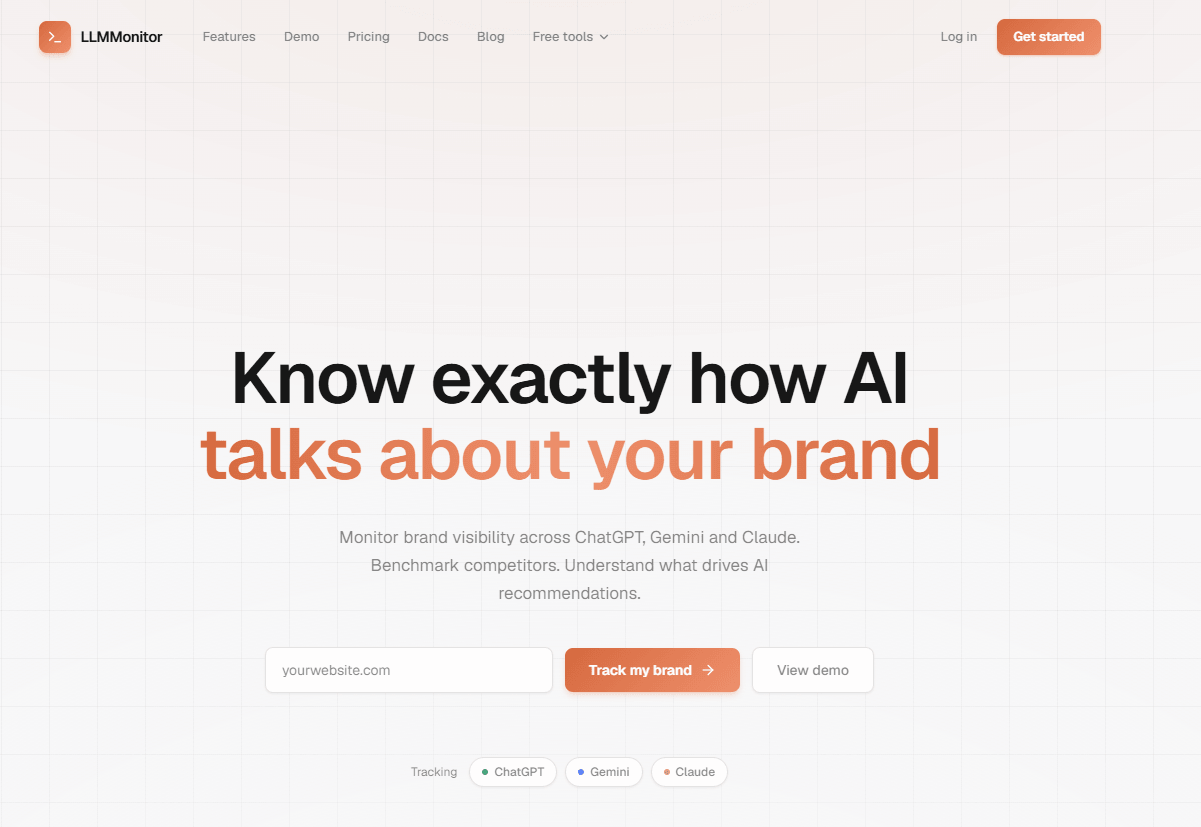
LLMMonitor tracks how AI assistants describe and cite your brand across models, then benchmarks your share of voice by model and query set. It focuses on recurring, model specific snapshots to catch visibility swings that traditional SEO tools miss.
- Best for: Teams that want a lightweight, model centric visibility baseline across ChatGPT, Perplexity, Gemini, and Claude.
- Key Features: According to vendor documentation, recurring prompt schedules, model by model benchmarking, branded share of voice metrics, and executive friendly digests.
- Why we like it: Simple way to turn hand run prompts into repeatable measurements, so leaders stop debating anecdotes.
- Notable Limitations:
- No independent user reviews from major directories found as of June 7, 2026, so due diligence is on you.
- GEO visibility fluctuates between runs, so you must measure as a distribution rather than a single rank, which adds operational overhead, as argued in an April 2026 methodology paper on repeated GEO measurement. See “Don’t Measure Once” on arXiv.
- Assistants often prioritize earned media, so monitoring alone does not create citations, a pattern documented by multiple Muck Rack studies. See the May 2026 edition of “What is AI Reading?”.
- Pricing: Pricing not publicly available on trusted third party listings. If a sales assisted or localized pricing page is presented during outreach, consider it unverified until corroborated by a directory or marketplace.
Orion
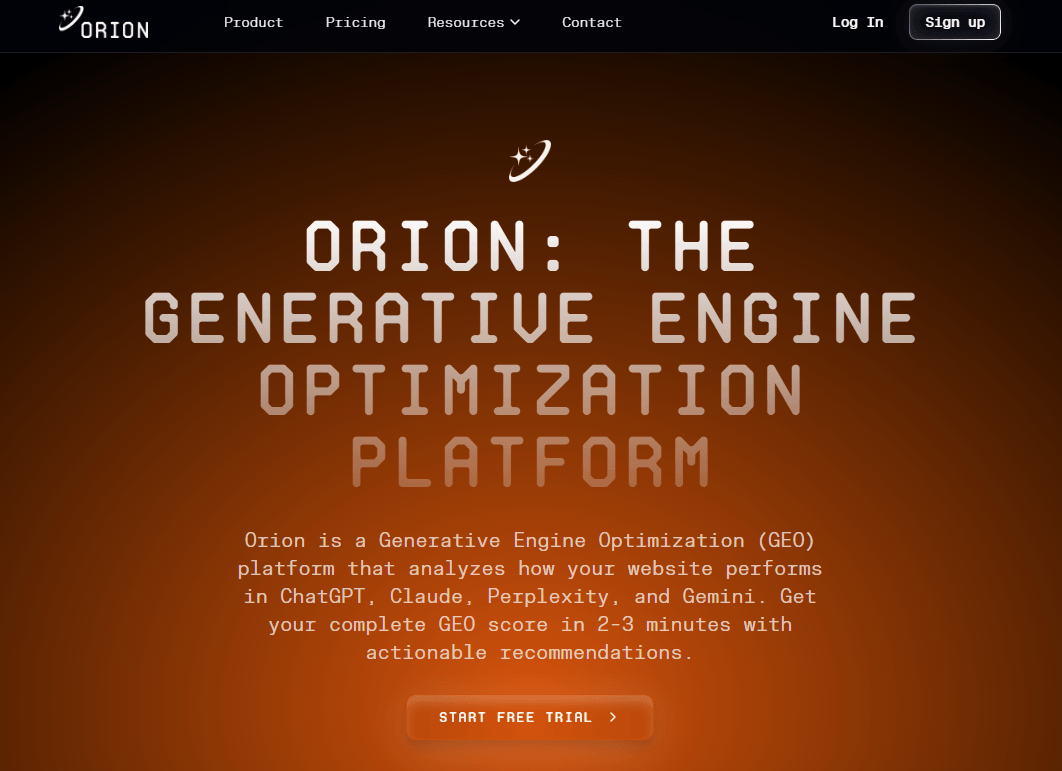
Orion analyzes how your site performs across ChatGPT, Claude, Perplexity, and Gemini, then assigns a GEO Score with prioritized fixes. It also includes an AI Bot Tracker to attribute AI referral and crawler activity.
- Best for: Marketing teams that need an actionable GEO score plus traffic attribution from AI crawlers.
- Key Features: GEO Score and recommendations, multi engine analysis, competitor benchmarks, and an AI Bot Tracker noted by third party reviewers on G2.
- Why we like it: Combines “what to fix” with “who crawled you” so you can connect recommendations to observed AI traffic.
- Notable Limitations:
- One G2 review calls out limited historical depth for long range reporting, which may matter for quarterly or annual rollups. See Orion’s G2 pricing page and review excerpts.
- Entry plan scan and prompt quotas can constrain larger programs unless you upgrade. Details appear on G2’s Orion pricing overview.
- Pricing: Free plan plus paid tiers starting at $59 per month, with Scale at $179 and Partner as custom, per G2 pricing last updated April 22, 2026. Source: G2 Orion pricing.
GEOPro
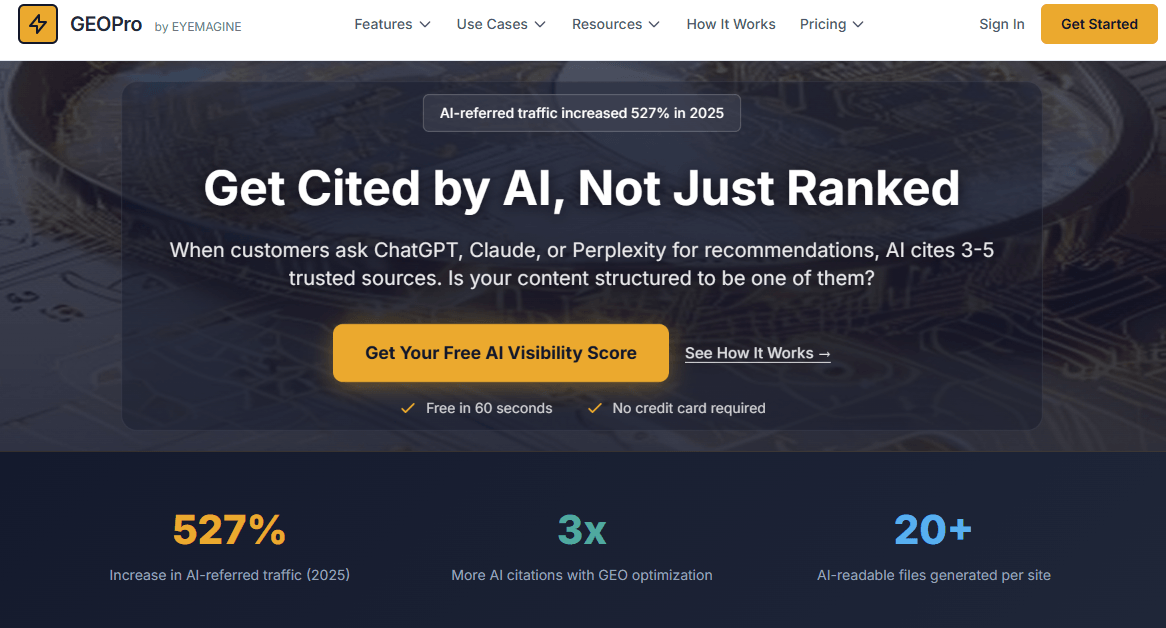
GEOPro focuses on “make it LLM friendly” implementation. It generates llms.txt, structured data, and other AI oriented assets designed to improve how assistants parse and quote your content.
- Best for: Resource constrained teams that want automated creation of AI readable assets like llms.txt and schema without heavy engineering lift.
- Key Features: Per vendor documentation, automated llms.txt generation, schema and content blueprints, and packaging of AI optimized assets for assistants.
- Why we like it: Useful if your biggest bottleneck is translating recommendations into structured, machine readable outputs that can be shipped quickly.
- Notable Limitations:
- There is no consensus that llms.txt changes whether ChatGPT, Claude, or Gemini will cite you, and multiple industry roundups characterize it as optional or unproven in AI search. Search Engine Journal summarizes the skepticism and related research.
- No independent user reviews on major directories were found as of June 7, 2026, so treat claims as unverified and pilot first.
- Pricing: Pricing not publicly available. Contact vendor for a custom quote.
Geolify
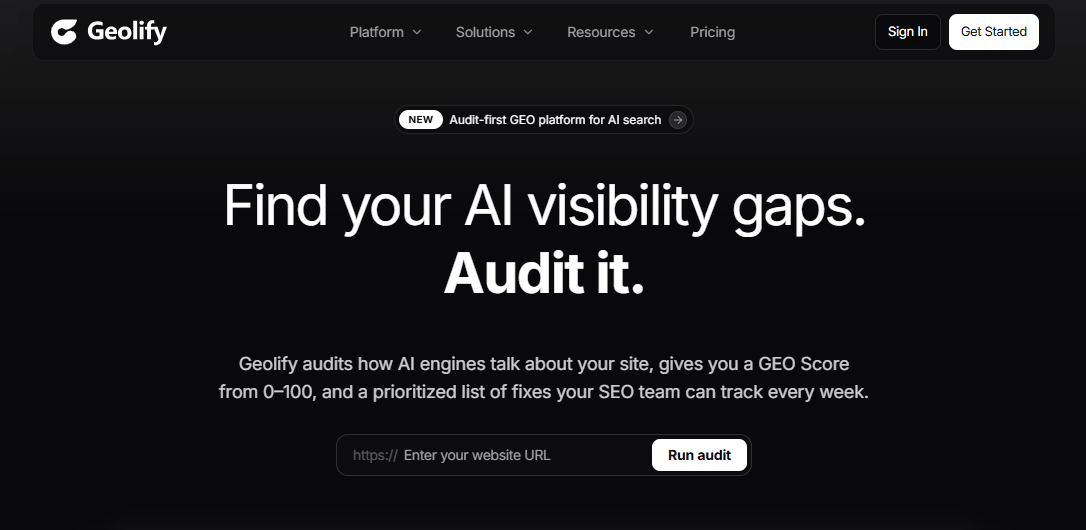
Geolify audits AI visibility gaps and rolls findings into a GEO Score with prioritized fixes across six pillars. A free audit and RICE ranked actions help teams sequence work.
- Best for: Teams that want a structured audit and backlog of GEO fixes with a simple score to rally around.
- Key Features: GEO Score, six pillar visibility model, prioritized actions, and a free plan with an audit and top three actions documented on G2’s pricing page.
- Why we like it: Clear triage. The RICE ranked action list helps move beyond “you are invisible” into week by week implementation.
- Notable Limitations:
- Limited public review sample size on G2, which reduces buying signal strength. G2 flags insufficient reviews for deeper insights.
- Free plan feature caps mean you will likely need a paid tier to operationalize recommendations at scale. See plan details on G2 pricing.
- Pricing: G2 lists a Free plan with defined audit limits, paid tiers not fully disclosed on G2 as of February 2, 2026. Source: Geolify on G2.
Generative Engine Optimization Tools Comparison: Quick Overview
| Tool | Best For | Pricing Model | Highlights |
|---|---|---|---|
| LLMMonitor | Baseline GEO monitoring across models | Not publicly listed | Simple recurring snapshots to benchmark visibility by model |
| Orion | Actionable GEO Score plus AI traffic attribution | Tiered SaaS, partner plan, free plan available | GEO Score, competitor benchmarks, AI Bot Tracker noted on G2 |
| GEOPro | Automated AI ready assets, llms.txt and schema | Not publicly listed | Implementation help for LLM friendly structure |
| Geolify | Audit plus prioritized GEO backlog | Free tier, paid tiers undisclosed on G2 | GEO Score, six pillar model, RICE ranked actions on G2 pricing |
Generative Engine Optimization Platform Comparison: Key Features at a Glance
| Tool | Feature 1 | Feature 2 | Feature 3 |
|---|---|---|---|
| LLMMonitor | Model specific visibility tracking | Scheduled prompt runs | Share of voice by model |
| Orion | GEO Score with recommendations | AI Bot Tracker for attribution | Multi engine competitor benchmarking |
| GEOPro | Auto llms.txt generation | Schema and content asset kits | Assistant oriented formatting guidance |
| Geolify | GEO Score across six pillars | Prioritized RICE action list | Free audit to start backlog |
Generative Engine Optimization Deployment Options
| Tool | Cloud API | On-Premise | Integration Complexity |
|---|---|---|---|
| LLMMonitor | Not publicly documented | No | Low, SaaS setup |
| Orion | Not publicly documented | No | Low to medium, SaaS plus basic tracking |
| GEOPro | Not publicly documented | No | Low, asset generation workflow |
| Geolify | Not publicly documented | No | Low, SaaS audit and backlog |
Generative Engine Optimization Strategic Decision Framework
| Critical Question | Why It Matters | What to Evaluate | Red Flags |
|---|---|---|---|
| Do we have a repeatable GEO measurement plan? | AI answers vary run to run, so single snapshots mislead. | Support for repeated, model specific snapshots and trend views. | Vendors selling one time “rank” reports without methodology. |
| Can we connect recommendations to AI traffic? | Leaders want evidence that fixes correlate with AI activity. | Bot attribution, crawler logs, and referral analysis. | No ability to distinguish AI crawlers from human traffic. |
| Which third party sources influence our category? | Assistants over index on earned media and reviews. | PR and content plan aligned to outlets AI cites most in your niche. | Roadmaps that ignore press, reviews, and forum presence. |
| How will we ship structured, AI friendly content? | Faster structured outputs mean faster citations and cleaner parsing. | Schema coverage, FAQ extraction, and content packaging. | Over reliance on llms.txt as a silver bullet, which is still unproven. |
Generative Engine Optimization Solutions Comparison: Pricing & Capabilities Overview
| Organization Size | Recommended Setup | Monthly Cost | Annual Investment |
|---|---|---|---|
| Solo or very small team | Orion Launch for GEO Score and attribution, plus free Geolify audit for backlog ideas | Starts at $59 for Orion, Geolify free tier available | ~$708 plus time to implement actions |
| Mid market marketing team | Orion Scale for higher scan and prompt caps, add LLMMonitor or Geolify for second opinion snapshots | Orion Scale listed at $179 on G2, others vary | ~$2,148 plus any add ons |
| Agency or enterprise | Orion Partner tier or equivalent custom plan, pair with an audit tool for governance and QA | Custom, pricing not publicly listed for most GEO audit tools | Custom budgeting, pilot to validate before scaling |
Problems & Solutions
-
Problem: “We rank in Google, but AI assistants rarely cite us. Is our content invisible to ChatGPT and Claude?”
Solution: First, confirm where assistants pull evidence in your niche. Multiple audits show that earned media and reputable third party sources dominate AI citations, which means PR, reviews, and high trust explainers move the needle more than additional on site blog posts. Use any GEO monitoring platform to quantify share of voice by query set, then pitch or publish into the outlets that models already cite for those prompts. Muck Rack’s May 2026 study found earned media accounts for about 84 percent of citations, and Axios covered similar patterns in 2025. See Axios’ summary of “What is AI Reading?”. -
Problem: “Leadership wants proof that AI crawlers hit our site after we shipped changes.”
Solution: Orion includes an AI Bot Tracker that, per G2 user feedback, records ChatGPT, Claude, and Perplexity crawler hits with timestamps, which ties recommendations to observed AI activity. This addresses the attribution gap many teams face when they only have a “score” without traffic context. See Orion’s G2 pricing page and review excerpts. -
Problem: “We cannot keep up with the schema, FAQs, and AI friendly packaging work.”
Solution: GEOPro focuses on automated creation of llms.txt, structured data, and AI optimized assets. Treat llms.txt as a helpful catalog, not a guarantee of placement. Independent coverage remains skeptical that llms.txt alone changes whether major assistants cite you, so pair asset generation with earned media and reviews. Search Engine Journal’s roundup explains current limits and cites related manipulation research. -
Problem: “Our stakeholders need a simple roadmap, not another dashboard.”
Solution: Geolify’s GEO Score and six pillar model roll findings into a prioritized backlog with RICE ranked actions on the free tier, which helps sequence work for sprints. For buyers, note that public review depth is limited on G2, so pilot with a small scope before committing. See Geolify’s listing for free plan details and review sample size status.
The Bottom Line on GEO Platforms
GEO is not a silver bullet, it is an operating system that spans measurement, content structure, and earned trust. The data says assistants cite what journalists and reputable reviewers have already validated, which means your best GEO lever is still credibility backed by verifiable sources, then structured for AI parsing. Start by measuring consistently, connect fixes to crawler and referral data, ship structured assets quickly, and invest in the outlets AI leans on in your category. For market context, Gartner’s spending forecast shows why GEO budgets are rising, and for channel mix, Muck Rack’s 2026 findings help you prioritize where to earn mentions. Pilot two tools in parallel for 30 to 60 days, use a fixed query set, and keep a skeptical eye on claims tied solely to llms.txt or single run “rank” screenshots.