

Most teams discover their SIS bottlenecks during peak registration and financial aid disbursements, not from vendor demos. From our experience in the startup ecosystem, the biggest time sinks show up in degree audit rule changes, SSO and role mapping with SAML, and Title IV R2T4 workflows that must reconcile with student accounts. You think you know your data model until cross listing, study abroad terms, and late add drops collide in production. Every spring, another team learns the hard way that integrations beat features on paper. Gartner defines higher ed SIS SaaS as the core system of record, covering essentials like registration, degree audit, financial aid, and student accounts, which is the lens we use here (Gartner Magic Quadrant reprint, 19 Mar 2025).
The global SIS market reached 12.0 billion dollars in 2025, with higher education a major end user and cloud deployments leading growth, which matches what we see in current selections (IMARC Group 2026 overview). You will learn where each platform fits, what the pricing looks like, how they integrate, and the traps to avoid in your next RFP.
Student First
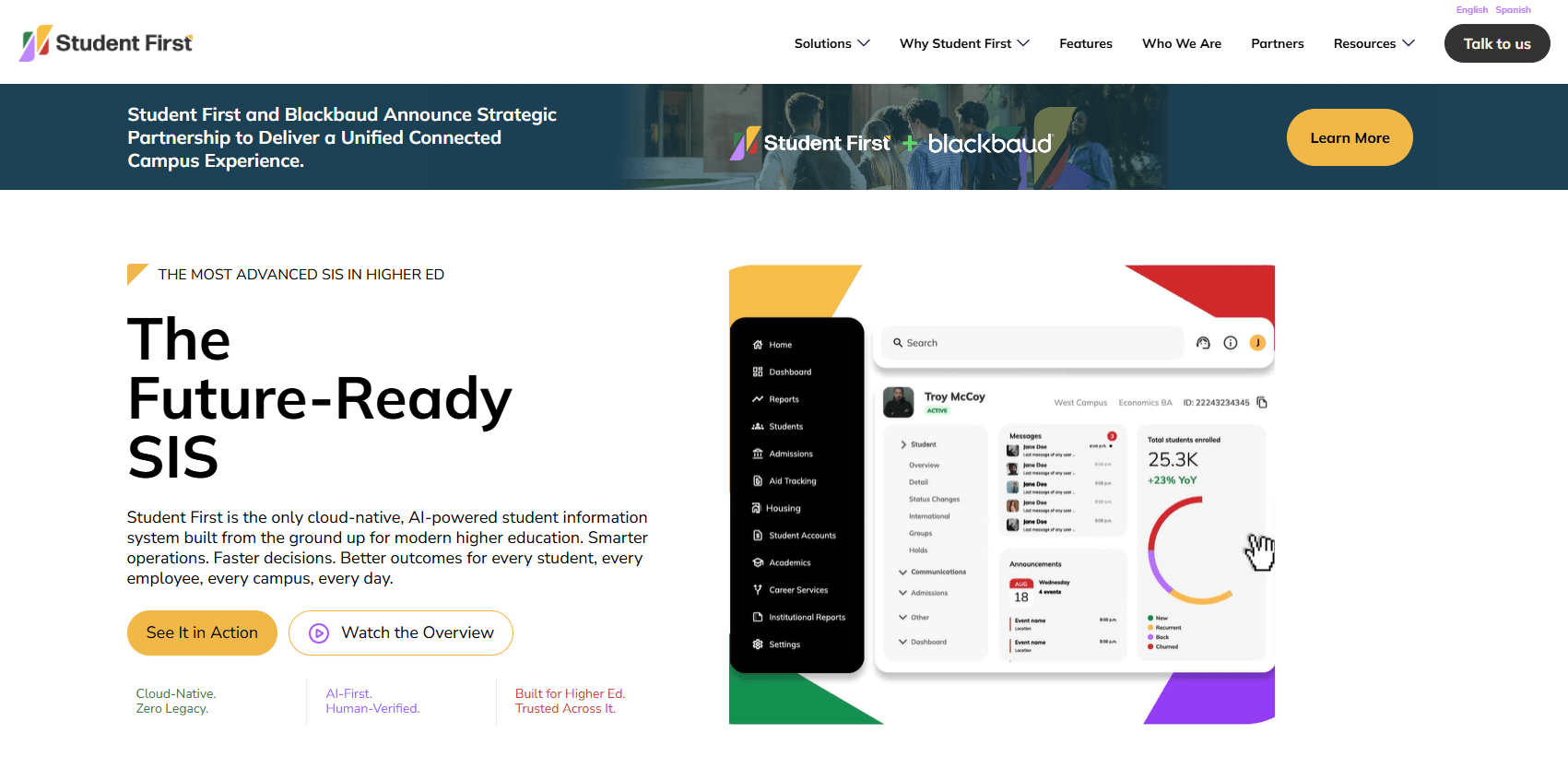
Cloud native SIS purpose built for modern higher education with AI assisted workflows. Emphasis on unifying student records with finance and advancement through a recent strategic partnership.
Best for: Colleges and universities seeking a modern, cloud native SIS with an emphasis on financial aid, automation, and future integration with finance or advancement systems.
Key Features:
- AI assisted early risk signals and task automation, per Student First documentation, aligned to SIS SaaS scope defined by Gartner's core capabilities.
- Cloud native architecture with open APIs for integrations, per Student First documentation.
- Financial aid module designed for Title IV processes, per Student First documentation.
Why we like it: When helping teams scale, we look for clean data models and vendor momentum. The recent strategic investment by Blackbaud suggests deeper connections to finance and advancement that many institutions want to modernize next (Blackbaud investment news).
Notable Limitations:
- Newer product, limited independent public reviews compared with incumbents.
- Implementation patterns, integrations, and references are still maturing in the public domain (ListEdTech profile).
Pricing: Pricing not publicly available. Contact Student First for a custom quote. Recent partnership context is covered in independent news recaps (Investing.com brief).
openSIS
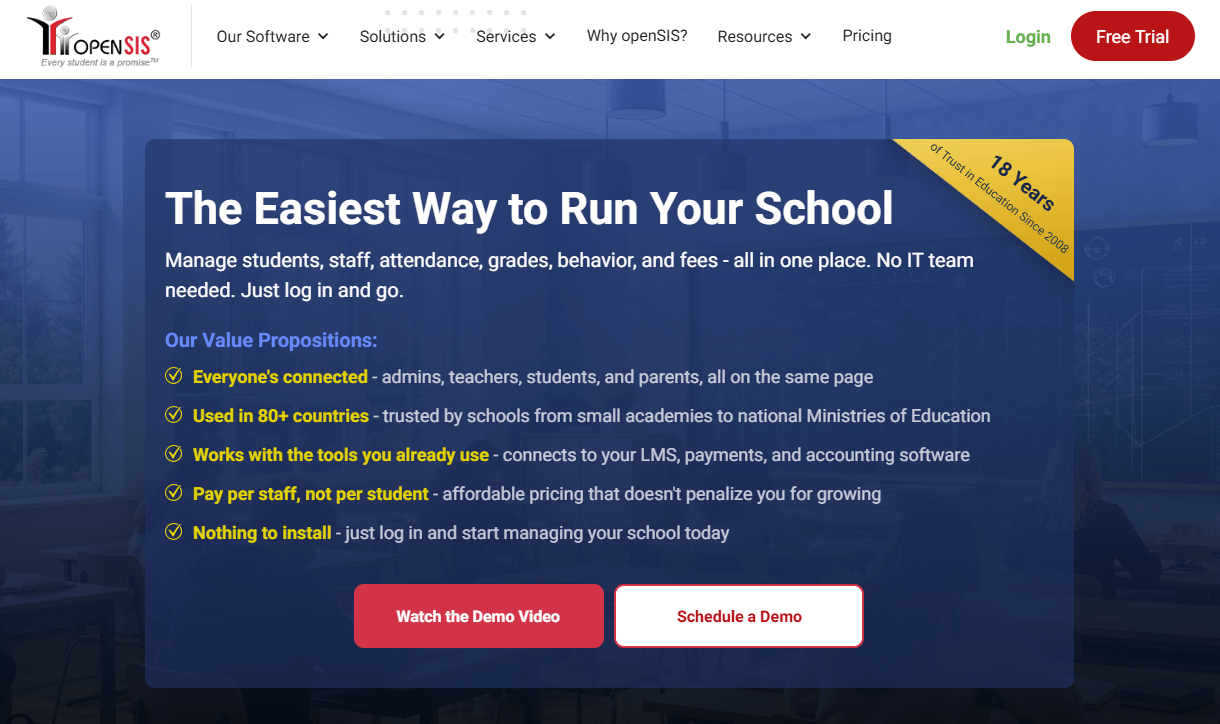
Open source lineage with a commercial cloud offering, used by K-12 and higher education programs. Known for core SIS functions and predictable, staff based pricing.
Best for: Community colleges, trade or career colleges, and continuing education programs needing core SIS plus budget friendly pricing.
Key Features:
- Attendance, scheduling, gradebook, portals, and API listed across third party feature summaries (Capterra feature list).
- Cloud plans with predictable staff based pricing, highlighted on review directories.
- Open source community edition history and on premises options via public repositories (SourceForge project).
Why we like it: Working across different tech companies, we value platforms that can start small, then scale licensing by administrators instead of charging per student. Staff based pricing can materially reduce TCO for programs with large enrollments but small admin teams.
Notable Limitations:
- Limited recent third party review volume compared to market leaders, which makes benchmarking harder (G2 listing with few reviews).
- Community edition public repos show older artifacts, so confirm the maintained branch and update cadence before self hosting.
Pricing: Capterra lists a starting price of 4 dollars per user per month, and notes a staff based pricing model - final costs vary by staff count.
OpenEduCat SIS
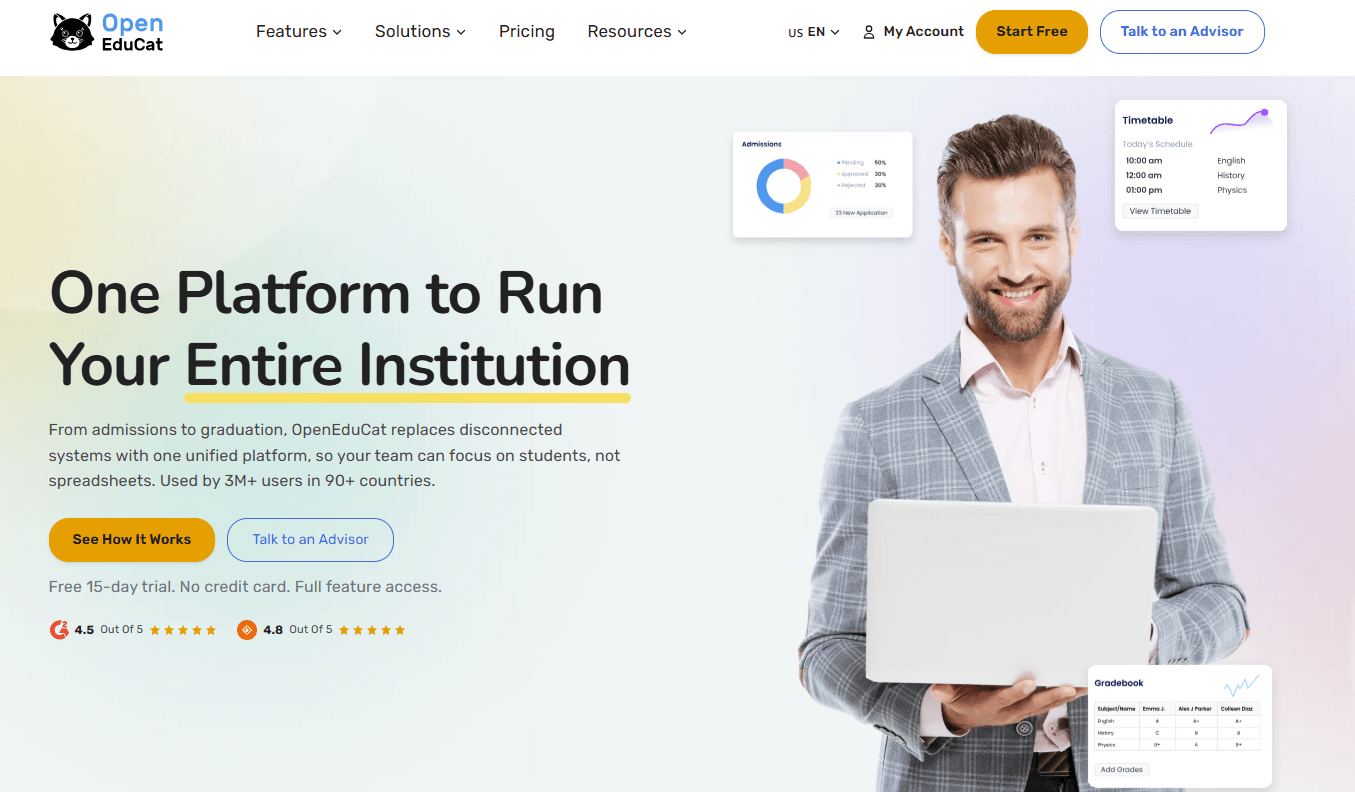
Open source SIS and education ERP built on Odoo, with cloud subscriptions and an on premises perpetual license option.
Best for: Institutions that want open source flexibility, modular add ons, and the option to deploy on premises for data residency.
Key Features:
- Admissions, attendance, exams, timetable, and core SIS workflows, with extensive module catalog documented in community resources (OpenEduCat GitHub).
- Cloud and on premises deployment choices, including a one time perpetual option for on prem (G2 pricing details).
- Active community edition with LGPL license and public docs (OpenEduCat docs portal).
Why we like it: Open architectures save real money in integrations. The on premises license with 500 users, plus the cloud tiers, gives teams latitude to meet residency or air gapped needs without a second platform.
Notable Limitations:
- Several reviewers mention a learning curve and setup complexity, which may require admin time or paid services (G2 review summary).
- Some users note polish gaps in certain modules compared with proprietary ERPs, so prioritize a pilot with your heaviest workflows.
Pricing: G2 lists three editions - One Year at 444 dollars per 25 users per year, Two Years plus one free year at 888 dollars per 25 users per year, and a One Time on premises license at 2,048 dollars for 500 users. Confirm details with the seller.
Higher Education SIS Tools Comparison: Quick Overview
| Tool | Best For | Pricing Model | Highlights |
|---|---|---|---|
| Student First | Modern higher ed teams wanting cloud native SIS with finance and advancement alignment | Custom quote | AI assisted workflows, recent investment to deepen Blackbaud integrations |
| openSIS | Community colleges, trade colleges, CE programs needing predictable admin based pricing | Starts at 4 dollars per user per month on directories | Core SIS features, staff based pricing noted on directories |
| OpenEduCat SIS | Institutions needing open source, modularity, and on premises options | 444 to 2,048 dollars depending on tier | Cloud or on premises, published pricing including perpetual on prem license |
Higher Education SIS Platform Comparison: Key Features at a Glance
| Tool | Registration and Scheduling | Financial Aid | APIs and Integrations |
|---|---|---|---|
| Student First | Per vendor documentation, built for higher ed registration, degree audit, and scheduling | Per vendor documentation, Title IV workflows | Per vendor documentation, open APIs for integration, aligned to SaaS SIS scope |
| openSIS | Listed on third party directories as supporting scheduling and registration | Financial aid capability appears in feature matrices, confirm fit in demos | API noted in feature lists on directories |
| OpenEduCat SIS | Core SIS workflows including timetable and exams | Available via modules, validate scope in pilot | Open source modules, integrable via Odoo framework and REST, broad module docs |
Higher Education SIS Deployment Options
| Tool | Cloud API | On Premise | Integration Complexity |
|---|---|---|---|
| Student First | Yes, per vendor documentation | No public on premises option | Moderate, SIS transitions are complex even with SaaS, plan for data migration and change management |
| openSIS | Yes, via cloud plans | Yes, via community or commercial editions | Varies by scope, confirm supported connectors and data model |
| OpenEduCat SIS | Yes, via cloud | Yes, via on premises perpetual | Varies by scope, open architecture can reduce vendor services spend if in house skills exist |
Higher Education SIS Strategic Decision Framework
| Critical Question | Why It Matters | What to Evaluate | Red Flags |
|---|---|---|---|
| Does the SIS cover Gartner's mandatory capabilities out of the box? | Avoids costly custom work on core functions | Degree audit, financial aid, student accounts, registration, reporting | Reliance on custom code for core functions |
| What is the migration plan and timeline? | SIS transitions fail without staged cutovers | Data model mapping, historical transcript rules, parallel runs | One phase big bang with minimal testing |
| Can we meet data ethics and student privacy expectations? | Student trust is fragile, especially with AI features | Role based access, audit logs, data minimization, explainability | Opaque AI claims and unclear data usage (EDUCAUSE Horizon 2024 on data trust) |
| How does vendor viability look for the next 5 to 7 years? | SIS lifecycles are long | Funding, partnerships, and customer growth | Recent turmoil or unclear roadmap, watch sector consolidation (EDUCAUSE note on 2026 Ellucian acquisition) |
Higher Education SIS Solutions Comparison: Pricing and Capabilities Overview
| Organization Size | Recommended Setup | Cost |
|---|---|---|
| Sub 2,000 FTE, limited IT | OpenEduCat cloud One Year plan for 25 users to pilot, expand as needed | 444 dollars per year for 25 users, scale by user packs |
| 2,000 to 10,000 FTE, admin light | openSIS cloud with staff based model | Starts at 4 dollars per user per month, confirm with sales |
| Online first or multi entity programs | Student First cloud native SIS | Pricing not publicly available, contact vendor for a custom quote |
| Data residency or air gapped requirement | OpenEduCat on premises one time license | 2,048 dollars one time for 500 users starting point, confirm scope and support |
Problems and Solutions
-
Problem: "We need SIS to talk to finance and advancement, or our data stays siloed."
Solution: Student First's recent strategic investment by Blackbaud signals tighter connective tissue between the SIS and financial management or advancement, which can reduce nightly batch work and duplicate data entry when deployed together. -
Problem: "Our budget cannot take per student fees, but we still need modern SIS features."
Solution: openSIS offers staff based pricing and a low published starting point, which shifts cost from enrollment size to admin seats, helpful for high enrollment programs with lean teams. OpenEduCat publishes low entry pricing on G2 with a 25 user package for 444 dollars per year, which works well for phased rollouts or departmental pilots. -
Problem: "We need on premises control for residency or air gapped environments."
Solution: OpenEduCat provides a one time on premises license for 500 users, which can meet residency needs and reduce recurring subscription exposure, provided your team can support the stack. openSIS has community edition options via public repositories for self hosting scenarios, though you should validate maintenance cadence before committing. -
Problem: "We are worried SIS modernization will take years and still miss key features."
Solution: Plan against a vetted capabilities list. Gartner's definition sets mandatory features like degree audit, financial aid, and student accounts. Use this to score gaps early and avoid custom builds that delay go live. Acknowledge that SaaS SIS transitions are often slower than expected, then use phased rollouts to derisk scope.
The Bottom Line on Choosing a Higher Ed SIS
Cloud first SIS adoption is rising, yet the market is still normalizing around feature parity and integration depth. Begin with a clear capability map, then match it to your constraints. If you want a modern cloud native path that links student records to finance and advancement, Student First is worth a close look given recent investment news that points to deeper integrations. If predictable admin based pricing is critical, openSIS can keep costs down while covering the basics. If open source flexibility or on premises control is non negotiable, OpenEduCat's documented cloud and on premises options with transparent pricing stand out. Anchor your selection to mandatory SIS capabilities and a staged migration plan, which aligns with how leading analysts frame successful projects today.