You think you know your cloud is under control until a Friday incident forces a hotfix in the console and your next Terraform apply threatens to wipe it out. Working across different tech companies, the biggest IaC mistakes we see happen when drift, missing approvals, or cost surprises collide during a release. From our experience in the startup ecosystem, three technical pressure points always surface: cross-tool orchestration across Terraform and Ansible, policy-as-code guardrails, and fast drift detection with safe remediation. Gartner predicted that by 2026, 80% of large software engineering organizations will have platform teams, a milestone that has now reached mainstream adoption as platform engineering demand - and with it IaC orchestration - continues to surge (Gartner newsroom).
Selection criteria included verified governance features, drift handling, VCS workflow fit, deployment flexibility, and transparent pricing signals. You will learn when to choose a SaaS control plane versus self-hosted Git-centric flows, how to budget using marketplace pricing where available, and a practical decision matrix to reduce tool risk.
Spacelift
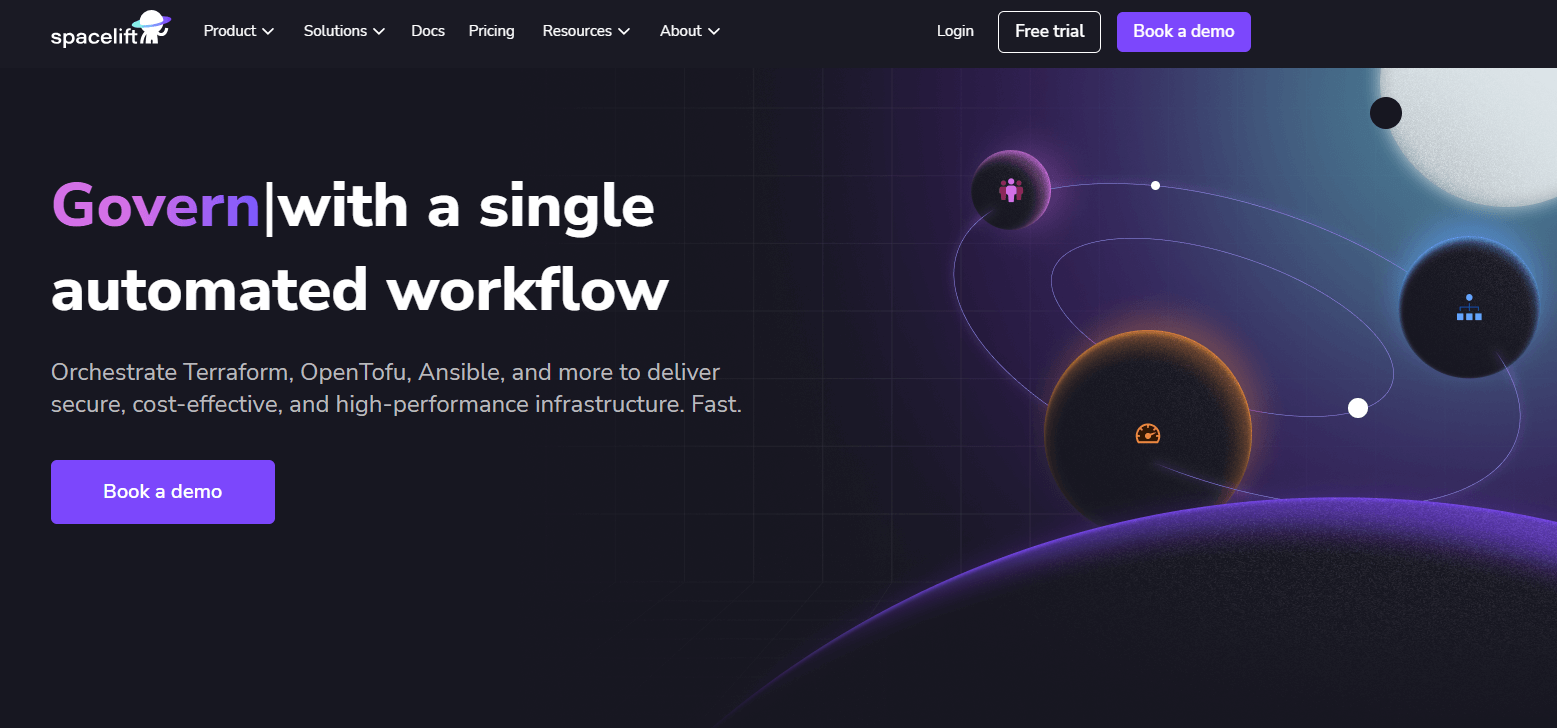
An IaC orchestration platform for Terraform, OpenTofu, CloudFormation, Pulumi, and Ansible that centralizes provisioning, governance, and developer self-service. According to vendor documentation, it includes policy-as-code and drift detection, plus blueprints for self-service.
Best for: Regulated or fast-growing teams that want a managed control plane with strong governance and a Git-native workflow.
Key Features:
- Multi-IaC engine with policy-as-code and developer self-service, per vendor docs.
- FedRAMP Moderate authorized environment for public sector adoption, with availability through Carahsoft (PR Newswire announcement).
- Integrated workflows that combine IaC, Ansible, and Kubernetes, plus blueprints for developer portals, per the AWS Marketplace listing (AWS Marketplace listing highlights).
Why we like it: Solid governance story with policy hooks, reliable Git PR flow integration, and verified public sector readiness gives it a wide deployment envelope.
Notable Limitations:
- Some users cite UI rough edges and navigation friction in reviews (G2 review sentiments).
- Peer reviews note price sensitivity for smaller teams (PeerSpot cons section).
- Self-hosted feature parity and integrations can lag behind SaaS per community comparisons (PeerSpot comparison notes).
Pricing:
- AWS Marketplace lists a Starter annual contract at $3,990 for 10 users and 2 public workers as of 2026 (AWS Marketplace pricing table).
- Also purchasable via cloud marketplaces that can count toward enterprise commitments, which many buyers prefer for procurement (AWS Marketplace pricing overview).
env0
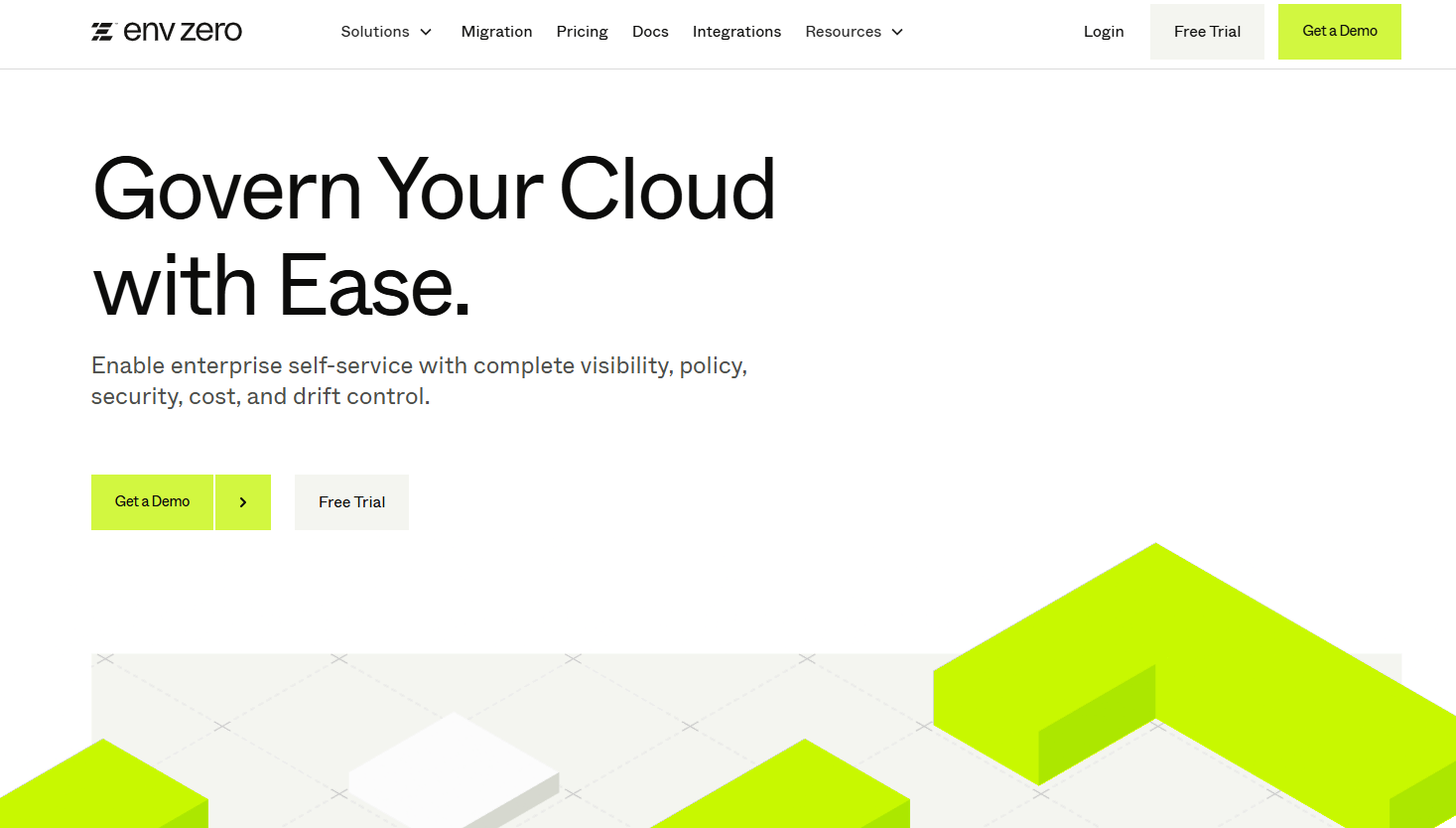
A cloud governance and IaC orchestration platform for Terraform, OpenTofu, Pulumi, CloudFormation, and Kubernetes that emphasizes self-service, policy-as-code, drift detection, and cost governance. According to vendor documentation, it supports OPA-based approval policies and automated drift remediation.
Best for: Organizations standardizing multi-IaC with drift remediation and strong policy workflows, especially where cost signals matter.
Key Features:
- Drift detection with code-to-cloud or cloud-to-code remediation policies, referenced by customers on Gartner Peer Insights and vendor materials (Gartner Peer Insights page).
- Policy-as-code approvals built on OPA, per vendor docs and community materials.
- Flexible deployment agents and VCS integrations, plus cost estimation and actuals, per third-party listings (Capterra overview).
Why we like it: It closes the loop between detected drift and remediation, and fits teams that want automated guardrails without abandoning Git workflows.
Notable Limitations:
- Reviews mention no on-premises choice and documentation or support response concerns in some cases (Gartner Peer Insights details).
- Pricing complexity and enterprise focus can be a hurdle for smaller teams, per community feedback and listings (G2 pricing overview).
Pricing:
- AWS Marketplace lists "Cloud Compass" at $18,000 per 12 months, and packages like "Cloud Navigator" or "Cloud Pilot" with listed annual prices or contact for quote (AWS Marketplace listing).
- G2 shows "Cloud Compass" starting near $18,000 per year with higher tiers as contact-for-quote (G2 pricing page).
Atlantis
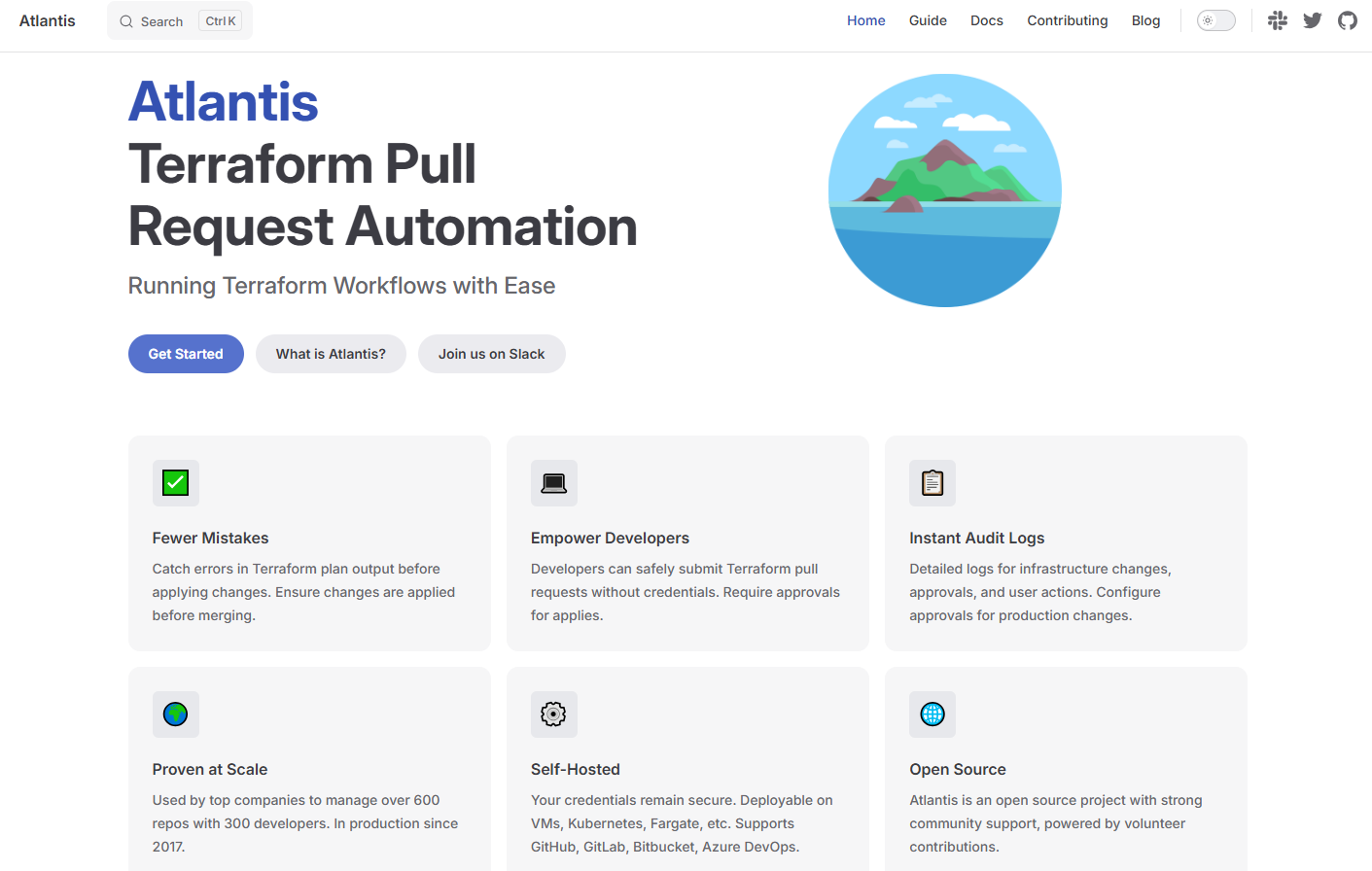
An open-source tool that automates Terraform plan and apply via Git pull requests, enabling approvals and auditable workflows in a self-hosted model.
Best for: Teams that want a simple, Git-first, self-hosted Terraform PR workflow without a managed control plane.
Key Features:
- Comment-driven Terraform plan and apply on PRs with VCS integrations like GitHub, GitLab, Bitbucket, and Azure DevOps (GitHub project README).
- Automerge after successful applies and configurable workflows via atlantis.yaml (Atlantis docs for automerge).
- Transparent audit trail in PRs and repo-level configs for standardized workflows (Atlantis site overview).
Why we like it: It keeps infrastructure changes in code review where they belong and is easy to reason about for Terraform-only teams.
Notable Limitations:
- Self-hosted model means you manage credentials and hardening, with explicit security caveats documented by the project (Atlantis security notes).
- Terraform-centric scope, so no native multi-IaC, policy engine, or cost analytics. This follows from the project's stated purpose and public docs; you will layer those externally (project scope on GitHub).
- No native drift detection loop, inferred from feature set that runs on PR events and executes plan and apply rather than scheduled state audits. This is an inference from official docs and common usage.
Pricing:
- Open source, no license fee (GitHub repo). Infrastructure and maintenance costs apply.
Kestra
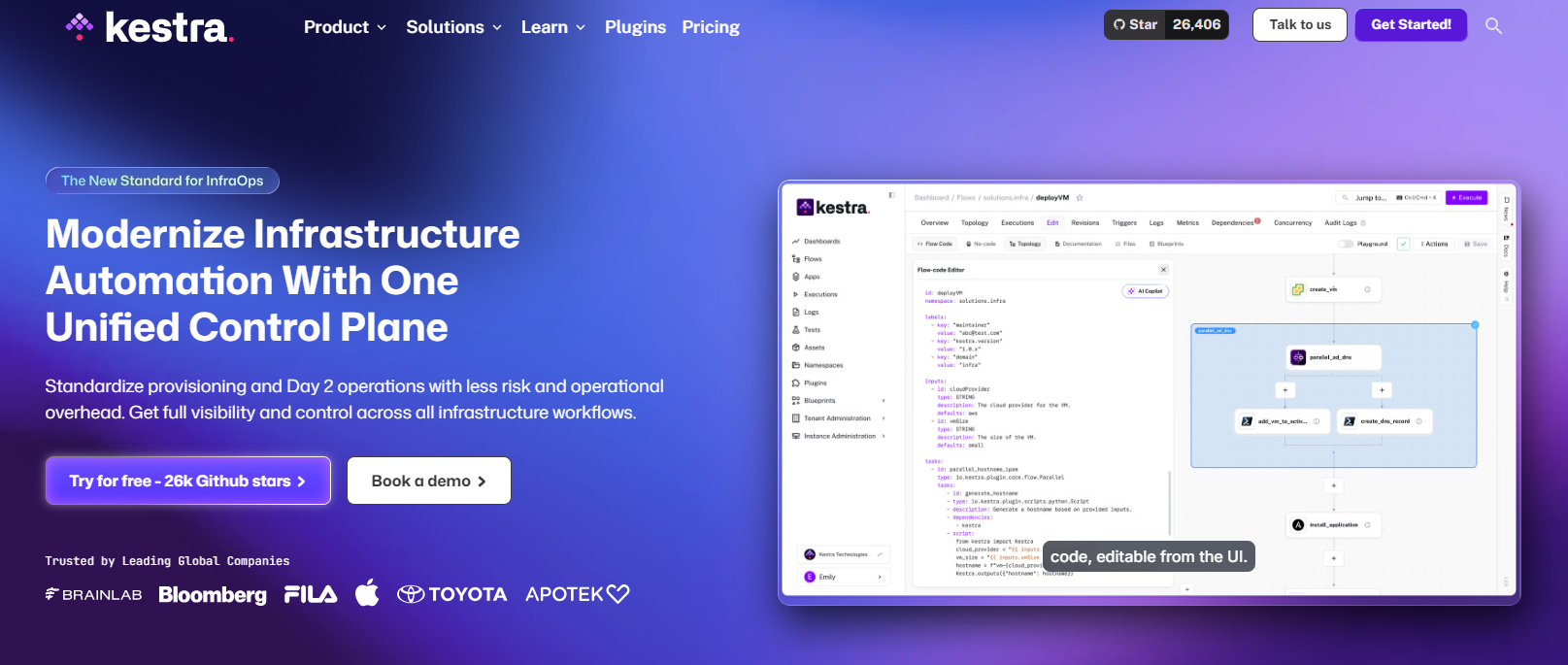
An open-source unified orchestration control plane that runs declarative workflows across infrastructure, data, and operations. According to vendor documentation, it offers Terraform and Ansible plugins, human-in-the-loop tasks, and governance features.
Best for: Platform and data teams that want one orchestrator to coordinate Terraform, Ansible, scripts, and data jobs in event-driven and scheduled flows.
Key Features:
- Open-source orchestration platform with growing enterprise footprint and investor validation (TechCrunch funding coverage).
- Terraform plugin to orchestrate plans and applies within workflows, plus a Terraform provider to manage Kestra itself as code (GitHub provider repo).
- Unified workflows that span infrastructure and data operations with YAML, per third-party coverage and community examples.
Why we like it: A single control plane to stitch infra, data, and operations can reduce tool sprawl and handoffs, useful when platform teams own both pipelines and provisioning steps.
Notable Limitations:
- Limited third-party enterprise reviews compared with older orchestrators, so risk-averse buyers may want extra diligence on support and roadmap, reflected in sparse public reviews and community chatter (G2 entry has minimal reviews).
- Pricing transparency for Enterprise is limited publicly, often reported only via quotes, so budgeting may require early vendor engagement (Windmill competitor comparison noting lack of public pricing).
Pricing:
- Open-source edition available at no charge on AWS Marketplace, enterprise pricing not publicly listed, contact vendor or reseller for a quote (AWS Marketplace listing).
IaC Orchestration Tools Comparison: Quick Overview
| Tool | Best For | Pricing Model | Highlights |
|---|---|---|---|
| Spacelift | Regulated or fast-growing teams needing governance and self-service | Annual contracts via marketplaces, enterprise quotes | FedRAMP Moderate authorized, multi-IaC with policy controls (PR Newswire) |
| env0 | Multi-IaC with drift remediation and policy approvals | Annual contracts, tiered packages, marketplace options | Drift detection and remediation, OPA approvals, cost governance |
| Atlantis | Git-centric Terraform PR workflow, self-hosted | Open source | PR-driven plan and apply with approvals and automerge |
| Kestra | Unified infra plus data orchestration with YAML workflows | OSS free, Enterprise quote | Terraform plugin and Terraform provider, event and scheduled orchestration |
IaC Orchestration Platform Comparison: Key Features at a Glance
| Tool | Policy-as-Code | Drift Detection | Multi-IaC Support |
|---|---|---|---|
| Spacelift | Yes, per vendor docs | Yes, per vendor docs | Terraform, OpenTofu, CloudFormation, Pulumi, Ansible |
| env0 | Yes, OPA approvals | Yes, with remediation modes | Terraform, OpenTofu, Pulumi, CloudFormation, Kubernetes |
| Atlantis | PR approvals, no native policy engine | No native loop, PR-event driven | Terraform only, per project scope |
| Kestra | Workflow-level governance, human-in-the-loop tasks | Via orchestrated steps, not a native IaC feature | Terraform, Ansible, scripts, cloud CLIs via plugins |
IaC Orchestration Deployment Options
| Tool | Cloud API / On-Premise | Air-Gapped Support | Integration Complexity |
|---|---|---|---|
| Spacelift | SaaS on AWS Marketplace; self-hosted available | Vendor states air-gapped support in public sector materials | Medium, strong Git and policy integration |
| env0 | SaaS with marketplace contracts; agents for hybrid | Not publicly documented as air-gapped | Medium, emphasis on approvals and drift |
| Atlantis | No SaaS, self-hosted only (VMs or Kubernetes) | Possible with self-hosting | Low to medium, focused on Terraform PRs |
| Kestra | OSS and Enterprise deployments; on-prem or multi-cloud | Possible with self-hosting | Medium, orchestrates many tools |
IaC Orchestration Strategic Decision Framework
| Critical Question | Why It Matters | What to Evaluate | Red Flags |
|---|---|---|---|
| Do you need FedRAMP or similar compliance? | Regulated buyers must meet specific controls | Verified authorization, deployment boundaries, auditability | No independent verification, unclear boundary docs |
| How do you remediate drift? | Drift breaks pipelines and can cause outages | Detection frequency, code-to-cloud and cloud-to-code remediation | Alerts only, no safe remediation path |
| Will you orchestrate beyond Terraform? | Platform teams span infra and data | Plugin coverage for Ansible, K8s, data tasks, human approvals | Single-tool bias, brittle custom scripts |
| What is your Git workflow? | PR-centric or pipeline-centric impacts fit | Native PR commands, checks, policy gates, parallelism | Forced migration from Git norms, opaque runs |
| How will you buy and scale? | Procurement and budgeting reduce friction | Marketplace SKUs, transparent tiers, support SLAs | Price opacity, surprise overages, support delays |
IaC Orchestration Solutions Comparison: Pricing & Capabilities Overview
| Organization Size | Recommended Setup | Annual Investment |
|---|---|---|
| Small team starting with Terraform | Atlantis self-hosted for PR workflows | Infra only |
| Mid-market with drift and governance needs | env0 Cloud Compass for assessment or package via marketplace | ~$18,000, per AWS Marketplace listing |
| Regulated or multi-IaC at scale | Spacelift Starter for pilot, expand via marketplace | $3,990 per 12 months on AWS Marketplace |
| Platform team orchestrating infra and data | Kestra OSS for orchestration, Enterprise if needed | OSS free, Enterprise pricing not publicly available |
Problems & Solutions
-
Problem: You need a FedRAMP-authorized IaC orchestrator for U.S. public sector work.
- Spacelift solution: Offers a FedRAMP Moderate authorized environment and public sector distribution through Carahsoft.
-
Problem: Engineers make emergency console changes that drift from code, causing the next deploy to fail.
- env0 solution: Customers note drift detection value, and the platform supports cloud-to-code pull requests or code-to-cloud remediation policies to bring systems back in sync.
-
Problem: You want to keep Terraform changes in PRs with clear approvals and minimal moving parts.
- Atlantis solution: Automates plan on PR, apply on approval, and supports automerge after successful applies, keeping an auditable trail in Git.
-
Problem: Platform team needs one orchestrator for infra and data tasks with human-in-the-loop controls.
- Kestra solution: Open-source orchestrator with Terraform plugin and provider, letting you run Terraform alongside data workflows in YAML, as covered by third-party press and public repos.
Bottom Line: Choosing the Right IaC Orchestrator
If you want a managed control plane with verifiable governance and public sector readiness, Spacelift is the strongest fit, helped by marketplace distribution and FedRAMP authorization. For multi-IaC governance with automated drift remediation and strong approvals, env0 stands out in peer reviews. If you need a Terraform-only PR workflow and want to keep everything in Git with minimal overhead, Atlantis is hard to beat for cost and simplicity. When your platform team must coordinate infra and data pipelines in one place, Kestra provides a unified orchestrator with Terraform integrations and OSS flexibility. Finally, align your choice to compliance needs, drift strategy, Git workflow, and procurement model. With platform engineering now mainstream, the winners will be the teams that standardize on clear guardrails and predictable spend.