

GitGuardian’s 2026 State of Secrets Sprawl found 28.65 million new hardcoded secrets on public GitHub in 2025, and 64 percent of secrets confirmed valid in 2022 were still valid in January 2026. The number that changes the shortlist is the second one. A match you cannot revoke is inventory. A leaked credential becomes actionable when you can identify its owner and make sure the secret is revoked or rotated.
People mix two queues. An employee key lives in git history, a laptop, or a CI runner. A customer secret lives in the JavaScript bundle or a public env file the user already downloaded. A standing AppSec platform and a one-shot PDF are also different buys. Catalog counts on vendor pages stay vendor claims. AI-service credential leaks also grew sharply: the report counted 1,275,105 in 2025, up 81 percent.
We compared seven scanners on that split: whether the finding is a standing queue or a one-shot report, where the leak actually landed, and whether any price is public. If you want validated secrets inside an AppSec queue, start with Keygraph. If the next question is what the key can still do in AWS, Cyscale. If you need a verified PDF tonight, GhostCred. If the leak is already in the JavaScript your users download, GetLeaked. If you want the incumbent repo and public-GitHub monitor with a $0 starter, GitGuardian. If you want live-verified open source plus an enterprise console, TruffleHog. If the repos already live on GitHub, Secret Protection.
What usually goes wrong when buying a credential scanner
Most quotes in this category fail for the same few reasons. The fix is operational, not a new acronym.
| Problem | Solution |
|---|---|
| A match is a string, not a live credential | Ask whether the match is validated as live |
| The scan never looks where you actually leak | Write whether it covers repos, cloud identities, or the public bundle |
| The list price is a different scanner | Confirm the credential-scan rate on the product you will actually buy |
| A standing queue and a one-off report get sold as the same buy | Write whether you are buying a queue or a report |
How we evaluated credential scanners
Four first-party facts a scanner page should answer made the cut: whether the scanner proves the secret is live, where it actually looks, whether any price is public, and who can rotate the key tomorrow. Regex-count slides did not move a ranking. Bare CI CLIs and suite-only secret modules sit in What we left out because they sit next door, not on those four questions.
TL;DR: The 7 Compared
| Service | Best for | What to check |
|---|---|---|
| Keygraph | Validated secrets inside a standing AppSec queue |
Where it looksRepos and history, then an LLM pass that drops placeholders and fixtures
PricePro from $50 / active developer / month. Shannon OSS is free and does not include secrets scanning
Watch-outAir-gap is Enterprise. A seat is anyone who committed, opened, merged, or pushed to a monitored private repo in the last 90 days and still has access
|
| Cyscale | A leaked key that still reaches a live cloud identity |
Where it looksAgentless CNAPP. Secrets attach to the workload and owner they still reach
PricePro $850 / month billed annually (up to 1,000 assets, 10 connectors). Scale $2,000 / month billed annually (up to 5,000 assets, 50 connectors)
Watch-outYou are buying a CNAPP. Asset counts include IAM objects, disks, and VPCs. Get the discovery call before you budget 1,000
|
| GhostCred | A verified PDF tonight, not a standing scanner |
Where it looksRepos, configs, and cloud hygiene on AWS, Azure, and GCP
PriceFree teaser. Single Scan $49 one-time. Pro $299 / month. MSP Pro $799 / month or $7,990 / year
Watch-outFree is a finding count and risk score, no full PDF. Private repos need a token on Pro and MSP
|
| GetLeaked | A public-URL launch gate on the JavaScript an attacker already has |
Where it looksPublic page, client bundles, inline targets, source maps when left open
PriceFree URL Scan $0. Deep Scan $49 one-time, paid in SOL or USDC on Solana
Watch-outScope is the public surface. Payment is crypto-only. Git history needs a complementary tool
|
| GitGuardian | AppSec teams that need repo, public-GitHub, and optional laptop coverage with validity-aware incidents. |
Where it looksRepos, public GitHub, optional endpoints
PriceStarter $0 / 25 contributing developers. Paid quote-only
Watch-outEndpoint coverage is an add-on. Starter caps history, API, and repo size
|
| TruffleHog Enterprise | Teams that want live-key verification first, then a console and public-web Forager on top of the OSS engine. |
Where it looksRepos and SDLC, verified keys
PriceOSS free. Enterprise quote-only
Watch-outThe $100,000 AWS Marketplace figure is a placeholder for private/custom pricing, not a usable list price
|
| GitHub Secret Protection | Orgs already on GitHub Team or Enterprise that want push protection and validity on the repos they already pay for. |
Where it looksGitHub repos, PRs, issues, wikis
PriceGitHub currently lists Secret Protection at $19 / active committer / month
Watch-outGitHub-perimeter only. Code Security is a separate $30 product
|
These rows are the seven purchases.
Keygraph
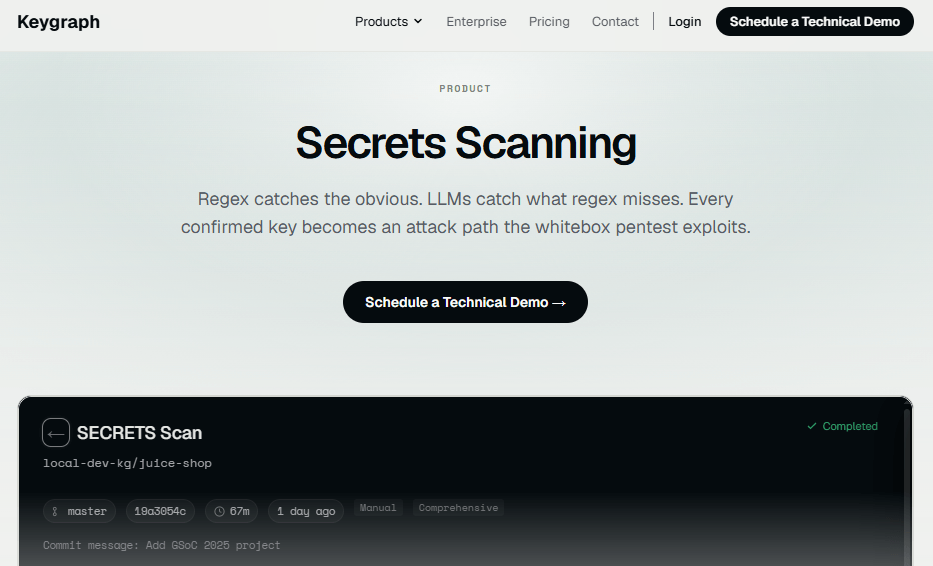
Keygraph is a continuous agentic pentesting platform. The secrets scanning module finds committed credentials, tokens, and API keys, then validates them against surrounding code, deduplicates, and classifies blast radius. Two tiers: pattern match first, then an LLM pass that drops placeholders, fixtures, and docs examples.
Shannon OSS is free and self-run, but secrets scanning is not on that product. The paid pricing page is where that module lives. Pro starts at $50 per active developer per month and includes secrets scanning, agentic SAST, a unified findings dashboard, SSO, and unlimited repos under bring-your-own LLM key. Enterprise is custom. Self-hosted and air-gapped operation is an Enterprise line. A U.S. 501(c)(3) or a seed / pre-Series-A startup with 20 or fewer active developers can run full Pro at $0 while they qualify.
Best for: AppSec teams that want secrets in the same queue as exploit-validated SAST, and that will pay per developer rather than per scan.
What you get:
- Two-tier detection: known formats, then model confirmation in code context.
- Classification by type, scope, and blast radius across repository history.
- Dedup and false-positive carry-forward so the same string does not reopen every scan.
- GitHub, GitLab, Bitbucket, Azure DevOps, plus Docker Hub, GHCR, ECR, and Artifact Registry.
Why we like it: The validation pass is what stops a rotation nobody finishes. The public seat price is also rare in this category. If policy says source cannot leave the building, that is the Enterprise conversation. Pro is $50.
Limits:
- Pro is a managed platform. Air-gap and fully network-isolated installs are Enterprise only.
- Secrets scanning is one module. Confirm the quote if that is all you intend to turn on.
- Bring-your-own-model means you own token cost and, in many shops, an internal AI approval cycle.
Price: Published on keygraph.io/pricing. Shannon OSS $0 (no secrets module). Pro from $50 / active developer / month, BYOK, unlimited scans. Blackbox pentest, SCA, and remediation PRs are Pro add-ons and included on Enterprise. Community Program is $0 for qualifying nonprofits and early startups. A seat is a person who committed, opened, merged, or pushed to a monitored private repo in the last 90 days and still has access. Bots and read-only users do not count.
Cyscale
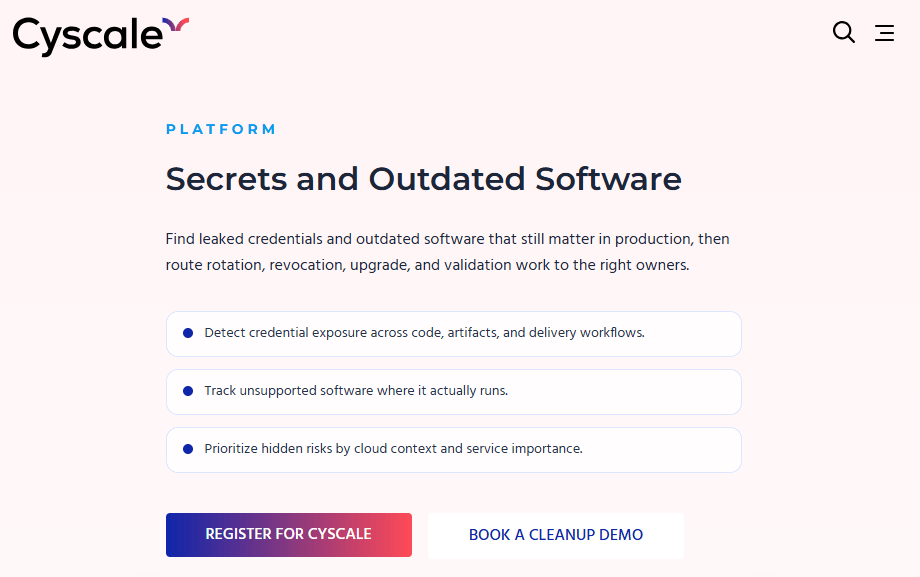
Cyscale is an agentless CNAPP. Leaked secrets sit next to outdated software, dependency risk, and container-image findings, then attach to the cloud identity and workload they still reach. Coverage is AWS, Azure, Google Cloud, and Alibaba Cloud, plus Kubernetes, Entra ID, Google Workspace, Okta, GitHub, and GitLab.
Every plan gets the full platform. The pricing page is per asset. Pro is $850 per month billed annually for up to 1,000 assets and 10 connectors. Scale is $2,000 per month billed annually for up to 5,000 assets and 50 connectors. Enterprise is unlimited assets and connectors, quote. A connector is a cloud environment or an identity provider. Cyscale Limited states ISO 27001; SOC 2 is listed as in progress. AWS Marketplace is a procurement path.
Best for: Teams whose first question after a leaked key is “what can it still touch,” not “how many regex hits did we get.”
What you get:
- Secret detection across repos, artifacts, and delivery workflows, with dedup.
- Container image scanning for packages, malware, secrets, and misconfig before the workload runs.
- CIEM context so a key is scored by the permissions it still holds.
- Compliance evidence mapped to CIS, ISO 27001, SOC 2, PCI DSS, NIST, and others.
Why we like it: A dead key and a production write key look the same to a regex scanner. This platform is built to tell them apart, then route the live one to an owner.
Limits:
- You are buying a CNAPP. If secrets scanning is genuinely all you want, the asset bill will feel wide.
- No public on-prem or air-gapped option.
- Asset counts include IAM objects, disks, and VPCs as well as compute. Get the discovery call before you budget 1,000.
Price: Published on cyscale.com/pricing. Pro $850 / month (annual, up to 1,000 assets / 10 connectors). Scale $2,000 / month (annual, up to 5,000 assets / 50 connectors). Enterprise custom. Full-access free trial.
GhostCred
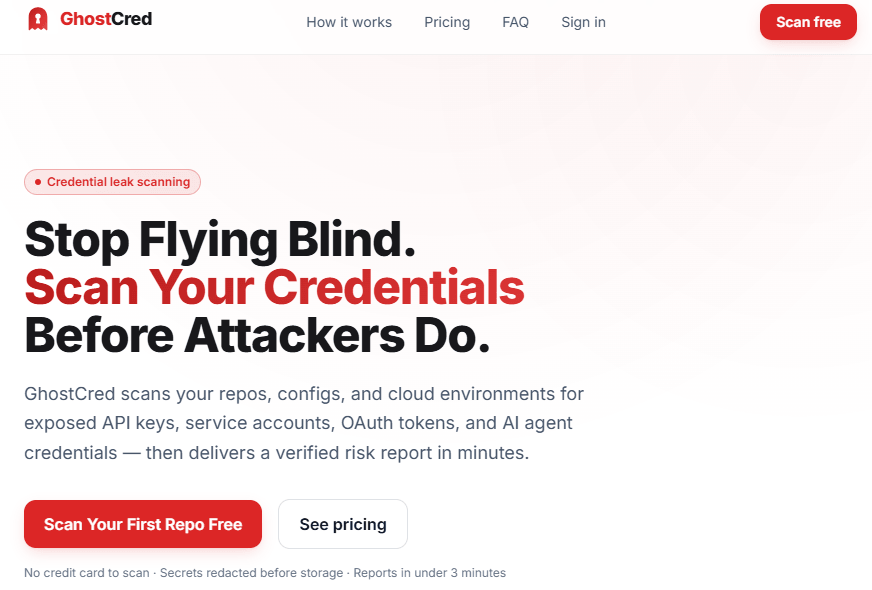
GhostCred is a verified-report product, not a standing AppSec queue. It scans repos, configs, and cloud environments for exposed API keys, service accounts, OAuth tokens, and AI agent credentials, then emails a verified risk report. Free teaser results land in under a minute. Paid PDFs typically follow in a few minutes. Secret values are redacted to the first four characters before anything is stored.
The scan looks at hardcoded passwords, private keys, connection strings, and JWT secrets in files, plus cloud hygiene on AWS, Azure, and GCP: IAM users without MFA, access keys older than 90 days, overprivileged roles, public buckets, open security groups, and orphaned service accounts. Findings map to SOC 2, NYDFS 500, HIPAA, and CMMC. Pricing sits on the homepage. There is no separate /pricing URL.
Best for: A verified PDF tonight, not a standing scanner. Engineering-led teams that want a branded report they can hand to an owner today, and MSPs that want the same PDF under their own logo.
What you get:
- GitHub URL or file drop. Private repos need a token on Pro and MSP.
- Verified findings with severity, remediation, and a compliance impact matrix.
- API access and a scan-history dashboard on Pro.
- White-label PDFs (logo, color, tagline) on MSP Pro.
Why we like it: A report that proves a key is live is a different conversation from a wall of suspicious strings. The public price list also lets you try one repo before you buy a month.
Limits:
- Small third-party review footprint. Run a proof on your own repos before you treat the PDF as an audit artifact.
- Free is a teaser (finding count and risk score, no full PDF).
- Pair it if you need history-wide, always-on coverage.
Price: Published on ghostcred.io. Free: one scan, summary teaser. Single Scan $49 one-time for the branded PDF. Pro $299 / month, unlimited scans, API, history (annual saves two months). MSP Pro $799 / month or $7,990 / year for white-label.
GetLeaked
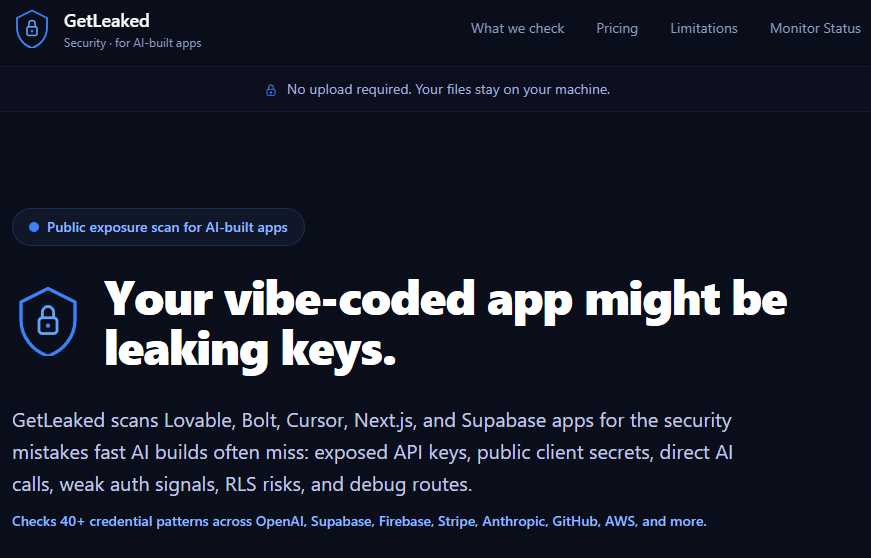
GetLeaked is a launch-gate scan of a public URL, not a peer to a repo or cloud-identity platform. It scans the public surface of Lovable, Bolt, Cursor, Next.js, and Supabase apps for the mistakes fast AI builds ship: exposed keys, public client secrets, direct browser-to-AI calls, weak auth, RLS-off tables, and debug routes. It checks 40-plus credential patterns across OpenAI, Supabase, Firebase, Stripe, Anthropic, GitHub, and AWS.
The pricing page is two lines. Free URL Scan inspects the public page, client bundles, and inline targets. Deep Scan is $49 one-time, paid in SOL or USDC on Solana, no subscription. Deep Scan adds live validation against OpenAI, Anthropic, and Stripe, auth-bypass probing, an OSV.dev dependency CVE audit, source-map reconstruction where the map is exposed, a Markdown report, a shareable link, and one free re-scan within 30 days. A working leaked key is auto-upgraded to critical.
Best for: A public-URL launch gate, not a repo or cloud-identity platform. Early-stage web and AI app teams that need a look at the JavaScript an attacker already has.
What you get:
- Public bundle and page inspection, including source maps when they are left open.
- Supabase RLS and BaaS misconfig checks on the anon key path.
- Flags for direct browser AI calls that turn your token bill into a public rate.
- Evidence that points at the file, URL, or route that triggered the finding.
Why we like it: This is a failure mode that fast AI-assisted development can make easier to ship: a client SDK placed in the frontend exposes the key to every visitor. The scan looks where that key actually lands.
Limits:
- Scope is the public surface. Git history and internal systems need a complementary tool.
- Payment is crypto-only on Solana. That will stall some procurement desks.
- The report says what was checked and what was not.
Price: Published on getleaked.sh/pricing. Free URL Scan $0. Deep Scan $49 per scan, one-time, SOL or USDC. No subscription.
GitGuardian
GitGuardian is the category incumbent for secrets in git. Internal Secrets Monitoring covers GitHub, GitLab, Bitbucket, Azure DevOps, CI/CD, and containers, with ggshield CLI and IDE hooks. Public Secrets Monitoring watches GitHub org and developer personal repos. Validity is a first-party claim: GitGuardian checks a secret with a non-intrusive HTTP call when it can, then scores presence and AI risk.
The pricing page still prints a $0 starter. Starter is always free for up to 25 contributing developers: unlimited real-time scans, up to 500 historical detections, 10K API calls a month, and a 1 GB repo scan. Growth and Enterprise are quote-only. Developer Endpoint Protection is a per-endpoint add-on with no list rate. AWS Marketplace lists a Business Plan at $5,500 per 12 months per 25 contributing developers. That is a marketplace listing, not the gitguardian.com price.
Best for: AppSec teams that need repo, public-GitHub, and optional laptop coverage with validity-aware incidents.
What you get:
- Internal Secrets Monitoring across GitHub, GitLab, Bitbucket, Azure DevOps, CI/CD, and containers, with ggshield CLI and IDE hooks.
- Live-credential validation with non-intrusive HTTP calls when possible, plus presence and AI risk scoring.
- Public Secrets Monitoring of GitHub org and developer personal repos.
- Optional Developer Endpoint Protection on developer machines. That coverage is an add-on, not the core seat.
Why we like it: GitGuardian is the incumbent that still splits internal repo monitoring, public GitHub leaks, and an optional laptop add-on, and it is the only vendor here with a $0 starter for up to 25 contributing developers.
Limits:
- Paid Growth and Enterprise seats are quote-only on the first-party site.
- Starter caps historical detections at 500, API calls at 10K a month, and repo scan size at 1 GB.
- Public monitoring is limited on Growth and unlimited only on Enterprise. Endpoint coverage is an add-on.
Price: Published on gitguardian.com/pricing. Starter $0 always for up to 25 contributing developers. Growth and Enterprise are quote-only. Developer Endpoint Protection has no list rate. Do not treat the AWS Marketplace $5,500 / 12 months / 25 developers listing as the gitguardian.com price.
TruffleHog Enterprise
TruffleHog Enterprise sits on top of the open-source TruffleHog engine. The first-party pitch is live verification, not a regex count: more than 800 detectors check a key against the provider, and Enterprise only alerts on verified secrets. The console can run on-prem or in Truffle cloud and covers Git, GitHub, GitLab, S3, Docker, CI, Slack, Jira, Confluence, and more.
Open-source TruffleHog is free. Enterprise, Analyze, and Forager are quote-only on the pricing page. Analyze is the blast-radius product. Forager scans public GitHub pushes and NPM for live keys and ties them to your org via emails, AWS or GCP account IDs, or GitHub org members. The $100,000 AWS Marketplace figure is a placeholder for private/custom pricing, not a usable list price.
Best for: Teams that want live-key verification first, then a console and public-web Forager on top of the OSS engine.
What you get:
- 800-plus detectors with live verification against key providers. Enterprise only alerts on verified secrets.
- Repo and SDLC scan on Git, GitHub, GitLab, S3, Docker, CI, Slack, Jira, Confluence, and more, on-prem or in Truffle cloud.
- Forager add-on for public GitHub and NPM, tied to your org.
- Analyze for blast radius once a live key is confirmed.
Why we like it: The product is live-key verification. Enterprise only alerts on verified secrets, and Forager extends that same check to public GitHub and NPM, which is why teams that already run the OSS CLI graduate to the console instead of buying a second regex scanner.
Limits:
- Enterprise, Analyze, and Forager have no public list price.
- The $100,000 AWS Marketplace figure is a placeholder for private/custom pricing, not a usable list price.
- Workstation coverage is pre-commit and pre-receive hooks, not a managed endpoint agent. Public leak scan is an add-on, not the base OSS CLI.
Price: OSS is free. Enterprise, Analyze, and Forager are quote-only on trufflesecurity.com/pricing. Do not treat the AWS Marketplace $100,000 figure as a rate.
GitHub Secret Protection
GitHub Secret Protection is the 2026 name for secret scanning on private and internal repos. It is not a single Advanced Security bundle. GitHub now sells Secret Protection and Code Security as two lines. Secret scanning, push protection, partner patterns, custom patterns, and validity checks sit on Secret Protection. Code scanning sits on Code Security.
GitHub currently lists Secret Protection at $19 per active committer per month, and Code Security at $30, on the Advanced Security page. An active committer is a unique user with a commit pushed to an enabled repository in the last 90 days. Secret scanning is free on public repositories. Private and internal repos need Secret Protection on GitHub Team or Enterprise.
Best for: Orgs already on GitHub Team or Enterprise that want push protection and validity on the repos they already pay for.
What you get:
- Secret scanning, push protection, partner patterns, AI-detected passwords, custom patterns, and validity checks that contact the issuing service when enabled.
- Repo-native alerts on Git history, issues, PRs, Discussions, wikis, and gists. Public repos scan automatically at no charge.
- Enterprise public monitoring can follow members' leaks in public repos the org does not own.
- Validity checks and private-repo scanning sit behind Secret Protection. Partner-program findings can go to the provider instead of your alert inbox.
Why we like it: If the repos already live on GitHub, Secret Protection sits in the same bill: push protection and validity checks at $19 per active committer per month, with public-repo scanning free.
Limits:
- GitHub-perimeter only. It is not a multi-VCS SaaS scanner and it is not an endpoint product.
- Validity checks and private-repo scanning sit behind Secret Protection. Code Security is a separate $30 product.
- Partner-program findings can go to the provider instead of your alert inbox.
Price: GitHub currently lists Secret Protection at $19 per active committer per month on GitHub Advanced Security. Code Security is $30 per active committer per month. Secret scanning is free on public repositories. Private and internal repos need Team or Enterprise plus Secret Protection.
Is this a standing queue, and where did the leak land?
This grid separates ongoing monitoring platforms from one-time scans. Across is billing: a standing platform on the left, a one-shot report on the right. Up is where the scan looks: cloud identity or the public page at the top, repo and history at the bottom.


 Standing repo scanners
Placement follows product language: a per-developer or per-asset platform versus a one-time scan, and repo history versus cloud identity or a public URL. GhostCred also touches cloud hygiene; it still sits on the one-shot side because the published price is a PDF, not a seat. The grid is orientation, not a trophy case.
What a match actually proves
| Service | What a match proves | How pricing works |
|---|---|---|
| Keygraph | A secret in code context, after an LLM pass that drops fixtures | $50 / active developer / month on Pro. Shannon OSS does not include this module |
| Cyscale | The identity and workload the key can still reach | $850 / month annual for 1,000 assets. $2,000 / month annual for 5,000 |
| GhostCred | A branded PDF with severity, remediation, and a compliance matrix | $49 one-shot. $299 / month Pro. $799 / month MSP Pro |
| GetLeaked | Deep Scan probes OpenAI, Anthropic, and Stripe. A live key goes critical | $49 per Deep Scan, SOL or USDC. Free URL Scan is triage only |
| GitGuardian | Validity via a non-intrusive HTTP check when possible, plus presence and AI risk scoring | Starter $0 / 25 contributing developers. Paid Growth / Enterprise is quote-only |
| TruffleHog Enterprise | Live verification against the provider. Enterprise only alerts on verified secrets | OSS free. Enterprise / Analyze / Forager are quote-only. The $100,000 AWS Marketplace figure is a placeholder for private/custom pricing, not a usable list price |
| GitHub Secret Protection | Push protection and validity checks on GitHub repos, PRs, issues, and wikis | GitHub currently lists Secret Protection at $19 / active committer / month. Code Security is a separate $30 product |
What we left out
Scanner neighbors that sit next door: a regex CLI in CI, a suite-only secret module, or a look that only covers one VCS you already pay for.
- Gitleaks - The right mention when a regex CLI in CI is the whole program. It is not a standing queue with an owner.
- GitLab secret detection - Right if the repos already live in GitLab. It is not a multi-VCS SaaS scanner.
- Spectral / Checkmarx secrets - Right if that AppSec suite is already in place. Not a seventh-plus logo here.
Questions before you buy a scanner
A quote that ducks these three is still a match count.
- Does it prove the secret is live? Unvalidated matches produce rotations nobody finishes. Ask whether confirmation is code context, a provider probe, or a cloud-identity permission graph.
- Where did the leak actually happen? History and CI logs are one queue. A key in the browser bundle is another. A key that still has production write in AWS is a third.
- Who can rotate it tomorrow? A finding that lands in a dashboard nobody owns is just a new backlog. A leaked credential becomes actionable when you can identify its owner and make sure the secret is revoked or rotated.
Which credential scanner should you pick
Validated secrets in an AppSec queue: Keygraph, from $50 per active developer, and Shannon OSS does not include that module. A key that still reaches a live cloud identity: Cyscale, $850 / month billed annually for up to 1,000 assets. A verified PDF tonight: GhostCred, $49 one-shot or $299 / month Pro. The JavaScript your users already downloaded: GetLeaked, $49 Deep Scan. Incumbent with a $0 starter: GitGuardian, Starter $0 / 25 contributing developers. Live-verified OSS plus a console: TruffleHog Enterprise, OSS free, Enterprise quote-only. Already on GitHub: Secret Protection, currently listed at $19 / active committer / month. Then put the pricing page next to a finding that names an owner.
Frequently asked questions
Is a $49 scan the same purchase as a $50 developer seat?
No. The $49 lines on GhostCred and GetLeaked are one-shot reports. Keygraph Pro is $50 per active developer per month for a standing platform, and secrets scanning is a Pro module, not Shannon OSS. Cyscale Pro is $850 per month billed annually for up to 1,000 assets. Mixing those bills is how a launch-gate receipt gets compared to a CNAPP.
Does an open-source secrets CLI replace these tools?
A CLI can replace part of this stack when repository scanning is the whole job. It will not attach a live key to a cloud identity, and it will not inspect the public bundle your users download. Shannon OSS is free and self-run - and secrets scanning is not on that product.
What if the secret never hit a repository?
None of these tools replace an endpoint pass over laptops, shell history, and AI-agent caches. GitGuardian’s 16 Jun 2026 Developer Endpoint Protection inside ggshield is the named product for that hole. If the leak is already in the client bundle, that is a public-URL scan, not a repo scanner.