

Most teams discover their roadmap is in trouble at integration cutover, not from a status report. The week you have to hit production SLOs and a compliance deadline in the same sprint is the week that separates a product engineering partner from a generic dev shop, and by then the contract is already signed.
The fastest recoveries come from disciplined engineering rather than more headcount: decomposing a monolith into event-driven services, hardening a multi-tenant SaaS on AWS with least-privilege IAM, and standing up CI and repeatable environments so releases stop being events. Whether a partner can actually do that work, at your scale and inside your compliance boundary, is what this guide is about.
The market backdrop is strong. Gartner's Market Opportunity Map for digital product engineering services forecasts the category to grow from $216 billion to $354 billion by 2028 at a 10.4 percent CAGR, with application technology consulting the fastest-growing segment at roughly 19 percent.
Demand that healthy means good partners book out early and weak ones market harder. This guide compares four firms, Zenithive, WeKan, RaftLabs, and Hughes Systique, on delivery model, verifiable third-party signal, pricing transparency, and the scale of program each can realistically carry.
Product Engineering Partners at a Glance
| Firm | Best for | Pricing model | Standout |
|---|---|---|---|
| Zenithive | Seed to mid-market teams wanting a senior pod | Project based, under $25/hr on Clutch | Engineering Pod model with named pod-lead ownership |
| WeKan | Teams putting agentic AI into production | Custom SOW, not published | Multi-agent MCP platform plus forward-deployed engineers |
| RaftLabs | Startups and scale-ups needing predictable scope | Project based, $25-$49/hr on Clutch | Fixed scope per phase, working software every two weeks |
| Hughes Systique | Enterprise telecom, embedded, and OTT programs | Custom SOW, not published | CMMI Level 5 v3.0 across development, services, and people |
How We Evaluated These Firms
Engineering partners are easy to compare on marketing pages and hard to compare on the things that decide an engagement. Every firm here was assessed on:
- Delivery model and ownership: whether you get an accountable pod with a named lead or interchangeable contractors filling a ticket queue.
- Seniority and team composition: the lead-to-IC ratio, and who actually makes architectural decisions once the engagement starts.
- Verifiable third-party signal: review counts, ratings, and certifications on independent sites, not vendor case studies.
- Pricing transparency: whether published rates or bands exist to sanity-check a quote before procurement gets involved.
- Program scale: headcount and parallel-workstream capacity, which determines whether multi-track programs run concurrently or staggered.
- Compliance and data boundary: certifications, security posture, and how the partner handles regulated data during modernization or AI work.
The 4 Best Product Engineering Partners
1. Zenithive
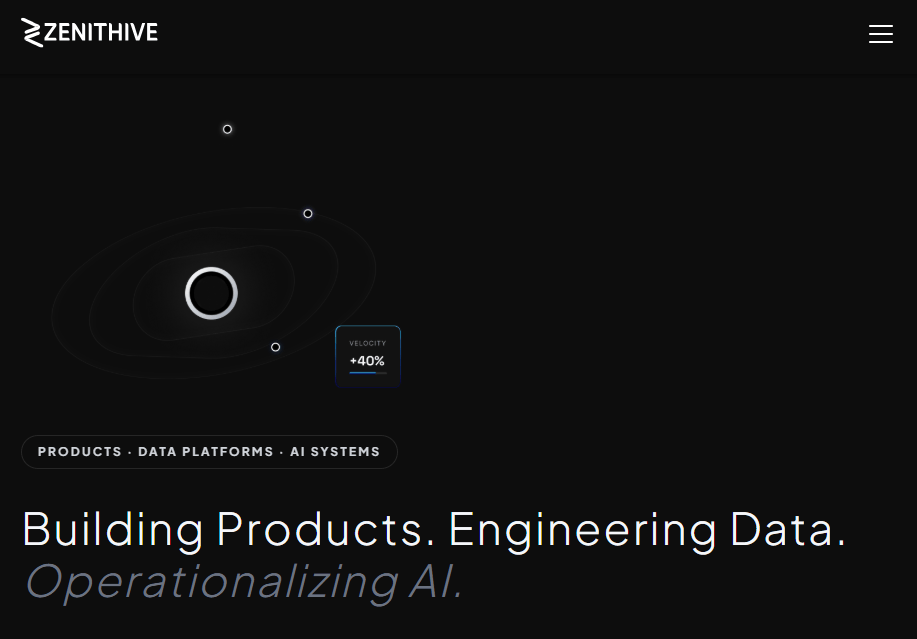
Zenithive is a technology consulting and product engineering company that fields senior engineering pods embedded with your product team, covering SaaS builds, custom software, and modernization work with a product-first stance rather than a staffing one.
Best for: Seed to mid-market teams that want a senior pod to ship SaaS features, data platforms, or AI integrations quickly, then iterate.
Key features:
- Engineering Pod model where each pod is an autonomous unit with named module ownership across discovery, delivery, and evolution
- Product engineering for SaaS and enterprise apps, including data platforms and AI features
- AI and data science practice spanning predictive analytics, NLP, computer vision, and MLOps on Python, TensorFlow, PyTorch, and LangChain
- Full-stack delivery across Golang, Ruby on Rails, Node.js, React, Angular, and Vue, plus UI/UX and DevOps
- Legacy modernization and platform reliability focus
Why we like it: The ownership model is unusually explicit for a firm this size. Zenithive assigns a defined owner to every module and service inside the pod rather than leaving it to shared responsibility, which is exactly the failure mode that turns an outsourced build into a maintenance problem twelve months later. For a startup or business-unit team that needs velocity without permanent headcount, that structure ramps fast.
Limitations:
- Small public footprint, with only 3 verified reviews on Clutch, which limits external reference checking against larger incumbents
- Those Clutch reviews skew toward web and marketing work, with client outcomes described in terms of website traffic and social reach rather than product engineering metrics, so ask for engineering-specific references
- Listed at 11 to 50 employees, which may cap parallel workstreams on large programs
Pricing: Clutch lists a minimum project size of $1,000 and an average hourly rate under $25, which puts project-based work within reach for small teams. Validate against your actual scope before budgeting.
2. WeKan
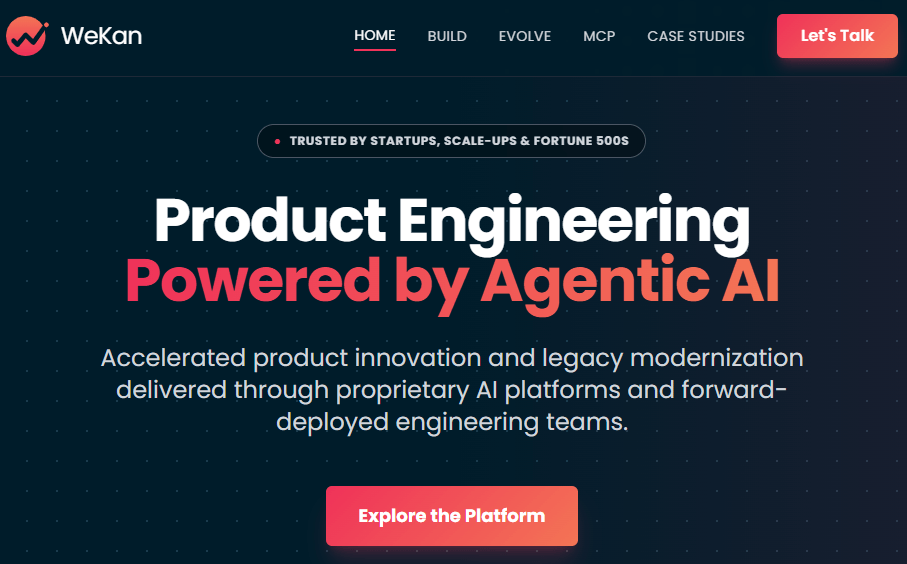
WeKan is an agentic product engineering platform that pairs proprietary multi-agent workflows with forward-deployed engineering teams, aimed at both greenfield builds and legacy modernization. It grew out of a venture studio and now runs modernization programs for Fortune 500 and regulated clients.
Best for: Teams putting agentic AI into production, and that want embedded engineers who work inside real constraints rather than handing over a prototype.
Key features:
- Multi-agent architecture built on Model Context Protocol, connecting agents to your real data, tools, and workflows
- NitroStack, an MCP platform for building AI-native applications or retrofitting agents onto existing systems
- Forward-deployed engineering model that embeds senior engineers alongside your team
- Multi-agent automation applied across modernization, build, QA, and documentation
- Progressive modernization of monoliths, databases, and infrastructure toward cloud-native targets
Why we like it: The forward-deployed model has stopped being a niche idea. Through 2026 the major AI labs and cloud providers have committed billions to standing up their own forward-deployed engineering organizations, AWS alone pledging $1 billion, because agentic systems do not survive the trip from demo to production without engineers inside the customer's environment. If you have already scoped use cases where agents shorten a real feedback loop, WeKan sells that operating model directly rather than selling you tooling and wishing you luck.
Limitations:
- Limited independent, aggregated customer reviews are publicly available, so request references and run a scoped pilot before committing
- Potential brand confusion with the unrelated open-source Wekan kanban tool, which carries its own G2 listing; confirm you are evaluating WeKan at wekan.ai
- Agentic engagements carry higher integration complexity than conventional builds, so data access, permissions, and evaluation criteria need settling in the SOW rather than in discovery
Pricing: Not publicly available. Contact WeKan for a custom quote.
3. RaftLabs
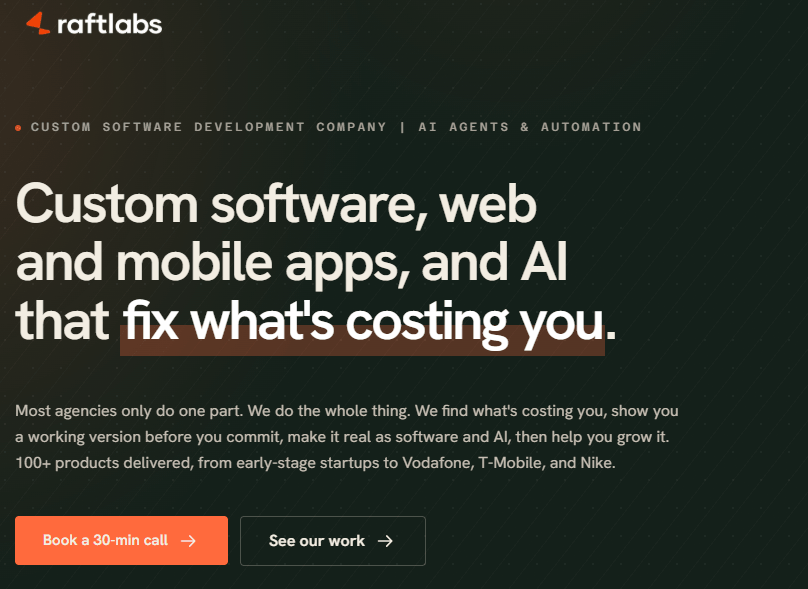
RaftLabs is a product engineering studio built around fixed scope per phase and shipping working software every two weeks, with full IP and code ownership transferring to the client. It works with startups and larger brands including Aldi, Vodafone, and Energia.
Best for: Startups and scale-ups that want predictable, phase-based delivery with senior individual contributors and product-minded engineering.
Key features:
- Fixed scope per phase with a working software increment every two weeks
- Discovery sprint first, then build, with full IP and code ownership
- Typical timelines of 6 to 8 weeks for an MVP and 12 to 14 weeks for a full-featured product across web, iOS, and Android
- More than 100 shipped products across SaaS and AI, per vendor documentation
- Project management run through Asana and Slack with weekly check-ins and direct founder access
Why we like it: Fixed scope per phase is the single most effective structural defense against the drift that kills outsourced builds. Combined with a two-week demoable cadence, it means you find out in a fortnight whether the engagement is working rather than in a quarter. Clutch reviewers consistently credit the firm with delivering inside agreed budgets and timelines, which is the rarer half of that promise.
Limitations:
- Clutch's current review summary flags minor communication issues across teams on some projects, resolved but worth pinning down in your engagement plan
- RaftLabs' own site cites a 4.9/5 rating across 50-plus reviews, while its Clutch profile shows roughly 17 verified reviews, so verify which figure you are being quoted
- Boutique size means multi-track programs may need staggered starts rather than concurrent teams
Pricing: Clutch lists a minimum project size of $10,000 and an average hourly rate of $25 to $49. Verified engagements on the profile range from roughly €1,800 for a product roadmap up to $120,000 for extensive development.
4. Hughes Systique
Hughes Systique (HSC) is a global software R&D and product engineering partner covering architecture, development, testing, and domain solutions across telecom, multimedia, IoT, and connected devices. Founded in 2005 and part of the Hughes group, it operates from Rockville, Maryland with engineering centers in Gurgaon and Bengaluru.
Best for: Enterprises in telecom, media, and device ecosystems that need full lifecycle engineering, modernization, or QA at scale.
Key features:
- Product engineering and custom software development across the full SDLC, including QA automation
- Wireless, embedded systems, satellite, and OTT video engineering capabilities
- Solution accelerators across retail, automotive, multimedia, networks, IoT, and security
- Secure-by-design delivery with ISO 27001:2022 and ISO 27701:2019 certification
- In 2024 HSC became the first company globally appraised at CMMI Level 5 under version 3.0 for development, services, and people combined
Why we like it: Depth where software meets networks and hardware is genuinely scarce, and HSC has it. The certification stack is not decoration either: for regulated procurement, a combined CMMI Level 5 appraisal and current ISO 27001 and 27701 credentials clear gates that would otherwise take months of security review. At 1,000-plus engineers it can also run concurrent workstreams that the boutiques on this list cannot.
Limitations:
- Few aggregated client reviews on major buyer sites, with the G2 seller page showing no product reviews, so you will rely on direct references
- Pricing is not published on marketplaces or buyer directories, which slows early-stage budget validation
- Enterprise process maturity cuts both ways; teams wanting a two-week MVP will find the engagement model heavier than a boutique studio
Pricing: Not publicly available. Contact Hughes Systique for a custom quote, and expect a detailed SOW rather than an hourly band.
Capability Comparison
| Firm | Delivery model | Core technical strength | Scale |
|---|---|---|---|
| Zenithive | Engineering Pods with named module ownership | Full-stack SaaS, data platforms, AI and MLOps | 11 to 50 employees |
| WeKan | Forward-deployed engineers plus agentic platform | Multi-agent MCP systems, monolith to cloud-native | Not publicly stated |
| RaftLabs | Fixed scope per phase, two-week increments | Product builds across SaaS, mobile, and AI | Boutique, 10 to 49 employees |
| Hughes Systique | Full-lifecycle enterprise engineering | Wireless, embedded, satellite, OTT video | 1,000-plus employees |
Engagement and Integration
| Firm | Typical environment | Integration complexity | Third-party signal |
|---|---|---|---|
| Zenithive | Cloud targets per engagement, customer-managed possible | Moderate, depends on legacy surface area | 3 verified Clutch reviews |
| WeKan | Cloud and API-integrated agentic workflows | Moderate to high for agentic use cases | Minimal aggregated reviews |
| RaftLabs | Cloud-first SaaS and mobile builds | Moderate, contained by phase scope | Roughly 17 verified Clutch reviews |
| Hughes Systique | Cloud plus device and network integrations | High for embedded and network-heavy stacks | CMMI Level 5, ISO 9001, 27001, 27701 |
Strategic Decision Framework
| Critical question | Why it matters | What to evaluate | Red flags |
|---|---|---|---|
| Do you need embedded senior ICs or staff augmentation? | Ownership level drives outcomes more than headcount | Pod composition, lead-to-IC ratio, escalation paths | Team is mostly juniors or interchangeable contractors |
| How will you ship value every two weeks? | Cadence beats scope drift | Demoable increments, release plan, definition of done | Vague sprint goals with no acceptance criteria |
| What is your data and security boundary? | AI and modernization work hinge on data flows | Data residency, PII handling, audit trails, certifications | "We will figure it out later" on data access and logging |
| Is there third-party validation for price and quality? | Independent benchmarks save time and money | Clutch or similar ratings, certifications, review counts | Only marketing claims, or self-reported ratings that do not match the profile |
| Can they run your workstreams concurrently? | Staggered starts stretch a two-quarter plan into four | Headcount, bench depth, named team availability | Vendor commits to parallel tracks without naming the people |
Problems & Solutions
-
Problem: Your SaaS team must add a production AI feature without derailing the roadmap.
Solution: RaftLabs' phase-based model with two-week increments keeps working software shipping on cadence, and its Clutch-listed rate band makes budget exposure predictable for a scoped addition. Lock documentation and acceptance criteria up front, since reviewers have flagged communication gaps on some projects. -
Problem: You need a senior team embedded quickly to stabilize a legacy codebase and ship a paid pilot.
Solution: Zenithive's pod model is built for embedded work with explicit module ownership. The low stated minimum and hourly band make small pilots easy to start, then scale if outcomes land. Ask specifically for engineering references, since its public review base leans toward web and marketing engagements. -
Problem: You want to accelerate modernization with agentic AI but your internal team is new to multi-agent workflows.
Solution: WeKan pairs an agentic platform with forward-deployed engineers to close the demo-to-production gap, the same operating model the major AI providers have invested heavily in through 2026. Because independent reviews are scarce, run a short pilot with measurable outcomes before committing to a program. -
Problem: Telecom or device-adjacent modernization requires embedded software, wireless, and OTT engineering in one place.
Solution: Hughes Systique operates across all three with certifications that satisfy procurement and security review, which matters when the buying process includes a formal vendor assessment. Ask for domain-matched references, since aggregated public reviews are thin, and price through a detailed SOW. -
Problem: Procurement wants a price benchmark before you can even start a conversation.
Solution: Zenithive and RaftLabs both publish rate bands and minimum project sizes on Clutch, which gives you a defensible starting number. WeKan and Hughes Systique quote per engagement, so build in extra lead time for scoping and budget approval.
The Bottom Line
Shortlist by outcomes, not adjectives. Start with one scoped increment that a real user touches inside two to four weeks, insist on a written acceptance rubric, and use independent signals to benchmark price and quality before you sign anything.
Which firm fits depends on the constraint you are actually solving for. If the problem is budget certainty, RaftLabs' fixed scope per phase is the most direct answer here. If it is speed with senior ownership at small scale, Zenithive's pod model starts cheaply enough to test.
If it is getting agents past the demo stage, WeKan sells the embedded operating model the whole industry converged on this year. And if procurement, compliance, and network or device complexity are the gates, Hughes Systique is the only option on this list built to clear them.
With the category heading toward $354 billion by 2028, the good partners book fast and the weak ones talk faster. Anchor the decision in references, a pilot, and a release plan that burns down risk week by week.