
You think you know where AI spend and risk live until month end hits and the audit committee asks why token bills spiked while three shadow tools slipped past your approvals. Working across different tech companies, the biggest gaps we keep seeing are technical, not just policy.
Three examples: token-level budget guards tied to model allowlists, browser and endpoint controls that stop sensitive data at the paste event, and audit trails mapped to NIST AI RMF and ISO 42001 outcomes. The market is moving fast, which is why independent spend and governance controls are rising as a priority, a trend echoed in recent CIO reporting on token cost creep and governance pressure (CIO, CIO).
According to Gartner, spending on AI governance platforms is projected to reach $492 million in 2026 and surpass $1 billion by 2030 as regulations expand and buyers operationalize oversight (Gartner newsroom). In minutes, you will learn how each platform approaches discovery, policy, spend controls, and evidence, plus where the limitations show up in the real world, with references to widely used frameworks like the EU AI Act, NIST AI RMF, and ISO 42001 (EUR-Lex, NIST AI RMF, ISO overview).
Govern365
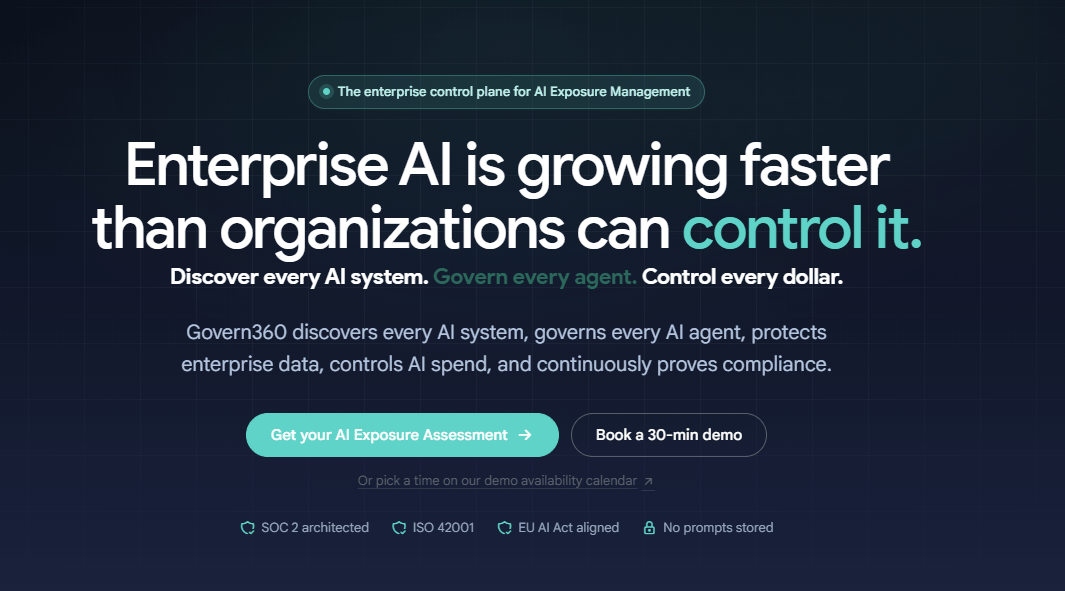
Mid-market AI governance platform that combines AI system inventory, risk assessment, compliance tracking, evidence collection, and incident management, with a stated goal of moving teams from spreadsheets to audit-ready in days. Per vendor documentation.
Best for: Mid-market GRC and compliance teams with limited resources that need audit-ready AI governance mapped to multiple frameworks without standing up a large compliance function.
Key Features:
- Central AI System Registry covering every model, application, and agent, with providers, versions, approval status, data inputs, and use cases, per vendor documentation.
- Risk Assessment Engine with contextual scoring aligned to ISO 42001, EU AI Act risk categories, and NIST AI RMF, plus an Audit Evidence Manager that generates PDF and DOCX compliance reports, per vendor documentation.
- Governance workflows, continuous monitoring, and incident management, with higher tiers adding LLM evaluation, bias and fairness testing, and shadow-AI agent discovery, per vendor documentation.
Why we like it: Fast time to value and framework-mapped evidence help close the "policy on paper" gap that auditors and boards flag most often.
Notable Limitations:
- Point-of-use runtime controls, such as paste-time or endpoint data-loss prevention, are not the platform's focus, so pair it with a dedicated DLP or endpoint tool if blocking sensitive inputs at the browser is a requirement.
- Independent third-party reviews are limited as of July 13, 2026, and buyer references are scarce in public forums compared with larger GRC suites (Gartner Peer Insights category overview).
- As with most governance platforms, integration work is required to align with existing DLP, EDR, SASE, and identity stacks, a common challenge noted in analyst coverage of operational governance rollouts (Forrester).
Pricing: Four fixed-price tiers (Starter, Professional, Business, and Enterprise) with a 14-day free trial; self-hosted deployment and SSO are available at higher tiers. Confirm current pricing with the vendor.
Kovalba
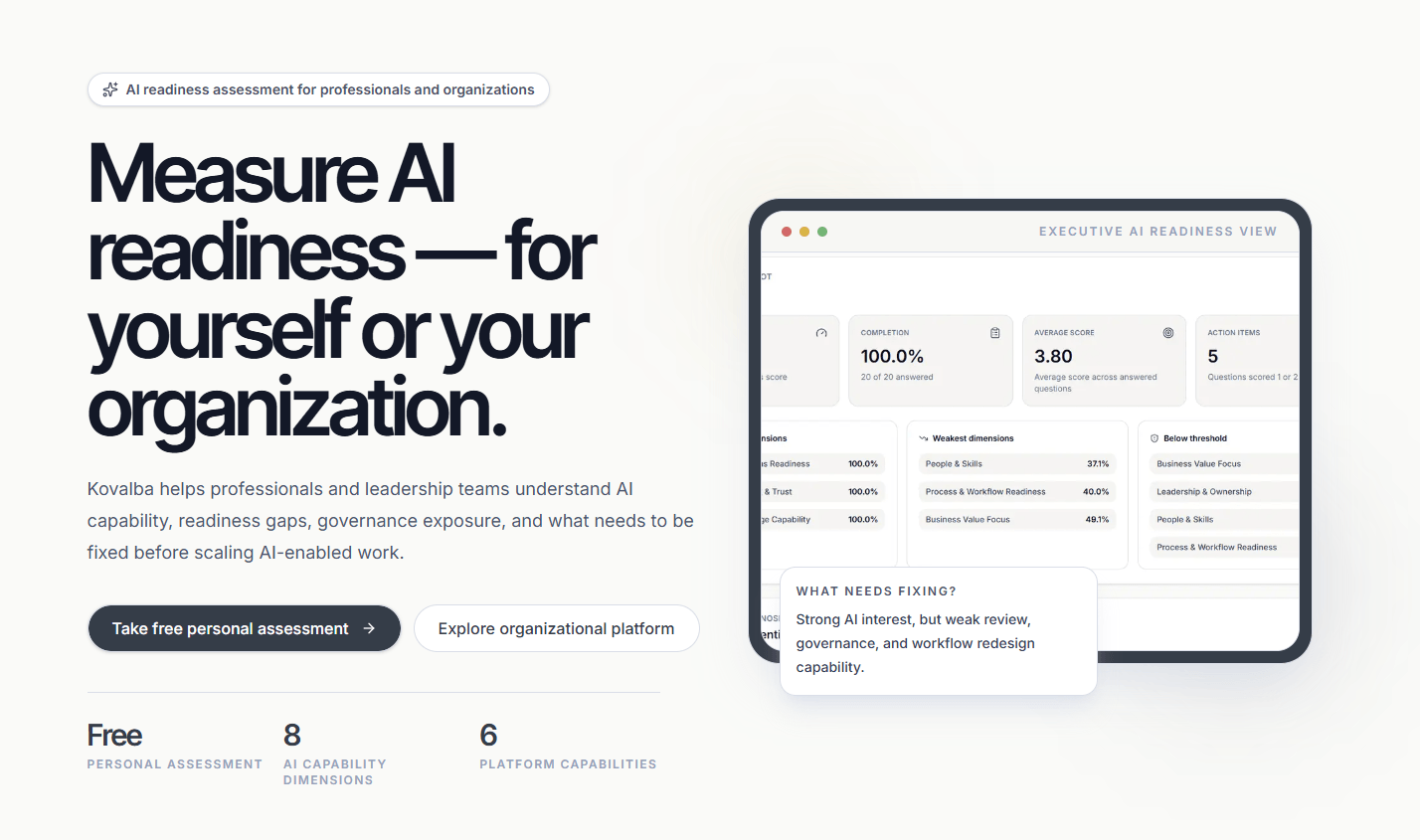
Organizational AI readiness and enablement platform that measures capability, governance exposure, and readiness gaps across individuals and departments. Verified per vendor documentation.
Best for: CIO, CAIO, and HR-led enablement programs that need a quantified readiness baseline before scaling AI use across business functions.
Key Features:
- Role-aware readiness assessments covering capability, adoption, oversight, and governance exposure, per vendor documentation.
- Department and individual gap analysis with prescriptive enablement plans, per vendor documentation.
- Portfolio-level diagnostics that inform governance priorities before production deployment, per vendor documentation.
Why we like it: Readiness and change management are where many AI programs fail. Kovalba focuses on organizational capability building that complements control planes and runtime policy tools.
Notable Limitations:
- Few independent customer reviews or analyst mentions are available as of July 13, 2026. Plan to run a pilot and request references.
- Does not replace runtime governance or spend controls, which multiple analysts position as distinct capabilities from readiness assessments (Forrester Wave on GRC vs AI governance scope).
Pricing: Pricing not publicly available. Contact Kovalba for a custom quote.
Onaro
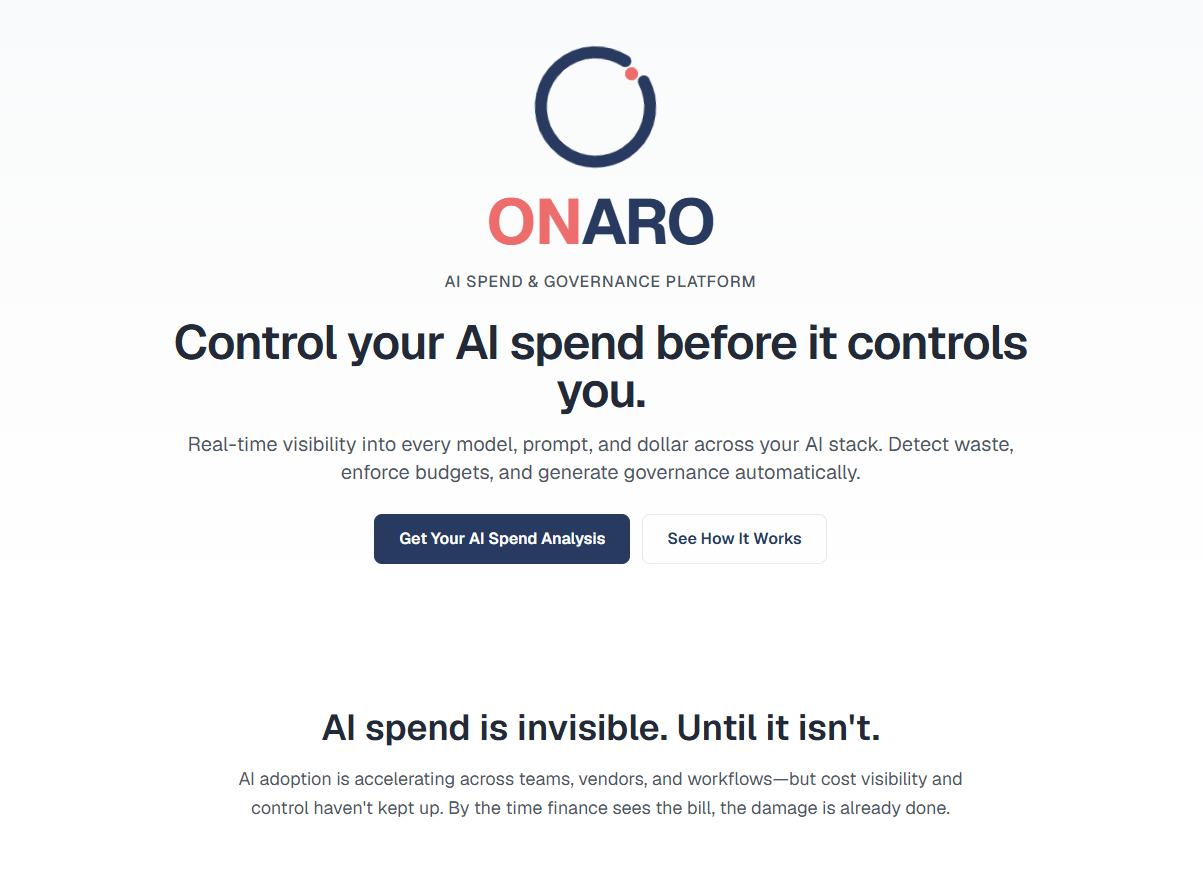
Real-time AI spend and governance platform focused on model usage tracking, waste detection, budget enforcement, and audit logs. Verified per vendor documentation.
Best for: FinOps and platform teams that need live token and spend visibility tied to governance policy, plus enforcement against budgets across models and vendors.
Key Features:
- Real-time model usage tracking with spend analytics and waste detection, per vendor documentation.
- Budget and policy enforcement that links workflows to audit-ready outputs, per vendor documentation.
- Governance workflow automation that translates policies into operational monitoring and evidence, per vendor documentation.
Why we like it: The platform ties governance and FinOps together, which aligns with independent guidance that token-based pricing drives unpredictable costs without tight controls (CIO, Flexera 2026).
Notable Limitations:
- Limited third-party reviews and benchmarks as of July 13, 2026. Treat production pilots and reference checks as mandatory.
- Feature depth around multi-cloud policy routing and on-prem agent coverage is not widely validated by independent sources.
Pricing: Pricing not publicly available. Contact Onaro for a custom quote.
Govern Your AI
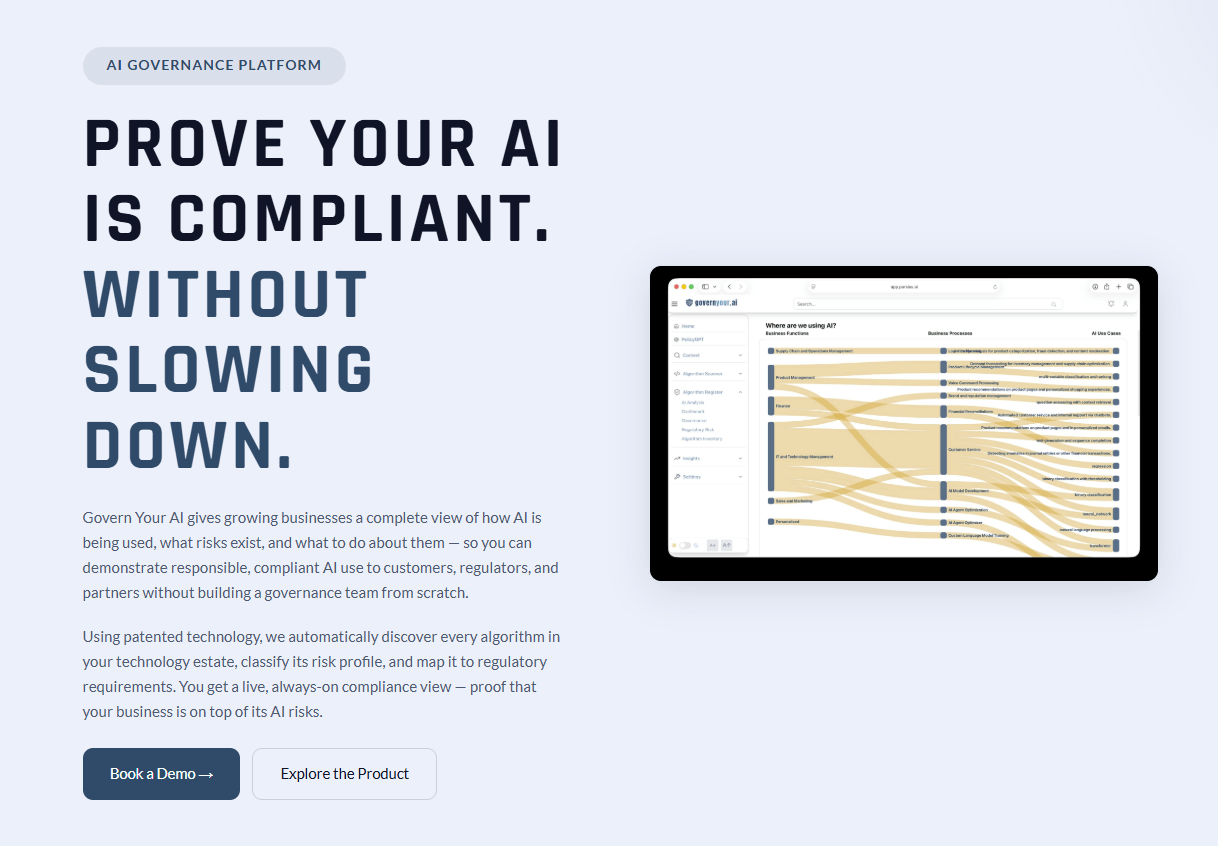
Automated governance platform that discovers algorithms, classifies risk against regulations, and produces readiness diagnostics and governance blueprints. Verified per vendor documentation.
Best for: Compliance and risk teams that want out-of-the-box regulatory mapping, portfolio visibility, and board-level reporting.
Key Features:
- Discovery of AI use across the business with risk classification against regulations, per vendor documentation.
- Readiness diagnostics and governance blueprints aligned to frameworks such as the EU AI Act and ISO 42001 concepts, per vendor documentation.
- Board-ready dashboards that show risk posture, ownership, and compliance status, per vendor documentation.
Why we like it: Strong emphasis on regulatory translation and evidence, which many teams now need for RFPs and customer audits as AI clauses become common in contracts and tenders (EU AI Act, NIST AI RMF Playbook).
Notable Limitations:
- Sparse independent reviews as of July 13, 2026. Validate roadmap and reporting exports during trials.
- The platform's coverage of runtime enforcement is less visible in third-party materials, so confirm how decisions translate to controls.
Pricing: Pricing not publicly available. Contact Govern Your AI for a custom quote.
AI Readiness and Governance Budget Tools Comparison: Quick Overview
| Tool | Best For | Pricing Model | Highlights |
|---|---|---|---|
| Govern365 | Mid-market GRC and compliance teams | Tiered, free trial | Inventory, risk scoring, audit evidence, framework mapping |
| Kovalba | Org-wide readiness and enablement | Custom quote | Capability and governance exposure assessments with prescriptive plans |
| Onaro | FinOps and platform teams | Custom quote | Real-time spend analytics, budget enforcement, audit logs |
| Govern Your AI | Compliance and risk teams | Custom quote | Regulatory mapping, readiness diagnostics, board reporting |
AI Readiness and Governance Budget Platform Comparison: Key Features at a Glance
| Tool | Discovery Inventory | Spend Budgets | Audit Evidence |
|---|---|---|---|
| Govern365 | Yes | No, not its focus | Yes |
| Kovalba | Readiness discovery | No | Program-level diagnostics |
| Onaro | Yes | Yes | Yes |
| Govern Your AI | Yes | Indirect | Yes, reporting and blueprints |
AI Readiness and Governance Budget Deployment Options
| Tool | Cloud API | On-Premise | Integration Complexity |
|---|---|---|---|
| Govern365 | Yes | Yes, self-hosted at higher tiers | Moderate, depends on DLP, SASE, IdP integrations |
| Kovalba | Yes | Not verified | Low to moderate, HRIS and SSO helpful |
| Onaro | Yes | Not verified | Moderate, requires FinOps and model provider data |
| Govern Your AI | Yes | Not verified | Low to moderate, depends on evidence sources |
AI Readiness and Governance Budget Strategic Decision Framework
| Critical Question | Why It Matters | What to Evaluate | Red Flags |
|---|---|---|---|
| Can we discover shadow AI, then govern at the paste or call level? | OWASP flags sensitive information disclosure as a top LLM risk, so point-of-use control is crucial (OWASP LLM Top 10). | Browser and endpoint controls, agent registry, model allowlists, token budgets. | Inventory without enforcement, or controls that only work post-incident. |
| How do we tie token usage to budgets and owners? | Token pricing drives unpredictable costs without discipline (CIO, Flexera 2026). | Real-time usage, budgets per app and team, alerts, shut-offs, chargeback. | Monthly CSVs, no per-model or per-team budgets, no alerting. |
| Are we aligned to required frameworks? | EU AI Act, NIST AI RMF, and ISO 42001 are now common in audits and RFPs (EU AI Act, NIST AI RMF, ISO overview). | Mappings to obligations and an evidence model that survives audits. | "Policy portal" without verifiable evidence or control-to-obligation traceability. |
| Can we prove governance to executives and auditors? | Breach costs remain high and AI governance gaps are now a documented cost driver (IBM Cost of a Data Breach 2025). | Board-level KPIs, audit logs, immutable trails, export formats. | Screenshots and spreadsheets as primary evidence. |
AI Readiness and Governance Budget Solutions Comparison: Pricing & Capabilities Overview
| Organization Size | Recommended Setup | Monthly Cost | Annual Investment |
|---|---|---|---|
| 200-1,000 employees | Discovery plus budget governance in one platform, readiness baseline for key teams | Pricing not publicly available | Pricing not publicly available |
| 1,000-10,000 employees | Control plane with paste-time controls, FinOps budgets, regulatory mapping, training paths | Pricing not publicly available | Pricing not publicly available |
| 10,000+ employees | Federated governance council, multi-cloud and SaaS discovery, integrated DLP and SIEM, executive KPIs | Pricing not publicly available | Pricing not publicly available |
Problems & Solutions
-
Problem: Shadow AI and paste-level data leaks. OWASP lists sensitive information disclosure as a top LLM risk, and recent research highlights system-prompt and context leakage concerns (OWASP LLM Top 10, OWASP 2025 PDF, arXiv on instruction leakage).
How the tools address it: Govern365 focuses on discovering and inventorying AI systems, classifying risk, and producing audit evidence, so unmanaged tools surface for review; pair it with a dedicated DLP or endpoint tool for paste-time blocking. Onaro focuses on runtime monitoring tied to policy, surfacing violations and leaving an audit trail. Govern Your AI emphasizes discovery and risk classification that informs where controls are needed. Kovalba helps identify governance exposure before rollout so you reduce risky pilot behavior. Statements per vendor documentation. -
Problem: Token overspend and budget unpredictability. Independent coverage shows token-based consumption can spike costs without active governance, and organizations report growing AI waste (CIO, CIO, Flexera 2026).
How the tools address it: Onaro centers on live usage, waste detection, and budgets with enforcement. Govern Your AI contributes by flagging high-risk or unapproved use cases that drive unbudgeted spend. Kovalba's readiness plans can incorporate FinOps guardrails before teams scale usage. Statements per vendor documentation. -
Problem: Regulatory and audit pressure. EU AI Act obligations and NIST AI RMF outcomes are increasingly referenced in audits, tenders, and customer questionnaires, and ISO 42001 gives organizations a management-system model for AI governance (EU AI Act, NIST AI RMF Playbook, ISO overview).
How the tools address it: Govern Your AI focuses on risk classification against regulations and board-ready reporting. Govern365 maps risk and evidence to frameworks such as ISO 42001, the EU AI Act, and NIST AI RMF, and centralizes governance workflows. Onaro generates operational evidence from runtime monitoring and workflows. Kovalba accelerates organizational alignment so framework adoption sticks. Statements per vendor documentation. -
Problem: Proving governance effectiveness to executives. Breach costs remain significant and AI-related breaches increasingly stem from ungoverned tools, which amplifies the need for tamper-evident trails and clear KPIs (IBM Cost of a Data Breach 2025).
How the tools address it: Govern365's compliance dashboards and audit evidence manager help translate governance into board-ready reporting. Onaro's audit logs and budget controls show cause-and-effect on spend and policy. Govern Your AI's dashboards package posture and ownership for board reviews. Kovalba's readiness metrics quantify progress outside of production. Statements per vendor documentation.
The Bottom Line on Buying AI Readiness and Governance Budget Platforms
Most teams discover their biggest gaps when finance flags token overages or a client security questionnaire asks for evidence you do not yet have. The four platforms here take different routes to the same goal, which is operational control with proof.
Use independent references as your compass: AI governance is now an investable category per Gartner, not just a policy binder, and token economics and governance practice continue to drive budget pressure in production programs (CIO). Start with discovery and budgets, map to frameworks with evidence, and insist on a pilot that proves enforcement before you scale.
