Most teams discover their quantum plans crumble during initial proofs of concept, not from analyst decks. Working across different tech companies, I have seen pilots stall because circuit depth budgets were misestimated, annealing embeddings exploded variable counts, or cloud shot costs consumed the budget. From my experience in the startup ecosystem, the biggest wins come when you match hardware modality to problem type, for example, using trapped-ion systems with mid-circuit measurement, annealing hybrids for large QUBO optimization, and photonics for Gaussian boson sampling validated in Nature. The market is no longer theory only, with spending projected to hit $7.6 billion by 2027 per IDC's forecast. You will learn where each shines, what it costs, and how to avoid expensive dead ends.
D-Wave Quantum
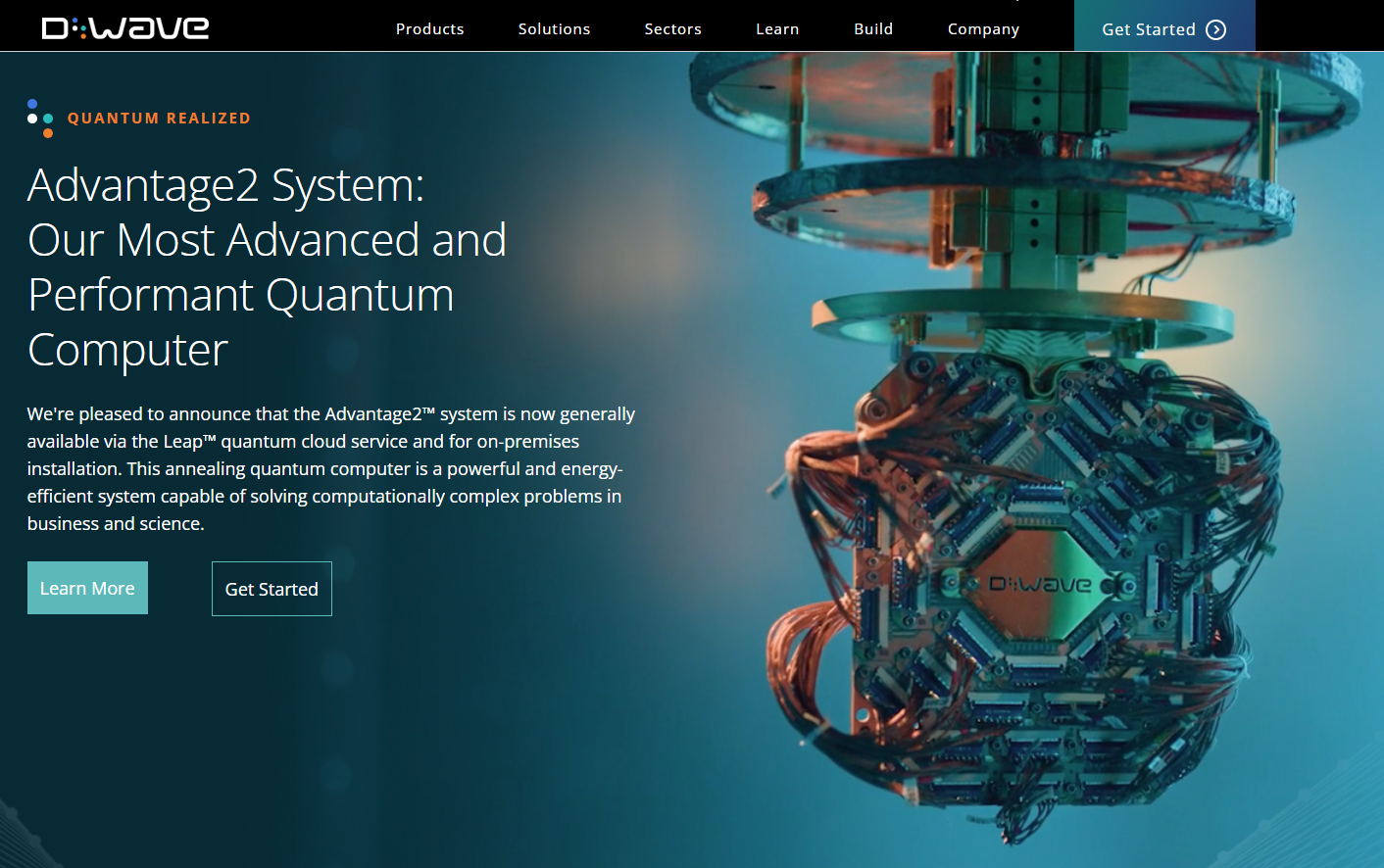
Provider of quantum annealing systems and a cloud service for large-scale optimization, scheduling, and sampling. Its sixth-generation Advantage2 annealer is available through the Leap service and in select on-prem deployments.
Best for: Operations research teams needing production-scale QUBO or Ising optimization with hybrid solvers.
Key Features:
- Advantage2 annealing QPU with 4,400+ qubits, generally available in 2025 via Leap, per company announcement carried on Business Wire.
- Proven deployments and placements for government and research use, including Davidson Technologies in Alabama and European expansion, covered by Investing.com and Barron's.
- Hybrid cloud solvers that accept very large optimization models, referenced in the Leap listing on the AWS Marketplace.
Why we like it: For logistics and scheduling, annealing often reaches useful answers fast without deep circuit design, and the hybrid solvers absorb messy real data.
Notable Limitations:
- Quantum annealing is specialized and not universal, and requires QUBO mapping that can add overhead per peer-reviewed analyses of embedding penalties in PRX Quantum and arXiv.
- Noise, calibration drift, and topology constraints can affect solution quality, documented in studies of annealer noise on arXiv.
Pricing: Pricing not publicly available. D-Wave offers private offers for Leap access and services on the AWS Marketplace.
IonQ
General-purpose trapped-ion quantum computers with high fidelity, delivered via major clouds and in data-center-ready racks.
Best for: R&D groups building gate-model algorithms, chemistry, optimization heuristics, and quantum ML with cloud access and optional reserved capacity.
Key Features:
- On-demand access on Amazon Braket with transparent per-shot, per-task, and hourly reservation pricing for Aria and Forte families, per the Amazon Braket pricing page.
- Azure Quantum token-based pricing and subscriptions, including detailed per-gate shot rates and minimums for Aria and Forte, documented by Microsoft Learn.
- Rack-mounted Forte Enterprise system for data center environments and global availability on Braket, covered by DataCenterDynamics and a Business Wire release indexed by IonQ's investor news.
Why we like it: Clear pricing on AWS and Azure simplifies budgeting, while trapped-ion fidelity and all-to-all connectivity help real algorithms converge with less transpiler pain.
Notable Limitations:
- Trapped-ion two-qubit gates are slower than some superconducting systems, which can limit throughput, noted in modality comparisons and benchmarking commentary such as post-quantum engineering analyses and broader cross-vendor benchmarks summarized by The Quantum Insider.
- The Algorithmic Qubits metric has published criticisms about susceptibility to error-mitigation assumptions, documented by the community in the Quantum Benchmark Zoo and overview notes on Wikipedia.
Pricing:
- Amazon Braket as of November 2025: per task $0.30, IonQ Aria $0.03 per shot, IonQ Forte $0.08 per shot, and reservations at $7,000 per hour, per the Braket pricing table.
- Azure Quantum per-gate shot pricing with execution minimums and optional subscriptions, per Microsoft Learn.
Quantinuum
End-to-end provider combining trapped-ion H-Series hardware with compilers and chemistry software, with access through its cloud and Azure Quantum.
Best for: Teams that need high-fidelity gate-model hardware with mid-circuit measurement, qubit reuse, and all-to-all connectivity, plus enterprise chemistry tooling.
Key Features:
- H2 systems with all-to-all connectivity, mid-circuit measurement, and qubit reuse highlighted by independent reporting, for example Forbes.
- Record-class collaborations, including Random Circuit Sampling results and speedups with JPMorgan Chase and national labs, covered by the Argonne Leadership Computing Facility and JPMC's tech news page.
- InQuanto chemistry suite and hybrid workflows with NVIDIA cuQuantum reported on Quantinuum's news blog and summarized by industry coverage.
Why we like it: The combination of fidelity, mid-circuit primitives, and enterprise chemistry stack cuts iteration time for algorithms that require feed-forward and error detection.
Notable Limitations:
- Gate speeds on trapped-ion platforms are slower, so deep circuits can have long wall times despite high fidelity, as discussed in technical breakdowns like post-quantum's Helios analysis.
- Primarily cloud access, with limited public detail on on-prem enterprise purchases, and queue windows that alternate with upgrade periods, per Microsoft's Quantinuum provider guide.
Pricing: Azure Quantum subscription plans list Standard at $135,000 per month and Premium at $185,000 per month with hardware and emulator credits, per Microsoft Learn.
Xanadu
Photonic quantum computing focused on room-temperature integrated optics and open-source software for photonic circuits and quantum ML.
Best for: Research teams exploring photonic algorithms, Gaussian boson sampling, and quantum ML with open-source tooling that targets photonic backends.
Key Features:
- Demonstrated cloud-accessible photonic computational advantage with Borealis performing programmable Gaussian boson sampling on 216 modes, peer-reviewed in Nature.
- Ecosystem leadership in photonic simulation and circuit design is reflected in reviews that survey Strawberry Fields among leading photonic simulators, for example an overview on arXiv.
- Corporate momentum with plans to go public via a SPAC merger in late Q1 or early Q2 2026, covered by Reuters.
Why we like it: Photonics runs at room temperature, lends itself to networking and modularity, and is backed by a strong software stack for photonic workflows from simulation to execution.
Notable Limitations:
- Borealis and related demonstrations target sampling problems, not general-purpose fault tolerance, and classical simulation advances continue to challenge some sampling claims, as discussed in Nature Physics coverage.
- Public pricing and broad enterprise SLAs are limited, and hardware access is typically gated through research programs or specific cloud portals noted in academic and trade press overviews like Optics & Photonics News.
Pricing: Pricing not publicly available.
PsiQuantum

Photonic quantum computing company pursuing fault-tolerant, utility-scale systems built on silicon photonics and large cooling and networking infrastructure.
Best for: Strategy and R&D leaders tracking timelines to fault tolerant machines and evaluating future photonic deployment models at data-center scale.
Key Features:
- Integrated photonic chipset development in commercial foundries, including GlobalFoundries, reported in funding and technology announcements via Business Wire and covered by AFP.
- Major project sites in Brisbane and Chicago with government and investor backing, reported by Reuters and Australian press such as The Australian.
- DARPA program progression toward validation of utility-scale architecture, reported on Business Wire.
Why we like it: If your roadmap hinges on fault tolerance and data-center integration, their foundry-grade pathway and public program milestones inform long-term planning.
Notable Limitations:
- No generally available hardware or cloud service for commercial workloads as of November 2025, and timelines remain dependent on large-scale integration milestones, as inferred from the construction and funding updates in Reuters.
- Pricing and APIs are not public.
Pricing: Pricing not publicly available.
Quantum Computing Platforms Comparison: Quick Overview
| Tool | Best For | Pricing Model | Highlights |
|---|---|---|---|
| D-Wave Quantum | Large optimization problems now | Private quotes for Leap and services | Advantage2 annealer, hybrid solvers, deployments reported by Investing.com. |
| IonQ | Gate-model algorithms on cloud or reserved access | Per-shot, per-task, hourly reservations on AWS, token model on Azure | Transparent prices on AWS Braket and plans on Microsoft Learn. |
| Quantinuum | High-fidelity circuits with mid-circuit measurement | Azure monthly subscriptions | Mid-circuit measurement, qubit reuse, and RCS results with JPMC per Argonne ALCF. |
| Xanadu | Photonic research, GBS, quantum ML | Not public | Cloud photonic advantage in Nature; public listing plan covered by Reuters. |
| PsiQuantum | Fault-tolerant photonic roadmaps | Not public | Billion-dollar funding and data-center builds reported by Reuters. |
Quantum Computing Platform Comparison: Key Features at a Glance
| Tool | Modality | Signature Capabilities | Independent Signal |
|---|---|---|---|
| D-Wave Quantum | Quantum annealing | Large QUBO optimization with hybrid solvers | New Advantage2 GA noted by Business Wire. |
| IonQ | Trapped-ion, gate-model | High fidelity, all-to-all connectivity, data-center racks | Pricing and availability on AWS Braket. |
| Quantinuum | Trapped-ion, gate-model | Mid-circuit measurement, qubit reuse, H-Series | RCS and algorithmic speedup per Argonne ALCF. |
| Xanadu | Photonic | Room-temperature photonics, programmable GBS | Photonic advantage peer-reviewed in Nature. |
| PsiQuantum | Photonic | Foundry-grade integrated photonics, large-scale cooling and networking | Facility buildout and funding per Reuters. |
Quantum Computing Deployment Options
| Tool | Cloud API | On-Premise | Integration Complexity |
|---|---|---|---|
| D-Wave Quantum | Leap cloud access | Yes, select placements reported | Low for QUBO users, mapping overhead documented by PRX Quantum. |
| IonQ | AWS and Azure | Yes, rack-mounted Forte Enterprise | Moderate, costs predictable via AWS pricing. |
| Quantinuum | Azure Quantum and vendor cloud | Limited public information | Moderate to high, queue windows noted by Microsoft Learn. |
| Xanadu | Research cloud access in programs | Not public | Moderate, photonic workflows per Optics & Photonics News. |
| PsiQuantum | Not public | Not public | Planning stage, timelines per Reuters. |
Quantum Computing Strategic Decision Framework
| Critical Question | Why It Matters | What to Evaluate | Red Flags |
|---|---|---|---|
| Do you need answers for optimization today or algorithmic research flexibility? | Modality choice drives time to value and cost | Annealing vs gate-model fit, hybrid solver limits, mid-circuit needs | Assuming a universal approach fits all problems; ignoring QUBO embedding penalties per PRX Quantum. |
| What is your true cost per experiment? | Shot and reservation fees add up quickly | AWS per-shot and reservation pricing, Azure token minimums | Budgeting without referencing current AWS Braket pricing and Microsoft Learn. |
| How sensitive is your use case to gate fidelity vs gate speed? | Trapped-ion excels in fidelity, not raw speed | Algorithm depth, parallelism, and wall-time | Ignoring slower two-qubit gates noted in modality overviews like post-quantum. |
| Do you require air-gapped or on-prem access? | Compliance and IP constraints | Availability of on-prem racks or system placements | Assuming every vendor offers enterprise on-prem with SLAs, when public info is limited. |
Quantum Solutions Comparison: Pricing and Capabilities Overview
| Organization Size | Recommended Setup | Monthly Cost | Annual Investment |
|---|---|---|---|
| Startup or Lab team | IonQ Aria on AWS Braket, 50k shots plus tasks for iterative VQE/QAOA experiments | Example, $0.30 task + 50,000 shots × $0.03 ≈ $1,500.30 per month, see AWS Braket pricing | ≈ $18,003, excluding data egress and storage |
| Mid-market R&D | Azure Quantum pay-as-you-go with IonQ token model for sporadic workloads | Minimums start at $12.42 to $97.50 per execution depending on settings, per Microsoft Learn | Usage dependent |
| Enterprise chemistry | Quantinuum Azure subscription, Standard plan | $135,000 per month per Microsoft Learn | $1,620,000 |
| Logistics optimization | D-Wave Leap private offer for hybrid solver access | Pricing not public, private offers via AWS Marketplace | Custom |
Note, costs are examples based on public rates as of November 2025.
Problems & Solutions
-
Problem, city-scale routing and yard scheduling: Docks, cranes, and delivery windows change hourly and classical heuristics plateau. Solution, annealing hybrids: Reports cite D-Wave's annealing systems improving port and retail scheduling efficiency through hybrid solvers, including case figures quoted in a Forrester-framed piece at TechNewsWorld. For program design, budget for QUBO embedding overheads discussed in PRX Quantum.
-
Problem, reaction pathway exploration in drug discovery: Classical simulation runs can be intractable without approximations. Solution, trapped-ion cloud runs: IonQ has reported collaborations with NVIDIA, AWS, and AstraZeneca, including reaction simulation speedups summarized by Investopedia. Use AWS per-shot pricing to cap experiment spend, per the Braket pricing table.
-
Problem, portfolio optimization and certified randomness for risk systems: Some cryptographic randomness protocols map well to RCS and mid-circuit workflows. Solution, high-fidelity trapped-ion hardware: JPMorgan Chase, Argonne, and Quantinuum demonstrated theoretical speedup in QAOA and certified randomness using Quantinuum's systems, detailed by the Argonne Leadership Computing Facility and JPMC's technology news.
-
Problem, graph problems and molecular vibronic spectra sampling: Exact classical sampling is prohibitive. Solution, photonic GBS: Xanadu's Borealis demonstrated programmable GBS at scale, peer-reviewed in Nature, with broader applications to dense subgraph and vibronic spectra discussed in reviews such as Science China/Elsevier on PubMed.
-
Problem, planning for fault-tolerant workloads and data-center integration: Teams need to understand likely timelines and infrastructure implications. Solution, monitor photonic foundry roadmaps: PsiQuantum's funding, government partnerships, and facility construction milestones inform readiness planning, covered by Reuters and investor news summarized on Business Wire.
The Bottom Line on Picking a Quantum Platform
You think you know which platform to pick until your first cost model exposes the real constraints - circuit depth budgets, queue windows, embedding overheads, and cloud billing that scales faster than your roadmap. The safest approach in 2026 is to start with a strict problem-to-modality mapping, lock a pilot budget to published cloud rates (AWS Braket, Azure Quantum), and run two short proofs of value across different modalities before committing to a single vendor stack.
Market momentum is still real, but treat topline forecasts as directional anchors, not guarantees. IDC’s widely cited outlook still points to quantum computing customer spend reaching $7.6B by 2027, and IDC has since extended its tracking into a 2024–2028 forecast window, signaling continued category expansion beyond the earlier horizon. Other research firms project larger 2030 outcomes (for example, MarketsandMarkets projects $20.2B by 2030), reinforcing the growth narrative while underscoring that estimates vary widely by definition and scope.
Decision-wise: if you need optimization impact this quarter, annealing and hybrid solvers (for example D-Wave) are the most direct path. If you are building gate-model IP, trapped-ion platforms with strong documentation and cloud access (for example IonQ, Quantinuum) reduce iteration friction. If you are betting on photonics, treat it as a roadmap bet - follow milestone proof points and financing signals (the sector is active, including major vertical-integration moves like IonQ’s announced SkyWater acquisition) but budget around what you can run on cloud today.