

People searching “sovereign AI cloud” still land here. The shortlist is infrastructure: hosted inference in a defined jurisdiction, dedicated or on-premises infrastructure, software for running open-weight models on your own hardware, and execution controls that govern where models and data are allowed to run. Those are not four flavors of the same cloud. A shipping container with GPUs on the plant, a German API you call like OpenAI, a USB-boot OS for a box you already own, and a software gate that decides which tool an agent may run are four different purchases. A low-cost hosted API and infrastructure deployed at your own site solve very different sovereignty requirements, so they should not be compared on price alone.
IBM, SAP, AWS, Scaleway, OVHcloud, and IONOS all sell European or air-gapped regions on an existing cloud account. This shortlist is a named object you can point at (a container, a German API, a USB-boot OS, or an on-box gate) plus weights you can move if the vendor disappears. A sovereign region on a hyperscaler account is a different purchase: you still sit inside that vendor’s tenancy, and a region flag can still send the prompt to a US subprocessor. Then ask where the prompt sits. Sovereign is a location plus an exit, not a logo.
The calendar moved too. The Digital Omnibus on AI (Regulation (EU) 2026/1744) entered into force on 27 Jul 2026, as the Commission’s notice records. Transparency obligations in Article 50 of the AI Act (Regulation (EU) 2024/1689) apply from 2 Aug 2026 to the parties that rule covers. Annex III high-risk rules move to 2 Dec 2027. Annex I product-embedded AI moves to 2 Aug 2028. A plan written against the old high-risk date is already stale.
If you need an EU-hosted, OpenAI-compatible API and will start on a free German sandbox, start with SUPA - and treat Professional as Coming Soon, not a budget line. If you have a GPU box and want a USB-boot OS with a published Entry rate, SovrinOS. If the hole is agent tool-calling, Open Cradle - the gate sits outside the prompt. If you already know you need a physically isolated container, SovPod AI, and pilot before anything sensitive.
What usually goes wrong when buying sovereign AI infrastructure
Most quotes in this category fail for the same few reasons. The fix is operational, not a new acronym.
| Problem | Solution |
|---|---|
| You thought you bought a host and got a gate | Write where the prompt sits: host or gate |
| Open weights cannot move if the vendor disappears | Ask whether the weights can leave that cloud |
| The list price is tokens, not the sovereign product | Use the public host rate, or treat it as quote-only |
| Residency is a slide, not a region you can name | Write the region and the legal entity on the contract |
How we evaluated sovereign AI clouds
The filter was the object you can actually buy, then four product facts: where the prompt sits, whether open weights can move if the vendor disappears, whether any price is public, and whether the inference path claims zero US subprocessors. A hyperscaler sovereign region on an existing cloud account did not make this shortlist, because it is not one of those four objects. Parked domains, European cloud accounts, and model families sit in What we left out because they are a different object than the four purchases above.
TL;DR: The Four Compared
| Service | Best for | What to check |
|---|---|---|
| SovPod AI | A physically isolated container on the site, not a cloud region |
Where it runsPortable on-site container. On-site GPUs. Physical isolation is the control
PriceQuote-only. Model power, cooling, and logistics into TCO
Watch-outPublic proof is thin. Lead time, permits, and grid capacity usually dominate the schedule
|
| SUPA | An OpenAI-compatible API on shared German infrastructure |
Where it runsVendor region. Homepage example is a base-URL change to
https://api.supa.works/v1PriceSandbox €0 / month, fair use. Professional and Enterprise marked Coming Soon
Watch-outThe homepage says zero US subprocessors on the inference path. It does not say whether Sandbox logs, billing, or community support leave the EU
|
| Open Cradle | An on-box execution gate, not a GPU farm |
Where it runsYour hardware. Local models through llama.cpp. A Docker server shape exists for shared setups
PriceDownload and self-run. Licence and support are quote if you want a vendor attached
Watch-outThis is a gate. You still need a model runtime. No public seat price
|
| SovrinOS | A USB-boot OS on a GPU box you already own, with a published Entry rate |
Where it runsYour node for self-hosted. Hosted Solo is a shared Canadian node with a 7B cap - a different product
PriceSelf-hosted Entry $29 / month after a free first month. Solo/Studio $95. Pro $245. Hosted Solo $95. Hosted Pro $295
Watch-outMinimum 24 GB VRAM per node. Cloud control plane is allowed telemetry only (token counts, latency, errors)
|
Read each row as a different object you can buy.
SovPod AI
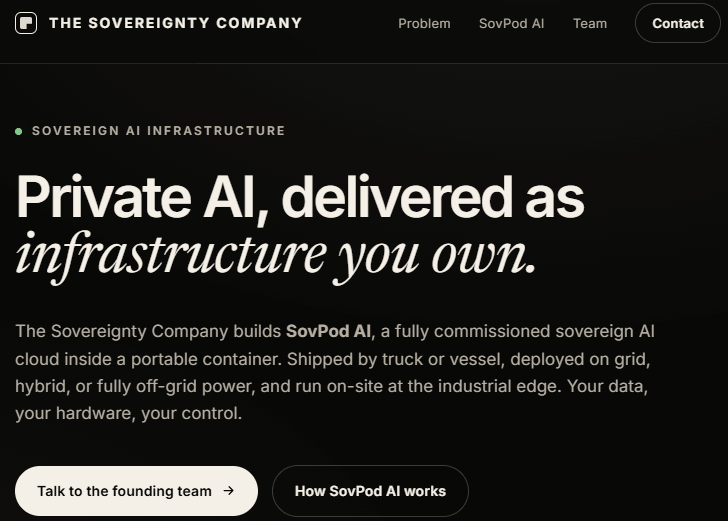
SovPod AI, from The Sovereignty Company, is a portable on-site sovereign AI cloud in a container. The use case is a plant, campus, or remote site where inference has to sit next to the work and the data cannot leave the fence. Vendor materials emphasize physical isolation and on-site GPUs rather than a cloud region.
There is no public price list. Treat every compliance claim as something to prove on a site visit, including power, cooling, and who can open the container.
Best for: Public sector, manufacturing, and energy sites that need a pre-integrated box more than a Kubernetes project.
What you get:
- Portable container form factor.
- On-site GPU inference.
- Edge and facility-adjacent deployment.
- Physical security as the control, per vendor documentation.
Why we like it: Air-gapped by design is easier to explain to a regulator than air-gapped by a config flag someone can flip. A container can beat a greenfield hall to first inference by months.
Limits:
- Independent reviews are scarce. Ask for site references in your sector.
- Lead time, permits, and grid capacity usually dominate the schedule.
- Containerization does not remove power or thermal limits.
Price: Quote-only. Pricing is custom. Model power, cooling, and logistics into TCO. Those are not optional line items.
SUPA
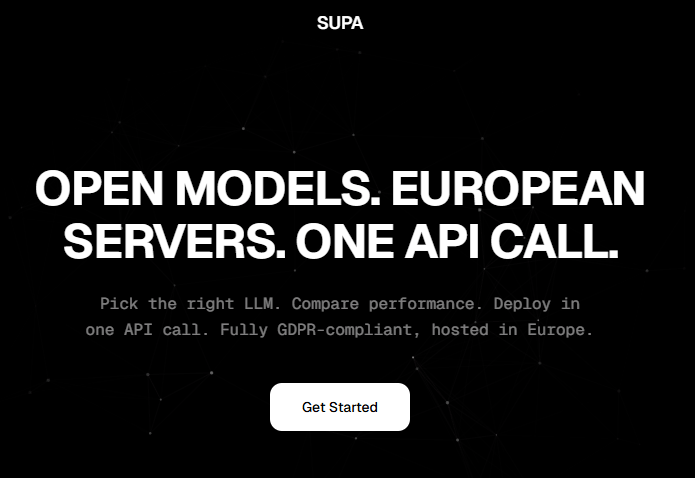
SUPA hosts open-weight models on German servers behind one OpenAI-compatible API. The homepage example is a base-URL change to https://api.supa.works/v1. Current catalog names include Gemma 4 31B IT, DeepSeek V3.2, Qwen 3.5 397B A17B, and Llama 3.3 70B. The company states 100 percent European infrastructure and zero US subprocessors on the inference path.
The pricing page is honest about maturity. Sandbox is €0 per month: SUPA:instant and SUPA:fast, fair-use limits, shared German infrastructure, community support. Professional (seat plus usage) and Enterprise (dedicated, SSO, audit logs, optional on-prem) are marked Coming Soon. If you need production SLAs this quarter, get that in writing. The free tier is the real product today.
Best for: EU teams that already write against the OpenAI SDK and need residency without standing up GPUs.
What you get:
- OpenAI-compatible chat completions. LangChain and Vercel AI SDK are listed as working clients.
- Open-weight catalog served from Germany.
- No GPU capacity management on Sandbox.
- Enterprise roadmap includes dedicated infrastructure and an on-prem option.
Why we like it: The drop-in API is the whole argument. Rewriting working code is the tax that stalls EU migrations. This removes that tax and keeps you on portable weights.
Limits:
- Paid production tiers are not generally available. Do not budget a Professional plan that still says Coming Soon.
- Managed hosting means you inherit their availability and roadmap.
- EU residency is not identity or governance. Those stay your problem.
Price: Published on supa.works/pricing. Sandbox €0 / month, fair use. Professional and Enterprise: Coming Soon. Contact SUPA for a production conversation. The paid plans are still labeled Coming Soon on supa.works/pricing. Do not budget a Professional plan that the page will not sell you.
Open Cradle
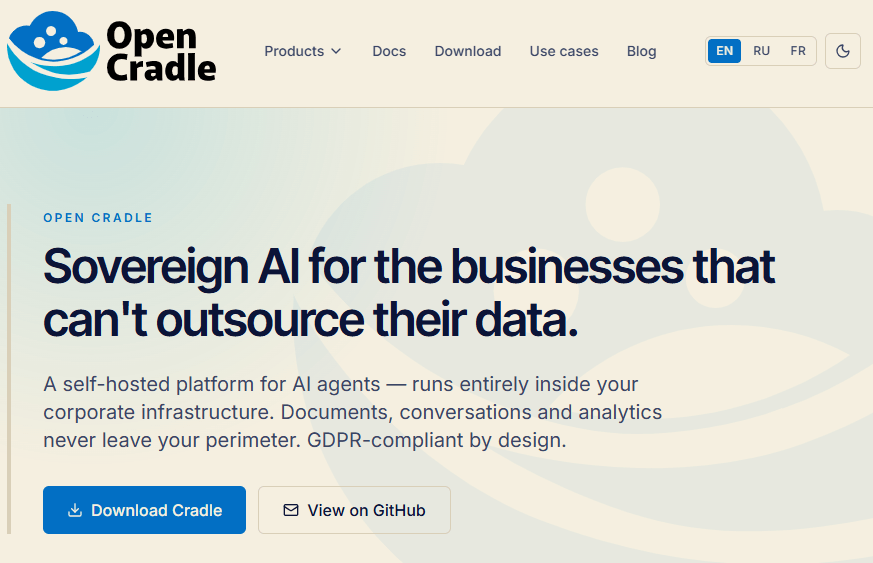
Open Cradle is no longer pitching itself as a generic model host. Cradle is an execution gate: the agent proposes a tool call, rules outside the prompt decide whether it may run, irreversible actions wait for a person, and every decision is appended to a hash-chained log. Models and data stay on your hardware. Local models go through llama.cpp. A Docker server shape exists for shared setups.
That is a different hole than a hosted API or a bootable OS. A sovereign model behind a cloud-hosted agent layer still exposes every prompt and every tool argument to the orchestration tier. Cradle puts the permission check on the box.
Best for: Mid-market teams that will run agents on their own machines and need a verifiable “why did this tool fire” log.
What you get:
- Typed tool proposals. Unregistered tools cannot be called.
- Rules live outside the agent, versioned, no model in the decision path.
- Human approval for irreversible actions. The same agent cannot approve itself.
- Hash-chained, append-only log you can verify with a command.
Why we like it: Most sovereign AI pages stop at “the weights are here.” Cradle starts at the next failure: the agent that emailed a customer or wrote a ledger line because the prompt said it should.
Limits:
- This is a gate. You still need a model runtime.
- Public review coverage is limited. Install it and read the first log line yourself.
- No public seat price.
Price: Download and self-run from opencradle.ai. Licence and support are quote if you want a vendor attached. No public seat rate.
SovrinOS
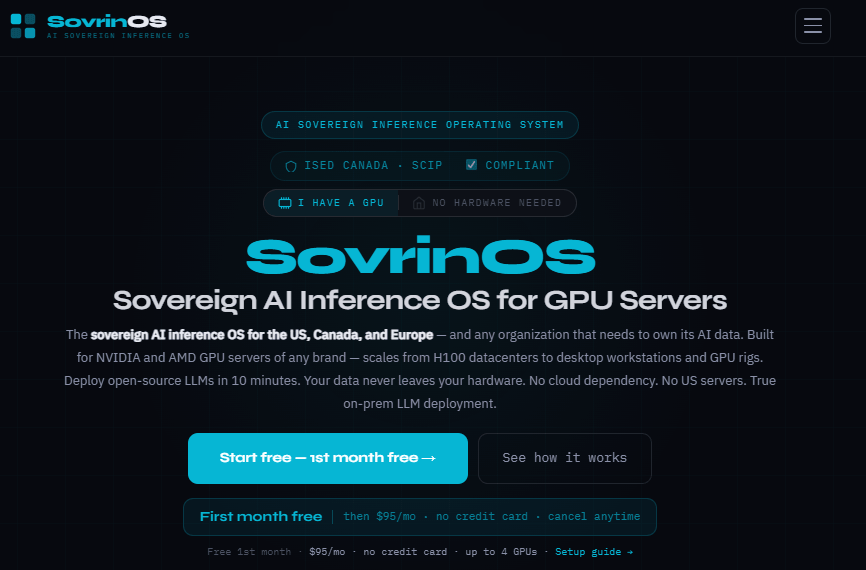
SovrinOS is a USB-bootable Ubuntu 22.04-based OS from Amatrix Inc. in Montréal. Flash the image, boot an NVIDIA or AMD GPU server (including idle mining rigs), and you get an OpenAI-compatible API on port 8000 (vLLM) or 11434 (Ollama). The company says first token in under 10 minutes. Inference content stays on the node. The cloud control plane is allowed telemetry only (token counts, latency, errors).
The pricing page is public. Self-hosted: first month free, up to 4 GPUs. Entry $29 per month (1 GPU, 1 node). Solo/Studio $95 per month (up to 4 GPUs, then $5 per extra GPU). Pro $245 per month (12 GPUs included, same overage). Enterprise is custom. Hosted AI, if you do not have hardware: Solo $95 per month (shared Canadian node, 20 million tokens, models up to 7B) and Pro $295 per month (dedicated node, unlimited tokens, models up to 70B). Engines auto-select among vLLM, TensorRT-LLM, llama.cpp, and ExLlamaV2. Default catalog includes Mistral 7B, Mixtral 8×7B, Llama 3.3 70B, and several Qwen and Gemma weights.
Best for: Labs and small teams that want a private endpoint on a box they already own, with a published monthly rate.
What you get:
- Bootable image. No re-image of the primary OS required for a first trial.
- OpenAI-compatible /v1/chat/completions, completions, and embeddings.
- Air-gapped mode with zero internet, per the product docs.
- Local BLAKE3 session-hash audit trail. Content is not uploaded to prove the request happened.
Why we like it: A bootable image plus a published Entry line is the lowest-friction private endpoint on this page. Standard engines underneath mean nothing you build is captive.
Limits:
- A USB eval is a trial. Patching, key management, and network policy still need an owner.
- Minimum 24 GB VRAM per node. Consumer rigs without that headroom are out.
- Hosted Solo is a shared Canadian node with a 7B cap, a different product from the bootable OS.
Price: Published on sovrinos.com/pricing. Self-hosted from $29 / month (Entry) after a free first month. Studio $95, Pro $245. Hosted Solo $95, Hosted Pro $295. Extra GPUs $5 / month on Studio and Pro. Enterprise custom.
Where does the prompt sit, and is this a host or a gate?
This grid plots two questions. Across is who owns the box: your hardware or site on the left, a vendor region on the right. Up is the product type: an isolation product or execution gate at the top, a drop-in model API at the bottom.

Placement follows product language: a container or execution gate versus an OpenAI-compatible host, and your hardware versus a shared region. SovrinOS Hosted Solo would sit on the vendor-region side; the product this shortlist is buying is the bootable OS. The quadrants are purchase types.
Where inference actually runs
| Service | Published rate | Where the prompt sits |
|---|---|---|
| SovPod AI | Quote-only | The site. Physical isolation, not a region label |
| SUPA | Sandbox €0 / month, fair use. Paid tiers Coming Soon | Shared German infrastructure. Confirm whether logs leave the EU |
| Open Cradle | Download and self-run. Licence quote | Your box. The gate decides whether a tool may run |
| SovrinOS | Self-hosted from $29 / month (Entry). Hosted Solo $95, Hosted Pro $295 | Your node on the bootable OS. Hosted Solo is a shared Canadian node, 7B cap |
What we left out
These are real products. They missed this shortlist because they are a different object than the four buys above: a parked domain, a European cloud account, or a model family without the host or the gate.
- Soverstack - a parked Hostinger domain. We will not shortlist it.
- Scaleway, OVHcloud, IONOS, plus IBM, SAP, and AWS sovereign SKUs - if the need is a European or air-gapped region on an existing cloud account. We left them out because the filter is a named object you can point at plus weights you can move, not a region on someone else’s tenancy.
- Mistral and Aleph Alpha - if the model family is the purchase. vLLM plus Ollama if you will assemble the node yourself and do not want a vendor OS. Those are building blocks.
Questions before you call it sovereign
If a quote cannot locate the prompt, the date, and the exit, you are still buying a logo.
- Where does the prompt go? Shared German sandbox, your box, or the site. If the agent layer is still in someone else’s SaaS, the model location does not save you.
- Which AI Act date actually hits you? Article 50 transparency obligations apply from 2 Aug 2026 to the parties that rule covers. The Digital Omnibus moves Annex III high-risk rules to 2 Dec 2027. Do not run a plan written against the old high-risk date.
- What is the exit? Open weights plus an OpenAI-shaped API. If the vendor disappears, you move the files. Custom SDKs without a drop-in alternative are the lock-in.
Which sovereign AI cloud should you pick
Physically isolated container: SovPod AI, quote-only, and pilot before anything sensitive. EU drop-in API: SUPA Sandbox at €0, and do not budget a Coming Soon Professional plan. On-box gate for tool calls: Open Cradle, download and self-run. GPU box you already own: SovrinOS Entry at $29 / month after a free first month - and Hosted Solo at $95 is a different product. Then put the pricing page next to a trace of where the prompt actually went.
Frequently asked questions
Is a European cloud region the same purchase as a sovereign host?
No. A hyperscaler sovereign region can still send the prompt to a US subprocessor. This shortlist is residency you can point at plus weights you can move. A German sandbox, a USB-boot node, a site container, and an on-box gate are four different locations. Mixing them is how a Coming Soon plan gets sold as air-gap.
Which of these four prints a monthly rate?
SUPA Sandbox is €0 per month, fair use; paid tiers are Coming Soon. SovrinOS self-hosted starts at $29 per month (Entry) after a free first month; Studio is $95, Pro $245; Hosted Solo is $95, Hosted Pro $295. SovPod AI and Open Cradle licence/support are quote-only.
Does a sovereign model make the agent layer sovereign?
No. If the agent still calls tools through someone else’s SaaS, that tier sees every prompt and every tool argument. An execution gate on your hardware is a different buy from a hosted API, even when both say open-weight.