Most teams discover access path blind spots during integrated ops rehearsals, not from a red team report. From our experience in the startup ecosystem, the biggest mistakes happen when ground operators rely on VPN trust, when satellite containers ship without signed policies, and when cross-domain filters get bypassed during outage drills. You think you know your blast radius until a single modem fleet or CI pipeline pushes a bad update. That is why the average breach still costs millions, as highlighted in IBM's 2025 Cost of a Data Breach analysis. The tools below cut toil and risk with identity-first controls, runtime policy, and key management designed for hybrid space architecture.
The commercial space economy reached $613 billion in 2024, according to Space Foundation's 2025 The Space Report. After filtering for hybrid ground to orbit use, on orbit demonstrations, air gapped or disconnected operations, and procurement traction with defense programs, three tools consistently delivered. In a few minutes you will learn which platform fits your ground segment, proliferated LEO constellation, or CASR aligned hybrid architecture, with verified features, pricing clarity where available, and real deployment tradeoffs.
Xage Security Fabric
Zero trust access, identity based policy, and data protection across ground and space with distributed enforcement suitable for hybrid satellite architectures.
- According to vendor documentation
Best for: Defense and commercial operators that need identity based zero trust across mixed legacy ground equipment and next generation space assets in hybrid architectures.
Key Features:
- Zero trust access management and data security across ground and space systems, highlighted by a $17 million Space Systems Command award to harden ground stations, enable secure commercial to DoD interactions, and protect data in hybrid satellite architectures, as reported by Via Satellite.
- Distributed policy enforcement at the edge for DDIL or disconnected environments, referenced in Space Force contracting coverage by GlobeNewswire.
- SBIR funded zero trust work for space systems that extends to RAPID test labs and TETHYS, per the U.S. SBIR award record for "Enabling Zero Trust for Space Systems" (SBIR.gov).
Why we like it: Working across different tech companies, we have seen identity overlays shorten compliance timelines while removing brittle network rules. Xage's focus on identity based segmentation and policy at the edge fits ground sites with legacy modems and mixed vendor payload operations.
Notable Limitations:
- Very limited public customer reviews, which can slow buyer due diligence. G2 lists only a single Xage review as of early 2026 (G2 Xage profile).
- One G2 reviewer notes the agentless model reduces deep software inventory visibility, which can hinder vulnerability reporting at device level.
- No public price list, which means longer procurement cycles compared to marketplace listed CNAPP tools.
Pricing: Pricing not publicly available. Contact Xage for a custom quote. Government awards reported in the press do not represent list pricing.
AccuKnox Fortresses (Zero Trust CNAPP)
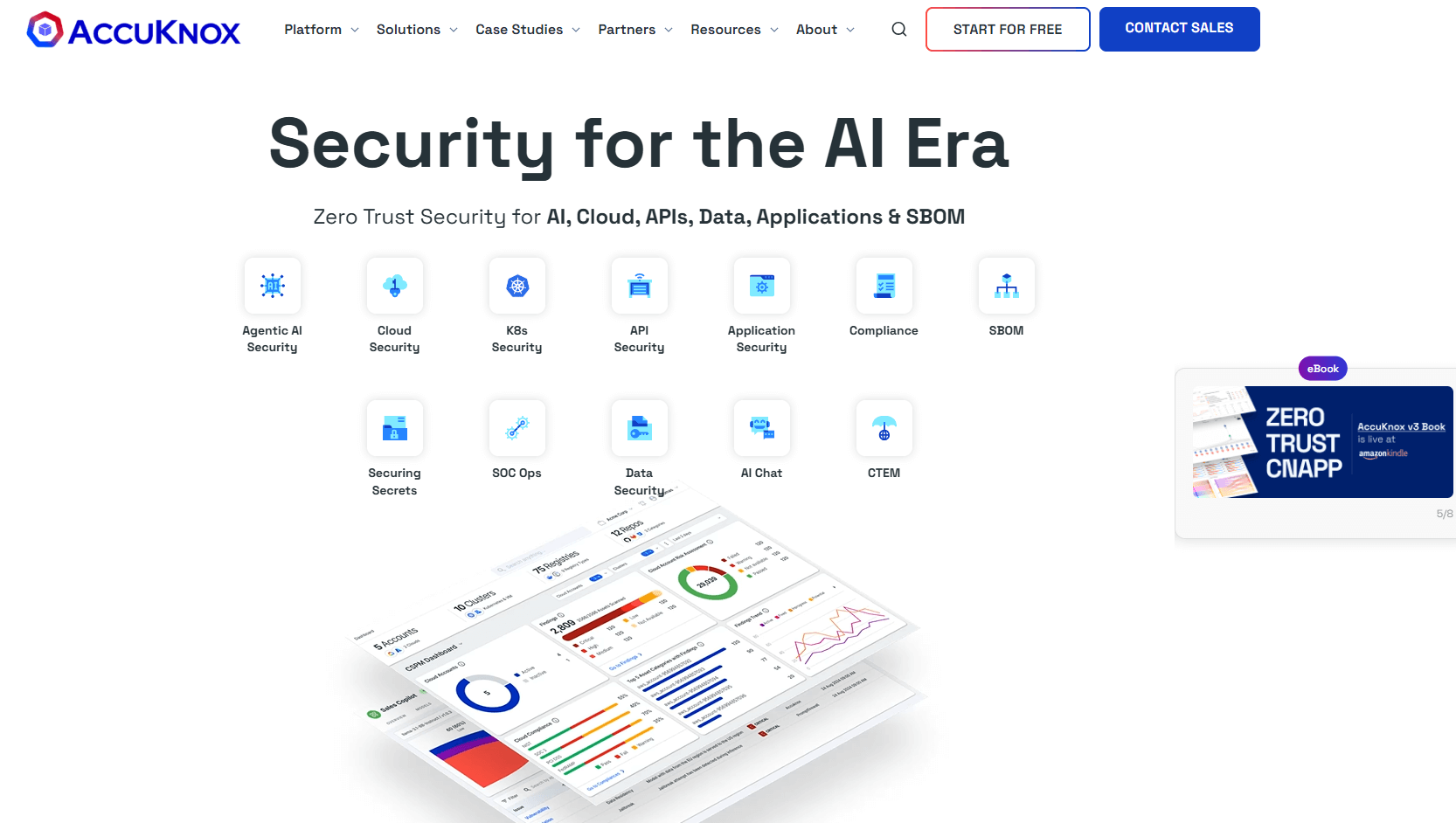
Runtime zero trust security, policy orchestration, and workload identity for containerized satellite and edge workloads, built on the KubeArmor open source engine.
- According to vendor documentation
Best for: Space programs adopting Kubernetes for satellite apps or ground processing that want eBPF and LSM backed runtime controls, with air gapped or marketplace based deployment choices.
Key Features:
- CNAPP with runtime enforcement using eBPF and Linux Security Modules via KubeArmor, a CNCF project page confirms KubeArmor's eBPF and LSM focus (CNCF KubeArmor community).
- Modular CNAPP coverage across CSPM, CWPP, KSPM with both agentless and agent based options, validated by AWS Marketplace listing details (AWS Marketplace listing).
- Public sector channel presence, including partnerships to reach satellites and tactical edge buyers as noted by Carahsoft's announcement (Carahsoft news).
Why we like it: After helping startups scale platform security, we value runtime controls that actually stop bad syscalls and file actions. eBPF plus LSM gives AccuKnox fine grained enforcement that is useful for flight software containers and ground microservices.
Notable Limitations:
- Reviewers cite a learning curve and integration time, especially for teams new to Kubernetes runtime analysis and eBPF, per recent feedback on Gartner Peer Insights.
- Community threads flag that agent heavy CNAPP deployments can be brittle in ephemeral namespaces, suggesting careful design to reduce RBAC drift (Reddit discussion on CNAPP friction).
- Independent validation of in orbit use is limited in public sources as of February 2026.
Pricing: Transparent tiers on AWS Marketplace. Examples shown as of February 2026 include Starter at $750 per month for 200 cloud assets and 20 nodes, with higher tiers up to $9,000 per month for 200 nodes. A free option exists via the Marketplace "Free Forever Plan" with limited assets and nodes (Marketplace tutorial summary).
SpiderOak OrbitSecure
End to end space cybersecurity with decentralized key management and application layer zero trust, demonstrated on orbit and ISS in contested, low bandwidth conditions.
- According to vendor documentation
Best for: Programs building hybrid architectures that need data centric security and key distribution that tolerates intermittent links, with demonstrated on orbit software updates.
Key Features:
- On orbit demonstration of OrbitSecure on a Ball Aerospace payload, with distributed ledger based key management described by SpaceNews.
- ISS based validation using an AWS Snowcone edge device, reported by SpaceNews and follow on testing noted by PR Newswire.
- DIU contract support for end to end security in the Department of Defense's Hybrid Space Architecture effort, per SpaceNews coverage.
Why we like it: After hands on work with containerized payloads and ground apps, we look for controls that travel with data. OrbitSecure's decentralized key approach helps maintain confidentiality and integrity even when parts of the network are compromised.
Notable Limitations:
- Public evidence of production scale constellation deployment is still emerging, with most reporting focused on demonstrations and pilots.
- Vendor's legacy consumer backup service has drawn negative support feedback, which buyers should weigh when assessing enterprise support posture (Trustpilot SpiderOak reviews).
- No public price list for OrbitSecure, which extends sales cycles.
Pricing: Pricing not publicly available. Contact SpiderOak for a custom quote. Public demos and DIU awards indicate maturity milestones, not commercial pricing.
Space Cybersecurity Tools Comparison: Quick Overview
| Tool | Best For | Pricing Model | Highlights |
|---|---|---|---|
| Xage Security Fabric | Identity based zero trust across mixed ground and space assets | Custom quote | SSC award for hybrid architectures, distributed policy at the edge |
| AccuKnox Fortresses | Kubernetes based satellite and ground workloads with runtime enforcement | Subscription via cloud marketplaces, free tier available | eBPF and LSM runtime via CNCF KubeArmor, modular CNAPP |
| SpiderOak OrbitSecure | Data centric zero trust and decentralized keys across hybrid space | Custom quote | On orbit and ISS demonstrations, DIU contract for hybrid space architectures |
Space Cybersecurity Platform Comparison: Key Features at a Glance
| Tool | Zero Trust Identity | Runtime Policy | On Orbit Evidence |
|---|---|---|---|
| Xage Security Fabric | Yes, identity based policy across ground and space | Policy enforcement at edge in DDIL per contract coverage | SBIR and SSC awards, lab work |
| AccuKnox Fortresses | Supports SPIFFE like workload identity per CNAPP approach | eBPF plus LSM runtime via KubeArmor | No public on orbit demo as of Feb 2026 |
| SpiderOak OrbitSecure | Zero trust at application layer | Application layer controls with decentralized keys | Yes, Ball payload and ISS demos |
Space Cybersecurity Deployment Options
| Tool | Air-Gapped Support | On-Premise | Integration Complexity |
|---|---|---|---|
| Xage Security Fabric | Yes, DDIL friendly per SSC context | Yes | Medium - agentless overlay helps but identity modeling takes planning |
| AccuKnox Fortresses | Claimed support, third party validation limited | Yes | Medium to High - reviewers note learning curve and integration effort |
| SpiderOak OrbitSecure | Designed for disconnected ops | Yes | Medium - data centric model changes key distribution and app flows |
Space Cybersecurity Strategic Decision Framework
| Critical Question | Why It Matters | What to Evaluate |
|---|---|---|
| Do we control identity at each hop from ground to payload? | VPN trust fails under lateral movement, as seen in ground segment incidents | Ability to enforce least privilege across modems, gateways, ops tools, and flight apps |
| Can runtime policy block bad syscalls and file actions in flight or at ground? | Posture only tools miss real exploits | eBPF or LSM backed controls and admission policies for containers |
| How do keys survive DDIL and contested links? | Centralized KMS breaks under disconnection | Decentralized key distribution and local policy decisioning |
| Is there public evidence of on orbit or high fidelity lab validation? | Reduces integration risk | Flight heritage, ISS or high fidelity flatsat demos |
| What is our procurement path in CASR or similar frameworks? | Faster surge capacity and integration | Marketplace pricing, GWAC vehicles, prior DoD awards |
Space Cybersecurity Solutions Comparison: Pricing and Capabilities Overview
| Organization Size | Recommended Setup | Annual Investment |
|---|---|---|
| Small satellite startup, proto flight | AccuKnox Starter tier for build to runtime CNAPP on ground and dev payloads | ~$9,000 |
| Mid size EO operator, multi ground sites | Xage for identity overlay across ground, AccuKnox for runtime on ground apps | Xage custom. AccuKnox ~$30,000 |
| National security program, hybrid architecture | Xage for zero trust access and data exchange, SpiderOak for decentralized keying on select missions | Custom procurement only |
Problems & Solutions
-
Problem 1: Ground segment breach takes out modems and disrupts service
The February 24, 2022 KA-SAT incident showed that attackers can exploit a VPN misconfiguration, pivot into trusted management networks, and push destructive commands to modems at scale, per Viasat's incident report and follow up coverage in Wired.
How tools help:- Xage Security Fabric applies identity based zero trust across ground control assets, removing implicit trust and centralizing policy with distributed enforcement to contain lateral movement, which Space Systems Command targeted in its 2023 award.
- AccuKnox Fortresses brings runtime policy via eBPF and LSM to containerized ground services, blocking unauthorized file and process actions in CI to runtime paths as documented by the KubeArmor project.
- SpiderOak OrbitSecure enforces data centric controls with decentralized keying that tolerates partial compromise, with on orbit validation reported by SpaceNews.
-
Problem 2: Hybrid space architecture needs assured secure cooperation under CASR
The Space Force is building the Commercial Augmentation Space Reserve, with first pilot contracts awarded in March 2025 and full operational capability for the initial cohort targeted by September 2026, per Executive Gov, Defense News, and SSC updates.
How tools help:- Xage's fabric unifies identity and policy across government and commercial interfaces to enable secure interactions in hybrid architectures, a capability emphasized in SSC contracting coverage.
- SpiderOak OrbitSecure provides decentralized trust and on orbit updatability aligned to hybrid space architectures, validated by DIU efforts.
- AccuKnox supports marketplace based procurement for ground workloads today with clear unit pricing, which can speed pilot integration ahead of CASR participation.
-
Problem 3: Disconnected operations and contested links break centralized security
Disconnected, degraded, intermittent, and limited environments are common in space ops. NIST's guidance for satellite ground segments stresses robust identity and control practices for command and control pathways (NIST IR 8401).
How tools help:- Xage distributes policy decisions to the edge, a fit for DDIL scenarios described in SSC aligned reporting.
- SpiderOak's decentralized key management and application layer zero trust continue to operate under intermittent connectivity, with demonstrations on ISS and in LEO.
- AccuKnox's runtime controls and policy driven CNAPP can be run outside of public clouds and, per public materials, can support air gapped deployments, though third party validation is limited as of today.
The Bottom Line for 2026 Space Programs
If you run a mixed fleet or are preparing for CASR style surge, start with identity and policy at the edge, then add runtime controls and decentralized keys where the mission needs them. The three platforms above map cleanly to those layers, with Xage strongest for identity and cross domain access at ground and edge, AccuKnox strongest for Kubernetes runtime on ground and dev payloads, and SpiderOak strongest for decentralized keying and application layer zero trust with flight heritage. For context on why this matters, revisit how a ground segment misstep escalated into a regional outage during the 2022 KA-SAT incident.
Research note: Where pricing is not public, we have stated that explicitly. Features attributed to "vendor documentation" are included without vendor links by design. If your environment has unique constraints, map them to NIST IR 8401 control families and then score each platform against your specific command path and deployment model.