
Most teams discover that “good enough” test data is the reason their AI pilots stall during integration testing, not from a model metrics review. Working across different tech companies, I have seen the same three issues surface repeatedly: preserving referential integrity across multi-table schemas, generating realistic seasonal time series without flattening peaks, and redacting PII in free text while keeping enough semantic signal for RAG and downstream search. These problems now carry real financial risk. IBM reports the global average cost of a data breach at $4.88M, reinforcing that poor data handling is both expensive and slow.
Synthetic data has moved from experimentation to infrastructure. Gartner projects that by 2026, 75 percent of organizations will use generative AI to create synthetic customer data as part of enterprise AI programs. This guide explains where each platform fits, how they differ in deployment and governance, and how to avoid the common cost and complexity traps teams hit during their first real rollout. their first rollout.
YData

A data‑centric platform that combines automated profiling, quality checks, and synthetic data generation in one place. It targets teams that want to standardize data preparation and orchestration for AI projects.
- According to vendor documentation, Fabric provides data profiling, synthetic data generation, and pipeline orchestration with IDE integrations for Jupyter and VS Code.
- According to vendor documentation, it supports deployment in popular public clouds and integrates with Databricks workspaces.
Best for: Data teams that want profiling plus synthesis on the same platform, especially those standardizing workflows around notebooks and Databricks.
Key Features:
- Automated data profiling with quality issue detection, per vendor documentation.
- Tabular synthetic data generation with SDK and UI, per vendor documentation.
- Pipeline orchestration for repeatable data‑centric AI workflows, per vendor documentation.
- Integrations with Databricks notebooks and Unity Catalog for governed sharing, as reported by Newswire coverage of the YData and Databricks partnership.
Why we like it: From my experience in the startup ecosystem, combining profiling and synthesis speeds up root‑cause analysis when models underperform, since you can iterate on data quality and synthetic augmentation without switching tools.
Notable Limitations:
- Reviewers mention a learning curve and limited customization for advanced Python users, plus occasional performance slowdowns on larger datasets, based on buyer feedback on G2.
- Smaller review volume compared to older enterprise tools may make benchmarking harder, as seen in the count of reviews on G2.
Pricing: Pricing not publicly available. Contact YData for a custom quote. If you buy through your lakehouse stack, check your marketplace terms and total cost of ownership.
Tonic.ai
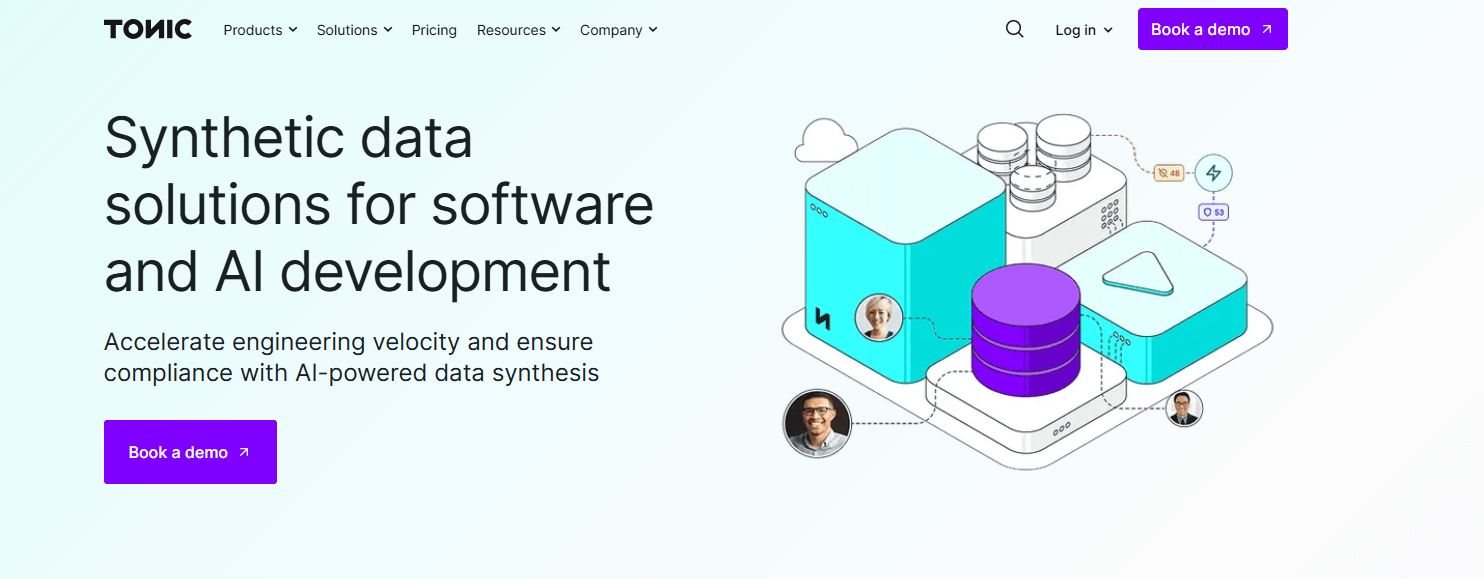
Enterprise‑grade synthetic and structural test data for software delivery and AI. Fabricate adds schema‑first generation for greenfield projects where no production data exists.
- Tonic acquired Fabricate in April 2025, expanding from production‑based synthesis to from‑scratch relational generation, as covered by FinSMEs and reflected in product updates.
- Independent reviews cite strong support for anonymized test data at database scale and multi‑DB support, with on‑prem options, per buyer feedback on G2.
Best for: Software and data teams that need privacy‑preserving test data with referential integrity, scheduled refreshes, and enterprise deployment, including self‑hosted or private cloud.
Key Features:
- Structured and semi‑structured synthesis with subsetting and referential integrity, per vendor documentation.
- From‑scratch relational generation via Fabricate, suited to greenfield development, as reported by FinSMEs.
- API and automation for CI workflows, with buyers citing daily refresh pipelines on G2.
Why we like it: Teams working under compliance pressure can plug Tonic into release pipelines, reduce data access requests, and still hit demo or staging needs, which shortens sprints without risking PII leaks.
Notable Limitations:
- Some users report on‑prem deployments are more complex than hosted setups, per reviews on G2.
- Requests for broader catalog integrations and more beginner‑friendly documentation appear in multiple buyer comments on G2.
Pricing: Pricing not publicly available. Contact Tonic.ai for a custom quote. Tonic products also appear in major cloud marketplaces, which can simplify procurement, as noted in marketplace availability coverage like EIN Presswire.
MOSTLY AI
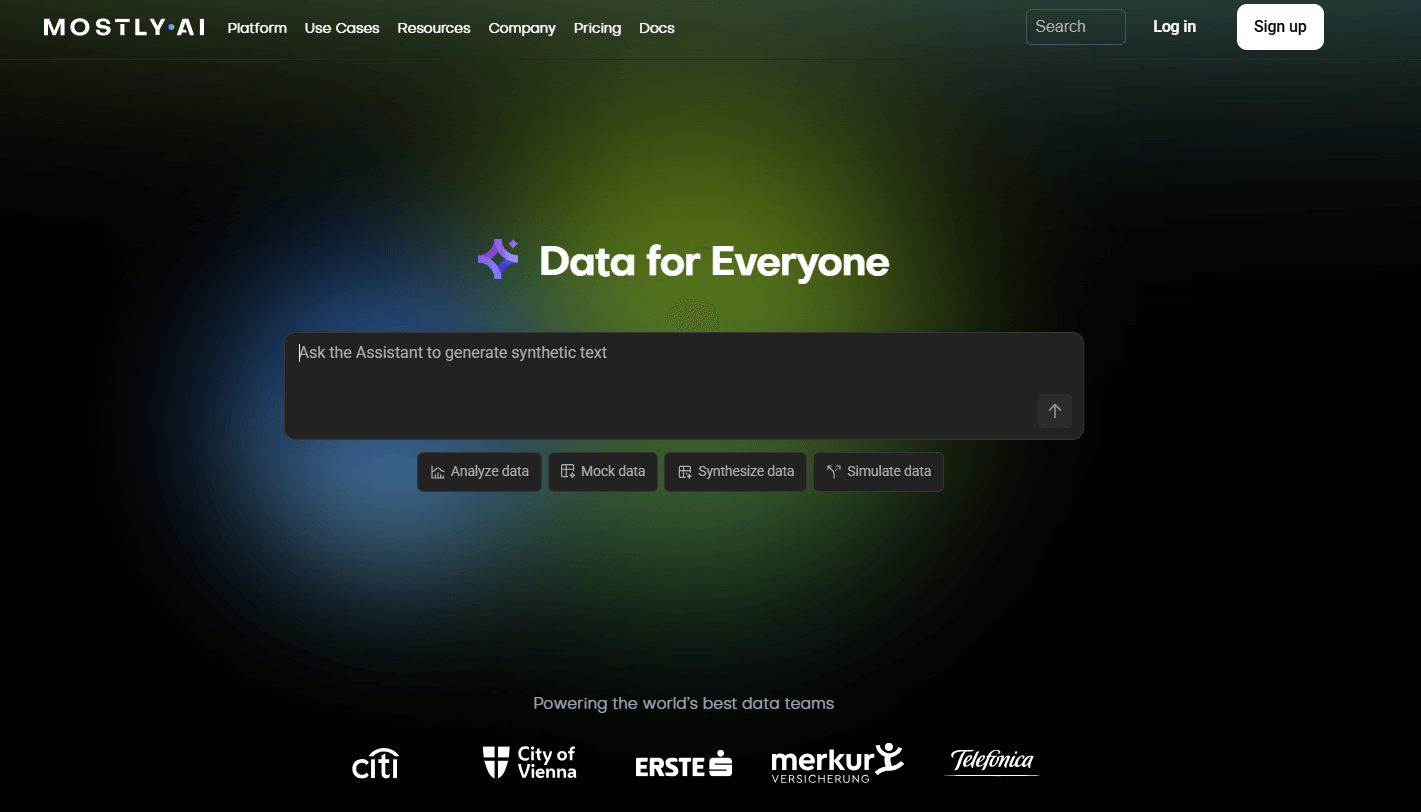
Enterprise synthetic data platform that focuses on high‑fidelity, privacy‑safe tabular and related use cases, with self‑hosted options. Recognized by analysts and available via cloud marketplaces.
- MOSTLY AI has been recognized in Gartner's Cool Vendors in data‑centric AI, indicating analyst visibility, as reported by GlobeNewswire.
- An AWS Marketplace listing provides Helm‑based deployment on EKS in the customer's environment, with a published flat‑fee option, per AWS Marketplace.
Best for: Regulated enterprises that want a governed, self‑hosted installation in their own cloud account, and a clear path to procurement through a marketplace.
Key Features:
- Privacy‑safe tabular synthesis that preserves statistical accuracy and relationships, described on AWS Marketplace.
- Kubernetes Helm deployment on EKS or EKS Anywhere, with private‑network operation, per AWS Marketplace.
- Enterprise controls aligned to governance and data teams, as summarized on AWS Marketplace.
Why we like it: The marketplace route lowers legal overhead and speeds vendor onboarding. Running in your own AWS account keeps data plane control with you, which matters for audit.
Notable Limitations:
- Users cite a learning curve for advanced configuration and dependency modeling, and note daily usage limits in some tiers, based on reviews on G2.
- Public information on pricing outside of marketplace SKUs can be limited, pushing buyers to sales cycles for exact quotes, as implied by the listing details on AWS Marketplace.
Pricing: AWS Marketplace lists a flat fee of 3,000 dollars per month for a managed listing, with contract terms and infra costs separate, per AWS Marketplace pricing. Enterprise deployments and non‑AWS options require contacting MOSTLY AI.
Synthetic Data Vault (SDV)

An open‑source Python ecosystem for tabular, relational, and time‑series synthesis with evaluation libraries. Originated from MIT's Data to AI Lab and maintained by DataCebo.
- The original method was introduced in "The Synthetic Data Vault," DSAA 2016, establishing SDV's academic roots, as documented on IEEE DSAA citations.
- The SDV toolkit provides multiple synthesizers including copula models, CTGAN, TVAE, and benchmarking and metrics libraries, as reflected across the open literature and project docs referenced in the DSAA paper's ecosystem.
Best for: Data scientists who prefer a Python workflow, want local or air‑gapped generation, and need programmatic control or custom evaluation.
Key Features:
- Single‑table, sequential, and relational synthesis options, per the DSAA 2016 paper overview in IEEE DSAA citations.
- Companion libraries for evaluation and benchmarking of synthetic data quality and privacy, noted in research community references, for example the recent review of evaluation challenges on arXiv.
- Local, CPU‑friendly training that can run on developer machines, a fit for air‑gapped or restricted environments, consistent with the project's academic lineage and Python distribution in public package indices.
Why we like it: SDV is ideal for teams that want full control, reproducibility, and the ability to instrument evaluation deeply before they graduate to a managed platform.
Notable Limitations:
- CTGAN and similar neural models can struggle with very high‑cardinality categorical fields or strict conditional sampling, and can be compute intensive, as summarized by independent technical explainers like DeepWiki and community findings on preprints.org.
- Maintaining relational constraints across many tables can be nontrivial and may require careful tuning, a challenge echoed in third‑party engineering writeups such as GreenM R&D's evaluation.
Pricing: Free to use as open‑source software for community use. Commercial SDV Enterprise licensing and support are offered by DataCebo, but pricing is not publicly listed. If you need enterprise support, request a quote.
Synthetic Data Tools Comparison: Quick Overview
| Tool | Best For | Pricing Model | Free Option |
|---|---|---|---|
| YData Fabric | Profiling plus synthesis in one platform | Custom quote | Not publicly listed |
| Tonic.ai + Fabricate | Enterprise test data, CI automation, greenfield generation | Custom quote | Not publicly listed |
| MOSTLY AI | Self‑hosted enterprise deployments in AWS | Marketplace or contract | Marketplace SKU |
| SDV | Python, on‑device or air‑gapped workflows | Open source, enterprise support available | Yes |
Synthetic Data Platform Comparison: Key Features at a Glance
| Tool | Feature 1 | Feature 2 | Feature 3 |
|---|---|---|---|
| YData Fabric | Automated data profiling | Tabular synthetic data via SDK and UI | Pipeline orchestration for data‑centric AI |
| Tonic.ai + Fabricate | Database‑scale synthesis with referential integrity | From‑scratch relational generation for greenfield | API automation for CI |
| MOSTLY AI | Privacy‑safe tabular synthesis | Kubernetes, Helm deployment on EKS | Runs in customer environment |
| SDV | Single‑table and relational synthesizers | Quality and privacy metrics libraries | Local training for restricted environments |
Synthetic Data Deployment Options
| Tool | Cloud API | On‑Premise | Air‑Gapped | Integration Complexity |
|---|---|---|---|---|
| YData Fabric | Yes | Yes | Case by case | Medium |
| Tonic.ai + Fabricate | Yes | Yes | Often requested in regulated orgs | Medium to High |
| MOSTLY AI | Yes via marketplace | Yes, in customer AWS | Possible in private VPC | Medium |
| SDV | SDK only | Yes, local installs | Yes | Low to Medium |
Synthetic Data Strategic Decision Framework
| Critical Question | Why It Matters | What to Evaluate | Red Flags |
|---|---|---|---|
| Do we need production‑derived or from‑scratch data? | Greenfield vs staging needs are different | Support for schema‑first generation and subsetting | One‑size‑fits‑all claims |
| How will we meet governance obligations? | EU AI Act timelines, transparency, and model governance | Deployment in your environment, audit trails, lineage | No clear deployment model or auditability |
| Can the tool maintain relational integrity and seasonality? | Prevents broken joins and flattened peaks | Multi‑table support, constraints, time‑series synthesis | Limited conditional sampling or unstable training |
| What happens when scale or security requirements increase? | Breach costs and compliance drive choices | Self‑hosting, air‑gapped patterns, marketplace options | Cloud‑only vendor without VPC or private options |
Synthetic Data Solutions Comparison: Pricing and Capabilities Overview
| Organization Size | Recommended Setup | Monthly Cost | Annual Investment |
|---|---|---|---|
| Small team or startup | SDV for prototyping locally, or MOSTLY AI marketplace trial | SDV is free, 3,000 dollars per month for MOSTLY AI | 0 to 36,000 dollars |
| Mid‑market engineering org | Tonic.ai for CI test data, SDV for niche pipelines | Not publicly listed for Tonic.ai | Varies by contract |
| Regulated enterprise | MOSTLY AI or Tonic.ai self‑hosted, Fabricate for greenfield | Most enterprise SKUs are quote based | Multi‑year contracts negotiated |
Problems & Solutions
-
Problem: PII‑heavy staging data blocks testing and RAG ingestion, and breach costs are rising.
- Context: The global average breach hit 4.88 million dollars in 2024 and multi‑environment data incidents are common, as noted by IBM. EU AI Act transparency and governance obligations are phasing in through 2026, which pressures data handling, per the European Commission.
- Tonic.ai: Buyers describe daily automated refreshes of anonymized data for developer environments, a setup that fits CI usage, per reviews on G2.
- MOSTLY AI: Running the platform in your AWS account, with Helm on EKS, supports privacy by design and audit, per AWS Marketplace.
- YData Fabric: Profiling plus synthesis can remove blockers earlier in the lifecycle, aligning with your lakehouse governance, as mentioned in Newswire's Databricks integration coverage.
- SDV: For air‑gapped sites, local generation and evaluation are possible, grounded in the DSAA 2016 approach in IEEE DSAA citations.
-
Problem: Multi‑table analytics need realistic foreign keys and distributions, not masked values.
- Context: Maintaining realistic relationships is a known challenge, especially with high‑cardinality categories and strict conditional sampling, as discussed in technical explainers like DeepWiki and engineering evaluations like GreenM R&D.
- Tonic.ai: Referential integrity and subsetting are core to its structural synthesis, per buyer experience on G2.
- MOSTLY AI: Emphasizes preserving relationships and statistical properties in governed environments, per AWS Marketplace.
- SDV: Offers multiple relational synthesizers and dedicated evaluation libraries that let you measure constraint satisfaction and fidelity, connected to the lineage from DSAA 2016.
- YData Fabric: Combines synthesis and profiling so teams can iterate on constraint violations inside one platform, per vendor documentation.
-
Problem: Time‑series and demand signals get flattened when you sample naively, hurting forecasting.
- Context: AI‑based forecasting is accelerating, but success demands reliable data, per Gartner supply chain analysis.
- YData Fabric: Teams can profile and correct quality issues, then synthesize with seasonality preserved, per vendor documentation.
- SDV: Time‑series synthesizers and diagnostics allow iteration locally before productionization, consistent with its research foundations in DSAA 2016.
- MOSTLY AI and Tonic.ai: Enterprise users report fast generation for downstream modeling and demos, though advanced temporal tuning may require vendor engagement, per buyer sentiment on G2 for MOSTLY AI and G2 for Tonic.ai.
The Bottom Line on Choosing a Synthetic Data Platform
By 2026, synthetic data is no longer a niche privacy tool. It is a prerequisite for scaling AI safely, especially as regulatory pressure, breach costs, and multi-environment development all increase. The right choice depends less on model novelty and more on how well the platform fits your governance, deployment, and delivery workflows.
If you need CI-ready test data with strict referential integrity and privacy controls, Tonic.ai combined with Fabricate is well suited to enterprise delivery pipelines. If you want a self-hosted, marketplace-procured platform that keeps the data plane inside your own cloud account, MOSTLY AI offers a clear path with governance in mind. If your team prefers full control through Python and needs local or air-gapped generation, SDV remains a strong foundation with a long research lineage. If you want to combine data profiling, quality checks, and synthesis in one workflow aligned to modern lakehouse stacks, YData Fabric is worth piloting.
The mistake teams make in 2026 is choosing a tool that solves a demo problem but not an operating one. Start by defining whether you need production-derived data, from-scratch generation, or both. Validate relational integrity, seasonality, and PII handling against real integration tests. Then scale only after the platform removes data access friction, shortens release cycles, and satisfies security and compliance review. With Gartner forecasting synthetic data adoption as mainstream by 2026, the winning platforms will be those that make synthetic data boring, repeatable, and auditable.