

Most teams discover their synthetic identity gaps during a chargeback spike or month-end credit losses, not from a red-team report. Working across different tech companies, we have seen three fixes move the needle fastest: add document plus selfie checks with liveness, score signals across email, phone, device and address in real time, and run velocity plus link analysis to catch multi-account farms. That matters because deepfake and injection attacks are eroding single-control IDV, a trend Gartner flags as a 2026 tipping point where 30 percent of enterprises will view face-based verification as unreliable in isolation (Gartner press release).
Here is the reality check. Synthetic IDs are now a measurable share of attacks. The 2026 Cybercrime Report from LexisNexis found an 8 percent global rise in fraud attempts with synthetic identities involved in 11 percent of frauds, an eight-fold increase year over year (LexisNexis press release). In lending, TransUnion reported US lenders had $3.3 billion in credit exposure to synthetic identities at the end of 2024 - an all-time high - and 24 percent of US fraud leaders said synthetics were their top fraud loss driver (TransUnion H2 2025 Fraud Trends). We prioritized platforms with synthetic-specific lift, clean SaaS integrations, and credible third-party validation. In minutes, you will learn where each tool wins, where it falls short, and how to deploy them to secure "synths" in SaaS flows without burning budget.
Socure Sigma Synthetic Fraud
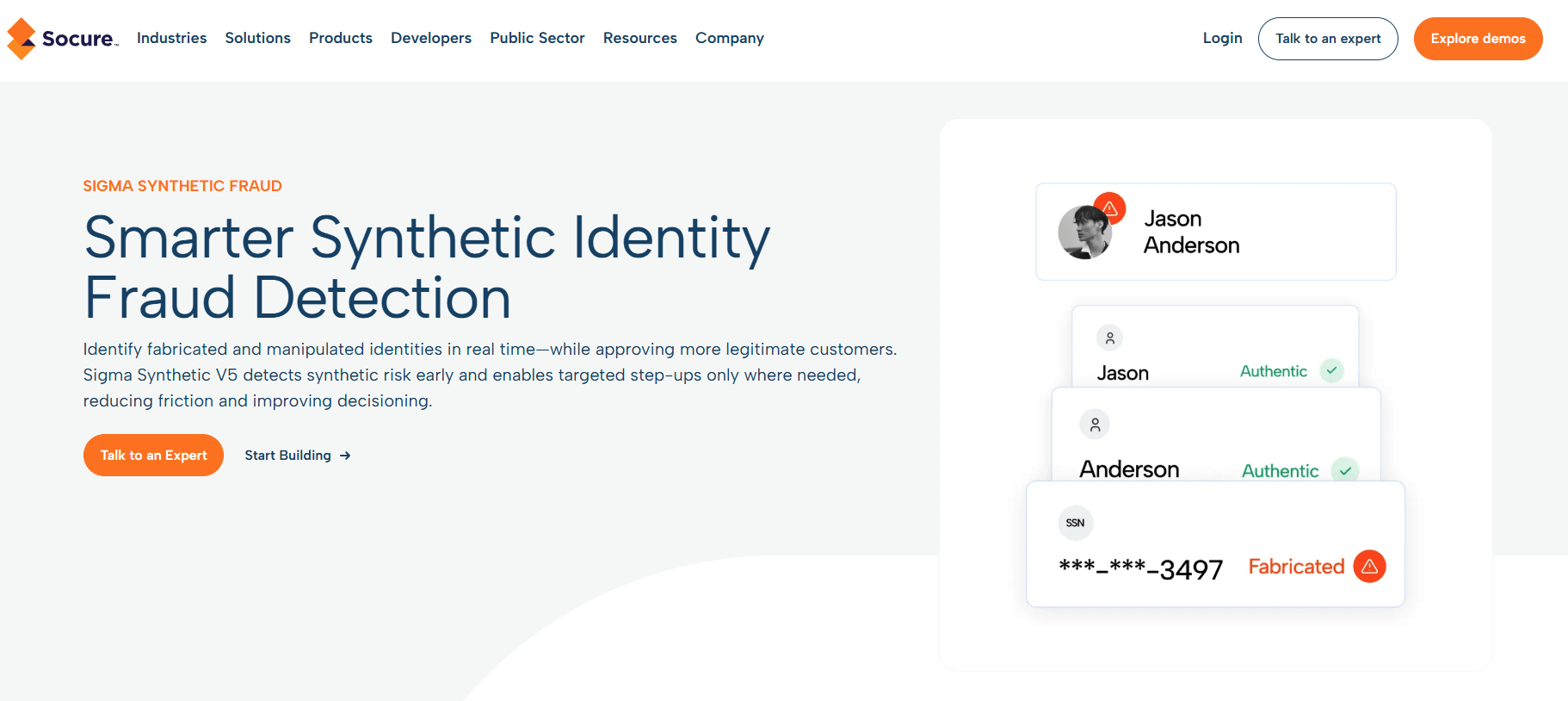
AI-driven synthetic identity detection that scores identities in real time and leverages broad network insights. Per vendor documentation and industry coverage, it brings consortium-scale intelligence to classify manipulated and fabricated personas.
Best for: Banks, fintechs, and marketplaces that need high-throughput onboarding and portfolio scrub programs.
Key Features:
- Graph and network intelligence drawing on billions of known good and bad identities and signals across thousands of attributes, per vendor documentation and industry coverage.
- Real-time risk scoring via a single API across onboarding and portfolio scrubs, per vendor documentation.
- Model lineage focused on synthetic patterns with feedback loops and explainability features for analysts, per vendor documentation.
- Incorporates "proof of life" style data to assess identity depth where digital footprint is thin, per vendor documentation and industry coverage.
- Aligns to the Federal Reserve framing of manipulated and fabricated synthetic identities, per vendor documentation.
Why we like it: From our experience in the startup ecosystem, Socure's synthetic models reduce manual review fatigue by routing obviously risky clusters to step-up while auto-approving deep, coherent identities, which speeds growth without inviting promo abuse.
Notable Limitations:
- Several G2 reviewers cite higher cost at scale and budget sensitivity for smaller volumes (Socure G2 reviews).
- A minority of public consumer reviews complain about limited recourse on adverse decisions or opaque rationale (Sitejabber page for Socure).
- Pricing transparency is limited in public sources.
Pricing: Pricing not publicly available. Contact Socure for a custom quote.
Veridian
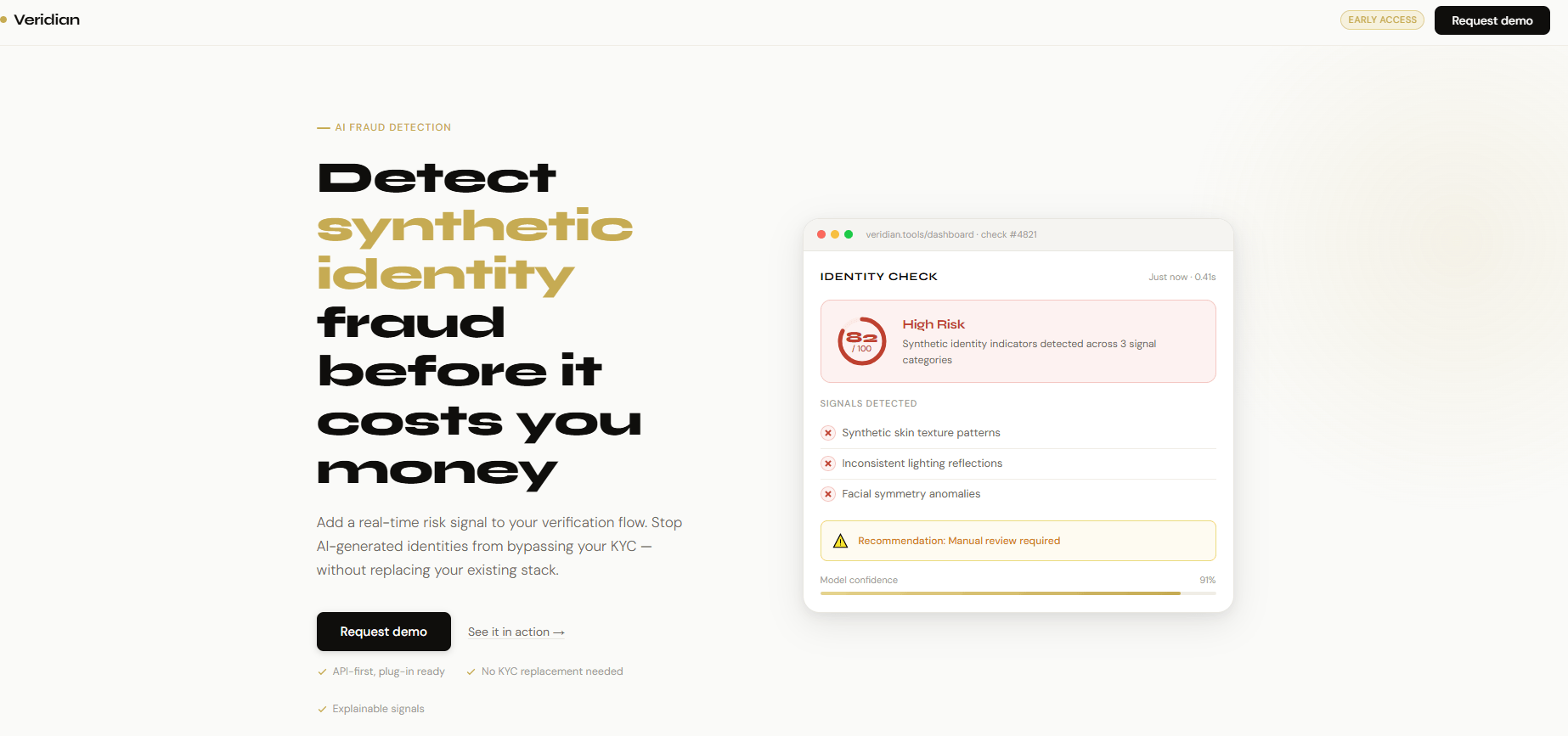
API-first add-on that injects real-time "synthetic risk" signals into your existing KYC. Built to flag AI-generated faces and forged IDs without replacing your current provider.
Best for: Developer-led SaaS teams and marketplaces that want an independent fraud signal alongside an incumbent KYC vendor.
Key Features:
- API-first, plug-in risk scoring that augments existing flows, per vendor documentation.
- Explainable signal categories focused on synthetic texture, lighting consistency, and symmetry anomalies, per vendor documentation.
- Lightweight request latency suitable for signup or step-up checks, per vendor documentation.
Why we like it: When helping startups scale, we value drop-in fraud signals that do not force SDK migrations. Veridian's "add a second opinion" approach helps catch AI-generated submissions that slip past standard IDV.
Notable Limitations:
- Early-access product with limited independent reviews as of 2026.
- Pricing and long-term roadmap are not publicly documented by third parties.
- Enterprise references are not widely reported by industry press yet.
Pricing: Pricing not publicly available. Contact Veridian for a custom quote.
GBG Synthetic Identity Check
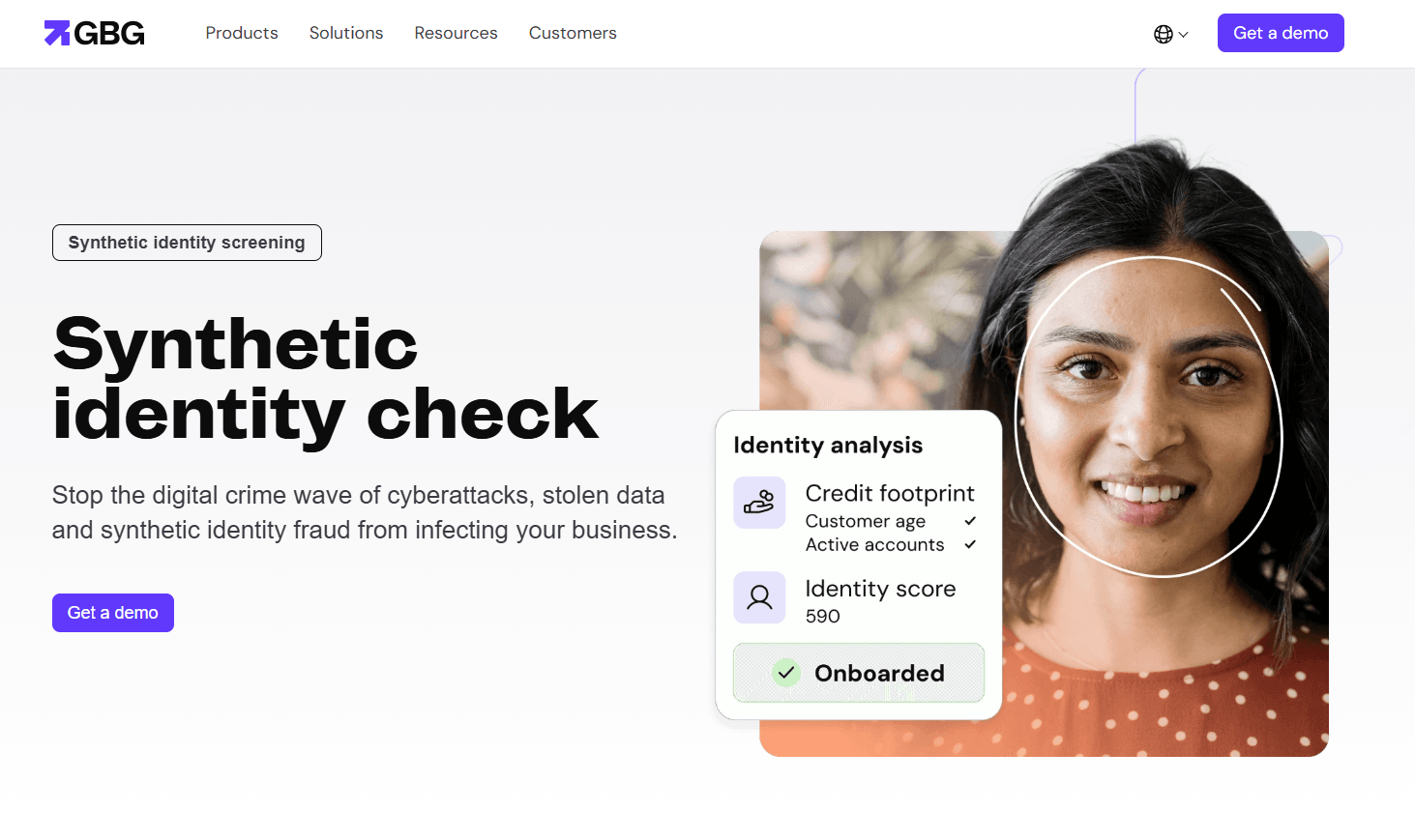
Synthetic screening that assesses identity quality, history, and consistency across credit and data sources. Backed by GBG's combined IDology and Acuant footprint.
Best for: Regulated enterprises that need large-scale orchestration and cross-border data coverage, especially telecom and financial services.
Key Features:
- Identity network depth through the integration of IDology and Acuant teams and data assets, forming a large Americas footprint (PR Newswire announcement).
- Document, data, device, and behavioral layers in one platform, useful for identity quality scoring, per publicly available product brochures and market coverage.
- Orchestration concepts aligned with analyst guidance to combine ID proofing, fraud detection and authentication for better outcomes.
Why we like it: Working across different tech companies, we have found GBG's modular approach helpful when you must combine bureau checks, document verification, and device risk while keeping latency predictable.
Notable Limitations:
- Mixed public review sentiment about GBG service experience in small sample sizes on consumer review sites (Trustpilot page for GBG).
- Product suite breadth can add configuration overhead for smaller teams, consistent with orchestration-heavy platforms discussed in analyst guidance.
Pricing: Pricing not publicly available. Contact GBG for a custom quote.
AuthenticID Fraud Shield
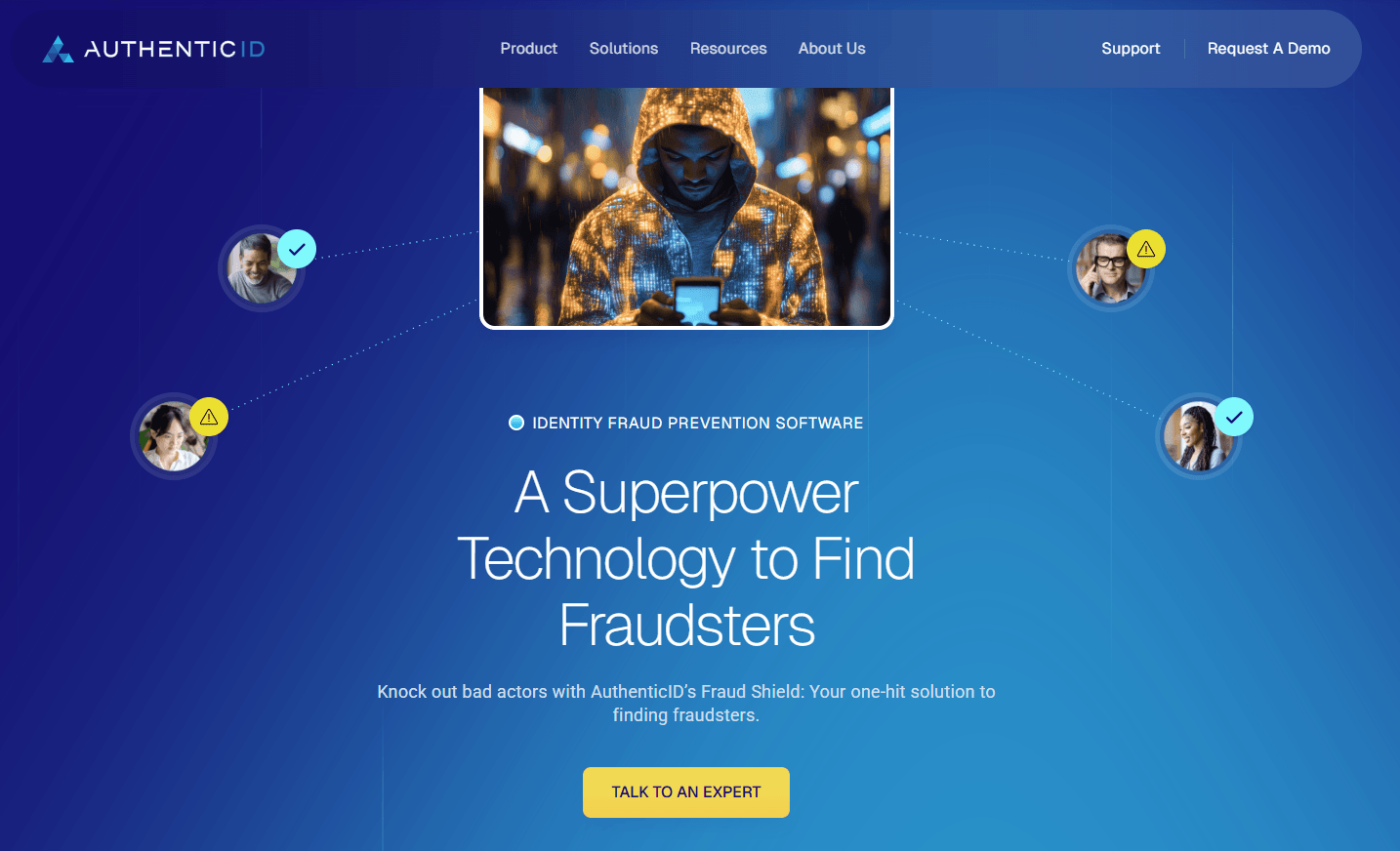
Identity fraud prevention that pairs document and selfie matching with watchlists and velocity checks to catch synthetic attempts. Often used as a biometric step-up in high-risk flows.
Best for: Enterprises that want strong document plus selfie matching with fraud watchlists for synthetic and lookalike attacks.
Key Features:
- Automated ID authentication with selfie match and liveness, per vendor documentation and industry coverage.
- Fraud watchlists and biometric-based velocity checks to block repeat bad actors, per industry coverage.
- Enterprise integrations across financial services and telecom, per industry coverage.
Why we like it: A fast, accurate selfie step-up is the simplest way to block synthetics that pass form-only checks, and Fraud Shield's focus on watchlists plus velocity makes repeated probing costly for attackers.
Notable Limitations:
- AuthenticID was acquired by Incode in August 2025, so packaging and roadmap may change (Holland & Knight transaction announcement).
- Fewer independent peer reviews than larger IDV peers on G2 as of 2026 (AuthenticID G2 listing).
Pricing: Pricing not publicly available. Contact AuthenticID for a custom quote.
Synthetic Identity Tools Comparison: Quick Overview
| Tool | Best For | Pricing Model | Highlights |
|---|---|---|---|
| Socure Sigma Synthetic Fraud | Banks, fintechs, high-velocity onboarding | Custom quote | Network and graph intelligence, real-time scoring, portfolio scrubs |
| Veridian | SaaS and marketplaces augmenting an existing KYC | Custom quote | API-first "second opinion" synthetic risk signal, explainable flags |
| GBG Synthetic Identity Check | Regulated enterprises needing orchestration and coverage | Custom quote | Document, data, device layers and identity network depth |
| AuthenticID Fraud Shield | Enterprises needing selfie step-up and repeat-fraud controls | Custom quote | ID plus selfie with liveness and watchlists, velocity checks |
Synthetic Identity Platform Comparison: Key Features at a Glance
| Tool | Network or Consortium Signals | Real-Time Risk Score | Document plus Selfie Step-up |
|---|---|---|---|
| Socure Sigma Synthetic Fraud | Yes, broad network insights reported in industry coverage | Yes | Available through adjacent products if needed |
| Veridian | Independent signal layer, not a full consortium | Yes | Not a primary function, designed to augment other IDV |
| GBG Synthetic Identity Check | Yes, via GBG, IDology, Acuant footprint | Yes | Yes, via GBG document and biometric stack |
| AuthenticID Fraud Shield | Primarily biometric plus watchlists | Yes | Yes, core strength |
Synthetic Identity Deployment Options
| Tool | Cloud API | On-Premise | Notes on Integration |
|---|---|---|---|
| Socure Sigma Synthetic Fraud | Yes | Not publicly documented | Single API, often used at signup and for portfolio scrubs |
| Veridian | Yes | Not publicly documented | Add-on signal beside existing KYC, minimal code changes |
| GBG Synthetic Identity Check | Yes | Not publicly documented | Orchestration concepts used to combine controls per analyst guidance |
| AuthenticID Fraud Shield | Yes | Not publicly documented | Common as a selfie step-up in high-risk branches of the flow |
Synthetic Identity Strategic Decision Framework
| Critical Question | Why It Matters | What to Evaluate |
|---|---|---|
| Can the tool detect shallow identity depth and AI patterns, not just match data? | Synthetics manufacture coherence across fields while lacking real-world depth | Evidence of depth checks and synthetic-specific features, third-party validation like analyst or press coverage |
| Does it combine signals beyond face biometrics? | By 2026, face-only approaches risk being unreliable in isolation | Device, behavioral, network or graph features plus injection detection, per analyst advice |
| How does it perform on portfolio scrubs and account linking? | Synthetics age into losses, so catching them post-onboarding protects charge-off rates | Proven portfolio scrub workflows, link analysis and batch scoring |
| Is there independent evidence of synthetic fraud lift? | Reduces vendor lock-in decisions based only on marketing | Analyst reports, industry press, peer reviews |
Synthetic Identity Solutions Comparison: Pricing and Capabilities Overview
| Organization Size | Recommended Setup | Estimated Cost |
|---|---|---|
| Startup and SMB SaaS | Keep your KYC, add Veridian as an augmenting signal, use AuthenticID step-up for risky branches | Contact vendors |
| Mid-market fintech | Socure as primary synthetic detection at signup and for periodic portfolio scrubs, AuthenticID step-up for ambiguous cases | Contact vendors |
| Large bank or telecom | GBG orchestration for data, device and document layers, pair with Socure synthetic risk and a selfie step-up path | Contact vendors |
Problems and Solutions
Problem 1: New-account fraud spikes at signup in telecom and ecommerce
- What we see in the wild: TransUnion reported 37.8 percent of US telecom account creations in H1 2025 were suspected digital fraud and highlighted rising exposure of full Social Security numbers that can fuel synthetic onboarding.
- How the tools help:
- Socure Sigma Synthetic Fraud, per industry coverage, scores identity depth and cross-correlations in real time to route obvious synthetics away from auto-approval.
- GBG's document, data and device layers make it harder for synthetics to maintain consistency across modalities, a pattern aligned with analyst guidance on orchestration.
- AuthenticID Fraud Shield can be inserted as a selfie plus liveness step-up when the risk score is borderline.
- Veridian adds an independent synthetic risk signal to catch AI-generated faces or forged images slipping past legacy checks.
Problem 2: Bot and agentic traffic mimicking humans overwhelms fraud teams
- What we see in the wild: LexisNexis observed a 59 percent rise in malicious bot attacks and a 450 percent rise in agentic traffic in 2025 as adversaries mimic human behavior, with gaming and ecommerce attack rates jumping sharply.
- How the tools help:
- Socure and GBG both incorporate behavioral and device-level checks in their broader stacks, which helps separate bots and agentic traffic from humans during account creation.
- Veridian's explainable anomaly signals make triage easier for ops teams under bot pressure.
- AuthenticID's selfie step-up with liveness forces real human presence before high-risk actions.
Problem 3: Deepfakes and injection attacks erode face-only IDV
- What we see in the wild: Gartner warns that by 2026, 30 percent of enterprises will stop trusting face-only verification in isolation, recommending injection detection plus image inspection, and additional risk signals. The Federal Reserve Bank of Boston also notes GenAI is accelerating synthetic identity fraud trends (Boston Fed article).
- How the tools help:
- Socure's synthetic-focused models and network intelligence, as covered by industry press, are designed to find incoherence beyond a single selfie.
- GBG's orchestration approach lets you combine document, device, and risk checks to resist injection.
- AuthenticID adds liveness and selfie match as a strong step-up where needed.
- Veridian contributes a complementary AI-forgery signal layer, reducing reliance on any one modality.
Conclusion, 2026 Buyer's Bottom Line
Synthetic identities are no longer edge cases, they are a mainstream fraud tactic riding on leaked credentials and GenAI. The data shows a rapid shift, with 11 percent of frauds now involving a synthetic identity and overall attack rates up 8 percent, plus sharp growth in agentic traffic that looks human. If you are securing a SaaS platform, pair a primary synthetic risk engine, an independent AI-forgery signal, and a selfie step-up in risky branches. Combine them with analyst guidance to avoid face-only traps and lean on orchestration to stack controls where they count.
Notes on verification and vendor status: AuthenticID was acquired by Incode in August 2025, so confirm packaging and contracts in 2026 roadmaps before purchase. Industry coverage also documents Socure's synthetic model lineage and consortium-style network that inform its detection approach (Biometric Update coverage).