You think you know how your DAO will make decisions until your first treasury allocation runs into cross chain voters, uncalibrated quorum thresholds, and a signer who is asleep when the timelock expires. From my experience in the startup ecosystem, the biggest wins come from choosing tools that reduce failure modes like misconfigured role based access, brittle proposal flows, and manual multisig execution. This guide distills what actually works in production, backed by neutral sources such as IDC's outlook that broader digital transformation spend is set to reach almost 4 trillion dollars by 2027, a reminder that governance infrastructure choices have real budget impact. That forecast frames why picking the right stack saves time and money, not just gas fees (IDC via BusinessWire).
The market keeps expanding, but reliable numbers are scarce, so use directional anchors from research and news, not inflated dashboards. You will learn which platforms fit token voting, multisig treasuries, and multichain execution, how to avoid common rollout pitfalls, and where the costs actually show up. For market context, crypto infrastructure that includes DAO tooling rides the same investment wave noted by IDC's multi trillion dollar DX forecast, which continues its double digit growth trajectory through 2027.
Aragon OSx
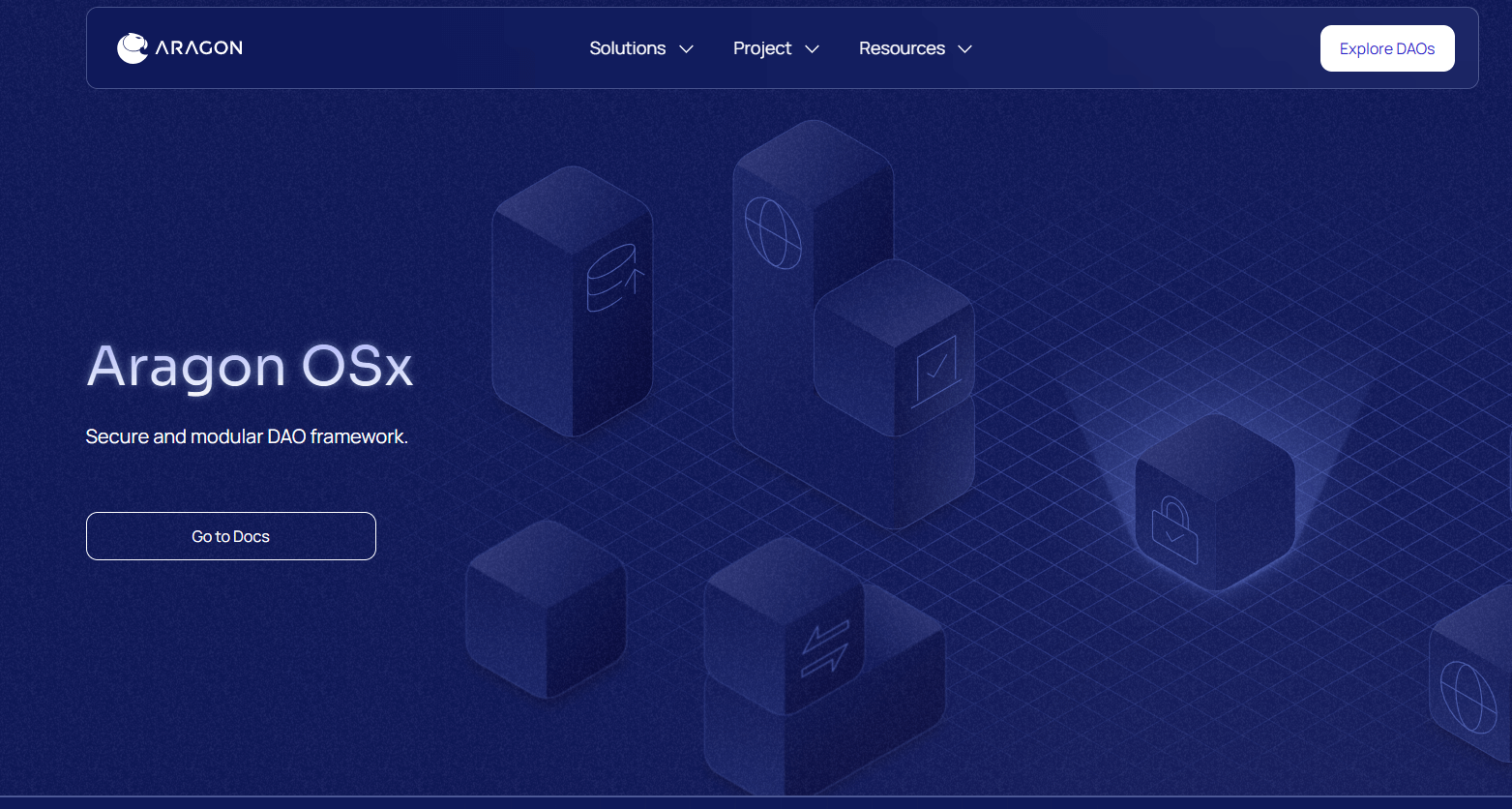
Modular on chain governance framework with a plugin system that lets you compose voting, permissions, and multichain execution. OSx separates core permissions from plugins, so you can swap governance models without redeploying a new DAO.
Best for: Protocol DAOs and product teams that want programmable governance with granular permissions and room to evolve, including dual governance and multichain voting.
Key Features:
- Plugin architecture, install token voting, dual or optimistic governance, and multichain vote aggregation.
- Fine grained permission system with allowlists, role scoping, and time delays.
- No code and developer options, run through an app or build custom plugins.
- Audited contracts and permission tracking focused design.
Why we like it: The plugin model decouples governance logic from the treasury, which speeds iteration. When your org shifts from multisig to token voting, you replace a plugin, not your DAO.
Notable Limitations:
- Complex setups still need Solidity literacy to model custom plugins.
- Migrating from legacy Aragon stacks can require planning and data mapping.
- Smaller third party plugin catalog compared to general purpose smart account tooling.
Pricing: Pricing not publicly available. Open source framework, typical costs are network gas and any third party service fees.
Tally
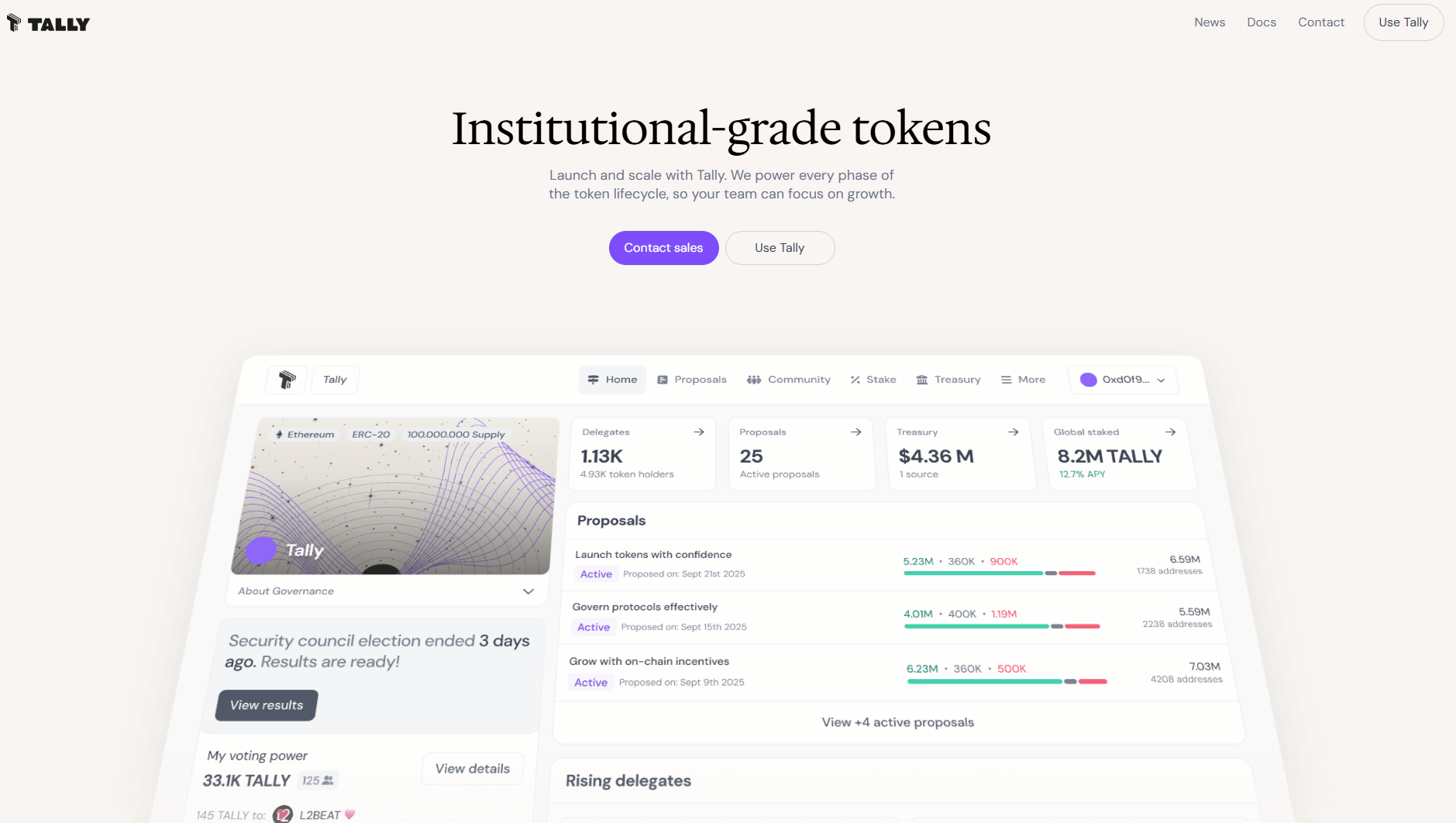
On chain governance interface for Governor style DAOs that covers proposal creation, delegation, voting, analytics, and cross chain governance orchestration.
Best for: Token voting DAOs on Ethereum and EVM L2s seeking a production UX for delegates, voters, and treasury actions, plus teams adopting cross chain governance.
Key Features:
- Full proposal lifecycle for OpenZeppelin Governor and similar contracts, including delegation.
- Governance analytics, voter history, and treasury visibility in a single UI.
- Multichain governance coordination for proposals that span multiple chains.
- Integrations with major DAOs and security council election flows.
Why we like it: It reduces governance friction at scale, especially for delegate workflows and multichain proposals, so fewer votes fail on logistics.
Notable Limitations:
- Works best with Governor style DAOs; other governance patterns may need custom work.
- Cross chain setups add operational overhead and require precise configuration.
- Some actions can incur platform fees per vendor documentation; factor this into budgeting.
Pricing: No standard seat based pricing disclosed. According to vendor documentation, certain executed proposal transfers may include a fee; confirm current terms with the provider. If undisclosed, treat as "pricing not publicly available."
DAOhaus
Community DAO platform built on the Moloch v3, Baal, framework, pairing on chain governance with a multisig treasury pattern and "ragequit" style member exits.
Best for: Purpose driven communities that want membership based governance, shares and loot tokens, and optional ragequit without complex token economics.
Key Features:
- ERC20 based shares and loot for flexible membership.
- Safe treasury connectivity via the Zodiac pattern, so DAOs can use Safe apps and modules.
- Arbitrary execution in proposals, including multisend batching.
- Extensible architecture with "shamans" for scoped permissions.
Why we like it: Moloch v3 keeps the governance layer simple and gives communities a proven exit pattern, which de risks early stage coordination.
Notable Limitations:
- Smaller ecosystem and fewer turnkey integrations than the most adopted smart account stacks.
- UI and feature velocity can lag during market cycles, plan for manual ops.
- Complex DeFi or multichain workflows may require external modules and expertise.
Pricing: Pricing not publicly available. Open source stack, typical costs are network gas, audits if you extend contracts, and any external service fees.
Gnosis Safe + Zodiac
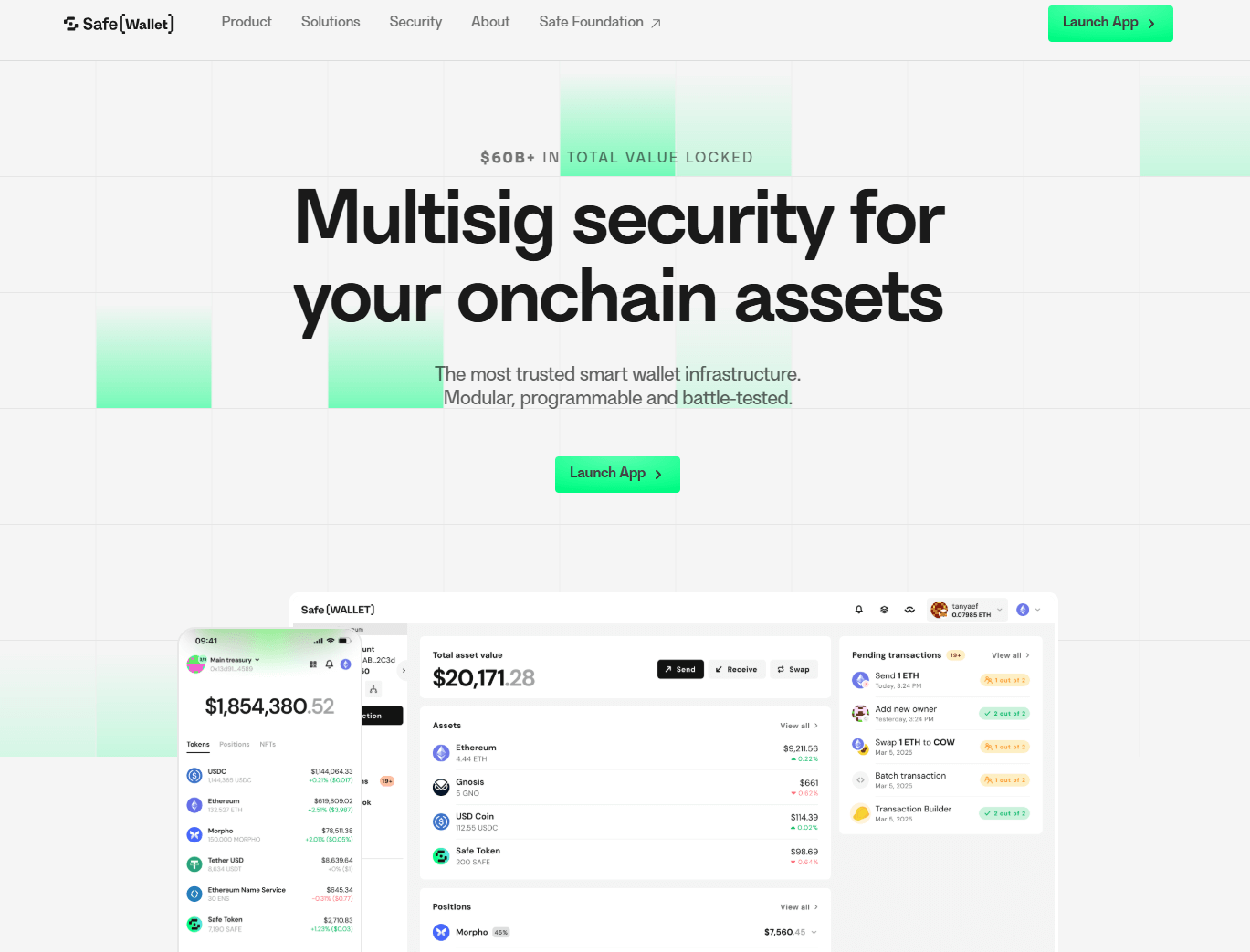
Safe is the widely used multisig smart account for DAO treasuries; Zodiac adds a modular governance layer with roles, bridge, reality, and governor modules.
Best for: Teams that start with a multisig treasury and need a secure path to progressive decentralization, as well as DAOs standardizing on Safe as the account layer.
Key Features:
- Multisig smart accounts with hardware wallet friendly flows and broad ecosystem support.
- Zodiac Roles Modifier for granular role based access control on treasury actions.
- Governor Module to bolt on on chain token voting to a Safe controlled treasury.
- Reality, often called SafeSnap, to execute off chain Snapshot votes on chain through an oracle.
Why we like it: You keep the battle tested Safe for custody, then add governance capabilities as modules when the org matures, which avoids treasury migrations.
Notable Limitations:
- Not a full DAO out of the box; you assemble modules and guard rails correctly.
- Module configuration is powerful but easy to misconfigure without reviews and testing.
- Web interface incidents have occurred in the ecosystem; secure workflows and least privilege are essential, even when core contracts are sound.
Pricing: No subscription for core open source components. Budget for gas, potential relayer fees, security reviews, and any paid integrations; pricing not publicly available for enterprise services.
Web3 Governance & DAO Tools Comparison: Quick Overview
| Tool | Best For | Pricing Model | Highlights |
|---|---|---|---|
| Aragon OSx | Protocol DAOs needing modular, upgradable governance | Open source, service fees vary | Plugin architecture, granular permissions, multichain voting |
| Tally | Governor style DAOs with delegates and cross chain votes | Platform fees may apply, gas costs | Rich UX, analytics, multichain coordination |
| DAOhaus | Membership centric DAOs with ragequit | Open source, gas costs | Shares and loot, Safe treasury via Zodiac |
| Safe + Zodiac | Treasury first DAOs that will add governance over time | Open source, gas and optional services | Roles, Governor, Reality, Bridge modules on Safe |
Web3 Governance & DAO Platform Comparison: Key Features at a Glance
| Tool | Token Voting | Multichain Governance | Role Based Permissions |
|---|---|---|---|
| Aragon OSx | Yes, via plugins | Yes, via plugins | Yes, core permissions system |
| Tally | Yes, Governor compatible | Yes, multichain coordination | Limited to underlying contracts |
| DAOhaus | Yes, membership tokens | Via Safe + modules | Via shamans and Safe modules |
| Safe + Zodiac | Via Governor module | Via Bridge module | Yes, Roles Modifier |
Web3 Governance & DAO Deployment Options
| Tool | Cloud API | On Premise | Integration Complexity |
|---|---|---|---|
| Aragon OSx | Not typical, self hostable front ends | Yes, contracts on chain | Moderate for custom plugins |
| Tally | Hosted UI, on chain execution | Limited, contracts on chain | Low to moderate |
| DAOhaus | Hosted UI options, OSS front ends | Yes, contracts on chain | Moderate |
| Safe + Zodiac | Hosted UI plus CLI, contracts on chain | Yes, contracts on chain | Moderate to advanced depending on modules |
Web3 Governance & DAO Strategic Decision Framework
| Critical Question | Why It Matters | What to Evaluate | Red Flags |
|---|---|---|---|
| Do we need token voting now or later | Avoids premature complexity | Delegate activity, quorum design, upgrade path | No plan to transition from multisig, no delegation model |
| How will we handle multichain assets | Prevents fragmented votes and execution | Message passing, bridge risk, spoke hub models | Ad hoc bridging, duplicated DAOs per chain |
| Who can move funds day to day | Reduces treasury risk | Roles based controls, approvals, simulators | Broad admin roles, no simulation or batching |
| How do we get turnout | Prevents capture and apathy | Delegation UX, incentives, cross chain access | No delegation, single chain voting, poor analytics |
Web3 Governance & DAO Solutions Comparison: Pricing & Capabilities Overview
| Organization Size | Recommended Setup | Cost Visibility | Typical Onchain Costs |
|---|---|---|---|
| Small community DAO | DAOhaus with Safe treasury, ragequit optional | No published SaaS pricing | Gas for proposals and membership updates |
| Mid size protocol | Aragon OSx with token voting and roles, or Safe + Zodiac Governor | Mostly open source, service engagements vary | Gas for proposals, audits for custom plugins |
| Large multichain DAO | Tally for UX plus underlying Governor stack, Safe + Zodiac Bridge and Roles | Platform and integration fees may apply | Gas across chains, relayer and monitoring costs |
Problems & Solutions
-
Problem: Voter apathy and concentrated voting power lead to controversial outcomes and poor legitimacy.
Solution with Tally: Tally's recent funding round explicitly targets low voter participation with staking and incentive mechanics, while its delegate centric UX and analytics make it easier to engage voters across mature DAOs (CoinDesk on Tally's 8 million dollar raise and turnout focus). Academic work also documents the scale and participation dynamics across more than 13,000 DAOs, which supports prioritizing delegation, quorum calibration, and voter incentives (arXiv study on DAO participation and decentralization). -
Problem: Multichain fragmentation - voters and assets span Ethereum mainnet and L2s, sometimes Solana, which breaks a single chain vote.
Solution with Tally: Multichain proposal creation and vote tallying are now production patterns, with MultiGov coordinating hub and spoke governance across Ethereum, L2s, and Solana. This reduces friction by meeting token holders where they are and then aggregating results for final execution (Blockchain.News coverage of MultiGov launch). -
Problem: Teams start on a multisig, then need on chain governance without migrating the treasury.
Solution with Safe + Zodiac: Add the Governor Module to let a Safe controlled treasury execute token voted proposals. For communities that still prefer off chain voting, the Reality, often called SafeSnap, pattern brings Snapshot outcomes on chain via an oracle, widely discussed since its early launch and later integrations with arbitration providers (CryptoNews summary of SafeSnap's introduction). -
Problem: Operational security risks at the interface layer even when core contracts are uncompromised.
Solution with Safe: Adopt strict role scoping and signer hygiene, simulate transactions, and use hardware wallets with least privilege. Industry research shows that service layers can be targeted, which makes process controls, audits, and module guards as important as the base contracts (Messari's State of Safe Q1 2025 outlines scale, usage, and a web interface incident with mitigation steps). -
Problem: Governance roadmaps need to evolve without redeploying a new DAO every time.
Solution with Aragon OSx: Use plugin based governance to swap models, for example moving from a core team proposal allowlist with veto to full token voting, then enabling multichain voting as distribution grows. The project's organizational changes did not halt OSx development, which continued under the product team after the association dissolution, a relevant governance continuity signal for adopters (Blockworks on the Aragon Association decision and product continuity).
How to pick and roll out the right stack
- Start treasury first, governance second: Most teams stabilize custody and payments with Safe, then layer in governance modules or migrate to a plugin based framework.
- Delegate early: Without a working delegation market and analytics, quorums will either be too high to pass or too low to prevent capture, exactly the dynamics flagged in research on DAO participation.
- Plan for multichain now: If your token or users live on multiple networks, adopt hub and spoke governance so adoption does not stall on bridge UX, a pattern now covered in multichain governance rollouts.
Bottom line: pick modular stacks, measure turnout, budget for ops
Every quarter, another DAO learns the hard way that governance failure is an operational failure, not just a smart contract issue. If you want composability and clear upgrade paths, Aragon OSx and Safe plus Zodiac provide durable building blocks that let governance evolve without migrating treasuries. If adoption ready UX, delegate workflows, and cross chain voting are your bottlenecks, Tally is the fastest path to reliable participation at scale.
At a market level, DAO tooling sits inside a much larger digital transformation wave, with IDC projecting nearly 4 trillion dollars in global DX spend by 2027, reinforcing that governance infrastructure choices increasingly carry real budget, security, and accountability expectations. The teams that win treat governance like production infrastructure - start with tight roles, simulation, and monitoring, then expand into token voting and multichain execution only when participation data and operational maturity support it.