

Jump to8 sections
Bare metal as a service gives you a single-tenant physical server with root access and no hypervisor, provisioned through an API in minutes. That matters for Kafka brokers that need NUMA pinning, databases that suffer from noisy neighbors, and GPU nodes where every point of throughput shows up on the bill. Out-of-band control also turns a reboot or a reinstall into a script call.
Demand for that hardware is climbing fast. IDC's Q2 2026 server tracker recorded $166.3 billion in quarterly server revenue, up 52 percent year over year, with AI infrastructure as the main driver. Component costs are rising alongside it, and Hetzner's June 2026 price adjustment was its second increase of the year.
That leaves egress terms, GPU supply, automation depth and data location as the deciding factors. If your cloud bill is already under review, our guide to cloud cost optimization platforms covers the software side of the problem.
This guide compares seven bare metal as a service platforms, from budget European dedicated servers to RDMA-connected GPU superclusters.
How We Evaluated Bare Metal as a Service Platforms
We reviewed each platform against its own documentation, pricing pages and official announcements, using five criteria:
- Automation: public API, CLI, Terraform or Ansible support, and out-of-band controls such as resets and rescue boots.
- Hardware range: current CPU generations, GPU models and network speeds on offer.
- Pricing transparency: rates published on the vendor pricing page, billing granularity and included egress, checked in November 2026.
- Location and residency: the regions where dedicated hardware actually runs.
- Recent momentum: 2025 and 2026 launches, acquisitions and capacity deals confirmed by first-party releases or official filings.
TL;DR: Bare Metal as a Service Platforms at a Glance
Each platform below earns its place for a different kind of buyer. Use this table to narrow the list before reading the full reviews.
| Platform | Best For | Pricing Model | Highlights |
|---|---|---|---|
| Latitude.sh | API-driven CPU and GPU bare metal with private cloud on-ramps | Hourly and monthly | Part of Megaport since November 2025, single H100 to 8x B300 nodes |
| phoenixNAP Bare Metal Cloud | DevOps teams that manage servers as code | Hourly, monthly and reservations up to 36 months | First-party Terraform, Ansible, Pulumi and Chef integrations |
| OVHcloud Bare Metal | EU data residency on a budget | Monthly | Bare Metal 2026 range on AMD Zen 5, unlimited traffic |
| Vultr Bare Metal | Mixed VMs, bare metal and GPUs under one API | Hourly, monthly and prepaid contracts | 32 regions, NVIDIA and AMD GPU options |
| Cherry Servers | Hourly dedicated servers in Europe, the US and APAC | Hourly, monthly and annual | Tokyo location added in 2026, crypto billing |
| Hetzner Dedicated | Lowest-cost EU dedicated servers with API control | Monthly | Server Auction from 78.70 euros per month |
| Oracle Cloud (OCI) Bare Metal | Large AI training on RDMA clusters | Pay as you go or committed credits | Superclusters up to 131,072 GPUs |
The table shows a clear split. Four platforms sell flexible, developer-first servers by the hour, two sell low monthly prices in Europe, and one sells hyperscale GPU clusters. The reviews below explain where each one fits and where it falls short.
The 7 Best Bare Metal as a Service Platforms
The order below runs from developer-first GPU and CPU platforms through budget European options to enterprise-scale AI infrastructure.
1. Latitude.sh
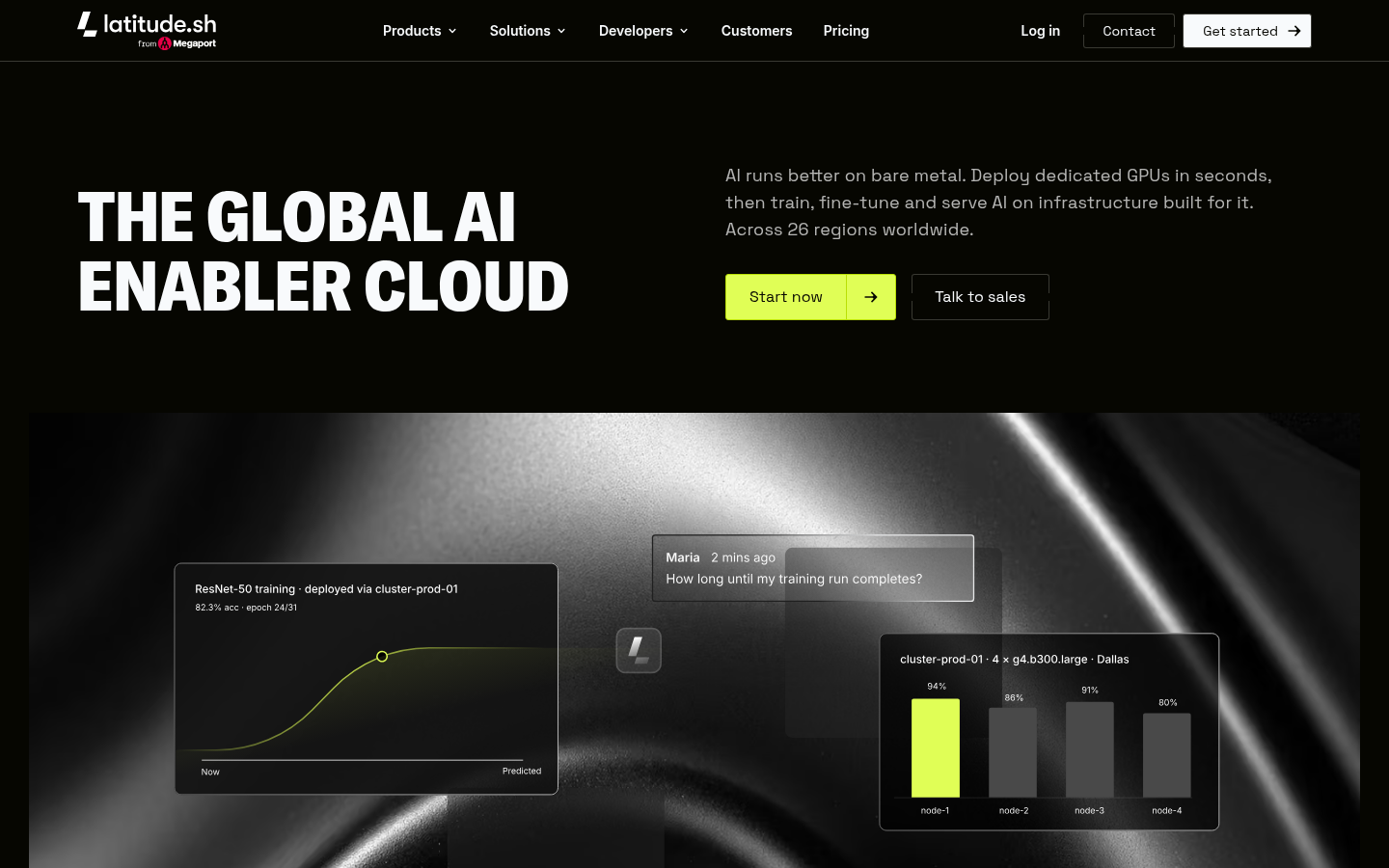
Latitude.sh is an API-first bare metal and GPU cloud that Megaport acquired in a deal that closed on 27 November 2025.
Best for: SaaS and AI teams that need code-driven CPU or GPU bare metal across the Americas, Europe and APAC, plus private links into public clouds.
Key Features:
- Servers deploy through an API, CLI or Terraform provider, with GPU plans running from a single NVIDIA H100 up to 8x HGX B300 nodes.
- Each server includes 20 TB of outbound traffic with unlimited inbound traffic.
- Megaport's network connects more than 1,100 data centers across 31 countries, so Latitude.sh servers can reach AWS, Azure or Google Cloud over private paths.
- In July 2026, Megaport raised about US$594 million, partly to build an on-demand inference pool that includes 2,048 NVIDIA B300 GPUs.
Why we like it: It combines a developer-first provisioning model with a private network fabric, which shortens the time between a GPU coming online and that GPU reaching the rest of your stack.
Notable Limitations:
- Much of the new GPU hardware supports multi-year contracts that Megaport announced in 2026, including a US$25.1 million agreement in April and three more worth US$182.9 million, so confirm on-demand stock in your target region before planning around it.
- The entry CPU plan costs $296 per month, which is well above the entry prices at Hetzner or OVHcloud.
- Product roadmap and contract terms now sit inside Megaport, so large buyers should confirm SLAs and support paths under the combined company.
Pricing: The Latitude.sh pricing page lists the m4.metal.small CPU server at $0.41 per hour or $296 per month, a single H100 at $1.68 per hour ($1,230 per month), and an 8x B300 node at $64 per hour (checked November 2026).
2. phoenixNAP Bare Metal Cloud
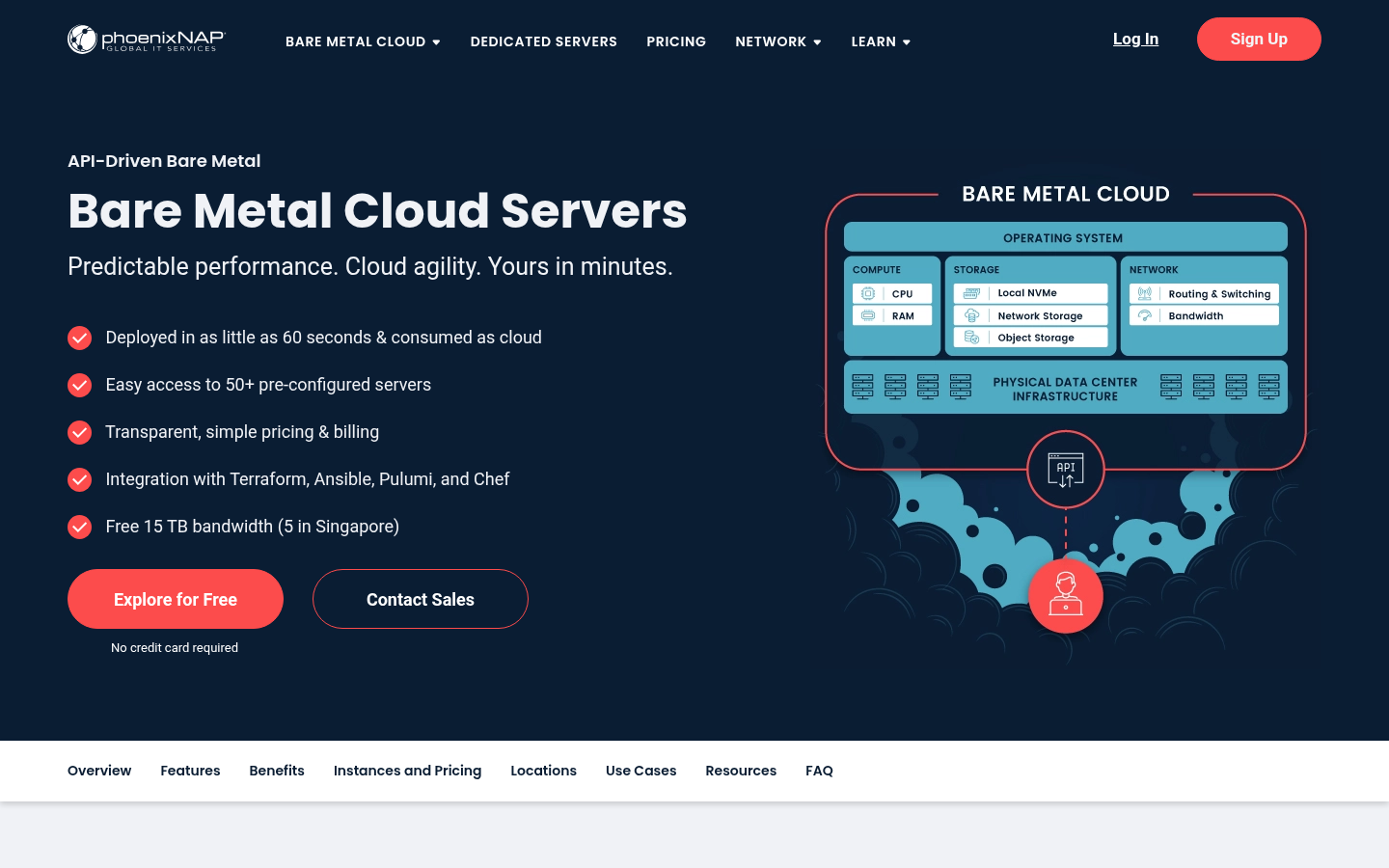
phoenixNAP Bare Metal Cloud provisions single-tenant servers through an API, CLI, web portal or infrastructure-as-code tools, with pay-as-you-go and reserved billing.
Best for: DevOps teams that want hourly billing and first-party IaC modules for repeatable environments.
Key Features:
- phoenixNAP maintains its own Terraform provider, Ansible collection, Pulumi provider and Chef plugin on GitHub.
- Billing runs hourly, with discounts for monthly and yearly reservations of up to 36 months.
- The catalog covers Intel Xeon 6 and 5th Gen Xeon instances, Ampere Altra Arm servers and Intel Max 1100 GPU instances.
- Each first deployment includes 15 TB of free bandwidth (5 TB in Singapore), bonded 20 or 50 Gbps networking depending on instance, and free 20 Gbps DDoS protection.
Why we like it: The IaC tooling is maintained by the vendor itself, and hourly billing keeps short experiments from turning into monthly commitments.
Notable Limitations:
- The public GPU catalog lists Intel Max 1100 instances only, so teams that need NVIDIA or AMD accelerators will need a second platform.
- The instance lineup is Intel-centric, with no AMD EPYC instance families listed on the pricing page.
- The free bandwidth allowance drops to 5 TB in Singapore, which matters for APAC-heavy traffic.
Pricing: The phoenixNAP pricing page advertises instances from $0.08 per hour, with exact per-instance rates shown in the Bare Metal Cloud portal and lower rates for reservations (checked November 2026).
3. OVHcloud Bare Metal
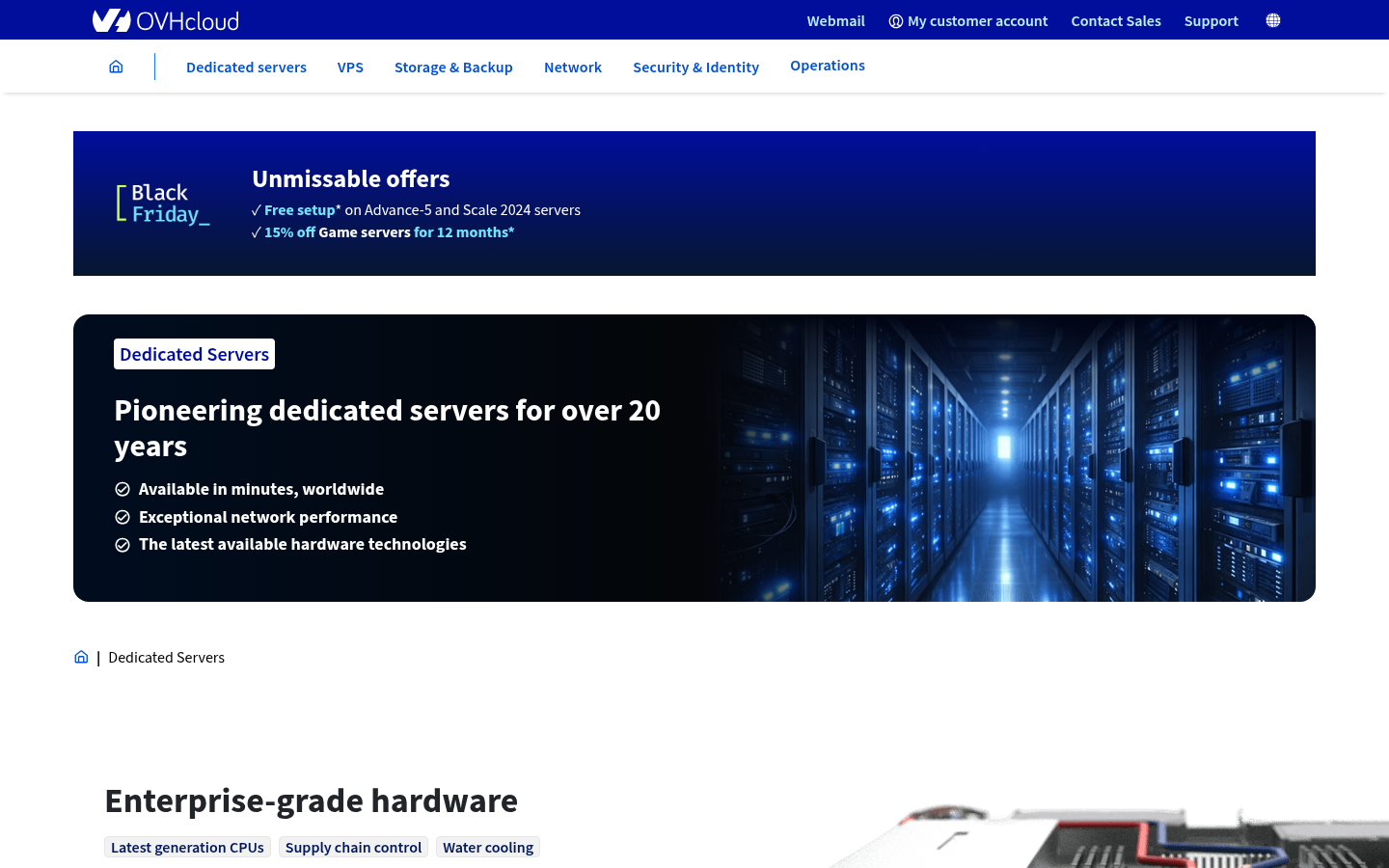
OVHcloud Bare Metal offers dedicated servers across the Rise, Game, Advance and Scale ranges, refreshed in February 2026 on AMD Zen 5 processors.
Best for: Cost-focused teams that need EU data residency, unmetered traffic and the option to spread workloads across several EU regions.
Key Features:
- The Bare Metal 2026 line-up launched in February 2026 with AMD Ryzen and EPYC processors built on Zen 5.
- Scale 2026 servers run up to dual-socket AMD EPYC 9005 processors with 384 cores, 3 TB of DDR5 ECC memory and 92 TB of NVMe storage, and support 3-AZ deployments.
- Advance 2026 servers use AMD EPYC 4005 processors and carry a 99.95 percent SLA.
- Traffic is unlimited, with guaranteed public bandwidth of 1 to 5 Gbps depending on the model and private bandwidth of up to 50 Gbps.
Why we like it: Unmetered traffic and a wide EU footprint make both budgeting and data residency easy to plan.
Notable Limitations:
- Rise 2026 and Game 2026 servers are available only in Europe and Canada.
- Guaranteed public bandwidth tops out at 5 Gbps per server, which can limit egress-heavy workloads such as video delivery.
- OVHcloud founder Octave Klaba has said that 2026 prices could rise 5 to 10 percent because of RAM and NVMe costs, as reported by DatacenterDynamics.
Pricing: The OVHcloud US site lists Rise servers from $41.30 per month, with an installation fee equal to the first month's price on that model (checked November 2026). Prices vary by region and range.
4. Vultr Bare Metal
Vultr Bare Metal runs single-tenant servers from the same API and console as Vultr's cloud VMs, with GPU bare metal in selected regions.
Best for: Startups and mid-market teams that want VMs, bare metal and GPUs under one API across many smaller points of presence.
Key Features:
- CPU bare metal runs on AMD EPYC processors, and Vultr Clusters delivers on-demand, self-service bare metal clusters.
- The GPU lineup includes NVIDIA HGX B200, HGX H100, L40S and GH200, AMD Instinct MI355X, MI325X and MI300X, and GB300 NVL72 through sales.
- Bare metal servers connect to Vultr File System through Vultr Storage Gateways or to S3-compatible Vultr Object Storage.
- The platform spans 32 cloud data center regions.
Why we like it: It lets a team standardize on one control plane for edge VMs, dedicated servers and GPU nodes.
Notable Limitations:
- Vultr's public pricing page lists GPU rates only, so CPU bare metal rates have to be checked on the deploy page or through the API.
- The lowest GPU rates require prepaid contracts of 24 to 48 months, and several AMD rates are preemptible.
- Vultr's FAQ notes that some locations carry different hourly and monthly prices because of regional costs.
Pricing: Vultr's pricing page lists NVIDIA HGX H100 at $1.99 per GPU hour on a 24-month contract, HGX B200 at $1.99 per GPU hour on a 48-month contract, and L40S at $1.671 per GPU hour on demand (checked November 2026). CPU bare metal pricing is shown in the console.
5. Cherry Servers
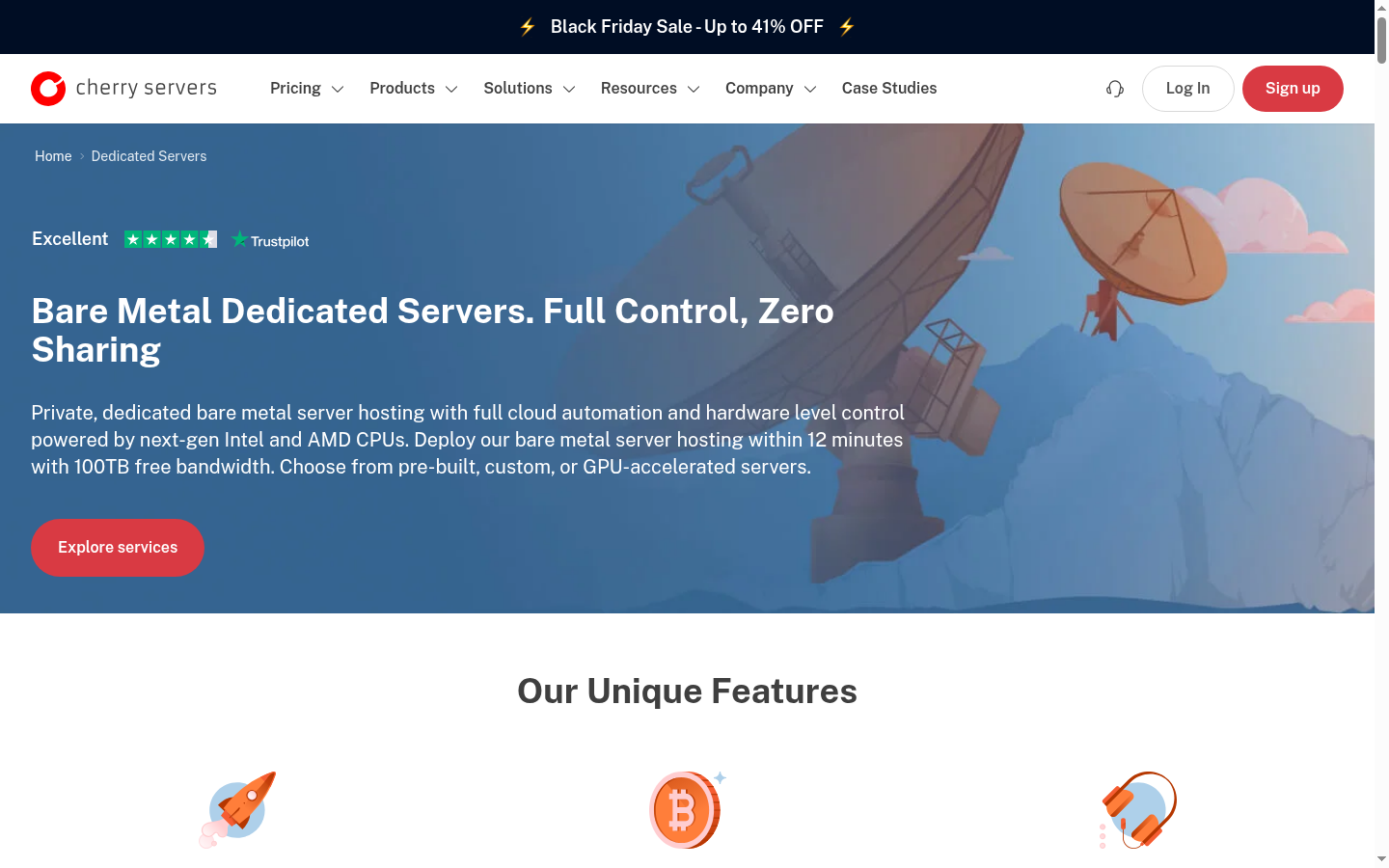
Cherry Servers sells hourly and fixed-term dedicated servers with API, Terraform and Ansible support, and has a strong following among Web3 and blockchain teams.
Best for: Developers and blockchain operators that want transparent hourly billing across Europe, the US and APAC.
Key Features:
- Dedicated servers bill hourly, monthly or annually, and pre-configured servers deploy in about 12 minutes on average.
- Locations include Lithuania, the Netherlands, Frankfurt, Stockholm, Chicago, Singapore and Tokyo, which went live in May 2026.
- 2026 updates added iPXE installs for bare metal, 10 Gbps dedicated servers in Singapore and ISO/IEC 27001:2022 certification.
- The platform accepts more than 20 payment methods, including crypto.
Why we like it: Hourly dedicated servers in less crowded locations such as Lithuania and Stockholm make it easy to place latency-sensitive or validator workloads where you want them.
Notable Limitations:
- Chicago is the only US location, so US-wide failover needs a second platform.
- Custom hardware builds take about 24 hours, compared with roughly 12 minutes for pre-configured servers.
- GPUs are added as custom configurations, and the platform has no large GPU cluster offering.
Pricing: The Cherry Servers pricing page lists dedicated servers from about $0.091 per hour, with a 15-day money-back guarantee on dedicated plans (checked November 2026).
6. Hetzner Dedicated (Robot API)
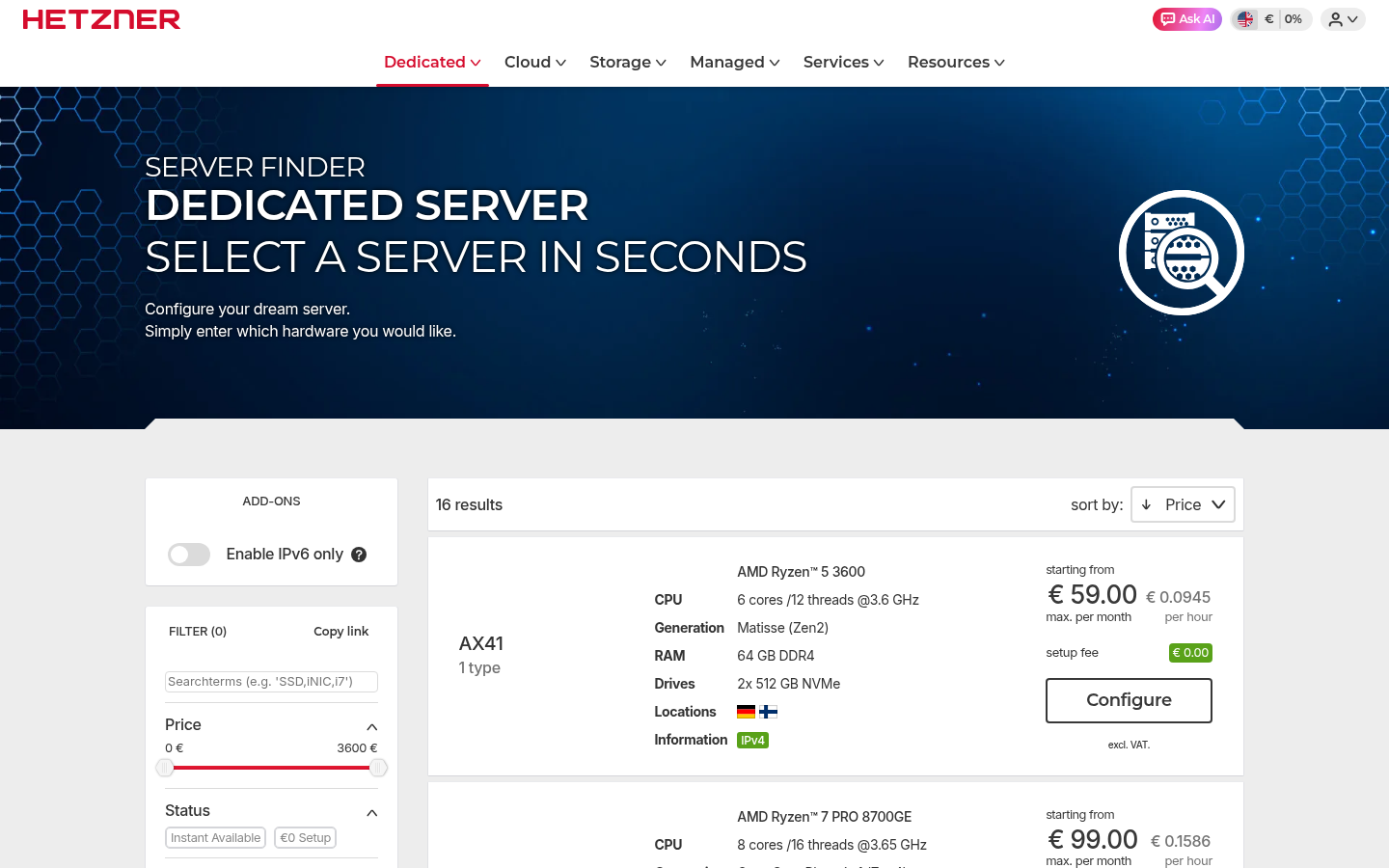
Hetzner Dedicated offers low-priced dedicated root servers in Germany and Finland, managed through the Robot panel and its webservice API, plus a Server Auction for refurbished hardware.
Best for: Budget-sensitive teams in Europe that can trade the newest silicon for a very low monthly cost and still want API control.
Key Features:
- The Robot webservice API handles server resets, reverse DNS, rescue system boots and IP management.
- The Server Auction sells refurbished servers through a Dutch-style auction, where prices fall until someone buys.
- Server lines include AX and EX general-purpose servers, GEX GPU servers, SX storage servers and DX servers built on Dell PowerEdge hardware, added in June 2026.
- The vSwitch feature links dedicated servers to Hetzner Cloud networks.
Why we like it: For EU workloads without GPU or RDMA requirements, the price per core is hard to beat, and the Auction can cut costs further.
Notable Limitations:
- Hetzner raised prices on 1 April 2026 and again on 15 June 2026 for new cloud and dedicated server orders, citing hardware component costs.
- Dedicated servers bill by the month, which makes short bursts of extra capacity expensive.
- Hetzner's terms prohibit cryptocurrency mining, which rules it out for some Web3 workloads.
Pricing: Hetzner's dedicated server page lists Server Auction systems from 78.70 euros per month, excluding VAT (checked November 2026). New-server prices follow the June 2026 price list, and existing contracts keep their earlier rates.
7. Oracle Cloud (OCI) Bare Metal
Oracle Cloud (OCI) Bare Metal provides hypervisor-free compute and GPU instances with RDMA cluster networking, built for large AI training and tightly coupled HPC.
Best for: Enterprises that need RDMA networks, supercluster scale and bare metal GPU nodes for large model training.
Key Features:
- Bare metal GPU shapes cover NVIDIA GB200 NVL72, B200, H200, H100, A100 and L40S, plus AMD MI300X and MI355X.
- OCI Supercluster scales to 131,072 B200 GPUs, more than 100,000 Grace Blackwell GPUs or 65,536 H200 GPUs per cluster.
- Cluster networking runs on RoCE v2 with 2.5 to 9.1 microseconds of latency and up to 3,200 Gb/sec of cluster bandwidth.
- Oracle and AMD announced a 50,000-GPU AMD Instinct MI450 supercluster, with deployment starting in Q3 2026 and expanding through 2027.
Why we like it: For large-model training, OCI's RDMA design and bare metal GPU lineup are proven at very large scale, and the 10 TB of free monthly egress helps data-heavy pipelines.
Notable Limitations:
- New tenancies usually need a service limit increase before they can launch bare metal GPU shapes, which slows small pilots.
- MI450 capacity is scheduled to ramp from Q3 2026 into 2027, so plan around phased availability.
- Billing in OCPUs, VCN design and the wider service catalog add a learning curve compared with single-purpose bare metal platforms.
Pricing: OCI publishes per-GPU-hour list prices for its bare metal GPU shapes on the OCI price list, and those prices are the same in every region. The first 10 TB of internet egress each month is free, and Universal Credits commitments unlock volume discounts.
Capability Comparison
The platforms differ most on automation depth, accelerator choice and network design. For the cost-control layer that sits on top of any of these platforms, see our roundup of FinOps and cloud economics platforms.
| Platform | Automation | GPU Options | Network Highlight |
|---|---|---|---|
| Latitude.sh | API, CLI, Terraform | NVIDIA H100, RTX PRO 6000, HGX B300 | Megaport private links to 1,100+ data centers |
| phoenixNAP | API, CLI, Terraform, Ansible, Pulumi, Chef | Intel Max 1100 | Bonded 20 or 50 Gbps, free DDoS protection |
| OVHcloud | API, Terraform | Separate GPU range | Unlimited traffic, up to 50 Gbps private |
| Vultr | API, CLI, Terraform | NVIDIA B200, H100, L40S, GH200, AMD MI355X | 32 regions, storage gateways |
| Cherry Servers | API, Terraform, Ansible | Custom configurations | 10 Gbps servers, direct EU interconnects |
| Hetzner | Robot webservice API | GEX GPU line | vSwitch to Hetzner Cloud |
| Oracle Cloud | API, CLI, Terraform | NVIDIA GB200, B200, H200, AMD MI355X | RoCE v2 RDMA, 2.5 to 9.1 microseconds |
Pricing Comparison
Prices below come from each vendor's own pricing page, checked in November 2026. Treat them as entry points and confirm current SKUs before you commit.
| Platform | Entry Price | Billing Options | Included Egress |
|---|---|---|---|
| Latitude.sh | $0.41 per hour ($296 per month) CPU, H100 from $1.68 per hour | Hourly, monthly | 20 TB per server |
| phoenixNAP | From $0.08 per hour | Hourly, monthly, reservations up to 36 months | 15 TB (5 TB in Singapore) |
| OVHcloud | Rise from $41.30 per month plus setup fee | Monthly | Unlimited traffic |
| Vultr | H100 $1.99 per GPU hour on 24-month contract | Hourly, monthly, prepaid contracts | Set per plan |
| Cherry Servers | From $0.091 per hour | Hourly, monthly, annual | Bandwidth package per server |
| Hetzner | Server Auction from 78.70 euros per month excl. VAT | Monthly | Unlimited traffic |
| Oracle Cloud | Per-GPU-hour list prices on OCI price list | Pay as you go, Universal Credits | 10 TB per month free |
Strategic Decision Framework
These five questions separate the platforms faster than any feature list. Work through them with your infrastructure and finance leads before you request quotes.
| Critical Question | Why It Matters | What to Evaluate | Red Flags |
|---|---|---|---|
| Do you need RDMA for multi-node AI training? | It decides whether standard Ethernet is enough or you need an RDMA fabric | Published network architecture, latency figures, cluster size limits | "High speed" claims with no fabric specs or scale examples |
| Is hourly billing essential, or will reserved terms cut cost? | Spiky and steady workloads have very different unit economics | Hourly, monthly and reserved options, plus bandwidth tiers | Contract-only pricing or egress shaping that only appears in the terms |
| Where must data live? | Regulation and latency both depend on region | EU, US and APAC regions, and where dedicated hardware actually runs | One region only, or no clear data location policy |
| How mature is the API and IaC ecosystem? | It drives how fast you can automate and how much you maintain | Official SDKs, Terraform or Ansible support, release cadence | Sparse docs and few working examples |
| Do you need current-generation GPUs this quarter? | AI timelines often hinge on supply | Recent capacity announcements, contract terms and lead times | No public roadmap for current accelerators |
Problems & Solutions
Most bare metal projects start from one of these four situations, and each one points to a different part of the shortlist.
Problem: Your LLM inference latency spikes during peak traffic across two continents. Solution: Place GPU bare metal close to users and connect it privately to your core stack. Latitude.sh offers H100 to B300 nodes in the Americas, Europe and APAC, and Megaport's network carries traffic back to your clouds over private paths.
Problem: You rebuild CI compute nightly and want to stop paying for idle servers. Solution: Use hourly bare metal driven by Terraform. phoenixNAP and Cherry Servers both bill by the hour and support Terraform and Ansible, so runners can be created and destroyed on a schedule.
Problem: Your compliance team requires EU data residency, and your budget is tight. Solution: OVHcloud's Bare Metal 2026 servers run in several EU regions with unlimited traffic, and Hetzner's Server Auction offers German and Finnish dedicated servers from 78.70 euros per month. Model Hetzner's 2026 price increases into any long-term plan.
Problem: You need to train multi-billion parameter models across hundreds of GPUs with microsecond-class interconnect. Solution: OCI bare metal GPU shapes run on RoCE v2 RDMA with 2.5 to 9.1 microseconds of latency and scale to superclusters of more than 100,000 GPUs.
The Bottom Line
Bare metal is now the practical home for performance-sensitive databases, real-time media stacks and AI clusters that need dedicated hardware. Start with Latitude.sh or phoenixNAP for fast, API-driven wins. Keep Vultr in play when you want VMs, bare metal and GPUs under one control plane.
For EU cost control, OVHcloud and Hetzner remain the value leaders, and Cherry Servers adds hourly flexibility. Short-list OCI when you need RDMA and supercluster scale. Validate pricing and GPU supply the same week you buy, then lock in reservations once you have capacity you can live with.