

The biggest difference between today's leading brain-computer interfaces is not channel count. It is whether the device is actually available outside a clinical trial, and what surgery is required to use it. A brain-computer interface reads signals from the brain and turns them into computer commands: a cursor, a click, or control of a device. Clinics and research groups look at these platforms when a person cannot use a keyboard or mouse because of paralysis, ALS, or spinal cord injury. A headset you would use at home, without surgery, is a different category. Those products are not on this list.
Neuralink and Synchron are still investigational implants. They do not have premarket approval (PMA) from the U.S. Food and Drug Administration (FDA), the full path for a high-risk implant. Precision Neuroscience has FDA clearance for a temporary cortical array that can remain in place for up to 30 days. Blackrock Neurotech is the established research option: the Utah Array, a penetrating electrode grid used in academic BCI work, sold as capital equipment. That means these are not four interchangeable products. They represent different levels of invasiveness, regulatory maturity, and clinical access.
If the protocol needs high-bandwidth threads placed through open-skull surgery, start with Neuralink. It is still an early feasibility study. If you will not open the skull, Synchron is the blood-vessel path. If you need a cleared array you can place this year for a short stay, Precision's Layer 7-T is the thirty-day option. If the lab already runs human intracortical work, start with Blackrock and budget it as capital equipment. The method is on How we review tools.
What actually matters when choosing a BCI
Most bad fits start with treating a trial device as something a hospital can order, or treating channel count as the decision.
| Problem | Solution |
|---|---|
| A research device is sold as orderable hardware | Write whether the hospital can order it or only join a trial |
| The surgical path is unnamed | Ask how the device reaches cortex before you plan rollout |
| Indication language is older than the study status | Use the current indication or trial status, with a date |
| No public device price exists | Treat it as quote-only |
How we evaluated brain-computer interface platforms
Four checks: how the device reaches cortex, whether a hospital can order it or only join a trial, the dated indication or study status, and whether any price is public. Channel-count slides did not decide the list. Neighbor products sit under Other brain-computer interface platforms worth considering.
TL;DR: The Four Compared
| Platform | Best for | What to check |
|---|---|---|
| Neuralink | High-bandwidth intracortical threads in an investigational study |
PathOpen craniotomy. N1 implant, R1 robot. 1,024 electrodes across 64 threads
StatusPRIME early feasibility, recruiting (NCT06429735). Primary completion estimated June 2026
PriceQuote-only. Not for sale. No PMA. Access is through clinical sites
|
| Synchron | Endovascular access when a craniotomy is off the table |
PathStentrode through the jugular. No open skull. Wireless, internalized
StatusCOMMAND: six participants, 12-month primary safety endpoint met (30 Sep 2024). 2026 pivotal funded; no public NCT is listed
PriceQuote-only. Still trial-only. No commercial implant you can order
|
| Precision Neuroscience | A cleared surface array you can place now, for up to 30 days |
PathLayer 7 thin-film on cortex. Non-penetrating. Still a neurosurgical placement
StatusFDA clearance K242618, 30 March 2025. Indication up to 30 days
PriceQuote-only. Chronic wireless BCI is a separate device and a separate FDA path
|
| Blackrock Neurotech | Labs that already run human intracortical work |
PathUtah Array / NeuroPort. Open-brain surgery. Research incumbent
StatusLong BrainGate-class human record. Breakthrough Device on a BCI system is not a PMA
PriceQuote-only. Budget as capital equipment and service, usually on a grant
|
Neuralink
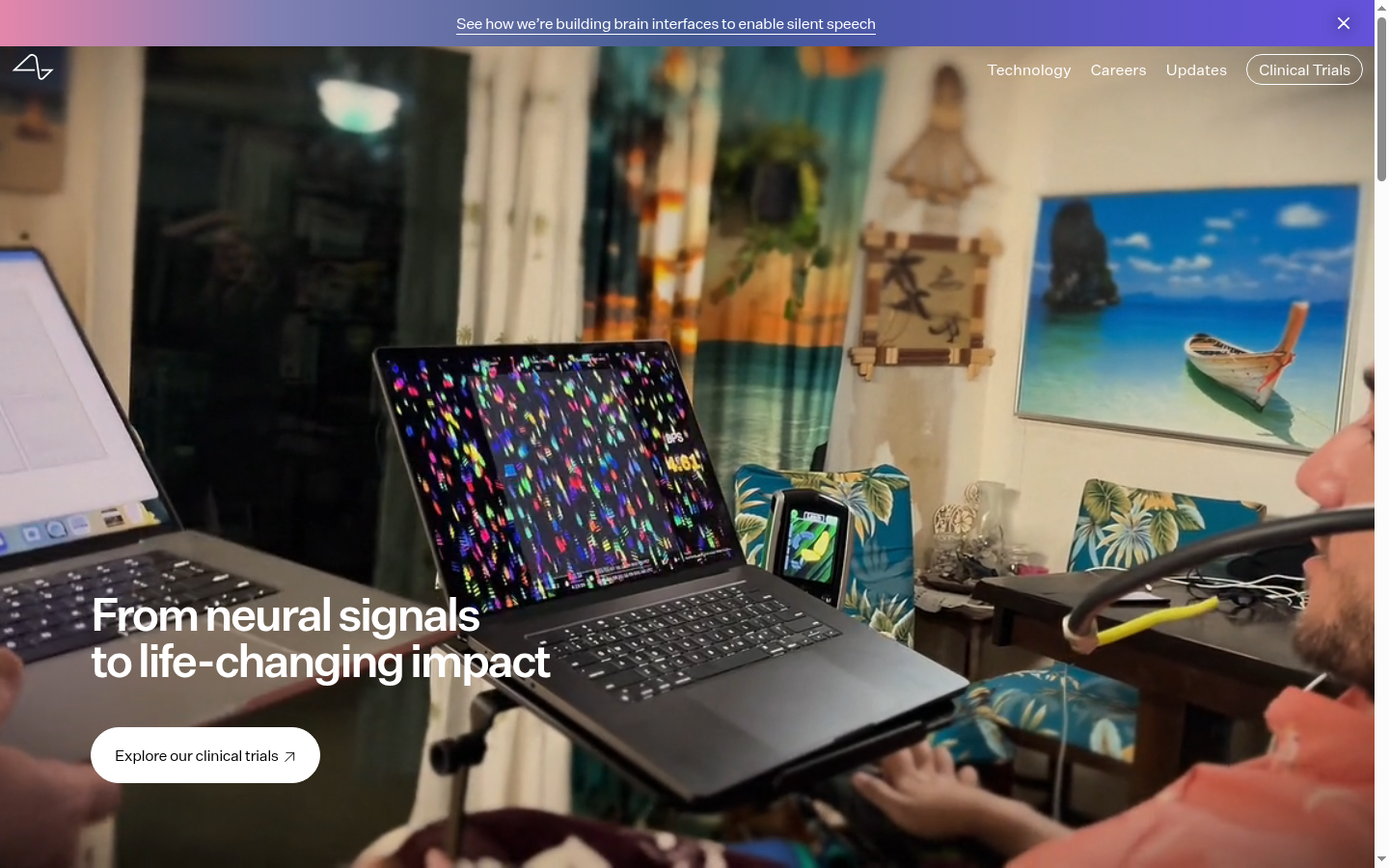
Neuralink is the high-bandwidth intracortical option. The N1 Implant is a skull-mounted, wireless, rechargeable package. The R1 Robot inserts polymer threads (1,024 electrodes across 64 threads) into motor cortex. The software surface patients use is Telepathy: cursor, clicks, gaming, browsing. Synchron will not give you that channel count. Blackrock will, as research capital equipment, without this robot.
The clinical study is PRIME (NCT06429735): Precise Robotically IMplanted Brain-Computer InterfacE. That is an early feasibility study under an investigational device exemption (IDE), which is FDA permission to implant an unapproved device in a clinical study. Each hospital still needs its institutional review board (IRB) to approve the protocol before anyone is enrolled. PMA is not in place. PRIME is recruiting. Primary completion is estimated June 2026. Estimated enrollment is 15. CONVOY (robotic-arm control) and VOICE (speech) sit on the same implant family. N1 is not a commercial device.
Best for: Investigators who need intracortical bandwidth and will run an IDE protocol.
What you get:
- N1 wireless implant plus R1 robotic thread insertion. High channel count relative to endovascular systems.
- PRIME: first-in-human early feasibility, recruiting, primary completion estimated June 2026 (NCT06429735).
- Telepathy software for digital control. CONVOY and VOICE sit on the same implant family.
- Sites include Barrow Neurological Institute and University of Miami. International PRIME variants have been announced separately.
Why we like it: If the task is high-degree-of-freedom cursor or device control, thread density is what the design is for, and the robot is how those threads go in. You can confirm the study is still recruiting before anyone books travel.
Limits:
- Open craniotomy and a custom robot. That is a different consent conversation than a day-case endovascular procedure.
- The first patient had thread retraction. Ask the site what design they implant now.
- Not for sale. No PMA. No public price. PRIME is still recruiting.
Price: Quote-only. Access is through clinical sites. There is no commercial list price.
Synchron
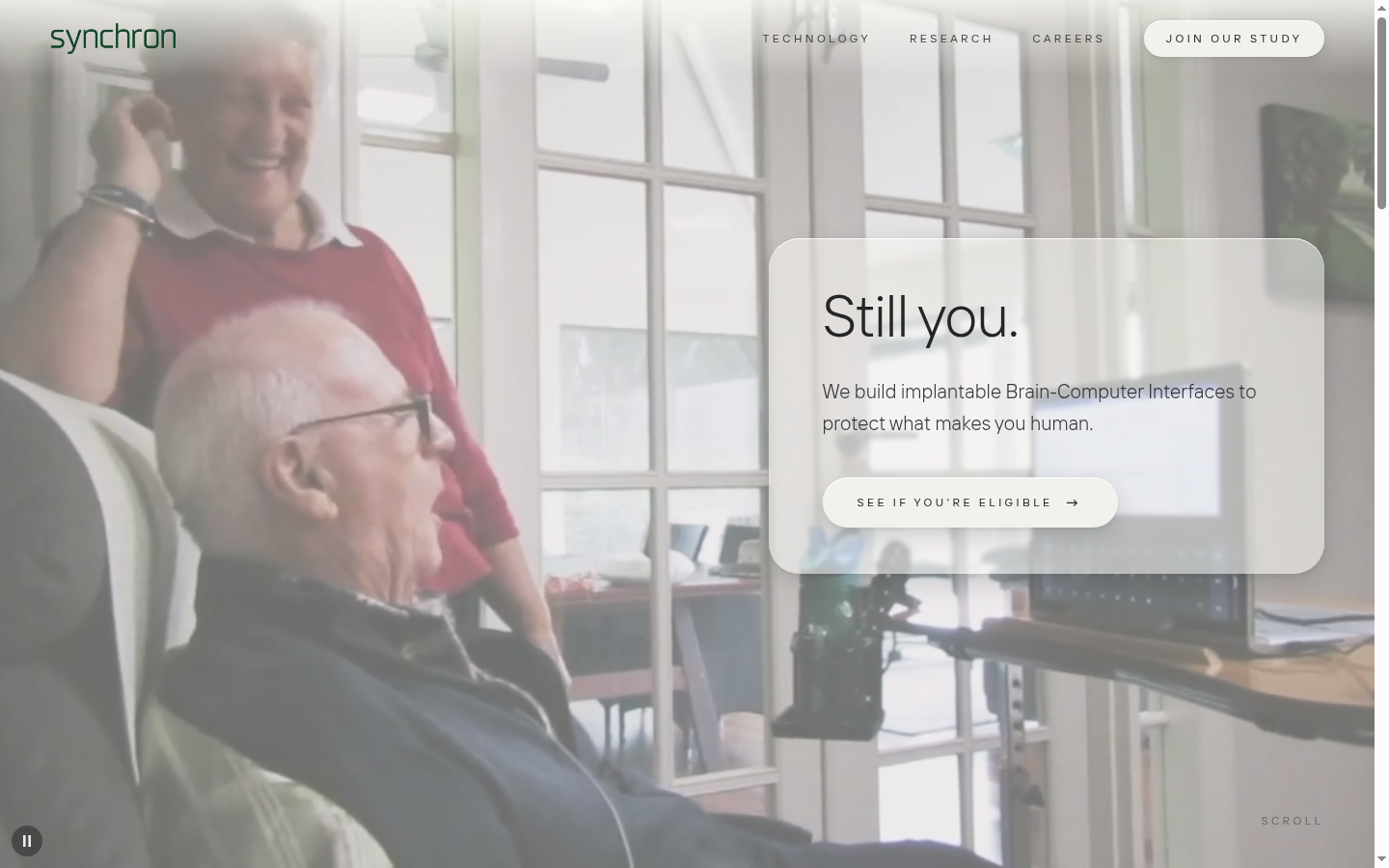
Synchron is the endovascular path. Stentrode goes in through the jugular, sits in a blood vessel over motor cortex, and never opens the skull. Motor-intent signals become digital clicks and cursor moves on a consumer device. It has Breakthrough Device designation. COMMAND was the first FDA IDE trial of a permanently implanted BCI in the United States. Neuralink and Blackrock require open-skull surgery. This implant does not.
On 30 September 2024 Synchron reported COMMAND: six participants, 12 months, primary safety endpoint met. No device-related serious adverse events resulting in death or permanent increased disability, and no serious brain or vasculature events. The device deployed on target in all six cases. Median deployment time was 20 minutes. Sites included Mount Sinai, University at Buffalo Neurosurgery, and UPMC. A $200 million Series D on 6 November 2025, about $345 million total, is earmarked for a 2026 pivotal trial and first-generation commercial prep. That pivotal is the gate to a PMA filing. It has not read out. Apple's accessibility path for iPad, iPhone, and Vision Pro is a real integration story. It is not FDA approval.
Best for: Hospitals that want an implant without opening the skull and can wait on a pivotal.
What you get:
- Endovascular Stentrode. No craniotomy. Wireless, internalized system.
- COMMAND: first U.S. IDE for a permanently implanted BCI. Six of six hit the 12-month primary safety endpoint (30 Sep 2024).
- Median 20-minute deployment in COMMAND. Works with consumer accessibility stacks, including Apple's 2025 path for iPad, iPhone, and Vision Pro.
- 2026 pivotal funded by the November 2025 Series D. PMA is the intended next regulatory step.
Why we like it: If the hospital will not open the skull, this is the implant that goes in through a blood vessel. COMMAND already has U.S. IDE safety data in six people, and patients keep using consumer devices.
Limits:
- Channel count and bandwidth sit well below intracortical arrays. Fine motor or high-rate speech decoding is the other constraint.
- COMMAND is six people and safety. Efficacy at scale is the pivotal's job.
- Still trial-only. No list price. No commercial implant you can order. No public NCT is listed for the 2026 pivotal. Ask before you write it into a protocol.
Price: Quote-only. Still trial-only. There is no commercial implant to order.
Precision Neuroscience
Precision Neuroscience is the surface-array path. Layer 7 is a thin-film cortical interface (1,024 microelectrodes on a film a fraction of a human hair thick) that sits on cortex and does not penetrate it. Neuralink's threads go into cortex. This film sits on the surface, and the cleared product is temporary.
FDA cleared Layer 7-T on 30 March 2025 (K242618). A 510(k) is the clearance path for a device shown substantially equivalent to one already on the market. It is not PMA. The indication is to record, monitor, and stimulate electrical activity on the brain's surface for up to 30 days. That is a Class II cortical electrode clearance, substantially equivalent to existing subdural grids: intraoperative mapping and short-stay research. The fully implantable wireless system is still in development. By the clearance date, the array had been used in 37 patients during scheduled neurosurgery. In July 2026, able-bodied volunteers used Layer 7 for cursor control while the temporary array was in. Chronic wireless implants are a later IDE.
Best for: Neurosurgery programs that need a cleared surface array for up to 30 days.
What you get:
- Layer 7 thin-film array, 1,024 contacts, non-penetrating, micro-slit delivery.
- FDA 510(k) K242618, 30 March 2025, commercial use up to 30 days.
- Fits existing EEG head stages and operating-room workflows. Cleared for recording, monitoring, and stimulation on the cortical surface.
- Chronic wireless BCI is a separate device and a separate FDA path.
Why we like it: This is the array a hospital can place under a current FDA clearance this year, for mapping and short-stay research, without waiting on a pivotal. The thirty-day limit is the tradeoff that makes that possible. Then the array comes out.
Limits:
- Not a chronic implant. Do not treat the thirty-day clearance as a permanent BCI.
- Placement still needs a neurosurgical procedure (craniotomy or burr hole). Minimally invasive is not percutaneous.
- No public device price. Hospital capital and study budgets.
Price: Quote-only. Hospital capital and study budgets. There is no public device price.
Blackrock Neurotech

Blackrock Neurotech is the research incumbent. The Utah Array and NeuroPort stack have sat under two decades of BrainGate and related human work: cursor control, robotic limbs, speech decoding, stimulation. If a paper says intracortical array in a human, there is a good chance the hardware is Blackrock. Neuralink is the newer robot-and-thread study. This is the array many labs already know how to sterilize, implant, and write against.
Breakthrough Device designation exists on a BCI system. That program can speed FDA review. It is not a PMA, and it is not approval. Labs still purchase this as capital equipment plus support contracts. The company also distributes noninvasive research gear around the implant line. A 2024 Tether investment is meant to push commercialization. That does not make the research array a catalog implant a hospital orders like Layer 7-T.
Best for: Labs that already run human intracortical work on a research array.
What you get:
- Utah Array / NeuroPort: hundreds of channels, recording and stimulation options, the reference stack in many labs.
- Long human-study track record via BrainGate and related programs.
- Breakthrough Device designation on a BCI system. Commercialization funded in part by the 2024 Tether investment.
- Noninvasive research products around the implant core, if the same lab also runs EEG or similar.
Why we like it: If the protocol needs the timing and a decoder the lab already knows how to train, this is still the hardware people know how to implant and write against. Budget it as capital equipment on a grant, not as a consumer implant.
Limits:
- Open-brain surgery, tissue response, and array longevity are the known tradeoffs. They have not gone away because the brand is familiar.
- A research-tools company becoming a commercial implant company is still the open question after the Tether investment.
- No public price list. Budget as capital equipment and service, usually on a grant.
Price: Quote-only. Budget as capital equipment and service, usually on a grant.
If the next comparison is clinic software rather than an implant, start with EMR tools.
Can a hospital order the device, and what surgery does it require?
This grid plots two questions. Across is access in 2026: trial-only on the left, a hospital or lab can place a purchase order on the right. Up is the surgical path: penetrating or intracortical at the top, endovascular or surface at the bottom.
Placement is trial-only versus a hospital or lab purchase order, and penetrating versus endovascular or surface. Precision's clearance is temporary. Blackrock's orderable path is research capital equipment, not a consumer implant. Placement only, not review scores.
What you can write on a protocol
| Platform | Public status | What you still cannot claim |
|---|---|---|
| Neuralink | PRIME recruiting. NCT06429735. Estimated enrollment 15. Primary completion estimated June 2026 | A commercial N1. A PMA. A public price |
| Synchron | COMMAND safety readout, six people, 30 Sep 2024. Series D funds a 2026 pivotal | Approval. Efficacy at scale. A public NCT for that pivotal (none is listed) |
| Precision Neuroscience | K242618, 30 March 2025. Up to 30 days | A chronic wireless implant. Permanence. A public device price |
| Blackrock Neurotech | Research Utah Array / NeuroPort. Breakthrough Device on a BCI system | A PMA. A public price list. That Breakthrough Device is approval |
Other brain-computer interface platforms worth considering
These are real programs. They are not on this comparison because they are a headset rather than an implant, or they are not yet available for a hospital protocol this year.
- Arctop - a noninvasive cognition API (focus, workload) with mobile and Unity SDKs. Useful for XR experiments. It is not a surgical implant.
- Nimbus - does not have the independent clinical or commercial record to sit on this comparison.
- Paradromics (high-bandwidth speech, Connect-One) and Science Corp - worth watching. They are not yet at the same access or clearance stage as the platforms above.
- OpenBCI and Emotiv - research or consumer EEG. Useful at home or in a lab without surgery. A hospital cannot order them as implants.
Questions before you pick a path
If you cannot answer these with a trial ID, an indication, or a capital quote, you do not have enough to choose yet.
- What control bandwidth do you actually need? Switch-scanning a tablet is a different implant than decoding attempted handwriting or speech. An endovascular stent will not give you Utah-Array bandwidth. Write the task before you pick a surgical path.
- Can a hospital order this in 2026, and for how long? A 510(k) that ends at 30 days is not a chronic implant. An early feasibility study is not a catalog product. A research array is a grant-funded purchase, not a consumer device.
- Is the next gate a pivotal, a wider indication, or a PMA? Series D funding and Breakthrough Device language are not approval. Ask for the public registration before you put a year on an internal plan.
Which BCI platform should you pick
High-bandwidth intracortical, robot in the OR: Neuralink, through PRIME, still recruiting. No craniotomy, digital access for severe paralysis: Synchron, and watch the pivotal. A cleared array you can place this year for a short stay: Precision Layer 7-T, thirty days. A lab that already runs human intracortical work: Blackrock, budgeted as capital equipment. If you cannot point to a trial, a clearance indication, or a capital quote, you are not ready to choose.
Frequently asked questions
Is Layer 7 a commercial BCI I can leave in?
No. K242618 is a temporary cortical electrode, up to 30 days. The wireless chronic system is in development and needs its own IDE. A July 2026 demonstration of cursor control does not change the indication. If a vendor slide blurs that, the clearance is still thirty days.
When does Synchron become a product a hospital can order?
After a pivotal and a PMA. The November 2025 Series D funds that work in 2026. Until readout, it is a trial device with a safety package in six people from COMMAND. No public NCT is listed for the pivotal.
Do any of these four have a public price?
No. Neuralink and Synchron are trial access. Precision Layer 7-T is a commercial clearance without a public device price. Blackrock is a capital-equipment quote, usually on a grant. Treat any unofficial dollar figure as unconfirmed.