

Most teams discover their data is untrustworthy during a board-level AI demo, not from a unit test. The pattern repeats across companies of every size: projects stall because nobody can trace a KPI back to source tables, classify PCI or PHI correctly, or explain how a model's training set changed after a schema tweak.
Three technical fixes repeatedly save time and money: automate column-level lineage across dbt, Spark, and Power BI, enforce data contracts on event streams, and stand up a governed data marketplace for reuse.
The stakes are rising fast. Gartner's Market Opportunity Map forecasts the data and analytics software market to grow from $175 billion in 2025 to $358 billion by 2029, a 15.4 percent CAGR. And in 2026 the pressure is regulatory as much as technical: the EU AI Act, NIST AI RMF, and ISO 42001 are turning AI governance from a slide in the deck into an audit requirement.
This guide compares five data intelligence platforms, Actian, Alation, Collibra, Atlan, and Accurity, on cataloging, governance, lineage, data quality, and AI control. You will see where each stands out, where the gaps are, and how to match a shortlist to your size, risk profile, and AI roadmap, grounded in verified market context and third-party reviews rather than vendor hype.
Data Intelligence Platforms at a Glance
| Tool | Best for | Pricing model | Standout |
|---|---|---|---|
| Actian Data Intelligence Platform | Enterprises that want an "Amazon for data" marketplace experience | Custom enterprise subscription | Active metadata and data product marketplace, AWS procurement |
| Alation | Teams pairing a mature catalog with agentic automation | Custom enterprise subscription | AI governance suite with a built-in regulation registry |
| Collibra | Regulated enterprises needing one control plane for data and AI | Custom enterprise subscription | AI Command Center for real-time agentic AI oversight |
| Atlan | Modern stacks on Snowflake and Databricks | Custom enterprise subscription | Context layer for AI with strong UX and collaboration |
| Accurity | Mid-market teams wanting glossary, quality, and lineage in one app | Custom subscription | Integrated modular suite with reference data management |
How We Evaluated These Tools
Every platform in this list was assessed on the factors that decide whether a data intelligence investment actually pays off:
- Catalog adoption and UX: whether stewards and analysts will actually use the catalog day to day, since a tool nobody opens governs nothing.
- Lineage depth: column-level lineage across dbt, Spark, warehouses, and BI tools, not just dataset-level maps that leave impact analysis to guesswork.
- Data quality and trust signals: built-in quality monitoring, contracts, and scoring that tell consumers whether an asset is safe to use.
- AI governance readiness: native support for the EU AI Act, NIST AI RMF, and ISO 42001, and controls for models and agents, not just tables.
- Deployment fit: cloud, customer-managed, and self-hosted options for regulated sectors with data residency or isolation requirements.
- Procurement and pricing transparency: trials, marketplace listings, and how much of the buying process requires a sales call.
The 5 Best Data Intelligence Platforms
1. Actian
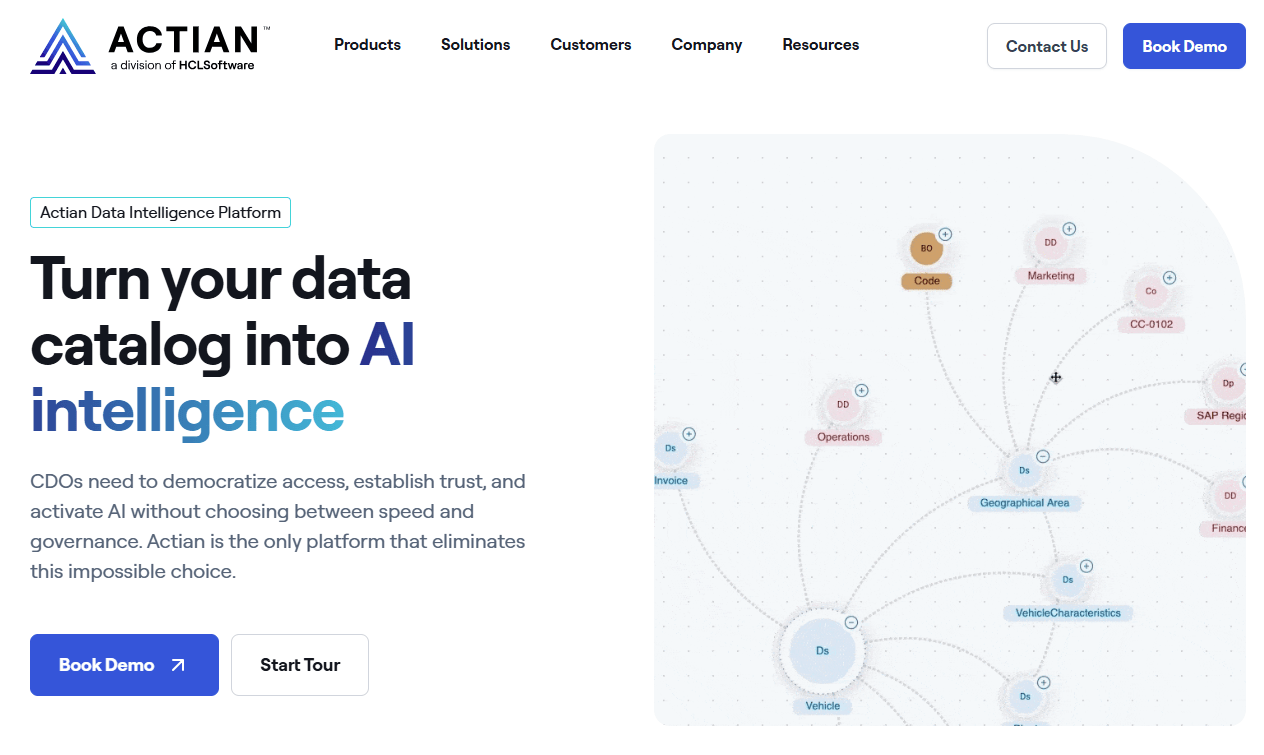
Actian Data Intelligence Platform is cloud-native data intelligence for discovery, active metadata, lineage, governance, and data product activation, built on the Zeenea catalog and advanced under HCLSoftware's data division. It is available through cloud marketplaces for streamlined procurement.
Best for: Enterprises standardizing on an "Amazon for data" experience with active metadata and marketplace concepts, especially if they procure through AWS.
Key features:
- Automated metadata harvesting and end-to-end lineage, plus governance workflows
- Data product marketplace model for discovery and access
- Integrations with modern stacks, including Databricks Unity Catalog and cloud warehouses
- "Context engine" positioning for AI agents and business users
Why we like it: A pragmatic balance of catalog, lineage, and governance with a marketplace UX that accelerates adoption for analytics and AI initiatives.
Limitations:
- Smaller review footprint and ecosystem maturity compared with long-time leaders, per Gartner Peer Insights summaries
- Buyer references indicate a learning curve around configuration and integrations, per limited feedback on G2's Actian Data Platform page
Pricing: Not publicly available. Sold via an AWS Marketplace listing with private offers.
2. Alation
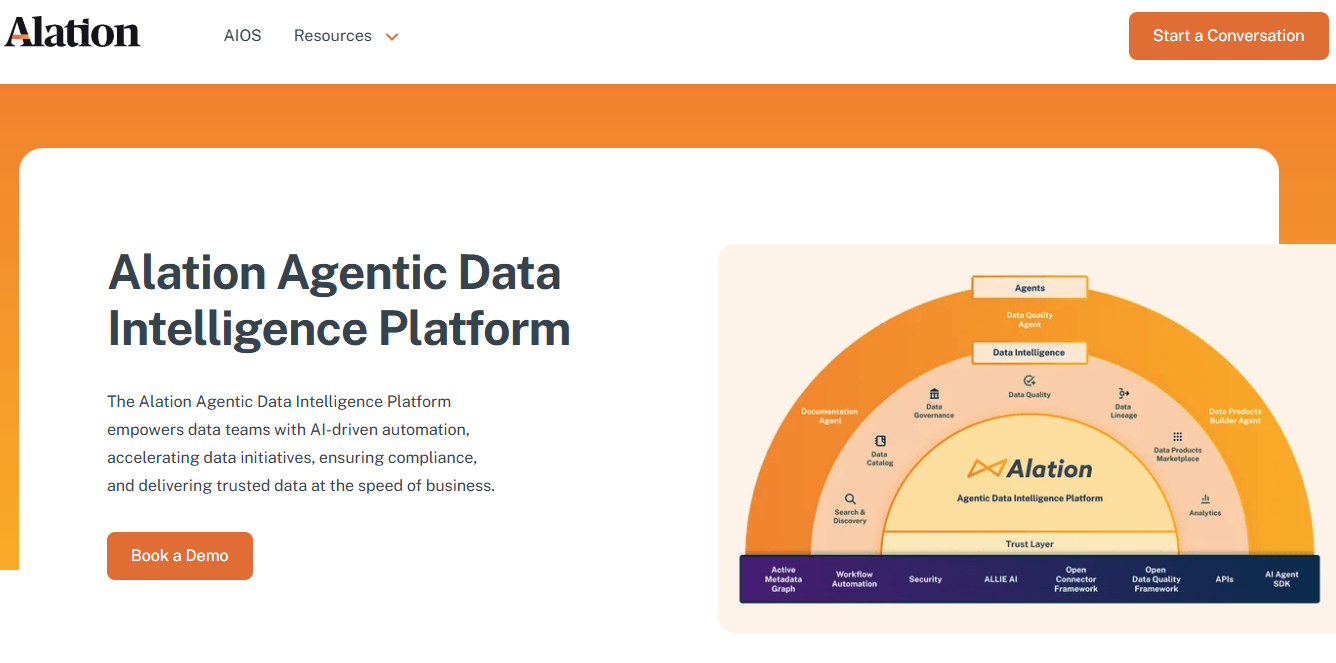
Alation pairs an enterprise data catalog and governance platform with agentic automation: AI agents and an SDK to document, steward, and govern data at scale. In May 2026 it added a dedicated AI governance offering aligned to major regulations.
Best for: Organizations that want a proven catalog, plus AI agents to automate curation and policy work, and a credible path for model and agent governance.
Key features:
- Agentic AI capabilities, including an agent SDK and a roadmap for additional agents, covered by TechTarget
- Data catalog with search, lineage, and collaboration
- AI governance suite with a regulation registry spanning the EU AI Act, NIST AI RMF, and ISO 42001, detailed by TechTarget's launch coverage
- Enterprise cloud service with a customer-managed option
Why we like it: Alation pairs a mature catalog with credible investment in agentic automation and governance, reducing manual stewardship overhead.
Limitations:
- Reviewers cite cost concerns and occasional performance issues, plus lineage gaps in complex estates, per G2 customer reviews
- Some capabilities roll out in staged betas, so delivery timelines matter for buyers, per TechTarget coverage of the agentic releases
Pricing: Not publicly available. Alation offers trials by agreement, see its trial use terms and an AWS Marketplace listing for procurement.
3. Collibra
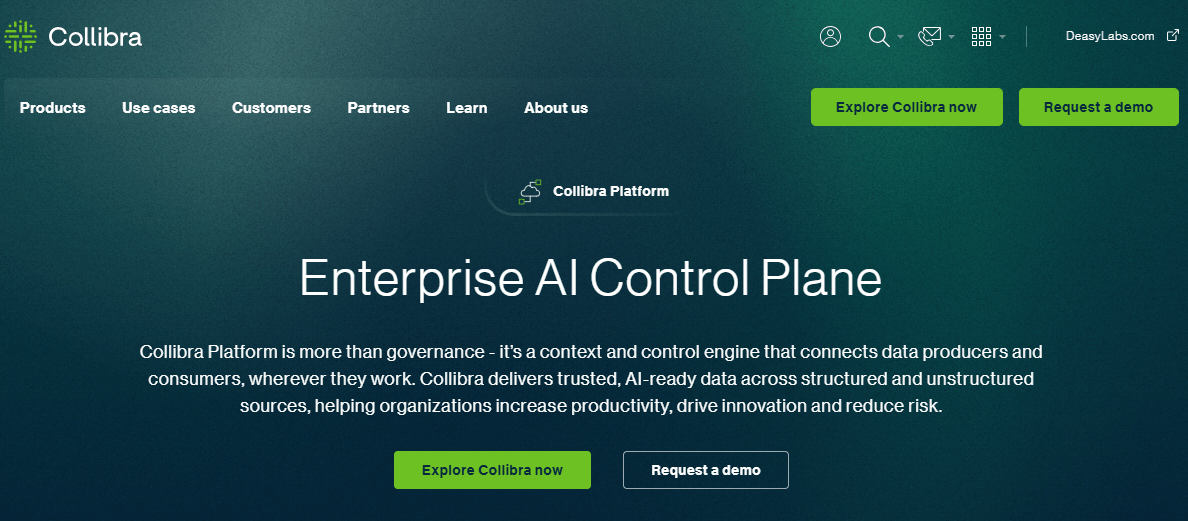
Collibra is a unified system for data cataloging, governance, lineage, data quality, and privacy, extended in May 2026 with the AI Command Center, which adds real-time oversight and control for agentic AI, per the launch announcement.
Best for: Regulated enterprises that need a single control plane across data, analytics, and AI programs with strong workflow depth.
Key features:
- Data catalog, governance, lineage, quality, and privacy in one platform
- AI governance capabilities, including assessments and real-time oversight of deployed agents
- Government and self-hosted options documented for specific deployment needs
- Broad partner ecosystem and marketplace availability
Why we like it: Collibra is a mature, extensible platform that centralizes policy, lineage, and quality, now with real-time oversight for agentic AI on top.
Limitations:
- Users report setup complexity and navigation friction in large rollouts, per G2 reviews
- Program success often depends on formal stewardship and process design, not only tooling, a theme reflected across peer reviews
Pricing: Not publicly available. Available for private offers through AWS Marketplace.
4. Atlan
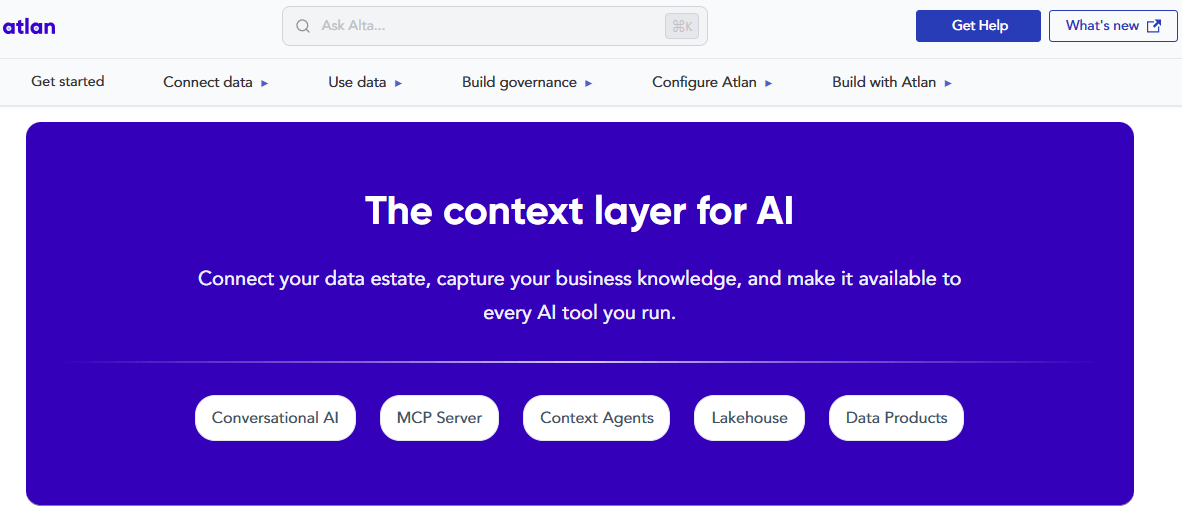
Atlan positions itself as a context layer for AI, unifying metadata, semantics, lineage, and business knowledge into a living enterprise data graph for trust and discovery. It raised $105 million in 2024 to build out that control plane, as covered by TechCrunch.
Best for: Modern data stacks on Snowflake and Databricks that want fast, collaborative cataloging with a strong UX and AI context emphasis.
Key features:
- Enterprise data catalog with column-level lineage and rich context
- Designed to connect warehouses, BI tools, and model workflows
- Collaboration features for faster documentation and discovery
- Rapidly evolving "control plane" positioning for AI
Why we like it: Atlan's UX lowers curation friction, and its context-for-AI approach helps analytics and ML teams converge on shared definitions quickly.
Limitations:
- Some reviews note slow responses at scale and missing features in specialized areas, per G2 feedback
- Enterprise breadth, especially for deeply regulated programs, may still require complementary tooling
Pricing: Not publicly available. Listed on AWS Marketplace.
5. Accurity
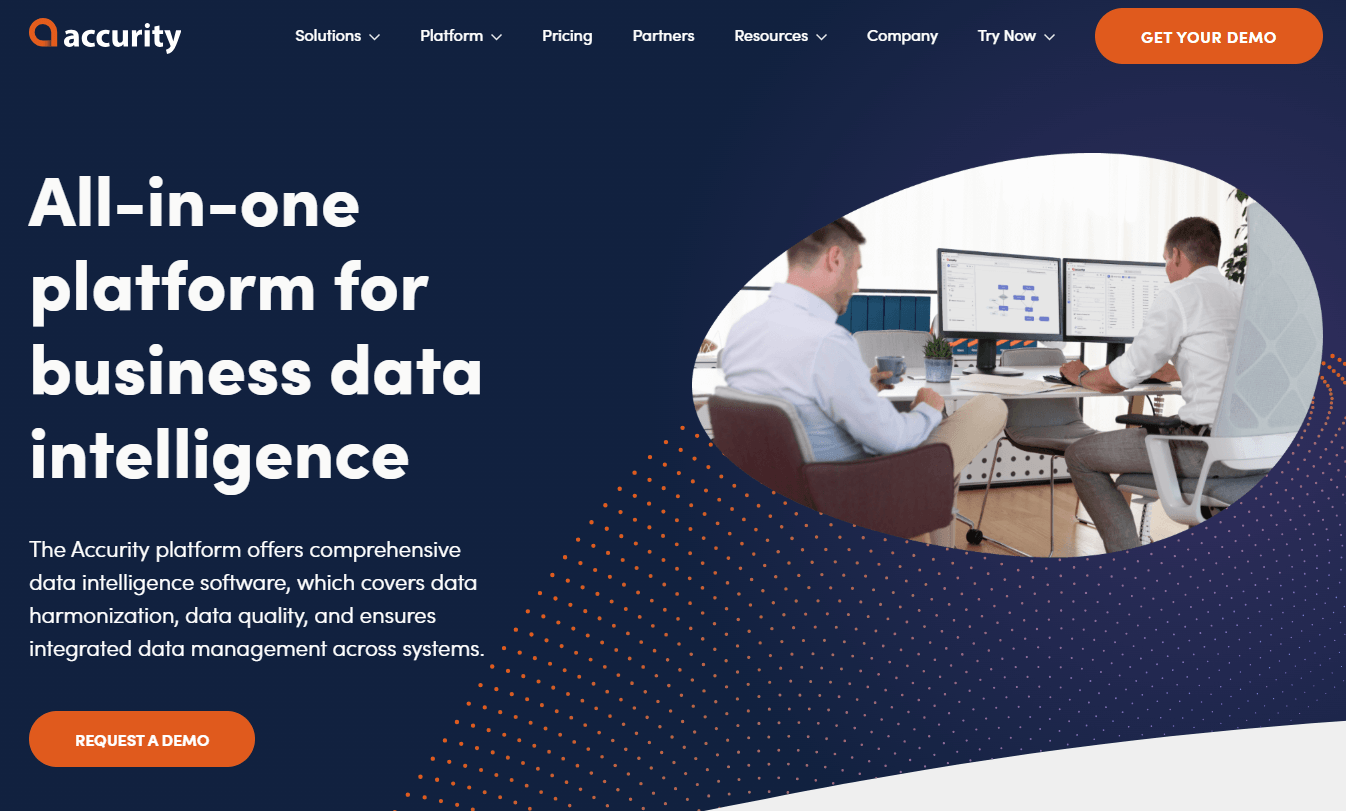
Accurity is an all-in-one data intelligence platform that combines a business glossary, metadata management, data quality, process lineage, and reference data management in a single application.
Best for: Mid-market teams seeking integrated glossary, quality, and lineage in one application with flexible deployment.
Key features:
- Business glossary and catalog for shared definitions
- Data quality and process lineage for trust and traceability
- Reference data management for consistency
- Modular suite to grow capabilities over time
Why we like it: Clear scope and integrated modules make it a practical fit for teams that need coverage across glossary, quality, and lineage without a large platform footprint.
Limitations:
- Reviewers cite initial configuration effort and relationship modeling limits, per Capterra reviews
- Smaller ecosystem and fewer enterprise references than category leaders, based on public review counts
Pricing: Not publicly available. Capterra lists no public pricing, see Accurity on Capterra.
Feature Comparison
| Tool | Lineage | Data quality | AI governance |
|---|---|---|---|
| Actian | End-to-end, automated | Yes | Governance workflows and marketplace model |
| Alation | Column-level | Yes | AI governance suite with regulation registry |
| Collibra | Yes, incl. technical lineage for BI | Yes | AI governance plus real-time AI Command Center |
| Atlan | Column-level | Emerging | Emerging AI context features |
| Accurity | Process lineage | Yes | Privacy alignment via glossary and policies |
Deployment Options
| Tool | Cloud | On-premise / self-hosted | Integration complexity |
|---|---|---|---|
| Actian | Yes | Limited public info | Medium |
| Alation | Yes | Customer-managed option available | Medium |
| Collibra | Yes | Self-hosted editions and government options documented | Medium to high |
| Atlan | Yes | Limited public info | Medium |
| Accurity | Yes | Available per vendor materials | Medium |
Strategic Decision Framework
| Critical question | Why it matters | What to evaluate | Red flags |
|---|---|---|---|
| Will this platform govern agentic AI, not just data? | AI programs fail without model and agent oversight | Native AI governance, assessment templates, policy automation | "Roadmap only" for AI controls |
| Can we trace a KPI to source with column-level lineage? | Faster impact analysis and audit readiness | Cross-tool lineage coverage for dbt, Spark, BI | Lineage only at dataset level |
| How quickly can stewards document trustworthy assets? | Time to value depends on curation velocity | AI-assisted descriptions, collaboration, bulk editing | Manual, ticket-heavy workflows |
| Do we need an internal data marketplace? | Drives reuse and safe self-service | Productization features, approvals, entitlement hooks | Catalog without access workflows |
| What deployment constraints exist? | Regulated sectors may need self-hosted | Government or self-hosted SKUs, VPC patterns | Cloud-only, unclear isolation story |
Problems & Solutions
-
Problem: "Our AI program cannot pass an internal audit, we lack evidence for how models and agents use data."
- Collibra's AI governance capabilities, first covered by TechTarget, now extend to real-time oversight through the AI Command Center launched in May 2026.
- Alation's May 2026 AI governance suite adds a regulation registry aligned to the EU AI Act, NIST AI RMF, and ISO 42001, as TechTarget reported.
- Actian, Atlan, and Accurity contribute the metadata, lineage, and glossary backbone needed to document inputs and controls, as reflected in their marketplace listings and third-party reviews on G2 and Capterra.
-
Problem: "Analysts are duplicating work because they cannot find trusted datasets."
- Atlan emphasizes a context layer across Snowflake, Databricks, and BI tools, improving discovery and reuse, per TechCrunch's funding coverage.
- Alation's catalog with agentic automation speeds documentation and search, as detailed in TechTarget's agent and SDK coverage.
- Collibra centralizes catalog, policy, and lineage to drive a governed marketplace approach, noted in G2's feature overview.
- Actian positions a marketplace UX for data products to streamline safe access, visible in its AWS Marketplace description.
-
Problem: "A schema change broke dashboards, but impact analysis took days."
- Reviewers highlight the value of automated lineage in Collibra, which supports technical lineage for BI tools, per its G2 reviews.
- Alation and Atlan both expose column-level lineage to accelerate root-cause analysis, backed by the TechTarget and TechCrunch coverage above.
- Accurity's process lineage and quality modules help teams catch regressions earlier, per its Capterra listing.
-
Problem: "Procurement slows us down, especially for pilots."
- Actian, Alation, Collibra, and Atlan all offer AWS Marketplace listings for streamlined buying and private offers, linked in their pricing sections above, and Alation additionally supports trials by agreement.
The Bottom Line
The fastest wins come from a platform that your data stewards will actually use and your auditors will respect. Collibra brings the most depth for regulated enterprises, and its 2026 AI Command Center adds the real-time agent oversight that audit teams are starting to ask about.
Alation accelerates curation with agents and pairs it with a regulation-aware AI governance suite, making it the pick when compliance evidence is the bottleneck. Atlan stands out for UX and shared context across modern Snowflake and Databricks stacks, Actian is a rising option for active metadata and data marketplace concepts with easy AWS procurement, and Accurity is a practical mid-market suite for teams that want glossary, quality, and lineage without a heavyweight platform.
Anchor the decision in your compliance scope, lineage depth, and AI roadmap, then pressure-test a pilot against one KPI end to end before you commit.