

A loss exceedance curve shows the probability that a cyber event will cost more than a given dollar amount this year, and it is the chart finance leaders actually read. Most security programs still report CVE counts, heat maps, and maturity scores instead. None of those tells a CFO what ransomware in the finance stack could cost, or whether a control upgrade pays for itself.
The pressure to answer in dollars grew in 2026. IBM's 2026 Cost of a Data Breach Report puts the global average breach at a record $4.99 million, up 12 percent, with AI-enabled breaches averaging about $6 million. Security leaders now need their own exposure expressed in that same currency, as a range rather than a score.
This guide compares six cyber risk quantification tools, from FAIR-based enterprise platforms to insurance-grade models and vendor-level loss estimates.
Cyber Risk Quantification at a Glance
| Tool | Best for | Pricing model | Standout |
|---|---|---|---|
| SAFE One | Large enterprises running FAIR CRQ with CTEM and TPRM | Annual contract, public AWS Marketplace tiers | FAIR scenarios, exposure, and vendor risk in one data model |
| Kovrr | Enterprises, insurers, and portfolio owners | Custom quote | Claims-calibrated loss curves and 1-in-100 tail risk |
| Axio360 | Critical infrastructure and OT-heavy organizations | Custom quote, subscription | Dragos partnership for OT quantification |
| Squalify | Boards needing a fast top-down estimate | Custom quote, Essential and Enterprise tiers | Munich Re model, first estimate in as little as 24 hours |
| CyberStrong | Compliance-led mid-market and regulated teams | Annual or multi-year subscription by hub | FAIR and NIST 800-30 tied to framework assessments |
| Black Kite | TPRM teams pricing vendor risk | Custom quote | Automated Open FAIR loss at vendor onboarding |
Each tool answers a different version of the same question: what could a cyber event cost, and which control or contract change shrinks that number fastest.
How We Evaluated These Tools
We assessed each tool against first-party documentation, official marketplace listings, analyst evaluations, and dated 2025 to 2026 announcements, using these criteria:
- Model transparency: a documented method such as FAIR, Open FAIR, Monte Carlo, or actuarial modeling, with outputs expressed as ranges rather than single scores.
- Loss data lineage: whether the model is calibrated on insurance claims, reinsurance loss data, or incident records.
- Time to first estimate: the inputs and effort needed before the tool produces a number a board can use.
- Decision support: control ROI, insurance limit analysis, and what-if simulation, not just reporting.
- Coverage fit: support for OT environments, third-party portfolios, and multi-entity groups.
- Commercial clarity: public pricing is rare in this category and independent review volume is thin, so we weighted vendor pricing pages and marketplace listings wherever they exist.
1. Safe Security (SAFE One)
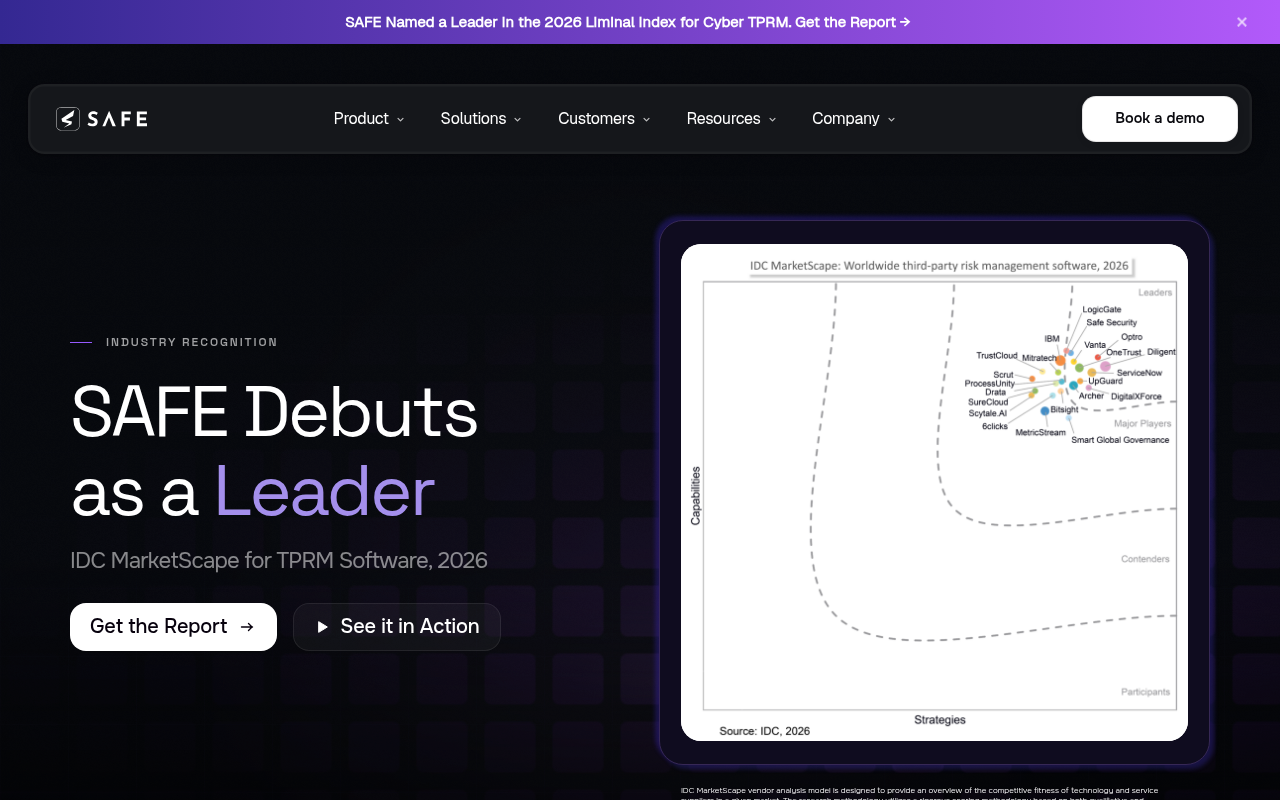
SAFE One combines FAIR-based cyber risk quantification, continuous threat exposure management (CTEM), and third-party risk management in a single data model.
Best for: Large enterprises that want continuous, FAIR-aligned CRQ fed by live security telemetry and reported in financial terms.
Key Features:
- Defensible risk scenarios powered by the FAIR model, with a built-in scenario library, custom scenarios, and automated ingestion of telemetry from enterprise-wide controls, as described on SAFE's AWS Marketplace listing.
- Deep FAIR roots: SAFE acquired RiskLens, the pioneer of FAIR-based CRQ software, and serves as a technical advisor to the FAIR Institute.
- Exposure management absorbed from Balbix, acquired in November 2025, which links exploitable exposures and control failures to dollar impact.
- An integrations marketplace that certified implementation partners put at 150+ native connectors.
- A Leader in The Forrester Wave: Cyber Risk Quantification Solutions, Q2 2025, where SAFE reports the highest possible score on 21 of 27 criteria.
Why we like it: A single financial view across internal controls, exposures, and vendors removes duplicate tooling, and SAFE One is one of the few CRQ platforms with public list pricing, so budgeting can start before a sales call.
Notable Limitations:
- The lowest public first-party tier costs $350,000 per year on AWS Marketplace, which puts SAFE out of reach for most mid-market teams.
- Output fidelity depends on connecting many internal data sources, so time to value tracks your integration backlog as much as the software.
- The Balbix integration is less than a year old, so confirm which exposure features are native to SAFE One today and which are still on the roadmap.
Pricing: AWS Marketplace lists 12-month contracts at $350,000 for SAFE One Essentials (first party, three APIs, unlimited users) and $500,000 for SAFE One Enterprise (six APIs), plus $25,000 for onboarding and $5,000 per Safe Academy seat with FAIR Fundamentals training (checked October 2026). Private offers can adjust these terms.
2. Kovrr
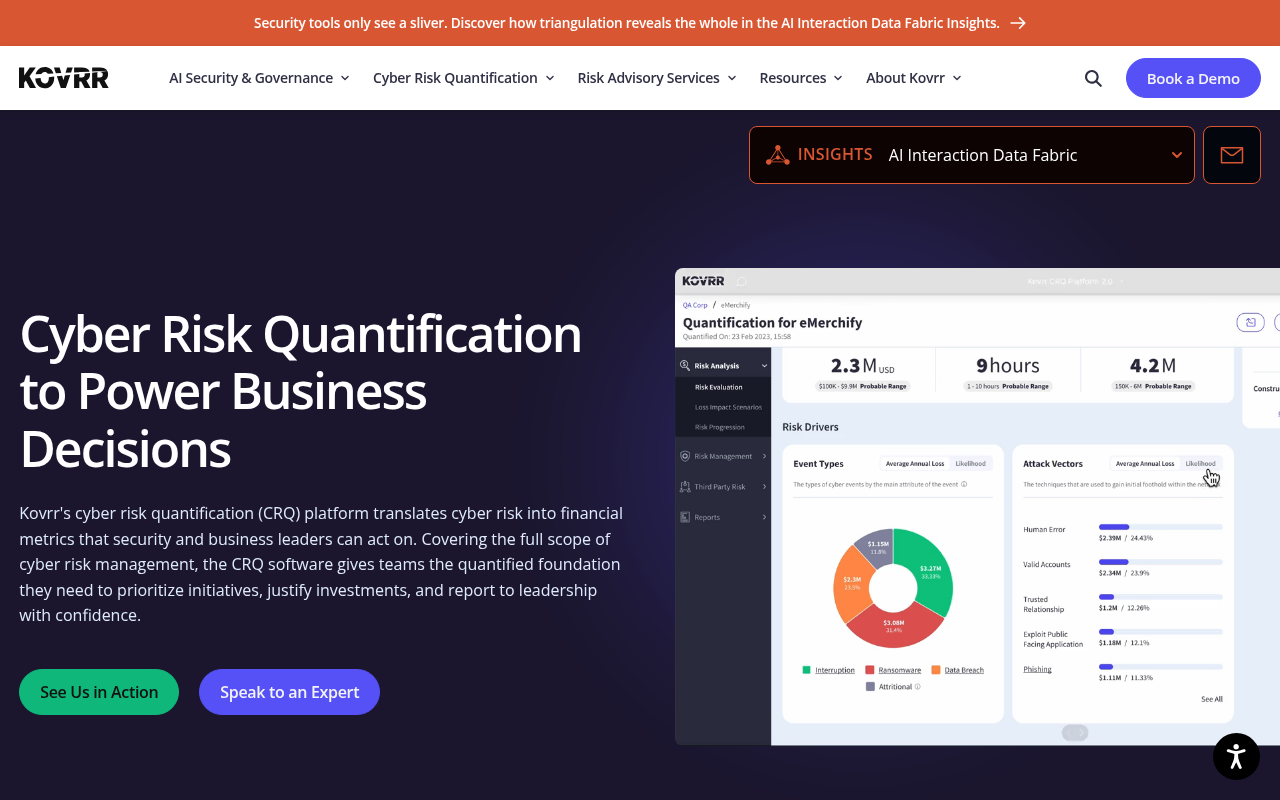
Kovrr models cyber exposure with insurance-grade actuarial methods built on proprietary claims data, threat intelligence, and control maturity.
Best for: Enterprises, cyber insurers, and portfolio owners that need actuarial-style loss distributions for boards, underwriting, and insurance negotiations.
Key Features:
- Top-down quantification from minimal inputs, producing average annual loss, loss exceedance curves, 1-in-100 tail risk, and event likelihood from thousands of Monte Carlo simulations, according to Kovrr's platform documentation.
- A CRQ-powered cyber risk register for bottom-up scenarios, with risk owners, likelihood, impact, and control recommendations tracked in one place.
- Insurance Data Insights, which tests limits, deductibles, sublimits, and full tower structures against modeled loss distributions.
- Portfolio Analysis and a Decision Simulator for comparing exposure across entities and calculating return on security investment before money is spent.
- Control maturity mapped across NIST CSF 2.0, CIS Controls, and ISO 27001, plus quantified materiality thresholds for SEC, NIS2, and DORA reporting.
Why we like it: Kovrr calibrates its models on claims that insurers actually paid, which makes its numbers easier to defend in front of finance, audit, and brokers.
Notable Limitations:
- Kovrr's website and product line now lead with AI security and governance, so CRQ buyers should confirm the roadmap commitment for the quantification platform.
- Results lean heavily on proprietary datasets, so request calibration documentation and parameter ranges before using figures in regulatory disclosures.
Pricing: Not publicly listed. Kovrr's pricing page says plans are tailored to risk management needs rather than company size or revenue, includes onboarding and support in every tier, and offers a self-serve demo environment (checked October 2026).
3. Axio (Axio360)
Axio360 connects cybersecurity assessments, cyber risk quantification, and insurance analysis, with a long track record in energy and critical infrastructure.
Best for: Critical infrastructure and OT-heavy enterprises that want control-to-cash translation and insurance planning in one platform.
Key Features:
- Cybersecurity assessments, CRQ, risk transfer analysis, and cyber insurance stress testing in a single platform, per Axio's company announcements.
- Framework assessments such as NIST CSF and C2M2 that feed scenario-based quantification.
- The Quantification Wizard, launched in October 2024, which shortens the path to board-ready loss scenarios.
- A February 2026 partnership with Dragos that brings Dragos threat intelligence and Dragos Platform risk reduction metrics into Axio's CRQ models, aimed at OT risk and cyber-physical insurance underwriting.
- A Leader in The Forrester Wave: Cyber Risk Quantification Solutions, Q2 2025.
Why we like it: The Dragos partnership gives Axio an OT quantification story that industrial buyers and insurance brokers recognize, and the assessment-led method turns existing control work into dollar figures.
Notable Limitations:
- Quantification quality depends on a completed controls assessment, so teams without current NIST CSF or C2M2 data face a longer ramp.
- The OT capabilities from the Dragos partnership draw on Dragos Platform data, so plants running other OT monitoring tools get less from it.
Pricing: Not publicly listed. Axio sells Axio360 by subscription on custom quotes (checked October 2026). Contact Axio for scoped pricing.
4. Squalify
Squalify is a top-down CRQ platform owned by Munich Re and licensed to use the reinsurer's cyber risk model, built for fast, board-level loss estimates.
Best for: Boards, CFOs, and audit committees that want a defensible first-loss view without months of data gathering.
Key Features:
- Essential CRQ, launched in 2026, produces financial loss metrics from 42 data points in as little as 24 hours using Monte Carlo simulations, according to Squalify's product announcements.
- Enterprise CRQ adds high-ROI control identification, decision-impact simulations, multi-entity risk steering, and board-level management reporting.
- Subsidiary Steering, which applies one quantification model consistently across business units, regions, and subsidiaries.
- Integrations with GRC and ERM systems, plus an API that lets cyber insurance brokers embed Essential CRQ in their advisory work.
Why we like it: Munich Re's underwriting lineage gives executives a finance-native starting number fast, and Squalify Essential CRQ is a low-effort way to frame risk appetite and insurance limits before investing in bottom-up modeling.
Notable Limitations:
- A top-down model built on 42 inputs is not granular enough for control-by-control decisions, and that analysis requires the Enterprise tier.
- Squalify expanded from Europe into the US only recently, so North American buyers should check local support capacity and reference customers.
Pricing: Not publicly listed. Squalify sells two tiers, Essential CRQ and Enterprise CRQ, on direct quotes, and brokers can bundle Essential CRQ into their own services (checked October 2026).
5. CyberSaint (CyberStrong)
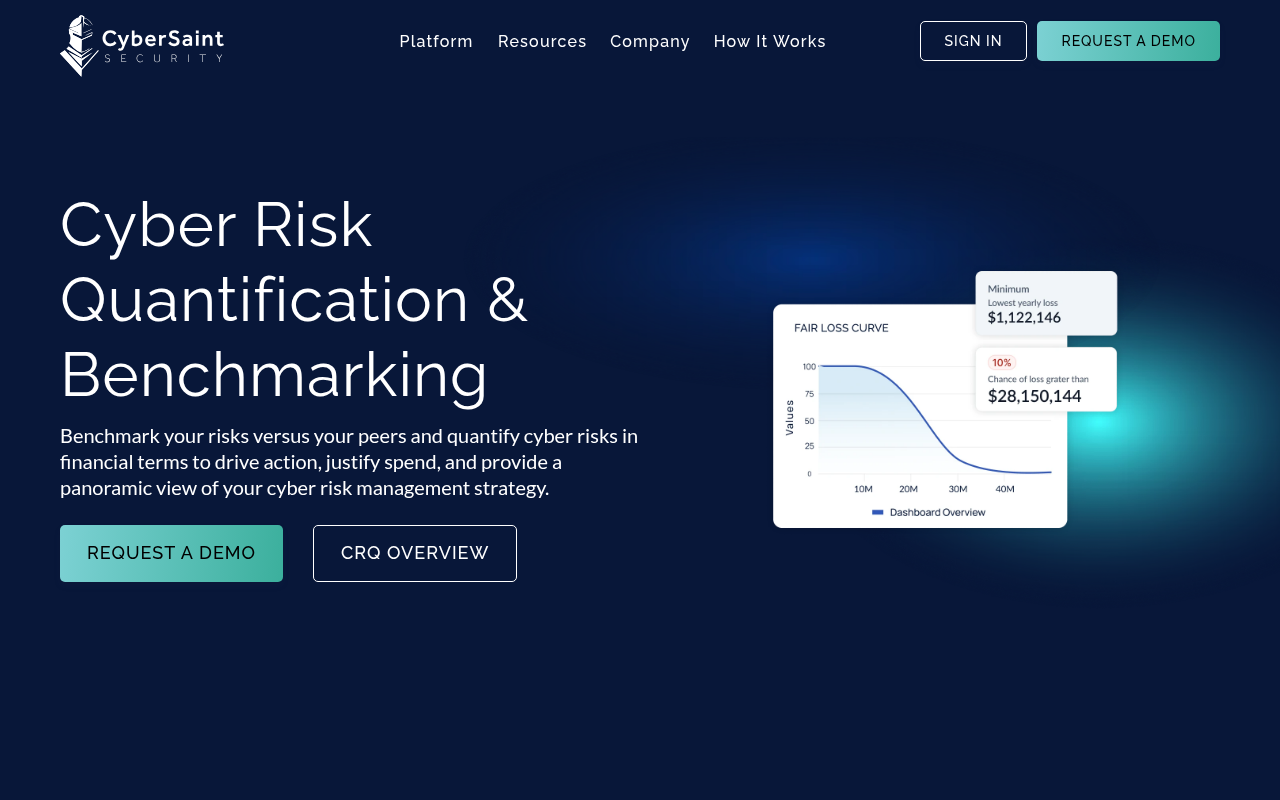
CyberStrong ties cyber risk quantification to framework assessments and continuous control monitoring inside one GRC-style platform.
Best for: Mid-market and regulated enterprises that lead with NIST CSF, ISO 27001, or similar frameworks and need dollar figures without a data science team.
Key Features:
- Three quantification models, FAIR, NIST SP 800-30, and CyberSaint's own CyberInsight, which can be used side by side, per CyberSaint's product documentation.
- A hub structure: Compliance Hub for framework libraries, automated crosswalking, and benchmarking; Risk Hub for the risk register, NIST 800-30 model, and risk dashboards; Executive Hub for board-level dashboards.
- Controls linked directly to risk register entries and investments, supporting return on security investment (ROSI) tracking and peer benchmarking.
- Continuous Control Automation, which replaces manual control scoring with AI-driven, near real-time compliance data.
Why we like it: Teams already scoring NIST CSF or ISO controls can produce board-level dollar figures in CyberStrong without leaving their compliance workflow.
Notable Limitations:
- Quantification starts at the Risk Hub tier, since the entry Compliance Hub does not include the risk register or the risk model.
- Outputs are only as current as the underlying control scores, so teams that skip Continuous Control Automation inherit point-in-time inputs.
Pricing: CyberSaint's pricing page lists the three hubs as annual or multi-year SaaS subscriptions without public price points, and offers a free Cyber Risk Analysis to the public (checked October 2026). Contact CyberSaint for a quote.
6. Black Kite
Black Kite is a third-party cyber risk platform that attaches Open FAIR-based loss estimates to the vendors it monitors.
Best for: TPRM teams that want outside-in ratings plus automated probable-loss estimates to prioritize vendor remediation and decisions.
Key Features:
- Open FAIR-based assessments, added in March 2026, that estimate probable loss from data breach, ransomware, and business disruption scenarios automatically during vendor onboarding and periodic reviews, according to Black Kite's announcement.
- Monitoring-led quantification that runs alongside technical cyber ratings and the Ransomware Susceptibility Index (RSI).
- Dollar-based vendor comparison for onboarding, renewal, and insurance decisions.
Why we like it: Black Kite gives procurement and security a shared money figure for each vendor decision instead of a letter grade alone.
Notable Limitations:
- Estimates rely on external signals and assessment inputs rather than internal telemetry, so treat outputs as probable ranges rather than precise figures.
- The quantification is built around vendors, so it complements rather than replaces an enterprise CRQ platform for first-party risk.
Pricing: Not publicly listed. Black Kite sells by quote, and its website offers a free Open FAIR report as an entry point (checked October 2026).
Feature Comparison
| Tool | Quant method | Data inputs | Portfolio or TPRM focus |
|---|---|---|---|
| SAFE One | Continuous FAIR scenarios | Control telemetry and exposure data | Built-in TPRM and CTEM |
| Kovrr | Insurance-grade Monte Carlo | Claims data, threat intel, control maturity | Multi-entity portfolio analysis |
| Axio360 | Scenario CRQ from assessments | Control assessments, Dragos OT data | Insurance stress testing and OT |
| Squalify | Top-down actuarial (Munich Re model) | 42 inputs for Essential, fuller data for Enterprise | Subsidiary steering across entities |
| CyberStrong | FAIR, NIST 800-30, CyberInsight | Framework assessments and control automation | Risk register and peer benchmarks |
| Black Kite | Open FAIR per vendor | Outside-in telemetry and vendor assessments | Vendor loss at onboarding and renewal |
Deployment and Integration
| Tool | What you supply | Integration surface | Setup effort |
|---|---|---|---|
| SAFE One | API access to security controls and data sources | 150+ native connectors | High |
| Kovrr | Firmographics, control maturity, optional vendor data | Continuous control monitoring from cloud and security tools | Moderate |
| Axio360 | Control assessment responses | Assessment workflows, Dragos Platform data for OT | Moderate |
| Squalify | 42 organizational data points to start | GRC and ERM systems, broker API | Low |
| CyberStrong | Framework assessment and control data | Continuous Control Automation from security tooling | Moderate |
| Black Kite | Vendor list and domains | Outside-in scanning plus TPRM workflow links | Low to moderate |
Strategic Decision Framework
| Critical question | Why it matters | What to evaluate | Red flags |
|---|---|---|---|
| What loss data calibrates the model? | Finance and auditors trust models grounded in real losses. | Source and recency of claims, reinsurance, or incident data, plus the validation process. | Black-box scores with no loss data lineage. |
| How transparent is the method? | You need to defend dollar figures to the board and regulators. | FAIR, Monte Carlo, or actuarial documentation, parameter ranges, and sensitivity analysis. | Single-point estimates without variance or exceedance curves. |
| Does it cover OT and AI exposure? | OT events and AI-enabled breaches change both impact and likelihood. | OT scenarios and partnerships, AI risk modules, and related controls. | One-size-fits-all breach templates. |
| Can vendor decisions be tied to dollars? | Vendor loss drives real spend and contract terms. | Open FAIR vendor loss, portfolio ranking, and remediation ROI. | Letter grades with no financial context. |
| How fast is the first credible estimate? | Budget cycles move faster than data warehouse projects. | Time to initial model, required inputs, and services effort. | Months of consulting before any numbers appear. |
Problems & Solutions
- Problem: The board wants a defensible tail-loss figure for ransomware this quarter, not a heat map. Solution: Kovrr reports average annual loss, loss exceedance curves, and 1-in-100 tail risk from claims-calibrated simulations, while SAFE One builds FAIR-based ransomware scenarios from live control telemetry.
- Problem: OT is now in scope, and insurers want cyber-physical exposure quantified before they underwrite it. Solution: Axio's February 2026 partnership with Dragos feeds OT threat intelligence and risk reduction metrics into its CRQ models, so CISOs and brokers can price cyber-physical risk.
- Problem: Vendor onboarding stalls because the CFO will not approve a critical supplier without a probable-loss figure. Solution: Black Kite runs Open FAIR loss estimates automatically during onboarding and periodic reviews, so the dollar figure arrives with the assessment.
- Problem: The vulnerability backlog is ranked by CVSS, and leadership wants remediation ordered by dollars avoided. Solution: SAFE One's exposure management, expanded through the Balbix acquisition, ties exploitable exposures and control failures to financial impact for operational prioritization. It still needs scanner data underneath, which our roundup of vulnerability scanning and management tools covers.
- Problem: Compliance teams already score NIST CSF and ISO 27001, but the board wants those gaps in dollars. Solution: CyberSaint links framework controls to risk register entries and quantifies them with FAIR or NIST 800-30, producing ROSI figures without a separate data science effort.
- Problem: A board workshop on risk appetite and insurance limits is days away, with no CRQ program in place. Solution: Squalify Essential CRQ produces a first-loss estimate on Munich Re's model from 42 inputs in as little as 24 hours, which can be refined later with bottom-up data.
The Bottom Line
Cyber risk quantification has moved past debates over method and into proof of value for each stakeholder. With IBM's 2026 data putting the average breach at $4.99 million, a heat map rarely survives a budget review anymore.
Choose SAFE One when one platform should tie FAIR CRQ to exposure and vendor risk, and the budget can absorb six-figure contracts. Choose Kovrr or Axio when insurance-grade modeling or OT quantification has to satisfy underwriters. Pick CyberSaint when quantification must live inside framework and audit work.
Add Black Kite to put a probable-loss figure on vendor decisions, and use Squalify to brief the board in days before refining with bottom-up data. In every demo, ask for loss exceedance curves, parameter ranges, and validation against recent incidents.