

For MSPs in 2026, endpoint detection and response has moved from a premium upsell to the price of entry. Cyber insurers expect it, SMB clients increasingly ask for it by name, and a single compromised endpoint can ripple across an entire client base. MSPs carry a unique kind of exposure: one weak control or compromised tool can cascade across every downstream client at once.
The catch is that most EDR products were built for enterprise security teams, not for a lean MSP managing dozens of tenants on tight margins. Roughly 77% of MSPs report wrestling with multiple, siloed security tools that do not talk to each other, which inflates both cost and operational overhead.
That overhead is the real problem to solve, which is why the right EDR for an MSP comes down to more than raw detection scores. This guide ranks platforms on the criteria that actually matter to a managed service business: true multi-tenant architecture, depth of PSA and RMM integration, wholesale or partner pricing that protects margin, and the maturity of the partner program behind the product. Below are six platforms worth shortlisting in 2026, what each is best at, and where the tradeoffs sit.
Guardz
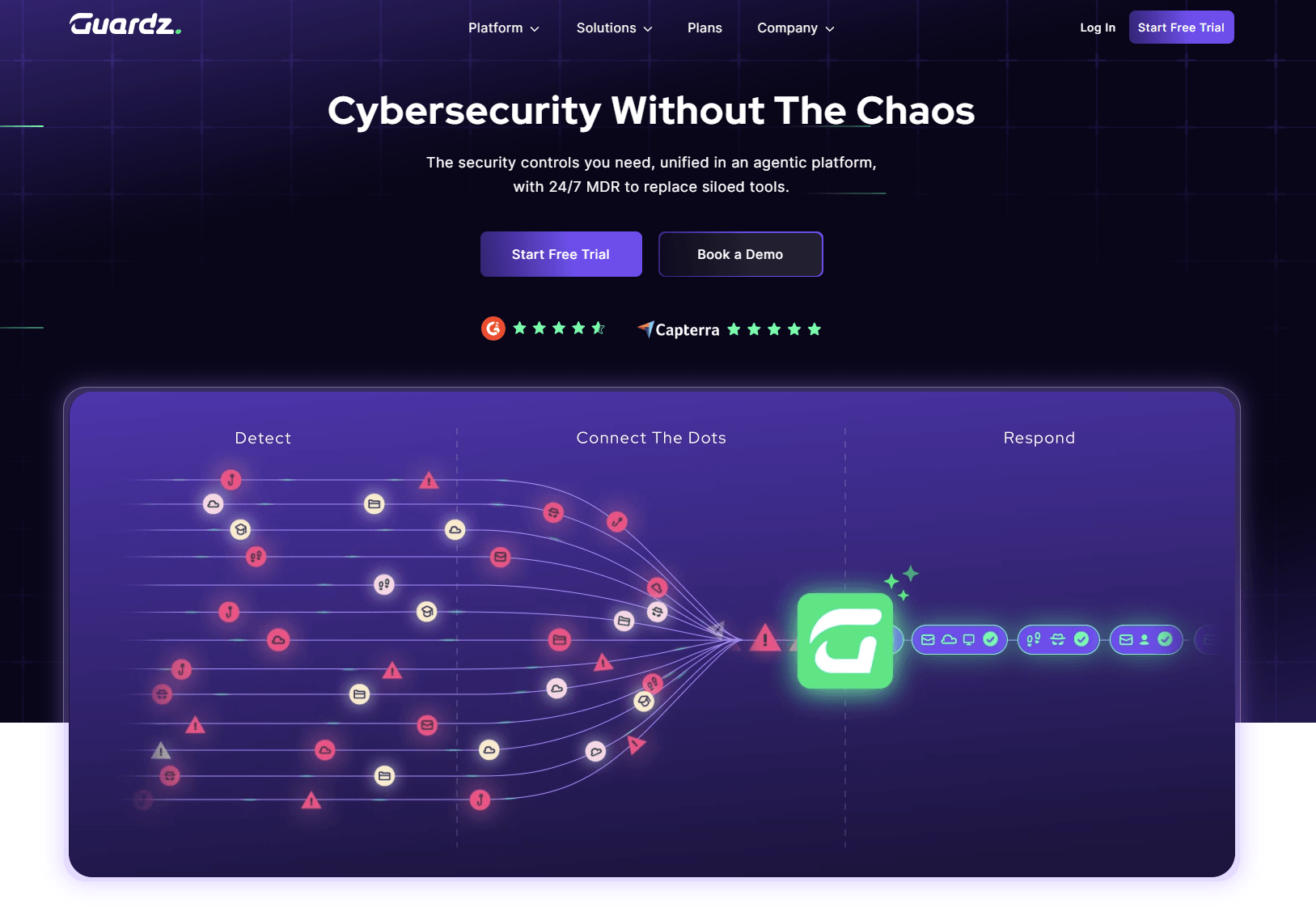
Guardz is an agentic unified detection and response platform purpose-built for MSPs, bundling SentinelOne-powered EDR with identity, email, cloud, and data protection under one multi-tenant console.
Guardz raised a $56 million Series B in June 2025 led by ClearSky, with participation from SentinelOne and others, bringing total funding to $84 million in just over two years. The platform is built around a multi-tenant single pane of glass, with 24/7 AI-plus-human MDR, integrated SentinelOne EDR, Check Point email protection, ITDR, and Microsoft 365 and Google Workspace monitoring.
On the business side, Guardz sells through simple per-user subscriptions with monthly billing, volume discounts, and two transparent packages, and adds partner-focused tooling like prospecting assets, security business reviews, co-managed workflows, and built-in cyber insurance. It holds a 4.7 out of 5 rating on G2 and integrates with MSP platforms including Syncro.
Best for:
MSPs that want one multi-tenant platform to unify endpoint, identity, email, and cloud protection for SMB clients rather than stitching together point tools.
Key Features:
- A multi-tenant single pane of glass unifying EDR, ITDR, email, cloud, and data protection across all client tenants.
- Integrated SentinelOne EDR paired with 24/7 AI-plus-human MDR, so endpoint detection is backed by managed threat hunting without added complexity (Guardz Series B announcement).
- Microsoft 365 and Google Workspace monitoring that flags account takeover and suspicious behavior, suspending compromised accounts before damage spreads (Guardz Series B announcement).
- MSP business enablement: per-user monthly billing, volume discounts, prospecting and reporting tools, co-managed environments, and bundled cyber insurance (Guardz vs Kaseya comparison).
Why we like it:
Guardz is one of the few platforms designed around how MSPs actually operate, not retrofitted from an enterprise product. It folds best-in-class SentinelOne EDR into a broader detection-and-response suite with managed response included, so a small team can deliver enterprise-grade security across many tenants without running a SOC or juggling separate consoles.
Notable Limitations:
- The endpoint engine is delivered through an embedded SentinelOne integration rather than a Guardz-built EDR.
- Guardz agentic platform is a full suite, so teams that only want a standalone endpoint agent may find it broader than needed.
Pricing:
Per-user subscriptions with monthly billing, volume discounts, and two packages; a free MSP community tier is available, with custom volume pricing on request (Guardz vs Kaseya comparison).
Sophos Intercept X
Sophos Intercept X is an enterprise-grade endpoint protection platform with EDR and XDR, managed for MSPs through the multi-tenant Sophos Central console and the MSP Flex program.
Sophos, a UK-based vendor owned by Thoma Bravo, refreshed its endpoint line in late 2025, introducing a dedicated Sophos EDR license tier that pairs its endpoint defenses with AI-accelerated detection and response; the tier became available for term licenses on November 1, 2025 and for MSP Flex in late January 2026.
For MSPs, Sophos Central provides multi-tenant management with cross-tenant deployment and consolidated billing, and integrates with ConnectWise Manage and Datto Autotask PSA through its MSP Connect and MSP Connect Flex programs, syncing usage nightly for accurate monthly billing. Sophos MDR can also monitor third-party EDR such as Microsoft Defender, CrowdStrike, and SentinelOne, so MSPs can layer managed response without ripping out an existing agent.
Best for:
MSPs wanting battle-tested, enterprise-grade endpoint protection with deep XDR, flexible monthly MSP licensing, and the option of vendor-agnostic managed response.
Key Features:
- Intercept X endpoint defenses (anti-ransomware, deep-learning AI, exploit prevention) with a dedicated EDR tier and full XDR in higher tiers (Sophos endpoint portfolio refresh).
- Multi-tenant Sophos Central console with cross-tenant policy deployment and consolidated billing (Sophos Central integrations).
- ConnectWise Manage and Datto Autotask PSA integrations that auto-create products and sync usage nightly for MSP billing (Sophos Central integrations).
- Sophos MDR with vendor-agnostic telemetry, able to monitor Defender, CrowdStrike, and SentinelOne agents alongside Sophos (MDR Cost Sophos analysis).
Why we like it:
Sophos pairs consistently strong independent detection results with one of the more mature MSP programs in the market. The flexible monthly MSP Flex licensing and a managed-response option that works over third-party EDR make it a safe, scalable choice for MSPs that want enterprise muscle without locking every client into a single agent.
Notable Limitations:
- Pricing scales quickly as you add XDR, MDR, and higher feature tiers, and several entry options are quoted on multi-year commitments, so per-endpoint costs need close modeling (UnderDefense Sophos pricing).
- The breadth of tiers and recent portfolio renaming, with Intercept X Essentials folding into Sophos Endpoint, can make license selection confusing for smaller partners (Sophos endpoint portfolio refresh).
Pricing:
Per-user or per-endpoint licensing with monthly MSP Flex billing; Intercept X list pricing starts around $28 per user per year on multi-year terms and rises with XDR and MDR.
Bitdefender GravityZone
Bitdefender GravityZone is a unified, multi-tenant security platform with proprietary EDR, XDR, and MDR, long favored by MSPs for its strong independent test results and monthly usage-based licensing.
GravityZone for MSPs centralizes all client tenants in one Control Center, with monthly usage-based billing that aligns to the MSP model and a single lightweight agent spanning prevention, EDR, and XDR built on Bitdefender's own technology rather than third-party engines. The platform is consistently highly rated by independent analysts and test labs including Gartner, Forrester, MITRE, AV-TEST, and AV-Comparatives (Bitdefender GravityZone for MSPs).
GravityZone integrates tightly with the MSP stack: ConnectWise PSA can provision and map customers directly from the Integrations Hub, ConnectWise Automate auto-deploys agents and surfaces EDR incidents, and Bitdefender EDR can run standalone alongside a third-party antivirus. ConnectWise's own MDR service runs on GravityZone EDR underneath.
Best for:
MSPs that want proven, top-rated endpoint protection with proprietary EDR and XDR, flexible monthly billing, and deep ConnectWise integration.
Key Features:
- Multi-tenant Control Center managing all tenants with monthly usage-based billing (Bitdefender GravityZone for MSPs).
- Single-agent prevention, EDR, and XDR on proprietary technology, with consistently strong AV-Comparatives and MITRE results (Bitdefender GravityZone for MSPs).
- ConnectWise PSA and Automate integrations for tenant provisioning, agent auto-deploy, and EDR incident sync (GravityZone April 2026 update).
- Standalone Bitdefender EDR and PHASR options that can coexist with third-party endpoint security (GravityZone MSP licensing).
Why we like it:
Bitdefender brings enterprise-grade, lab-proven detection to the MSP channel with a billing model that matches managed-service economics. The proprietary single-agent stack keeps overhead low, and its ConnectWise depth makes it a natural fit for MSPs already standardized on that PSA and RMM ecosystem.
Notable Limitations:
- The console and tiering can be complex to configure across many tenants, and the most advanced response capabilities sit in higher tiers or paid add-ons like PHASR (GravityZone April 2026 update).
- Its first-party MDR is comparatively newer than the pure-play managed offerings, so MSPs wanting fully managed response often layer a partner MDR over GravityZone EDR (ConnectWise Bitdefender EDR).
Pricing:
Monthly usage-based licensing through the Bitdefender MSP program, billed on deployed endpoints with volume-based partner rates; custom quotes via Bitdefender or a distributor (Bitdefender GravityZone for MSPs).
Huntress
Huntress Managed EDR is a channel-first, fully managed EDR for MSPs that pairs lightweight behavioral detection with a 24/7 human SOC included in every subscription.
Huntress is built specifically for MSPs, with a multi-tenant platform, behavior-based detection, white-label reporting, and PSA and RMM integrations, and every alert is triaged by its Security Operations Center before it reaches the partner. It manages more than 5 million endpoints and holds a 4.9 out of 5 rating on G2 across more than 800 reviews, among the highest in the category.
Pricing is partner-friendly: Huntress publishes direct pricing around $8.99 per endpoint per month, while MSP partner rates run roughly $1.90 to $3.50 per endpoint depending on volume, with a 50-unit minimum, monthly billing in arrears, and a fully featured 30-day free trial. Beyond Managed EDR, Huntress offers modular Managed ITDR, SIEM, and Security Awareness Training, and integrates with PSAs and RMMs including ConnectWise, Autotask, HaloPSA, Kaseya, Syncro, NinjaOne, Datto RMM, and N-able (Rallied Huntress review).
Best for:
MSPs that want fully managed, low-noise endpoint protection with a true 24/7 SOC and partner pricing that protects margin, without running detection themselves.
Key Features:
- Managed EDR with behavior-based detection and a 24/7 human SOC that reviews every alert before escalation, included in the base price (Huntress MSP guide).
- Multi-tenant management with white-label reporting and agent deployment via RMM in under an hour (Rallied Huntress review).
- Modular add-ons: Managed ITDR for Microsoft 365 identity, Managed SIEM, and Security Awareness Training, priced per unit with no feature gating (Huntress pricing analysis).
- Broad PSA and RMM integrations including ConnectWise, Autotask, HaloPSA, Kaseya, Syncro, NinjaOne, Datto RMM, and N-able (Rallied Huntress review).
Why we like it:
Huntress is the MSP community's reference point for managed EDR, and for good reason: the SOC filters noise so partners only see what matters, the pricing is transparent and margin-friendly, and deployment is fast. It is the lowest-overhead way for a lean MSP to deliver 24/7 endpoint coverage.
Notable Limitations:
- Some MSPs describe it as a quiet MDR that handles work behind the scenes, which means less raw telemetry and visibility for technicians who want to see every signal.
- The 50-unit minimum and per-product modular model mean very small deployments must aggregate across clients to hit thresholds, and a full stack of EDR plus ITDR, SIEM, and SAT adds up (Huntress pricing analysis).
Pricing:
Per-endpoint monthly, around $8.99 direct with MSP partner rates near $1.90 to $3.50 depending on volume; 50-unit minimum, monthly billing in arrears, and a 30-day free trial with full SOC support (Huntress pricing analysis).
Kaseya 365 EDR
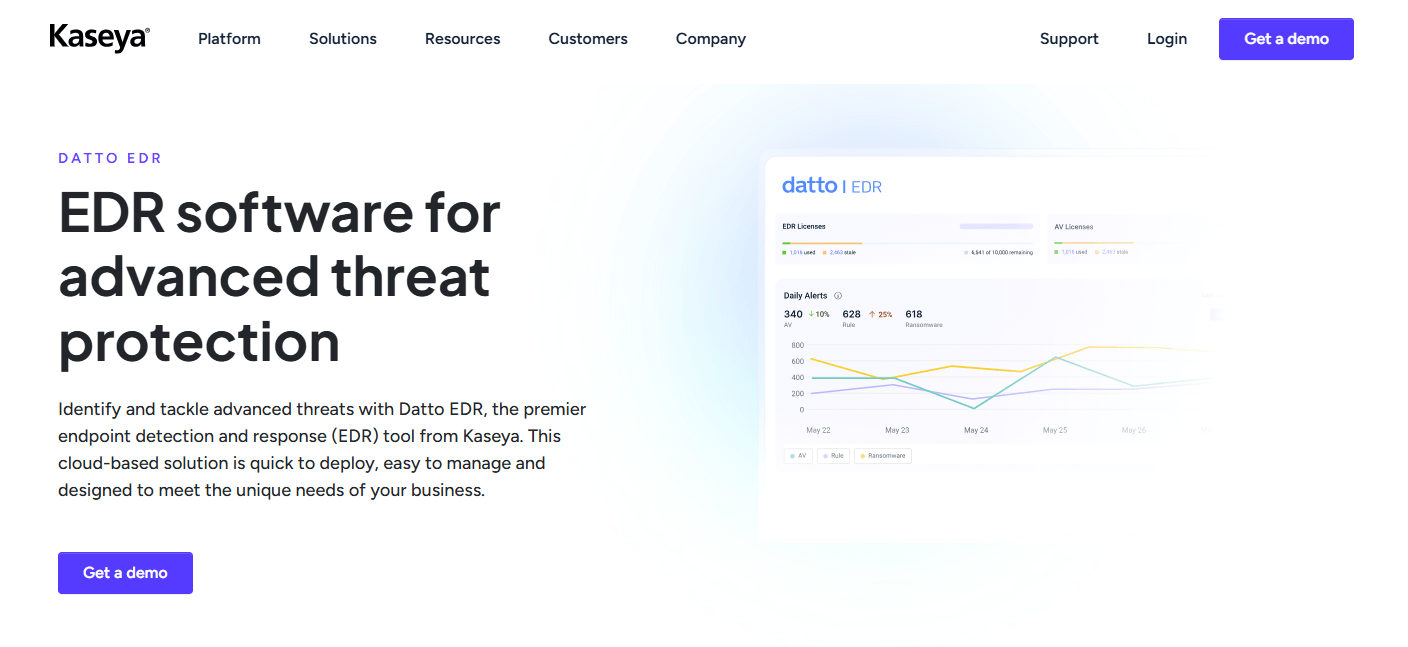
Kaseya 365 Endpoint bundles Datto EDR with antivirus, RMM, endpoint backup, and a managed SOC into a single low-cost, per-endpoint subscription inside the Kaseya IT Complete platform.
Kaseya 365 Endpoint packages Datto EDR, with ransomware detection plus rollback and file recovery, alongside Datto AV, a choice of RMM (Datto RMM or Kaseya VSA), endpoint backup, and Kaseya MDR (formerly RocketCyber) for a managed SOC. Kaseya, which acquired both Datto and RocketCyber, positions the bundle to roughly double MSP margins by consolidating tools, with a new-purchase minimum of 50 licenses.
It integrates natively across the Kaseya IT Complete ecosystem, including Datto RMM, Kaseya VSA 10, Autotask PSA, BMS and Vorex, and RocketCyber, with reseller bundle pricing reported around $4.99 per license per month.
Best for:
MSPs already invested in the Kaseya and Datto ecosystem that want EDR bundled with RMM, AV, backup, and a managed SOC at an aggressive per-endpoint price.
Key Features:
- Datto EDR with ransomware detection, automated rollback, and file recovery as the endpoint core (Kaseya 365 Endpoint).
- A bundled stack of EDR, AV, RMM, endpoint backup, and Kaseya MDR managed SOC in one subscription (Kaseya 365 Endpoint).
- Native integration across Datto RMM, Kaseya VSA 10, Autotask PSA, BMS and Vorex, and RocketCyber within IT Complete (Datto EDR integrations).
- Low bundled per-endpoint pricing aimed at improving MSP margins, backed by a Partner-First Pledge and MSP enablement program (Kaseya IT Complete).
Why we like it:
For MSPs already standardized on Kaseya and Datto, 365 Endpoint is hard to beat on bundled value, folding EDR, backup, RMM, and a managed SOC into one low per-endpoint price and one integrated platform, which cuts both cost and tool sprawl.
Notable Limitations:
- Reviewers cite a complex, sometimes unintuitive interface and inconsistent support response across the VSA and broader Kaseya stack.
- The value depends on committing to the Kaseya ecosystem and its licensing model, including minimum-commitment billing, which is less appealing for MSPs that want a best-of-breed standalone EDR (Kaseya 365 FAQ).
Pricing:
Bundled per-endpoint subscription, reported around $4.99 per license per month for the endpoint bundle, with a 50-license minimum on new purchases (Techs+Together Kaseya 365).
Acronis EDR
Acronis EDR is part of Acronis Cyber Protect Cloud, a multi-tenant MSP platform that uniquely fuses EDR and XDR with backup, disaster recovery, and RMM in a single agent and console.
Acronis Cyber Protect Cloud combines AI-based anti-malware, EDR and XDR, backup, disaster recovery, and RMM in one agent, one console, and one license model built for MSPs, with multi-tenant management across 50-plus global data centers. Its differentiator is the tight loop between security and data protection: MSPs can back up an endpoint before patching, recover instantly after an incident, and scan backups for malware before restore.
The platform integrates natively with leading MSP tools including Autotask, ConnectWise (Automate, Manage, and Control), Kaseya VSA 10, Datto, and Atera, plus 15-plus alert-to-ticket integrations, all provisioning tenants and deploying agents from one place (Acronis MSP 2026). Pricing uses per-workload, per-gigabyte, or per-user models across Standard, Advanced, and Premium editions.
Best for:
MSPs that want endpoint detection and response unified with backup and disaster recovery in a single agent, especially those selling data protection as a core service.
Key Features:
- EDR and XDR combined with backup, DR, anti-malware, and RMM in a single multi-tenant agent and console (Acronis Cyber Protect Cloud).
- A security-plus-data-protection loop: pre-patch backups, instant recovery, and malware scanning of backups before restore (Acronis RMM).
- Native integrations with Autotask, ConnectWise, Kaseya VSA 10, Datto, and Atera, plus 15-plus alert-to-ticket connectors (Acronis MSP 2026).
- Flexible per-workload, per-GB, or per-user billing across Standard, Advanced, and Premium editions (Acronis pricing).
Why we like it: No other platform on this list ties EDR so directly to backup and recovery. For MSPs whose service is built around resilience, the ability to detect, respond, roll back, and restore from one agent is a genuinely differentiated workflow that reduces both risk and tool count.
Notable Limitations:
- Reviewers note that neither the backup nor the security component is individually best-in-class against specialists, and the web console can be slow at large scale.
- The Standard, Advanced, and Premium tiers with multiple billing models can be confusing, and its EDR is less sophisticated than dedicated endpoint vendors (Softabase Acronis review).
Pricing:
Per-workload, per-GB, or per-user billing across Standard, Advanced, and Premium editions; custom partner pricing with a free trial available (Acronis pricing).
Best EDR for MSPs: Quick Overview
| Tool | Best For | Pricing Model | Highlights |
|---|---|---|---|
| Guardz | Unifying endpoint, identity, email, and cloud for SMB clients | Per-user monthly, free community tier | $84M raised, SentinelOne EDR plus 24/7 MDR, 4.7 G2 . |
| Sophos Intercept X | Enterprise-grade EPP and XDR with a mature MSP program | Per-endpoint, monthly MSP Flex | New EDR tier for 2026, vendor-agnostic MDR, strong lab results. |
| Bitdefender GravityZone | Top-rated proprietary EDR and XDR with ConnectWise depth | Monthly usage-based | Gartner, MITRE, and AV-Comparatives recognition, single agent. |
| Huntress | Fully managed EDR with a 24/7 SOC included | Per-endpoint, ~$1.90-$3.50 partner | 4.9 G2 across 800+ reviews, 5M+ endpoints, channel-first. |
| Kaseya 365 EDR | Kaseya and Datto shops wanting bundled value | Bundled per-endpoint, ~$4.99/license/mo | Datto EDR plus AV, RMM, backup, and MDR in one. |
| Acronis EDR | EDR unified with backup and disaster recovery | Per-workload, per-GB, or per-user | Single agent to detect, respond, roll back, and restore. |
Best EDR for MSPs Comparison: Key Features at a Glance
| Tool | Feature 1 | Feature 2 | Feature 3 |
|---|---|---|---|
| Guardz | Multi-tenant suite across endpoint, identity, email, cloud | SentinelOne EDR with 24/7 AI-plus-human MDR | M365 and Google Workspace account-takeover protection |
| Sophos Intercept X | Intercept X defenses with dedicated EDR and XDR tiers | Sophos Central multi-tenant management | Vendor-agnostic MDR over Defender, CrowdStrike, SentinelOne |
| Bitdefender GravityZone | Single-agent prevention, EDR, and XDR | Lab-proven detection (MITRE, AV-Comparatives) | ConnectWise PSA and Automate provisioning and sync |
| Huntress | Managed EDR with 24/7 human SOC included | Behavior-based detection with low alert noise | Modular ITDR, SIEM, and Security Awareness Training |
| Kaseya 365 EDR | Datto EDR with ransomware rollback and recovery | Bundled AV, RMM, backup, and managed SOC | Native IT Complete (Datto RMM, VSA 10, Autotask) |
| Acronis EDR | EDR and XDR fused with backup and DR | Pre-patch backups and malware-scanned restores | Single agent and console across all workloads |
MSP Fit: Multi-Tenancy and Integrations
| Tool | Multi-Tenant Console | Key PSA and RMM Integrations | Partner / Wholesale Model |
|---|---|---|---|
| Guardz | Single multi-tenant pane of glass | Syncro, Microsoft 365, Google Workspace | Per-user monthly, volume discounts, free community tier |
| Sophos Intercept X | Sophos Central | ConnectWise Manage, Datto Autotask (MSP Connect and Flex) | Monthly MSP Flex with nightly billing sync |
| Bitdefender GravityZone | GravityZone Control Center | ConnectWise PSA and Automate | Monthly usage-based MSP program |
| Huntress | Multi-tenant with white-label reporting | ConnectWise, Autotask, Halo, Kaseya, Syncro, NinjaOne, Datto, N-able | Partner rates near half of direct, 50-unit minimum |
| Kaseya 365 EDR | Within Kaseya IT Complete | Datto RMM, VSA 10, Autotask, BMS and Vorex | Bundled per-endpoint, Partner-First Pledge |
| Acronis EDR | Cyber Protect Cloud multi-tenant | Autotask, ConnectWise, VSA 10, Datto, Atera | Per-workload, per-GB, or per-user with reseller management |
Best EDR for MSPs Strategic Decision Framework
| Critical Question | Why It Matters | What to Evaluate | Red Flags |
|---|---|---|---|
| Is the architecture truly multi-tenant? | Native multi-tenancy lets one team manage many clients; multi-instance workarounds add overhead | Single console that aggregates and segments client data natively | Separate logins per client or bolt-on tenant management |
| How deep are the PSA and RMM integrations? | Shallow integrations leave signals siloed and force manual billing and ticketing | Native ConnectWise, Autotask, Datto, Kaseya, and N-able support with billing sync | One-way integrations or no automated usage-to-invoice flow |
| Does pricing protect MSP margin? | Wholesale or partner rates and monthly billing keep services profitable as clients scale | Per-endpoint or per-user partner pricing, volume discounts, monthly arrears billing | Annual prepay, steep minimums, or rate hikes at renewal |
| Do we need managed response or self-managed EDR? | A lean MSP rarely staffs a 24/7 SOC; managed coverage fills nights and weekends | Included MDR or SOC, after-hours coverage, escalation model | EDR with no managed option that floods technicians with alerts |
Best EDR for MSPs: Pricing and Capabilities Overview
| MSP Profile | Recommended Pick | Pricing Model | Key Consideration |
|---|---|---|---|
| Wants one unified, MSP-native security suite | Guardz | Per-user monthly, free community tier | Broadest unified coverage with MDR; younger, smaller review base |
| Needs enterprise EPP and flexible managed response | Sophos Intercept X | Per-endpoint, monthly MSP Flex | Strong detection and vendor-agnostic MDR; model the tier costs |
| Wants lab-proven proprietary EDR with ConnectWise | Bitdefender GravityZone | Monthly usage-based | Top test scores and single agent; advanced response in higher tiers |
| Wants fully managed EDR with a 24/7 SOC | Huntress | Per-endpoint partner pricing | Lowest-overhead managed coverage; less raw visibility by design |
| Already standardized on Kaseya and Datto | Kaseya 365 EDR | Bundled per-endpoint, ~$4.99/license | Best bundled value; ties you to the Kaseya ecosystem |
| Sells resilience and data protection as core | Acronis EDR | Per-workload, per-GB, or per-user | Unique backup-plus-EDR loop; EDR less deep than specialists |
Problems & Solutions
-
Problem: MSPs juggle multiple siloed security tools across dozens of tenants, inflating cost and leaving gaps where signals do not connect.
Solution: Guardz unifies endpoint, identity, email, and cloud protection in one multi-tenant platform with SentinelOne EDR and 24/7 MDR, so a small team secures many clients from a single console (Guardz Series B announcement). -
Problem: Lean MSPs cannot staff a 24/7 SOC, so after-hours alerts go unwatched and technicians drown in noise.
Solution: Huntress includes a 24/7 human SOC in every Managed EDR subscription that triages every alert before it reaches the partner, delivering managed coverage at margin-friendly per-endpoint partner rates (Huntress MSP guide). -
Problem: MSPs standardized on ConnectWise need top-tier detection that provisions, deploys, and bills natively inside their stack.
Solution: Bitdefender GravityZone pairs lab-proven proprietary EDR and XDR with ConnectWise PSA and Automate integration for tenant provisioning, agent auto-deploy, and usage-based monthly billing (Bitdefender GravityZone for MSPs). -
Problem: Ransomware that gets past prevention can encrypt client data before anyone responds, and recovery often means juggling separate backup and security tools.
Solution: Acronis Cyber Protect Cloud fuses EDR with backup and disaster recovery in one agent, backing up endpoints before patching and restoring malware-scanned data after an incident (Acronis RMM); Kaseya 365's Datto EDR adds similar ransomware rollback within its bundle (Kaseya 365 Endpoint). -
Problem: Tight margins make it hard to add security without raising client costs or eroding profit.
Solution: Kaseya 365 bundles EDR, AV, RMM, backup, and a managed SOC into one low per-endpoint subscription to consolidate spend, while Huntress and Sophos offer wholesale partner pricing and monthly billing that scale with deployed endpoints (Techs+Together Kaseya 365).
Final Take
The best EDR for an MSP in 2026 is the one that fits how the business runs, not just the one with the highest lab score. Guardz leads this guide for MSPs that want a single multi-tenant platform unifying endpoint, identity, email, and cloud, with SentinelOne EDR and managed response built in and a partner model designed around MSP economics.
Among the incumbents, Sophos Intercept X brings enterprise-grade protection with flexible MSP Flex billing and vendor-agnostic MDR, Bitdefender GravityZone offers lab-proven proprietary detection with deep ConnectWise integration, and Huntress remains the community favorite for fully managed EDR with a 24/7 SOC included and transparent partner pricing. For MSPs already inside a broader platform, Kaseya 365 EDR delivers the strongest bundled value across the Kaseya and Datto stack, while Acronis EDR is the standout for those who sell resilience, tying detection directly to backup and recovery.
Start with the criteria that protect a managed service: confirm true multi-tenancy, map the PSA and RMM integrations to your existing stack, model the partner pricing at your real endpoint count, and decide how much managed response you need. Then run a short pilot on one or two client tenants before rolling out across the base.